


More news on this day
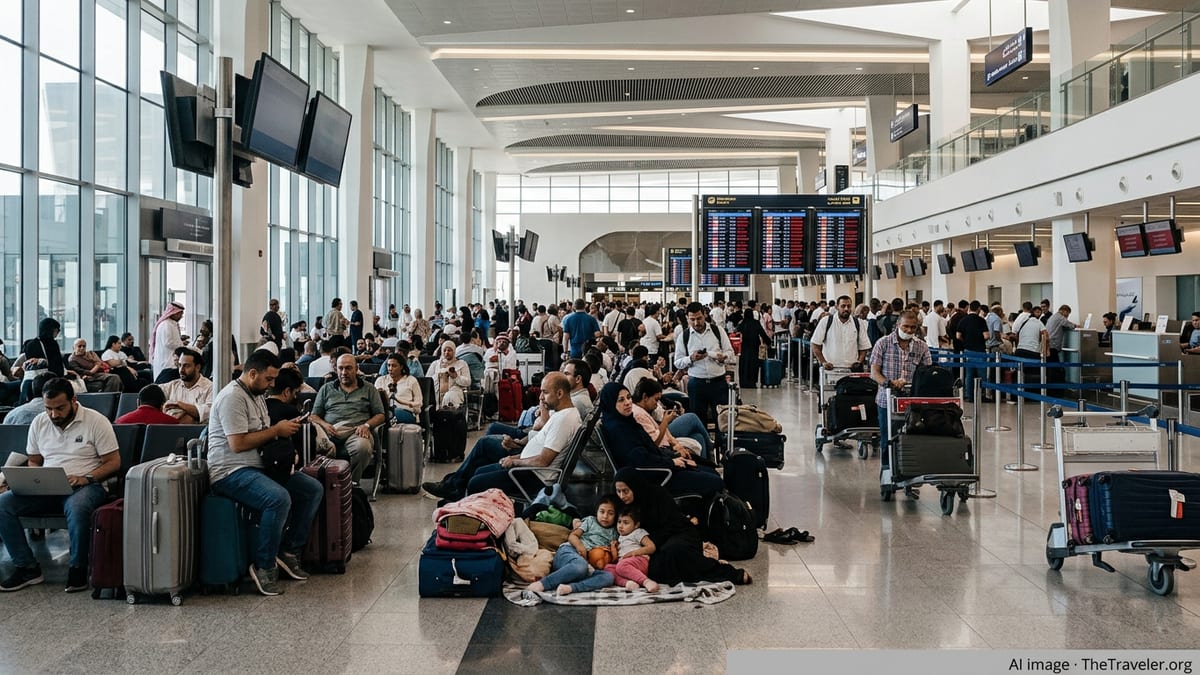
Bahrain International Airport is grappling with widespread operational disruption after 44 flight delays and 10 cancellations in a single day upended connections linking the Gulf with major cities in Europe and Asia, according to aviation data and regional media reports.
Get the latest news straight to your inbox!
Ripple Effects Across a Strategically Placed Hub
The spike in delays and cancellations has highlighted the vulnerability of Bahrain International Airport’s role as a regional connector. Flight tracking data and independent aviation monitors show that disrupted services have affected short-haul routes within the Gulf as well as long-haul itineraries bound for European and Asian destinations.
Many of the delayed flights involve popular Gulf corridors linking Manama with Dubai, Abu Dhabi, Riyadh, Jeddah and Kuwait City. These segments are frequently used as feeder legs for onward journeys to Europe and Asia, meaning a delay out of Bahrain can cascade into missed connections at larger hubs.
Longer-haul services to cities such as London, Frankfurt, Istanbul, Mumbai and key Indian and Southeast Asian gateways have also been affected. Industry observers note that even when a particular long-haul flight departs roughly on schedule, earlier disruption in the aircraft’s rotation can translate into tighter turnaround times, schedule compression and reduced resilience to further delays.
Publicly available airport and airline information suggests that some affected flights are being retimed or rerouted rather than outright cancelled, with carriers seeking to preserve as much connectivity as possible while operating within regional airspace and safety constraints.
Security Tensions and Regional Airspace Constraints
The latest operational turbulence comes against the backdrop of heightened security tensions in the wider Gulf region, which have periodically constrained airspace and forced airlines to recalibrate routings. Earlier in the year, airspace closures and temporary airport shutdowns across several Middle Eastern states prompted large-scale schedule upheaval, including wholesale suspensions of certain routes.
Analysts tracking the region report that Bahrain’s airspace has reopened and that the airport is technically operational, but that carriers continue to face a patchwork of route restrictions and risk assessments as the conflict environment evolves. This has contributed to a tightening of available flight corridors and longer detours around sensitive areas, increasing flight times and fuel burn.
Logistics and supply chain bulletins circulated to corporate clients in recent weeks have warned of constrained capacity into and out of Bahrain, along with a higher likelihood of last-minute schedule changes. These advisories describe a fragile equilibrium in which regular operations are possible, but subject to rapid disruption when security conditions shift or when knock-on effects from neighboring hubs spill over.
Aviation analysts also point to ongoing congestion at alternative Gulf gateways, where some traffic originally routed through Bahrain has been redistributed. This redistribution has, in turn, limited spare capacity for irregular operations, making it harder for airlines to absorb an unexpected spike in disruption such as the one currently recorded in Bahrain.
Impact on Passengers Linking Europe and Asia
The operational strain is being felt most acutely by passengers using Bahrain as a transit point between Europe and Asia. Travel forums and social media posts describe cases of travelers facing missed onward connections, extended layovers and, in some instances, overnight stays while waiting for rebooked services.
Many itineraries between European cities and destinations in South Asia or Southeast Asia rely on a two-leg journey with a Gulf stopover. When departures from Bahrain are delayed, passengers risk arriving late into European or Asian hubs, where onward flights may already be full due to earlier disruptions or capacity reductions related to the regional security environment.
According to publicly available airline guidance, travelers whose flights are delayed or cancelled are being offered rebooking options on later services or, where feasible, rerouting via alternative regional hubs. However, constrained capacity around the Gulf means that same-day alternatives are not always available, particularly on high-demand routes during the summer peak.
Passenger-rights advocates note that the current situation underscores the importance of flexible ticket conditions and travel insurance coverage that includes disruption in volatile regions. They suggest that travelers build longer buffers for connections, particularly where journeys involve multiple carriers or separate tickets purchased independently.
Operational Status at Bahrain Airport and Airline Responses
Despite the scale of the latest disruption, statements from Bahrain Airport Company and information on the airport’s public channels indicate that core airport systems remain operational. A previous advisory from the operator emphasized that technical infrastructure was functioning normally and that earlier disruption episodes were largely attributable to external factors such as airline scheduling decisions and regional constraints, rather than failures within the airport itself.
Recent regional media coverage has detailed how individual carriers are responding. Gulf-based airlines have been adjusting their schedules to and from Bahrain, including selective cancellations on routes to nearby Gulf cities and to South Asian destinations, when demand and operational risk calculations make it difficult to maintain normal frequencies.
At the same time, some airlines are opting for tactical measures rather than broad suspensions. These include swapping aircraft types to better match capacity with available demand and crew, operating consolidation flights that combine passenger loads from multiple services, and temporarily reassigning aircraft to less exposed routes to keep fleets productive while mitigating risk.
Aviation consultancies monitoring on-time performance say Bahrain’s situation reflects a broader pattern for the region in 2026, where persistent geopolitical uncertainty has eroded schedule reliability even at airports that remain open. They note that Bahrain’s relatively compact size as a hub makes it especially sensitive to fluctuations in airline capacity and short-notice airspace changes.
Guidance for Affected Travelers
For passengers due to travel through Bahrain in the coming days, publicly available guidance from airlines and the airport stresses the importance of monitoring flight status closely. Travelers are being encouraged to check airline apps and online portals frequently, as departure times may change multiple times within a 24-hour window in response to evolving conditions.
Travel advisers recommend that passengers holding tickets with tight connections consider contacting their carrier proactively to explore rebooking onto earlier feeder flights or securing longer transit windows in Bahrain. Those with separate tickets on different airlines face particular risk, because missed onward flights may be treated as no-shows rather than protected connections.
Reports indicate that accommodation and meal support for severely delayed passengers is being handled on a carrier-by-carrier basis, in line with each airline’s own conditions of carriage and any applicable consumer protection rules in the jurisdictions involved. Travelers are being urged to keep receipts for out-of-pocket expenses in case reimbursement options arise later.
While aviation forecasters expect periods of relative stability to return as airlines and regulators adjust to the new operating realities in the Gulf, they caution that Bahrain International Airport and its partner carriers are likely to face an elevated risk of disruption for some time. For now, the tally of 44 delays and 10 cancellations in a single day serves as a reminder of how quickly conditions can shift at one of the region’s key crossroads.