


More news on this day
Bahrain has come under heightened aviation scrutiny from United States, United Kingdom and European regulators after new Iran-related security warnings for central Manama added to concerns over missile and drone activity across Gulf air corridors.
Get the latest news straight to your inbox!
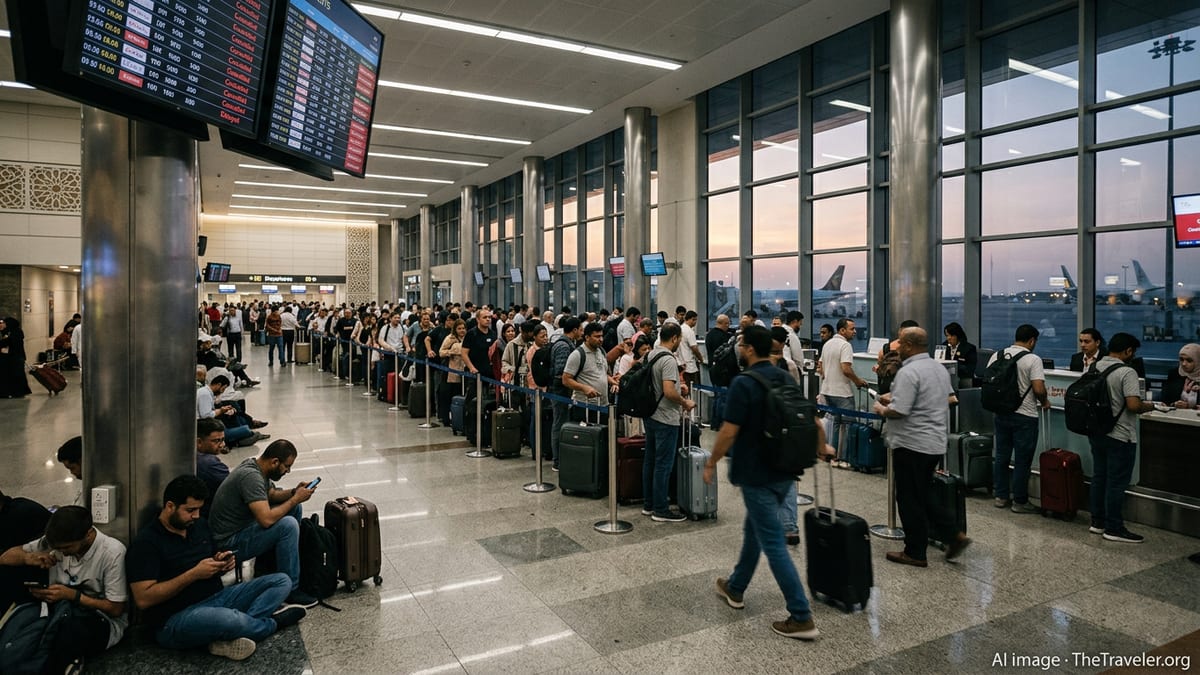
Expanded Western Aviation Warnings Over Bahrain Airspace
Publicly available advisories indicate that Western aviation authorities are widening their focus on Bahrain as part of a broader reassessment of flight risks in Gulf airspace linked to the ongoing Iran United States confrontation. European guidance circulated in mid July advised airlines to exercise extreme caution or avoid sections of airspace covering Bahrain and several neighboring states following renewed United States strikes on Iran and subsequent missile and drone launches in the region. The notice highlighted the potential for misidentification of civilian aircraft in a rapidly changing military environment and urged operators to review routing, crew briefings and diversion options.
Industry analysts note that the United States has long maintained its Navy Fifth Fleet headquarters in Bahrain, placing the island at the center of regional security dynamics. As Iran continues to signal that United States linked sites are potential targets, risk models used by civil aviation authorities have increasingly factored in the possibility of spillover near major civilian corridors and hubs serving Manama and the wider Gulf.
The latest cautionary measures build on months of warnings related to Iranian strikes on or near Bahrain territory, which have involved ballistic missiles and armed drones intercepted by local and allied air defense systems. While Bahrain International Airport has remained open in recent days, the evolving picture has prompted regulators to stress that an open airport does not automatically guarantee normal operations for all foreign carriers.
Iran Security Warning Raises Central Manama Risk Profile
Concern around central Manama intensified after a recent Iran related security alert referenced the possibility that unspecified locations in the downtown area could face elevated threat levels. Published accounts of the advisory described it as a warning about potential Iranian targeting in the Bahraini capital, without specifying timing or exact sites. The language reflected a climate of uncertainty in which authorities are balancing reassurance to residents with acknowledgement of continuing regional hostilities.
In parallel, Bahrain’s defense forces have reported multiple interceptions of Iranian missiles and drones over or near the capital and other populated areas in July, with images showing debris and smoke visible from central Manama. Regional media coverage has pointed to repeated instances of air raid sirens and loud interception blasts across the city as air defenses engaged incoming threats. These developments have contributed to the perception among risk analysts that the urban core, including key government, financial and hospitality districts, could be indirectly affected by future strikes or debris.
For aviation planners, the combination of an explicit Iran related warning for central Manama and a record of recent interceptions has reinforced the need to map potential hazard zones beneath departure and arrival paths. Even where no flight paths are directly adjusted, airlines are reassessing scenarios involving temporary airspace closures, diversions to Saudi Arabian airports and passenger disruption if missile activity intensifies close to civil routes.
British Airways, Gulf Air and Emirates Closely Track Gulf Operations
Major international carriers serving Bahrain and nearby hubs are monitoring the situation while keeping schedules broadly intact. British Airways continues to operate its London services into the Gulf region, but travel advisories encourage passengers to verify flight status close to departure, reflecting the possibility of last minute airspace or routing changes. The airline has experience managing prolonged disruption in the region and is understood to be working within the parameters set by United Kingdom and European safety guidance.
Gulf Air, Bahrain’s flag carrier, remains central to the kingdom’s connectivity and has previously demonstrated flexibility during earlier phases of the Iran conflict by repositioning parts of its fleet to neighboring states when risks near Manama were perceived to be higher. Industry observers suggest the airline is again planning contingencies that could include tactical schedule adjustments, revised crew layover patterns and increased reliance on Saudi Arabian alternates if trajectories over central Manama are temporarily constrained.
Emirates and other United Arab Emirates based airlines, which rely heavily on traffic transiting through the wider Gulf, are likewise reviewing routings across Bahrain adjacent corridors in light of strengthened European and regional advisories. Aviation analysts note that while Dubai and Abu Dhabi remain major long haul hubs, traffic patterns inevitably intersect with airspace that has seen increased military activity, prompting carriers to build additional fuel margins, refine diversion plans and keep contingency crews on standby.
What Travelers Transiting the Gulf Should Expect
For passengers with upcoming itineraries involving Bahrain or nearby hubs such as Dubai, Abu Dhabi, Doha or Kuwait, the immediate impact is more likely to be schedule uncertainty rather than outright route suspensions. Travel industry guidance emphasizes the importance of monitoring airline notifications and airport bulletins in the 24 hours before departure, particularly for late night and early morning services when many long haul connections transit the region and when past missile and drone launches have sometimes occurred.
Experts in aviation risk note that commercial flight paths can often be adjusted vertically and laterally to avoid identified hazard areas without cancelling services altogether. This can result in modestly longer flight times, higher fuel burn and occasional missed connections even when departure and arrival airports remain open. Airlines are also expected to lean more heavily on established contingency corridors over Saudi Arabia, Egypt and northern routes that skirt the most sensitive Gulf airspace.
Travel insurers and corporate security teams are updating their assessments of Bahrain as a transit and short stay destination, weighing the increased profile of central Manama against the mitigating effect of robust regional air defense networks and established crisis management protocols at Gulf airports. Short notice policy changes remain possible if the threat level escalates or if a civilian aviation incident occurs, so travelers are being encouraged to retain flexible tickets where possible.
Regional Aviation Outlook as Gulf Tensions Persist
The latest focus on Bahrain underscores how quickly regional tensions can reshape the aviation map of the Gulf. Since early 2026, successive rounds of Iranian missile and drone activity targeting Bahrain and other states have periodically forced airlines to reroute, adjust schedules or temporarily suspend certain city pairs. Each new exchange of strikes and counter strikes has triggered updated assessments by United States, United Kingdom and European aviation authorities, producing a patchwork of advisories that carriers must integrate into daily operations.
Airspace managers and airlines are preparing for a protracted period of elevated but uneven risk, in which specific Gulf sectors may move in and out of higher alert depending on the tempo of regional military activity. Bahrain’s proximity to key United States facilities and its dense urban core place it near the center of these calculations, even as the country’s main airport continues to function and national carriers emphasize continuity of service.
For the wider travel industry, Bahrain’s experience is being watched closely as a case study in how small but strategically located states navigate the intersection of geopolitical conflict and global connectivity. While present warnings have not yet produced large scale flight cancellations, the combination of expanding Western aviation scrutiny, Iran related security alerts for central Manama and ongoing missile interceptions suggests that Gulf routes will remain under intensive review for the foreseeable future.