


Bandaranaike International Airport (CMB) in Katunayake is the main gateway to Sri Lanka and, for most visitors, the first place they will need local money. Knowing how currency exchange, ATMs and card payments work here can save you time, hassle and unnecessary fees the moment you land.
Get the latest updates straight to your inbox!
Understanding Sri Lankan Rupees and What You Need on Arrival
Sri Lanka’s currency is the Sri Lankan rupee, often written as LKR or Rs. Notes commonly used by travelers range from 20 to 5,000 rupees, with 100, 500 and 1,000 rupee notes being the workhorses of everyday transactions. At recent mid-market rates in 2026, 1 US dollar has typically bought around a few hundred rupees, but the exact rate moves daily and airport counters build in a margin.
On arrival at Bandaranaike, you will immediately need rupees for things like a taxi to Colombo or Negombo, a SIM card, snacks or a coffee. A metered taxi from the airport to central Colombo often costs roughly what would be the equivalent of 8 to 20 US dollars depending on traffic and vehicle type, while a bottle of water in the arrivals area might be around the equivalent of 50 to 80 cents in rupee terms. Having at least the rough equivalent of 30 to 50 US dollars in rupees when you leave the terminal usually covers initial costs comfortably.
Most travelers cannot get rupees easily in their home country, and Sri Lanka has at times had currency controls that make export of rupees limited. In practice that means your first realistic opportunity to get local cash will be inside Bandaranaike Airport itself, either at an ATM or a currency exchange counter in the arrivals zone.
Because exchange rates and fees change, it is sensible to think in ranges rather than exact figures. Expect airport exchange counters to build in a noticeable margin compared with mid-market rates, and ATMs to charge a local fee plus any fees your home bank applies. Your personal “best” option depends on whether you have a fee-free debit card, how much cash you are comfortable carrying and whether you arrive during peak or off-peak hours.
Where to Find Currency Exchange Counters at Bandaranaike
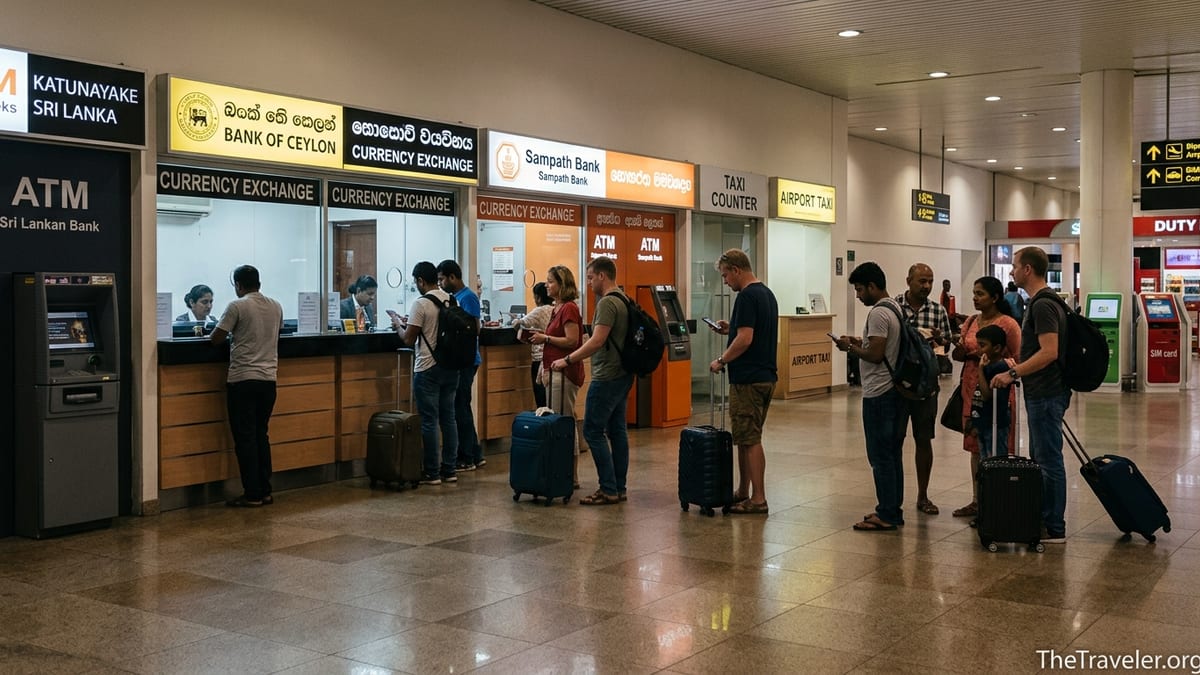
Currency exchange is widely available throughout Bandaranaike International Airport. After immigration and baggage claim, you will pass through customs and into the restricted arrivals area where, according to recent government announcements, licensed money changers now operate even within the customs zone so that passengers can change cash before fully exiting into the public arrivals hall. Just beyond the sliding doors into the main arrivals area you will see a cluster of brightly lit bank counters and bureau de change windows.
These counters are typically operated by major Sri Lankan banks such as Bank of Ceylon, People’s Bank, Commercial Bank and others, often open 24 hours to match flight schedules. Travelers consistently report being able to exchange major currencies like US dollars, euros and British pounds at any time of night. For example, a visitor on a 3 a.m. arrival flight in 2026 described walking straight from customs to a row of bank counters, exchanging 100 euros and receiving rupees within minutes, with a printed receipt that showed the daily buying rate.
Rates at the airport are generally less favorable than the absolute best you might find at a specialized money changer in Colombo city, but they are usually better than rates offered by banks or exchange kiosks in many travelers’ home countries. Several recent visitors have mentioned that the rate they received for euros or dollars at CMB was noticeably better than what they were quoted in European or Indian cities before departure. Because of that, a common strategy is to exchange a modest amount on arrival, say the equivalent of 50 to 150 US dollars, for immediate expenses, then compare rates in town once you are settled.
Procedurally, exchanging money is straightforward. You present your passport, hand over your foreign currency and sign a receipt. Keep that receipt in case you have rupees left at the end of your trip and want to convert them back before leaving. Some counters in departures will only buy back rupees into the same foreign currency shown on your original slip, and only up to the amount you converted when you arrived.
ATMs at CMB: Locations, Fees and Practical Tips
For many visitors, ATMs are the most convenient way to obtain Sri Lankan rupees at Bandaranaike. Several major local banks maintain cash machines in the arrivals area, including popular names such as Sampath Bank, Commercial Bank, Bank of Ceylon and People’s Bank. Travelers report ATMs directly opposite or near the currency exchange counters in the arrivals hall, as well as a few machines in the departures concourse. Some machines are freestanding, while others are embedded in small bank kiosks.
Using an ATM can give a rate closer to the wholesale interbank rate, though this advantage can be offset by withdrawal fees. Many Sri Lankan ATMs charge a fixed fee per withdrawal for foreign cards, and your home bank or card issuer may add both a foreign transaction fee and an ATM usage fee. For instance, a traveler with a debit card that charges a 2 percent foreign ATM fee reported that withdrawing the equivalent of a few hundred US dollars in rupees at CMB was still cheaper overall than exchanging the same amount at a city money changer, but more expensive than using a truly fee-free travel card.
To make the most of CMB ATMs, it is wise to withdraw a reasonably sized amount in one transaction rather than multiple small withdrawals, especially if your bank charges a flat fee each time. Limits vary by bank, but Sri Lankan ATMs often allow the equivalent of several hundred US dollars per withdrawal. Be prepared that the machine may offer or even default to “dynamic currency conversion,” asking whether you want to be charged in your home currency. In almost every case it is better to decline this and choose to be charged in Sri Lankan rupees, letting your own bank handle the conversion.
As a practical example, a visitor arriving with a multi-currency travel debit card used a Sampath Bank ATM in the arrivals hall to withdraw roughly what would be around 200 US dollars worth of rupees. The on-screen Sri Lankan bank fee was small, and their card issuer added no foreign ATM fee. When they later compared the effective rate against the mid-market rate from a currency converter app, they estimated the overall cost at just a few percent, which was lower than the margin built into cash exchange counters.
Cards, Contactless Payments and Where Cash Is Still King
Bandaranaike International Airport itself is relatively card friendly. Cafes, duty-free shops, branded fast food outlets and many SIM card kiosks in the arrivals and departures areas readily accept major cards such as Visa and Mastercard, often including contactless payments from phones and smartwatches. If you land late at night, you can usually pay for a coffee, snack or SIM package with a card while still arranging cash for taxis and smaller purchases.
Outside the airport, however, Sri Lanka still runs largely on cash, especially for budget travel. Mid-range and upmarket hotels in Colombo, Negombo and major tourist towns generally accept cards, and larger restaurants and supermarkets increasingly do the same. In contrast, small guesthouses, homestays, roadside snack stalls, local buses and many tuk-tuk drivers expect payment in rupees. Travelers who have relied solely on cards have reported running into difficulties when trying to pay for village guesthouses, smaller dive shops or national park jeep drivers who do not have card terminals.
Card reliability can also fluctuate with power cuts, connectivity and terminal outages. At busier times, restaurant staff may politely request cash if their machine is offline or if the bill is small. For instance, a cafe in a coastal town might have a minimum card payment equivalent to a few US dollars, so a 300 rupee tea or short tuk-tuk ride often needs to be settled in cash.
Given this, a pragmatic approach is to treat your card as a backup and convenience tool for larger payments, while assuming that everyday local expenses under the equivalent of 10 to 15 US dollars will usually be cash-based. This mindset makes it easier to decide how much to withdraw at the airport and reduces the stress of trying to hunt down an ATM in smaller towns where branches may be limited or machines temporarily out of service.
Paying for Taxis and Transfers from Bandaranaike
The first major transaction many visitors make is the ride from Bandaranaike to their hotel. You will find several options: official airport taxi counters inside the arrivals hall, fixed-rate counters for private car services, metered taxis waiting outside, and app-based rides booked through local services like PickMe or international platforms where available. Each option has its own approach to payment, so it helps to know what to expect before you are surrounded by offers just beyond the arrivals doors.
The official airport taxi counters typically display price boards for popular destinations such as Colombo, Negombo or Kandy. You choose your destination, pay at the counter, collect a receipt and then are directed to your driver outside. These counters have historically favored cash in rupees, but some are now set up to accept card payments for the fare itself. Even when cards are accepted, systems can go offline or terminals may be slow, so having enough rupees for at least your first ride is still strongly recommended.
Pre-booked private transfers, such as those arranged through hotels or travel agencies, may allow you to pay online in advance by card. In those cases you will generally only need a small amount of cash for tolls, driver tips or parking. For example, a guesthouse in Negombo might offer an airport pickup at a fixed price payable via card or bank transfer beforehand, and the driver only expects a small cash tip on arrival, often the equivalent of 1 to 3 US dollars in rupees depending on distance.
App-based rides can sometimes be the cheapest option, but availability fluctuates and some drivers strongly prefer cash payments. Several frequent visitors report that when using local ride-hailing apps at CMB, the default payment option is cash, even if the app technically supports cards. Drivers may ask you at pick-up whether you intend to pay cash or use the app’s wallet. If you choose cash, have enough small notes ready, as change for larger bills is not always guaranteed on late-night runs.
The Importance of Small Notes and How to Get Them
While 1,000 and 5,000 rupee notes are convenient for hotel bills or big supermarket shops, they are impractical for daily life in Sri Lanka. Tuk-tuk fares, bus tickets, street-food snacks and temple donations are usually in tens or low hundreds of rupees. Handing a small vendor a 5,000 rupee note for a 200 rupee snack often leads to awkwardness as they scramble to find change, or even refusal if they simply cannot break it.
The easiest time to get mixed denominations is when you first exchange cash at the airport. If you hand over the equivalent of 100 US dollars and the teller returns only large notes, politely ask for a mix. Something like five 1,000 rupee notes, ten 500s and the rest in 100s typically works well. Staff are used to this request and usually accommodate it, especially if the counter is not extremely busy. You can say something as simple as “Can I have more small notes for tuk-tuks and small shops, please?” and gesture to the big denominations.
If you rely on ATMs, you may find that machines dispense mostly higher-value notes. In that case, break them at the earliest opportunity at a supermarket, larger restaurant or your hotel reception by paying for something relatively inexpensive with a big bill. For example, if your ATM withdrawal includes several 5,000 rupee notes, you might buy a few bottles of water and snacks at a minimarket in Colombo and pay with a single 5,000, receiving smaller notes in change.
Temple visits and tips are another reason to carry small denominations. Many travelers like to leave small offerings of 50, 100 or 200 rupees at shrines, and tipping hotel porters, housekeeping staff or tuk-tuk drivers in similar amounts is common. Having a stash of 50 and 100 rupee notes in a separate pocket or small pouch makes these gestures easy and avoids digging out your main wallet repeatedly in crowded places.
What to Prepare Before You Leave Home
Some simple preparation before flying to Bandaranaike makes handling money on arrival much smoother. First, contact your bank or card issuer a few days before departure to ensure your debit and credit cards will work in Sri Lanka and that your travel dates are noted. Ask specifically about foreign ATM fees, daily withdrawal limits and whether they charge extra for transactions in Sri Lankan rupees. Knowing that, for example, your bank will charge a flat 5 US dollar fee per overseas ATM withdrawal plus a 3 percent foreign transaction fee can influence how much you choose to withdraw at a time.
Second, if possible, bring at least one widely accepted major currency in cash, such as US dollars, euros or British pounds, in addition to your cards. Having 100 to 300 US dollars (or equivalent) in clean, recent notes gives you a backup in case your primary card fails at the airport ATMs. Sri Lankan bank counters at CMB generally accept these major currencies without issue, though they may refuse very old or damaged notes. Keep this emergency stash separate from your everyday wallet, such as in a money belt or a hidden pocket, so that losing one bag does not deprive you of all access to funds.
Third, plan your first few hours in Sri Lanka in terms of money. Estimate how much you will need for your airport taxi, first night’s accommodation if paying cash, food and a SIM card. For example, if your hotel offers card payment and you plan to use an app-based taxi, you may only need the equivalent of 40 to 60 US dollars in rupees initially. If your first stay is a small guesthouse that only accepts cash and you plan to travel onward by bus the same day, your initial cash requirement could be higher.
Finally, install any relevant mobile banking apps and local ride-hailing apps before departure while you still have reliable internet. Enable push notifications so you can confirm ATM withdrawals in real time and quickly spot any suspicious charges. Saving screenshots of visa fee tables, recent typical taxi prices and your hotel’s address in Sinhala and English on your phone can also be useful if data is slow or your SIM activation is delayed.
The Takeaway
Bandaranaike International Airport is fairly well equipped for arriving travelers who need local money, with multiple bank-run exchange counters and ATMs operating at all hours. While rates and fees are not perfect, they are generally good enough that you can confidently sort out your first batch of rupees on landing rather than worrying about sourcing the currency before you fly.
Using a mix of tools tends to work best. Many visitors withdraw a chunky but manageable amount of cash from an ATM using a low-fee debit card, change a small sum at a bank counter for extra small notes, and keep cards for hotels, larger restaurant bills and any online-paid transfers. Being intentional about small denominations, having a backup stash of major currency and understanding that smaller businesses off the tourist trail are cash-first will reduce friction once you leave the airport bubble.
With a little planning before you leave home and a clear idea of what awaits you in the arrivals hall at CMB, you can step into Sri Lanka with the confidence that your money logistics are under control. That frees you up to focus on more rewarding decisions, like whether your first stop should be a sunset walk on Negombo beach or a late-night kottu roti in Colombo.
FAQ
Q1. Can I get Sri Lankan rupees before I arrive at Bandaranaike Airport?
In many countries, Sri Lankan rupees are either unavailable or sold at very poor rates, so most travelers wait to get rupees from ATMs or exchange counters after landing at CMB.
Q2. Is it better to use an ATM or a currency exchange counter at CMB?
ATMs usually give a rate closer to the market rate but may include local and home-bank fees, while exchange counters have a built-in margin. If you have a low-fee debit card, an ATM often works out cheaper overall.
Q3. Are the currency exchange counters at Bandaranaike open 24 hours?
Yes, the main bank-operated counters in the arrivals hall typically match flight schedules and operate around the clock, so you can change money even on late-night or early-morning arrivals.
Q4. Which cards are most widely accepted at the airport and in Sri Lanka?
Visa and Mastercard are the most widely accepted, both at Bandaranaike and around the country. Other card brands are less common, so it is wise to carry at least one Visa or Mastercard.
Q5. Can I pay for my taxi from the airport by card?
Some official airport taxi desks accept card payments, but systems can be unreliable, and many metered taxis and app drivers prefer cash. Having enough rupees for your first ride is the safest option.
Q6. How much cash should I withdraw or exchange on arrival?
For most short stays, getting the rupee equivalent of roughly 50 to 150 US dollars on arrival covers the airport transfer, first meals, a SIM card and incidental expenses until you find more ATMs.
Q7. Will ATMs at CMB accept my foreign debit card?
Most ATMs at Bandaranaike accept international debit cards with Visa or Mastercard logos, but acceptance is never guaranteed, so carrying a backup card and some major-currency cash is recommended.
Q8. Do I need small notes immediately, or can I manage with large bills?
You will quickly need small notes for tuk-tuks, tips and small purchases. Ask the exchange counter at the airport to give you a mix of denominations so you are not stuck with only large bills.
Q9. Is it easy to change leftover rupees back into foreign currency when I depart?
Yes, you can usually reconvert reasonable amounts of rupees at bank counters in the departures area, especially if you kept your original exchange receipt, though rates may be less favorable than on arrival.
Q10. Are there any safety concerns when using ATMs or carrying cash at Bandaranaike?
Standard precautions apply: use ATMs inside the terminal, shield your PIN, avoid counting large sums in public and keep your cash split between different pockets or bags in case one is lost.