


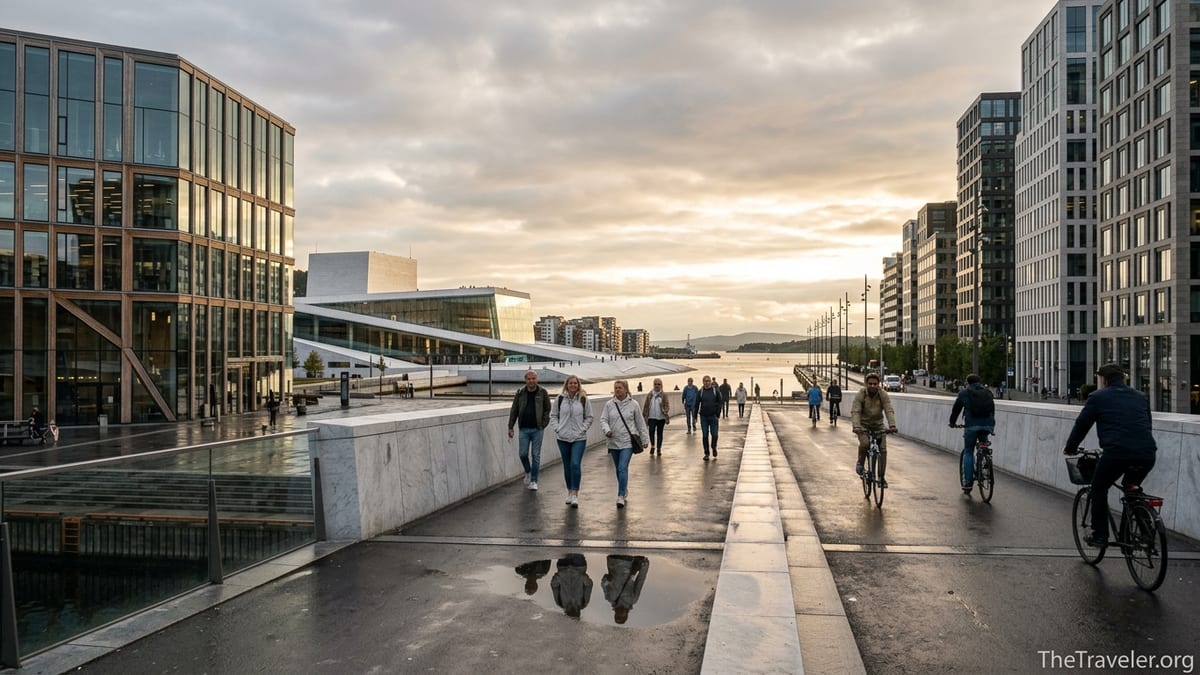
Bjørvika has become Oslo’s postcard of the future – all sharp angles, glass towers and waterfront promenades. Travelers land at Oslo Central Station, walk straight to the Opera House roof, maybe peek inside the MUNCH museum, then leave convinced they have “done” the area. Yet within a ten to fifteen minute walk, there are older streets, quieter viewpoints, cheaper eats and local routines that most visitors never see. Before you head to Bjørvika, it is worth knowing what lies just beyond the dramatic skyline.
Get the latest updates straight to your inbox!
Look Beyond the Postcard: Why Bjørvika Is Only the Beginning
From the plaza outside Oslo Central Station, Bjørvika looks irresistible. The white ramp of the Oslo Opera House pulls you toward the water, while the Barcode towers line up behind it like an architectural showroom. The district is a showcase for Norway’s largest urban renewal project, transforming what was once an industrial harbor and rail yard into a cultural hub with the Opera, the MUNCH museum and the Deichman Bjørvika library clustered around the head of the Oslofjord.
Because everything feels new and concentrated, many travelers assume that Bjørvika alone is the destination. They walk the Opera roof, take photos of the Barcode skyline and maybe grab a coffee by the water, then head back on the train. In a city as compact as Oslo, that narrow focus means missing neighborhoods where people actually live, older streets that show how the city grew and local food spots that cost less than a museum ticket.
Think of Bjørvika as a bright foyer rather than the whole house. It is the most photogenic introduction to Oslo, but some of the city’s most rewarding experiences sit just behind it: Gamlebyen’s medieval ruins, the swim platforms at Sørenga, the food stalls of Barcode Street Food, even the high-ceilinged food hall inside the old Oslo East Station. With a little planning, you can enjoy the headline sights and still leave feeling you touched everyday Oslo.
The good news is that almost everything mentioned in this article is within a twenty minute walk of the Opera House. If you are arriving by train, you can drop a bag in a station locker, cross a bridge or two and quickly trade glass towers for brick churches, grassy moats or a bench beside the fjord.
Oslo Central Station & Østbanehallen: Do Not Rush Through the Gateway
Many visitors treat Oslo Central Station as an obstacle between airport and fjord, but the station itself is one of the easiest places to get a soft landing in the city. Attached to the concourses is Østbanehallen, the historic former east station building turned indoor food hall and gathering space. Under its glass roof you find everything from cinnamon pastries to Italian trattoria dishes, along with tourist information and one of the city’s most central hotels.
If you have just arrived on the airport express train and are tempted to walk straight to the Opera House, make a short detour through Østbanehallen instead. You can pick up a strong filter coffee and a still-warm kanelbolle from a bakery like Kanelsnurren, where the bakers work through the night so the hall smells of fresh dough by morning. In practical terms, this is also where you can adjust to Norwegian prices without pressure: window-shopping restaurant menus here gives you a realistic range of what casual meals in Oslo cost.
Østbanehallen is also a useful fallback if the weather turns. Winter and early spring in Oslo can bring sleet off the fjord that makes Bjørvika’s open plazas feel exposed. Ducking back into Østbanehallen for a bowl of ramen, a plate of pasta at Bella Bambina or a beer at a gastropub lets you stay central while avoiding the wind. Because the building connects directly to the platforms and to the end of Karl Johans gate, Oslo’s main street, you can improvise: an hour browsing shops, another hour at the Cathedral, and you are still only a five minute walk from Bjørvika.
For travelers with limited time, say a two hour layover in the evening, the station complex plus the river of light outside its doors is a whole micro-visit. You can have a proper hot meal, sample a Norwegian pastry, and then walk out to the Opera House in less than ten minutes for a last view of the fjord before your next train.
Gamlebyen & Middelalderparken: Oslo’s Past Hiding Behind the Glass
Stand on the Opera House roof and look southeast and you will see low green slopes and old brick buildings beyond the roads. This is the start of Gamlebyen, Oslo’s “Old Town,” which most visitors never bother to reach. The walk from the Opera plaza to Gamlebyen takes about fifteen minutes, yet psychologically it feels much farther, which is exactly why so many travelers skip it.
The heart of the area is Middelalderparken, a park that contains traces of medieval Oslo: church ruins, parts of the old city wall and grassy earthworks around a small lake. On a summer evening you might see local families barbecuing on disposable grills while children ride scooters along the paths. In winter, the same lawn can sit quietly under snow, with dog walkers and commuters cutting across it as a shortcut. There is little in the way of ticket lines or souvenir shops here, which is part of the appeal.
Visiting Gamlebyen offers a completely different sense of time than Bjørvika. The Barcode buildings were largely completed in the 2010s, while the stones around Middelalderparken point back to the 11th and 12th centuries. You can walk from MUNCH’s glass facade to the ruins of St. Clement’s Church in under twenty minutes and in that short distance cross almost a thousand years of Oslo’s urban history. For travelers who enjoy context, this contrast explains more about the city than any single museum panel.
Practically, Gamlebyen is an easy half-day extension from Bjørvika. Start with the Opera roof, step into Deichman for a coffee, then follow the paths and underpasses that lead toward the park. Bring a simple picnic from a supermarket near the station and eat it on the grass while you watch trams glide along Oslo gate. You will see students, parents with strollers and dog walkers using the area as part of their daily routine, which can be more revealing than any curated cultural attraction.
Sørenga & The Harbor Promenade: A Local Waterfront, Not Just a Photo Stop
Most Bjørvika visitors walk along the edge of the Opera House, admire the fjord and then turn back inland. The mistake is not continuing along the waterfront to Sørenga, a residential peninsula with one of Oslo’s most popular seawater pools and boardwalks. From the Opera, the stroll to Sørenga along the harbor promenade takes about fifteen to twenty minutes at a leisurely pace, with constant views across the water.
At Sørenga Sjøbad, a public seawater bath, you will find floating docks, diving platforms and steps down into the fjord. On warm summer days locals spread towels along the wooden decks, teenagers practice cannonballs off the platforms and office workers come down from the surrounding apartment buildings for an after-work swim. The atmosphere is informal and free; you can swim at no charge and there are outdoor showers and ladders. This is one of the most direct ways to experience Oslo’s relationship with the fjord, yet many short-stay visitors never make it this far.
Even if you are not planning to swim, Sørenga is worth the detour. Cafes and restaurants along the seawall set up outdoor seating as soon as the weather allows, and the low angle of evening light over the water in late spring and summer is ideal for photography. Because the peninsula faces back toward the Opera House and Barcode, you get a reverse view of Bjørvika that few travelers capture: the marble roof and glass towers framed against the hills behind the city.
If you are visiting outside the summer season, the promenade to Sørenga still works as a quiet walk. In late autumn it can feel almost austere, with gray water, empty benches and the occasional resident walking a dog along the boards. That understatement is very Norwegian and gives you a better sense of daily life than another crowded museum lobby. Dress for the wind coming off the fjord, bring a thermos of coffee from the station, and you have an inexpensive, low-key outing that balances Bjørvika’s intensity.
Deichman Bjørvika & Everyday Culture: Not Just Another Library
Deichman Bjørvika, Oslo’s main public library, sits directly across the street from the Opera House yet many tourists ignore it, assuming they need a library card or that it will feel irrelevant to a short visit. In reality, this building is one of the easiest ways to access local culture at no cost and without any gatekeeping. You can simply walk in, find a seat with fjord views and watch how people in Oslo use a public space designed for them.
The interior is light and open, with long sightlines through the atrium and reading terraces that step up floor by floor. On weekdays you will see secondary school students revising for exams, freelancers working on laptops, parents reading to toddlers in the children’s section and elderly residents flipping through newspapers in multiple languages. Visitors do not need to register to sit, study or browse; a library card is only required to check materials out of the building.
From a traveler’s perspective, Deichman Bjørvika serves several practical functions. It is a comfortable place to warm up on a cold, bright winter day, to charge a phone or to catch up on work in a calm environment between sightseeing. There is a cafe on the ground floor, and during the lighter months an outdoor terrace where you can sip coffee while looking back at the Opera and the ferries crossing the fjord. The building also hosts lectures, film screenings and small exhibitions, many of them free, which can be a welcome alternative to paid attractions if you are on a tighter budget.
Most importantly, spending even half an hour here shifts your perspective on Bjørvika. Instead of seeing the district only as a stage set of dramatic buildings, you see how those buildings are woven into routines: people commuting by tram, meeting friends after work in the lobby, or bringing children to weekend storytelling sessions. That recognition turns the area from an architectural spectacle into a place with social texture.
Food Halls, Street Food & Simple Meals: More Than Fjordside Fine Dining
Bjørvika’s waterfront restaurants often come with big windows and correspondingly big bills, so travelers on a budget sometimes leave the area hungry, assuming there are no affordable options nearby. In reality, you have several layers of food experiences within a short walk, from modern street food halls to simple bakeries tucked inside station concourses. The key is to look a block or two back from the water.
First, there is Østbanehallen, which, beyond its bakeries and sit-down restaurants, works as a casual meeting place where you can share a pizza, order a burger or try a local beer without feeling rushed. Prices run higher than in a supermarket but are comparable to mid-range European capitals, and you are paying for convenience and atmosphere under a restored 19th century roof. Travelers with an early morning train often grab breakfast here so they can walk straight to the platform afterward.
Just behind the Barcode row, you will find newer options like Barcode Street Food, a food hall concept where independent vendors offer everything from tacos and bao buns to vegan bowls and Norwegian-inspired dishes at more modest portions and prices than along the quay. On a busy evening you might see office workers ordering craft beers at the bar while friends split dishes at shared tables. For solo travelers, this setup feels less formal than a restaurant and makes it easy to try several small plates rather than committing to one main course.
Do not overlook the simplest solutions either. The shopping centers and side streets between the station and Bjørvika contain supermarkets and take-away counters where you can assemble a picnic: a packet of flatbrød, some slices of brown cheese, smoked salmon, fruit and a carton of kefir or juice. Eating that picnic on the Opera House roof or down by the water at Sørenga gives you a meal with million-kroner views for a fraction of restaurant prices. Many Norwegians do exactly this on sunny days, turning public spaces into makeshift dining rooms.
Venturing a Little Further: Grønland, Youngstorget & Karl Johans Gate
Another common mistake is treating Bjørvika as an island, when in practice it is one corner of a triangle that includes Grønland to the east and the traditional city center around Youngstorget and Karl Johans gate to the west. Each direction gives a different version of Oslo that helps balance the carefully planned feel of Bjørvika.
Walk ten minutes east from the station and you reach Grønland, a traditionally working-class and immigrant neighborhood where kebab shops, South Asian grocery stores and discount clothing outlets line the main street. Here you can buy a generous plate of shawarma or a portion of fish curry for less than a typical sit-down meal near the fjord, and you will likely hear a mix of Norwegian, Urdu, Somali and Arabic on the pavement. This side of Oslo offers a messier, more lived-in atmosphere that contrasts sharply with the polished glass along the waterfront.
Head in the opposite direction from Oslo Central and you quickly reach Jernbanetorget and then Karl Johans gate, the main boulevard that runs toward the Parliament and Royal Palace. Many visitors wander part of this street without realizing how close it is to Bjørvika. Here you find chain stores, side alleys with long-established pubs, and squares like Youngstorget that host markets and political rallies. If you time it right, you might see a farmers’ market, a charity event or a small concert, all of which offer glimpses into local civic life that architect-designed plazas cannot provide.
By triangulating these three areas, you give your Bjørvika visit context. The Opera House and MUNCH become not just isolated attractions, but one edge of a city that includes immigrant groceries, historic labor movement headquarters and the more anonymous office blocks that keep Oslo running. Walking these short distances, rather than hopping on a tram immediately, is often the difference between a superficial and a textured experience of Norway’s capital.
The Takeaway
Bjørvika deserves its reputation as one of Scandinavia’s most striking new urban districts. The Opera House roof, the soaring MUNCH museum and the reflecting surfaces of the Barcode towers are genuinely memorable. Yet if you treat the area as a self-contained “attraction zone,” you will leave Oslo with an incomplete picture of the city. Just beyond the glass, there are medieval ruins, harbor baths, busy food halls, immigrant streets and a public library that quietly anchors local life.
Before you visit, sketch your route to include both the famous and the everyday. Plan to arrive a little early so you can have coffee and a pastry in Østbanehallen, walk the Opera roof, dip into Deichman’s calm interior, wander along the harbor promenade to Sørenga, then loop back through Gamlebyen or Grønland. None of this requires a tour guide or a large budget, only comfortable shoes and a curiosity about how Oslo actually works.
If you do, Bjørvika will still give you the sharp photographs and modern design you came for, but it will also serve as a doorway to experiences that most travelers skip. In a compact city like Oslo, those small detours often become the memories that last longest.
FAQ
Q1. How much time should I plan for Bjørvika and the nearby areas?
You can see the main Bjørvika sights in two to three hours, but adding Sørenga, Østbanehallen and a short walk to Gamlebyen or Grønland turns it into a rewarding half or full day.
Q2. Is it easy to walk from Oslo Central Station to Bjørvika?
Yes. The Opera House and Bjørvika sit directly behind the station. It takes about five to ten minutes on foot from the main concourse to the Opera’s marble ramp.
Q3. Do I need tickets to go on the Oslo Opera House roof?
No. The roof is free and open to the public during posted opening hours. Tickets are only required if you want to attend a performance or a guided backstage tour.
Q4. Can I use Deichman Bjørvika library as a visitor without a library card?
Yes. Anyone can enter, sit, study and use the spaces without a card. A library card is needed only if you plan to borrow books or other materials and take them outside.
Q5. Is it safe to walk to Gamlebyen and Sørenga from Bjørvika?
For most travelers, walking these routes during the day and early evening feels straightforward and safe. As in any city, stay aware of traffic, follow marked crossings and use lit paths after dark.
Q6. Where can I find more affordable food options near Bjørvika?
Check Østbanehallen at the station for bakeries and casual restaurants, supermarkets around the central area for picnic supplies, and street food halls like those behind the Barcode buildings for reasonably priced meals.
Q7. Can I swim in the fjord near Bjørvika?
Yes. Sørenga Sjøbad, about a fifteen to twenty minute walk along the harbor promenade from the Opera House, has public seawater pools and platforms where swimming is common in warmer months.
Q8. What is the best season to explore these areas on foot?
Late spring to early autumn offers the most pleasant walking conditions, with long daylight hours in summer. Winter walks can still be atmospheric if you dress warmly and watch for icy patches.
Q9. Are there luggage storage options if I only have a layover?
Oslo Central Station provides lockers and staffed storage services where you can leave bags, making it easy to explore Bjørvika, Sørenga or Gamlebyen during a layover of a few hours.
Q10. Is Bjørvika suitable for families with children?
Yes. Children often enjoy climbing the Opera roof, playing along the harbor promenade and visiting the children’s floor at Deichman. Sørenga’s swimming area is also popular in summer with families who supervise kids closely by the water.