


Grünerløkka has become the shorthand answer whenever someone asks where to stay or hang out in Oslo. Its street art, cafe culture and vintage shops are firmly on the tourist map. But if you head straight for Thorvald Meyers gate and never look around the edges, you miss the quiet streets, riverside paths and neighboring districts that actually explain why "Løkka" feels so special. Before you follow the crowds, it is worth exploring a handful of often overlooked places that locals use every week, and which sit just beyond (or even underneath) the Instagram surface.
Get the latest updates straight to your inbox!
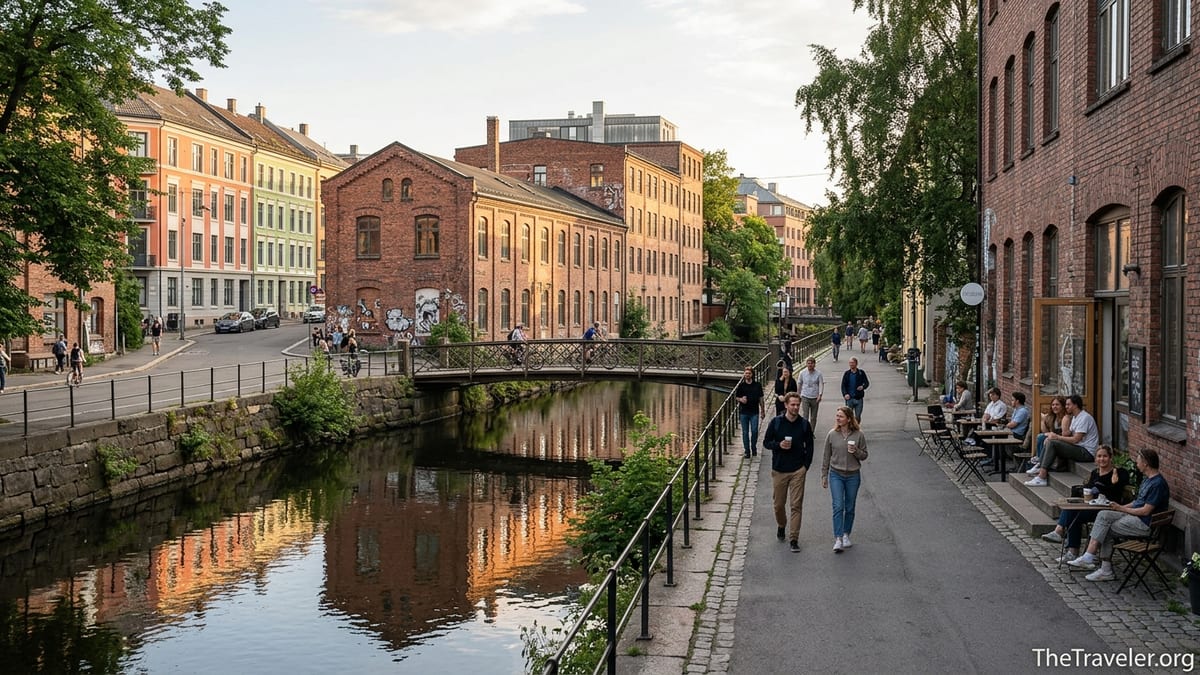
Walk the Akerselva Before You Walk the Shops
Most visitors rush straight to Grünerløkka’s main streets without realizing that the neighborhood exists because of the river that runs just below it. Akerselva flows right through Oslo from the forest lake Maridalsvannet down to the fjord, passing under bridges and between old brick factories on the edge of Grünerløkka. Today it is a green corridor where office workers eat lunch on benches and locals jog in the evenings, but for more than a century it powered mills and workshops whose buildings you can still see as you walk.
If you start north of Grünerløkka, for example around Nydalen, you can follow a clearly signed riverside path all the way down towards the city center. Sections near Grünerløkka are some of the most atmospheric, with small waterfalls, weirs and red-brick factory walls on both sides of the river. Many first-time visitors only glimpse Akerselva when they cross a bridge on the way to coffee; taking an hour or two to walk along it first gives you a better feel for Oslo as a lived-in city instead of just a collection of trendy blocks.
In practical terms, this walk is easy to fit into a short stay. On a summer day you might buy a takeaway coffee near Nydalen, follow the path downstream and stop at small clearings where people sunbathe, grill food or even swim when the water is warm enough. There are benches and simple playgrounds at intervals, and you will see parents pushing strollers, older couples out for slow walks and students using the riverbank as an outdoor study space. By the time you reach the bridges near Grünerløkka, the neighborhood’s crowds make more sense: the cafes and vintage stores are simply an extension of this daily life along the river.
For visitors used to more dramatic scenery elsewhere in Norway, Akerselva will not feel spectacular. That is exactly why many skip it and later say Oslo felt like “just another small city.” Spending a morning on the river path is one of the quickest ways to turn that impression around, and it costs nothing beyond a tram ticket to get to your starting point.
Explore Vulkan and Mathallen, the Industrial Edge of Løkka
On the official map, Vulkan technically sits on the opposite side of Akerselva from Grünerløkka, but locals treat the area as Løkka’s western edge. Once home to ironworks and mechanical workshops, it has been redeveloped into a compact cluster of cultural venues, offices and places to eat. Many tourists hear the name only in connection with Mathallen, the indoor food hall, and then move on after a quick snack. Spending more time here reveals how much of Oslo’s current identity has grown out of former industry.
Mathallen occupies a long brick hall that once housed part of the old factory complex. Inside you find a dense mix of counters and small restaurants selling everything from Norwegian cured meats to fresh fish, pastries, cheeses and imported delicacies. Prices reflect Oslo’s cost level, but you can still keep a visit affordable by sharing a platter of local charcuterie, ordering a bowl of fish soup or grabbing a single pastry and coffee rather than sitting down for a full three-course meal. On weekends, the hall is lively without feeling like a tourist trap, because many of the customers are Oslo residents doing their regular food shopping.
Step outside Mathallen and you reach a small square that functions as an outdoor living room for the neighborhood. In warm weather, people sit on the steps with takeaway food, while children play around a water feature. Around the square you will notice an unusually high concentration of architecture and performing arts institutions, from a contemporary dance venue to environmentally focused office buildings. If you are interested in how old industrial zones are being reused across Europe, this is a textbook example at walkable scale.
From Vulkan it is only a few minutes’ walk across one of the footbridges into Grünerløkka proper. Many locals suggest doing exactly that: start with lunch at Mathallen, wander around the industrial courtyards and then cross the river into the streets of Thorvald Meyers gate. Seen in that order, the cafes and bars of Løkka feel like the natural continuation of a story that began with water power and factory work, not just trendy places that appeared overnight.
Head North to Torshov and Torshovparken
Ask Oslo residents where they would live if they wanted the same easygoing feel as Grünerløkka but with fewer stag parties, and many will answer Torshov. This neighborhood sits just north of Løkka, technically in the Sagene borough, and is linked by the same tram line that runs along Thorvald Meyers gate. Because it is slightly uphill and mainly residential, most tourists never bother to ride those extra two or three stops. That is a shame, because Torshov offers one of the city’s best views and a slice of everyday Oslo life.
The focal point is Torshovparken, a hilltop park laid out in the 1920s, lined with mature trees and surrounded by classic yellow and red apartment buildings. On a summer evening locals gather here with blankets and small picnic coolers, watching the sun set over central Oslo and the forested hills beyond. Families visit the playground lower in the park, dog walkers loop the paths and teenagers cluster around a characteristic fountain that has become a kind of local landmark. For visitors, it is an easy place to pause after a long day of sightseeing and simply observe how Oslo residents use their green spaces.
Surrounding streets such as Vogts gate are dotted with low-key cafes, bakeries and pizza places aimed at local residents rather than visitors. You can grab an espresso at a neighborhood coffee bar, sit by the window and watch parents walk children to activities or commuters hop on and off the tram. There are also small independent shops, from wine merchants to plant stores, and the level of English tends to be excellent yet the atmosphere remains calm and unhurried.
To reach Torshov from Grünerløkka, you can either follow the tram tracks uphill or walk via quieter residential streets that gradually open up into the park. In winter the park’s slopes become informal sledding hills; in autumn the trees turn vibrant yellow and orange. Even a brief visit reshapes your mental map of Oslo from a city of “must-see” attractions into a set of layered neighborhoods, all just a few minutes apart by public transport.
Discover Sofienberg and the Quiet Side of Grünerløkka
Within the boundaries of Grünerløkka itself there are also areas that most visitors overlook. Sofienberg, to the east of Thorvald Meyers gate, feels like a different neighborhood entirely, even though it is only a few minutes’ walk from the busiest bars. The main landmark here is Sofienbergparken, built around an old cemetery and framed by rows of early 20th century apartment buildings. On sunny days, locals spread blankets across the lawns, and you are more likely to hear Norwegian or other European languages than a chorus of English-speaking tour groups.
The streets around Sofienberg are narrower and more residential, with corner grocery shops, simple cafes and takeaways rather than high-profile restaurants. Prices can be slightly lower than on the main drag, particularly if you opt for everyday Norwegian staples like open-faced sandwiches, cinnamon buns or hearty lunchtime stews. It is an easy place to pick up a picnic and carry it back into the park, where sitting on the grass is not just tolerated but expected.
Because Sofienberg is less obviously “cool” than the center of Grünerløkka, it also offers a quieter look at local architecture and daily rituals. Stroll down side streets in the early morning and you will see people carrying bread from neighborhood bakeries, cyclists heading towards the city center and older residents tending to communal gardens in shared courtyards. If you are staying in the area, paying attention to this slower rhythm can be more rewarding than ticking off another famous coffee bar.
In the evening, Sofienberg is usually calmer than western Løkka, making it a good option if you want to stay close to nightlife without being in the middle of it. You can have a relaxed dinner at one of the local restaurants, then walk ten minutes to a busier bar or music venue if you feel like extending the night. For many travelers, this balance between access and quiet is a key ingredient in enjoying Oslo, yet it rarely appears in quick-hit neighborhood guides.
Look South to Grønland and the Multicultural Markets
Just across the river from the southern tip of Grünerløkka lies Grønland, a district that feels entirely different yet is only about a fifteen-minute walk away. Many tourists hesitate because Grønland has a reputation as “rougher around the edges,” and some city-center hotels still steer guests towards more familiar streets. While it is sensible to stay alert here as you would in any dense urban area, skipping Grønland means missing one of the most vivid everyday markets in Oslo.
The main streets near the metro station are lined with halal butchers, Turkish and South Asian grocers, inexpensive clothing shops and small snack bars. Fruit and vegetable stores often fill their storefronts with crates of herbs, mangoes, peppers and other produce you will not find in standard Norwegian supermarkets. Prices can be noticeably lower, which is why many locals from other parts of the city come here to do their bulk shopping on weekends. For a visitor on a budget, it is one of the easiest places in central Oslo to assemble a picnic for the price of a single sandwich in a sit-down cafe elsewhere.
Cafes and restaurants in Grønland tend to focus on Middle Eastern, North African, Somali, Pakistani and Indian cuisines. Instead of hunting for classic Norwegian dishes, you might sit down for a plate of grilled meat and flatbread, a generous vegetarian thali or a simple shawarma wrap. Independent coffee bars have also appeared, often run by young Oslo residents with roots in multiple countries. This mix of backgrounds is a reminder that modern Oslo is far more multicultural than its postcard images suggest.
From a practical standpoint, Grønland is easiest to combine with a day when you are already exploring Akerselva. You can start with a riverside walk near Grünerløkka, then follow the path south until the scenery becomes more urban and you approach the lower part of the river. Once you turn towards Grønland’s streets, the transition from quiet green banks to densely packed shops and markets is striking. Ending your day back in Grünerløkka’s bars, you will have a much richer sense of the city that surrounds them.
Slow Down in the Small Parks and Side Streets
Birkelunden, the park that anchors western Grünerløkka, is on many visitors’ mental map, especially on Sundays when its flea market sets up between the trees. Fewer people take the time to explore the string of smaller parks and playgrounds that run through and around Løkka. These green pockets are where residents actually spend their time, and they are easy to miss if you only walk down the busiest commercial streets.
Just a few blocks from the crowds you can find narrow gardens sandwiched between apartment buildings, basketball courts buzzing with teenagers, and pocket parks with climbing frames for younger children. Benches are often occupied by older locals reading newspapers, students with takeaway coffee or workers enjoying a short break. Because public drinking rules in Norway can be strict, most people stick to soft drinks or takeaway coffee here rather than open bottles, but the mood remains relaxed and friendly.
Side streets off Markveien and Thorvald Meyers gate are also worth weaving through slowly. Many of them are lined with low-rise wooden houses or early 20th century apartment blocks that survived waves of redevelopment. You might stumble upon a cooperative gallery in a former workshop, a bar hidden behind an unmarked door or a courtyard that hosts occasional neighborhood events. Oslo is compact, and distances between these small discoveries are often measured in minutes rather than half-hour walks.
For travelers staying in an apartment or guesthouse rather than a hotel, these quieter streets are also where you will find practical services: self-service laundries, local hardware shops, small clinics and everyday supermarkets. Knowing where to buy a roll of tape or a cheap umbrella can make a short stay smoother, yet most destination roundups never mention these simple, human details.
The Takeaway
Grünerløkka deserves its reputation as Oslo’s trendiest neighborhood, but that label can make it feel smaller than it is. When visitors treat it purely as a destination for coffee and vintage shopping, they miss the river that powered its factories, the working-class districts that border it on all sides and the parks where residents spend their free time. Looking beyond the main streets costs little in money or effort, but pays off in a clearer sense of how Oslo fits together.
Before you join the crowd on Thorvald Meyers gate, consider walking a section of Akerselva, eating at Mathallen, riding the tram up to Torshov or wandering across the river to Grønland’s markets. Build in time for Sofienberg’s quiet residential blocks and the pocket parks that stitch everything together. At the end of your stay, you will remember not only a fashionable borough but a set of real neighborhoods that are evolving together.
That, in the end, is the real reward of exploring the places most tourists overlook around Grünerløkka. You still get your latte, your record store and your evening cocktail, but they are framed by river light, hilltop sunsets and grocery bags full of unfamiliar ingredients. Oslo stops being an abstract northern capital and becomes a city whose streets and rivers you can picture clearly long after your flight home.
FAQ
Q1. How much time should I plan around Grünerløkka’s overlooked areas? Most travelers can see key spots like Akerselva, Vulkan and Torshov in one relaxed full day, or spread them out over two shorter half days.
Q2. Is the Akerselva riverside walk suitable for all fitness levels? Yes, the paths along Akerselva near Grünerløkka are generally flat, well maintained and suitable for casual walkers, though parts can be icy in winter.
Q3. When is the best season to explore these neighborhoods? Late spring to early autumn offers the most pleasant weather, with outdoor life in parks and along the river at its liveliest and daylight stretching late.
Q4. Are Vulkan and Mathallen expensive to visit? You can keep costs moderate by sharing dishes, choosing simpler snacks or just browsing; there is no entry fee to the area or the food hall itself.
Q5. Is Torshov safe to visit in the evening? Torshov is mainly residential and generally feels calm and safe in the evening, with people out walking dogs, using the park and riding the tram.
Q6. How do I get from central Oslo to Grünerløkka and its surroundings? Frequent trams run from the city center to Grünerløkka and on to Torshov, and the same tickets are valid on buses and the metro across Oslo’s central zones.
Q7. Can I combine Grønland and Grünerløkka in one day? Yes, many visitors walk a stretch of Akerselva between the two, stopping in Grünerløkka for coffee and Grønland for food shopping or dinner.
Q8. Are these areas good for families with children? The riverside paths, playgrounds in parks like Torshovparken and Sofienbergparken, and car-light side streets make the area convenient for families.
Q9. Will I find traditional Norwegian food in these overlooked spots? You will find some Norwegian dishes in places like Mathallen, but neighboring Grønland and parts of Løkka also highlight Oslo’s diverse international food scene.
Q10. Is English widely spoken in and around Grünerløkka? Yes, most people you meet in cafes, shops and public transport speak good English, and it is easy to ask for directions or recommendations.