


Riisitunturi National Park in Finnish Lapland has quietly become one of the most photographed winter landscapes in Europe. The famous crown snow trees, wide open mires and sweeping views toward Lake Kitka draw more visitors every year. Yet many people arrive unprepared for the realities of this remote fell, from parking and winter driving to trail difficulty and basic facilities. Before you point your rental car toward Posio or book that snowshoe tour from Rovaniemi, it is worth understanding a few things that rarely make it into glossy brochures.
Get the latest updates straight to your inbox!
Understanding Where Riisitunturi Really Is
On the map, Riisitunturi National Park looks close to the big Lapland hubs of Rovaniemi and Kuusamo. In practice, it feels much more remote. The park sits in the municipality of Posio, roughly a 40 minute drive from the village of Posio and about two hours by car from Rovaniemi in good winter conditions. Travelers often underestimate that this is a genuine rural area with limited services once you leave the main highway.
Most independent visitors approach from Rovaniemi or the Ruka ski resort near Kuusamo. From Rovaniemi, you follow main roads north-east before turning toward Posio and finally up a smaller local road to the Riisitunturi trailhead. That last 10 or so kilometers climb steadily and can be snowy or icy, especially in December and January. Car hire companies in Rovaniemi usually provide studded winter tires by default, but it is still common to see cautious visitors pulling into the parking lot with white knuckles after their first proper Lapland road.
The nearest town with a full range of supermarkets, petrol stations and accommodation is Posio. Many travelers stay instead at cabins or holiday apartments around Ruka, roughly an hour’s drive away, because it combines ski resort comforts with access to Riisitunturi as a day trip. Wherever you base yourself, plan your route and refuelling before you set off; you cannot simply rely on stumbling across a convenient petrol station in the forest.
Public transport is another point visitors misjudge. There is usually no regular bus that stops at the Riisitunturi parking area itself. Some regional buses run between Rovaniemi, Posio and Kuusamo, but they typically leave you on the main road, still many kilometers from the trailhead. In winter, most non-driving visitors either book a guided excursion that includes transportation or negotiate a taxi transfer from Posio, which can cost as much as a mid-range hotel night.
Seasonality, Light and Weather Catch People Off Guard
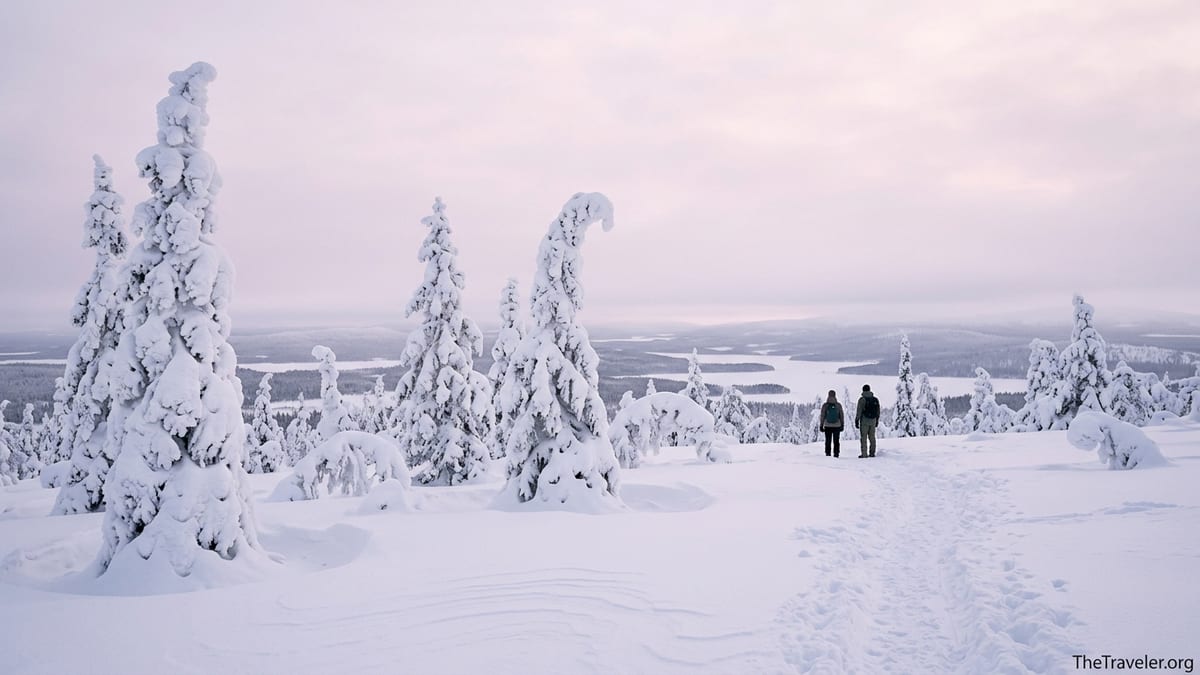
Images of Riisitunturi on social media usually show heavy “tykky” snow bending spruces into frozen sculptures against pink Arctic skies. Those scenes are real, but they exist only for a relatively short window most winters, often from late December or January through early March, and can vary year to year. In early winter there may be too little snow; in late spring the snow can be heavy and melting, with brown patches and slush. Travelers who do not check the season carefully sometimes arrive in late November or April and are surprised to find icy paths, thin snow cover or a landscape closer to autumn.
Daylight is another factor that first-time Lapland visitors often overlook. Around the winter solstice in late December, Riisitunturi can have only a few hours of dim daylight and extended blue twilight. A hike advertised as three to four hours, such as the popular Riisin rääpäsy winter route, can easily fill all usable daylight if you start late. Tour companies that run from Rovaniemi typically pick up guests in the morning for exactly this reason. If you travel independently in midwinter, it is sensible to be on the trail soon after first light, even if that means starting from Rovaniemi before dawn.
The weather itself is highly changeable, especially in late autumn and winter. It is not unusual for the car park to feel calm while the fell plateau above is exposed to biting wind, swirling snow or thick fog. Visitors sometimes dress for the conditions at the trailhead rather than for what they will meet at 450 meters on an open fell. A typical mistake is arriving in thin fashion boots and a city parka in minus 15 degrees Celsius with windchill. Locals blend insulating midlayers, proper winter boots with grippy soles, windproof outer shells and accessories such as balaclavas and mittens. When the wind picks up on the summit ridge, the difference between that and a basic city outfit becomes obvious in minutes.
In summer, many people assume Lapland equals constant sunshine and mild temperatures. While June and July can be warm and bright, the mires and forest trails at Riisitunturi often remain wet and muddy, particularly after rain. Duckboards across wetlands may be slippery, and mosquitos appear in force from early summer. A summer hiker in shorts and running shoes who has seen only dry Instagram photos can find the real trail conditions surprisingly demanding.
Trails Are Short on Paper, Harder on Your Legs
One of the biggest surprises for new visitors is how demanding Riisitunturi’s main routes feel compared with their stated lengths. The classic winter day route, Riisin rääpäsy, is roughly 4 to 5 kilometers, depending on the exact line and signage in a given year. Another popular option, Riisin rietas, is around 10 kilometers and advertised as an intermediate to demanding hike with notable elevation changes. On a flat urban path those distances would sound easy; on a snowy fell with climbs, descents and uneven surfaces, they are something else entirely.
For example, a reasonably fit traveler might walk 4 kilometers on dry ground in under an hour. On the Riisin rääpäsy snowshoe route in January, that same person can easily take two to three hours. Deep snow, wind-packed drifts, icy sections and stopping often for photos of the snow-laden spruces all slow progress. Guided tours from Rovaniemi and Ruka commonly schedule Riisin rääpäsy as a four-hour excursion including transfers, gear fitting and breaks, which gives a more realistic sense of the pace.
Elevation gain is another underappreciated factor. The main trail climbs from the parking area up onto the fell plateau, with some sections that feel steep when you are wearing snowshoes for the first time. In summer, Riisin rietas adds longer, rolling ascents and descents that test the knees, especially when the path is wet and rocky. Families sometimes bring small children expecting a leisurely stroll, only to find themselves carrying tired kids up snowy hills. If you are unsure, start with the shorter winter loop and treat it as a test of how you handle the terrain.
Many trails share sections and junctions, and in snowy or foggy weather signage can be partially buried or less obvious than in summer. Local authorities mark winter routes with poles and colored signs, but it is still possible to take a wrong turn at an intersection, particularly when following a GPS track from a blog that was recorded in a different season. Having a current trail map from the official Finnish parks information and understanding the difference between summer and winter routes helps avoid confusion.
Facilities Are Minimal: Plan for Self-Reliance
Another common misconception is that Riisitunturi will offer the same level of infrastructure as a major ski resort or North American national park. In reality, facilities are deliberately simple to keep the environment wild. At the main parking area you typically find an information board with maps and safety guidelines, a dry toilet, a fire site with a lean-to shelter and wood supply, and sometimes a small service building associated with trail maintenance. There is no café, no heated visitor center directly at the trailhead and no shop selling gloves or snacks if you forget your own.
Mobile reception is improving but still patchy on some parts of the trails. On the plateau and higher ridges you can usually get a signal with the major Finnish networks, but it is not guaranteed. This is one reason local authorities encourage visitors to tell someone their planned route and expected return time and to carry a basic first-aid kit and emergency warm layer. It is also why guided tours remain popular with people who are not used to winter navigation or remote hiking.
Water is another overlooked detail. In winter, streams are frozen or hidden under snow, and while you can melt snow in an emergency, most day visitors rely on water bottles they bring from their accommodation. In summer, there are natural water sources but they are not treated, so carrying a filter bottle or purification tablets is a sensible backup. It is easy to underestimate how much you will drink when snowshoeing uphill in cold air; one liter per person is a bare minimum for a half-day outing.
Overnight options inside the park are very limited. There is a wilderness hut near the main route that can be used for short rests and in some seasons for simple overnight stays under Finnish hiking rules, but it is basic, often busy in peak summer and cannot be reserved like a hotel room. Many hikers who dream of photographing northern lights among the snow ghosts instead book cabins in Posio or Ruka and plan late-evening or very early-morning visits by car or tour, accepting the trade-off between comfort and spontaneity.
Winter Driving, Parking and Tours: Practical Realities
For many visitors, simply reaching the Riisitunturi parking area is the most stressful part of the day. The road that climbs from the main highway to the trailhead is plowed but can still be narrow, snow covered and occasionally slick with compacted ice. Conditions can change within a few hours after snowfall or wind. Rental cars from Rovaniemi and Kuusamo are generally equipped with studded tires in winter, but drivers without snow experience often underestimate how long the final stretch will take. Leaving extra time and accepting a slower speed than local traffic is one of the most important safety decisions you can make.
Parking itself is straightforward but limited in capacity at peak times. On popular winter weekends and during the February school holiday period in Finland, the main lot can fill quickly. When this happens, latecomers sometimes park haphazardly along the access road, which can complicate snow clearing and block emergency vehicles. Authorities regularly remind visitors to park only in marked spaces and to be prepared to modify their timing, for example visiting later in the afternoon when early crowds have left.
Travelers who are uncomfortable with winter driving often choose a guided tour. Several small operators based in Rovaniemi and Ruka offer half-day snowshoe excursions to Riisitunturi that include transportation, snowshoe rental, poles and hot drinks, with prices that typically sit in the range of a modest day’s car hire plus fuel. While this can feel expensive per person, it removes concerns about road conditions and navigation and is particularly attractive for those with no previous experience of snow or temperatures well below freezing.
One aspect that can catch tour guests by surprise is the time spent in the vehicle. A “four-hour Riisitunturi experience” from Rovaniemi usually includes at least two hours of driving in total. It remains an excellent way to reach the park without a car, but travelers should read itinerary details carefully to avoid disappointment. Those who want more time on the trails might find it worthwhile to rent a car for a couple of days and combine Riisitunturi with nearby spots like Korouoma canyon or the Ruka ski area.
Respecting Local Rules and Nature
Finland’s everyman’s rights allow broad public access to nature, but national parks come with specific rules that some international visitors miss. At Riisitunturi, hikers must stay on marked routes in sensitive mire and fell areas, especially during the snow-free season when vegetation is most vulnerable. Off-trail wandering across delicate slope wetlands or climbing onto fragile snow formations may make for dramatic photos but can cause lasting damage.
Open fires are only permitted at designated fireplaces using the firewood provided, and are always subject to any current forest fire warnings, which can apply in both dry summer conditions and some windy winter days. Bringing your own gas stove for a hot drink is allowed and often more practical during busy periods when lean-to fireplaces are occupied. Leaving no trace is taken seriously: visitors are expected to carry out all rubbish, including food packaging, tissues and disposable hand warmers. Bins are not provided at the trailhead.
Dogs are welcome but must be kept on a leash at all times within the national park, regardless of how well-behaved they may be. This protects ground-nesting birds and reindeer herds that sometimes move through or near the park. Winter visitors from countries with looser dog rules sometimes find this strict, but local herders and conservation staff count on it. If you visit with a pet, be prepared with a harness, short leash and possibly booties if your dog is not used to snow and ice.
Cultural respect also matters. There are Sámi homelands elsewhere in Lapland and reindeer husbandry areas throughout the region. While Riisitunturi itself is not heavily marketed as a cultural site, visitors should understand that reindeer they see are semi-domesticated animals belonging to local herders, not wild wildlife. Chasing them for photos, flying drones near them or blocking herders on narrow roads is both inconsiderate and potentially dangerous. When in doubt, follow the lead of local signage and the quiet, respectful behavior of Finnish hikers around you.
What to Pack That You Might Not Think Of
Many packing lists for Riisitunturi focus on obvious items such as warm jackets and hats, but frequent visitors describe a different set of “small essentials” that have an outsized impact on comfort and safety. One is proper traction. In midwinter, snowshoe rentals from tour operators or local outfitters are usually sufficient, but in shoulder seasons like November and April, trails can be more icy than snowy. Light crampons or slip-on traction devices worn over boots can make the difference between a cautious but enjoyable walk and a constant fear of falling on hard ice.
Lighting is another overlooked item. In December and early January, darkness falls early and weather can reduce visibility even earlier than expected. A compact headlamp with fresh batteries allows you to navigate safely if your estimate of hiking time proves optimistic or if photographing the last light takes longer than planned. Relying exclusively on a phone flashlight in minus temperatures is risky, as batteries drain quickly in the cold and gloves make touchscreens awkward to use.
For photography, wide-angle lenses and spare batteries are more valuable at Riisitunturi than heavy telephoto equipment. Many of the classic views, such as snow-buried spruces against broad horizons, are best captured between 16 mm and 35 mm on a full-frame camera. Smartphone cameras can do an impressive job, but cold quickly depletes their power. Seasoned photographers keep spare batteries in an inside pocket close to body warmth and carry simple lens cloths to deal with snowflakes and condensation when moving between frigid air and warm car interiors.
Finally, pack for small comforts: a light foam sit pad for breaks on cold benches, a thermos flask with something hot to drink, thin liner gloves under thicker mittens for when you need finger dexterity, and a dry base layer in your backpack in case you sweat on the ascent and cool down during a long photo stop. None of these items is dramatic on its own, but together they turn a demanding winter outing into a memorable, manageable experience.
The Takeaway
Riisitunturi National Park rewards those who prepare with some of the most distinctive winter and wilderness landscapes in Finland. Its snow-laden forests, open mires and quiet fell ridges feel far removed from the busier resort scenes of Lapland, yet it is accessible as a day trip from Rovaniemi or Ruka for those willing to respect its conditions. Most disappointments stem not from the park itself but from mismatched expectations about transport, daylight, trail difficulty and facilities.
Before you go, think carefully about the season, check current trail information from Finnish park authorities, and be honest about your own comfort with winter driving and remote hiking. Consider whether a guided excursion might suit your skills better than venturing out alone, especially in midwinter. Pack for self-reliance with extra layers, traction, lighting and enough food and water, and approach the landscape with the same care that local hikers show.
Do that, and Riisitunturi will likely deliver what you imagined and more: a quiet, wind-sculpted plateau where trees become frozen sculptures, horizons stretch over lakes and mires, and the only sounds are snow under your boots and the occasional croak of a raven. In a region increasingly shaped by tourism, it remains a place where wildness still sets the terms, and where a bit of thoughtful preparation turns potential challenges into part of the adventure.
FAQ
Q1. Do I need a guided tour to visit Riisitunturi National Park in winter?
Guided tours are not mandatory, but they are strongly recommended for travelers without winter hiking or snowshoeing experience, or those uncomfortable with driving in snowy conditions. Confident winter drivers and hikers with suitable gear can visit independently, but should study current trail information, weather forecasts and daylight hours carefully.
Q2. What is the best time of year to see the famous snow-covered trees?
The heavily snow-laden “crown snow” trees usually look their most dramatic from roughly January to early March, depending on the winter. Early winter may not have enough snow, and by late March or April warmer temperatures often start to deform or melt the formations. Exact timing varies annually with weather and snowfall.
Q3. How long does the main winter hike take for an average visitor?
The shorter winter loop, often called Riisin rääpäsy, is around 4 to 5 kilometers and typically takes most visitors 2 to 3 hours in full winter conditions. This includes time for rest stops and frequent photo breaks. Strong hikers can move faster, but deep snow, hills and cold temperatures slow almost everyone compared with their usual walking pace.
Q4. Can I reach Riisitunturi by public transport from Rovaniemi?
There is usually no direct public bus to the Riisitunturi trailhead. Some regional buses run between Rovaniemi, Posio and Kuusamo, but they tend to stop on main roads far from the parking area. In practice, most travelers either rent a car, book a guided excursion that includes transport, or arrange a taxi transfer from Posio or Ruka.
Q5. Are there any restaurants or cafés at the Riisitunturi trailhead?
No. Facilities at the main parking area are basic and usually limited to an information board, dry toilets, a lean-to shelter with a fireplace and firewood. There is no café or shop, so visitors should bring their own food, hot drinks and any extra clothing or gear they might need for the day.
Q6. Is Riisitunturi suitable for young children or older travelers?
It can be, but only with realistic route choices and preparation. The shorter winter loop is manageable for many families and older hikers who have a basic level of fitness, proper winter clothing and traction. Very young children may struggle with the hills and cold, especially in windy conditions. For less mobile visitors, a guided tour that can adjust the pace and offer extra support is often the safest option.
Q7. What kind of footwear should I wear on the trails?
In winter, insulated waterproof boots with good grip are essential. On deeper snow, you will likely use snowshoes, provided by many tour operators or rented locally. In shoulder seasons, light crampons or traction devices over sturdy boots help on icy sections. In summer, ankle-supporting hiking boots with waterproofing are recommended due to wet, uneven and sometimes muddy terrain.
Q8. Can I camp or stay overnight inside Riisitunturi National Park?
Overnight options inside the park are limited to a basic wilderness hut and designated areas that follow Finnish national park rules. Most visitors choose to stay in cabins, guesthouses or hotels in Posio, Ruka or other nearby areas and visit Riisitunturi as a day trip. If you plan to camp or use wilderness facilities, check the latest regulations and hut information before your trip.
Q9. Is it possible to see the northern lights from Riisitunturi?
Yes, the park’s open fell tops and low light pollution make it an excellent place for northern lights viewing on clear nights when the aurora is active. However, visiting at night in winter requires extra caution: you will need strong headlamps, warm layers, navigation skills and a safe way to return to your accommodation. Many travelers opt to combine daytime hiking with separate northern lights outings from their lodge or tour base.
Q10. What safety precautions should I take before hiking in Riisitunturi?
Check the weather forecast and trail conditions, and be aware of daylight hours for your visit date. Dress in layers suitable for sub-zero temperatures, carry a map or offline navigation, bring more food and water than you think you will need, and pack a headlamp, small first-aid kit and spare warm clothing. Inform someone of your route and expected return time. If the forecast shows severe cold, high winds or heavy snowfall and you lack experience in such conditions, consider postponing your hike or joining a guided tour instead.