


Oslo Airport Gardermoen is one of Europe’s smoother hubs, but the real time saver is how quickly you can get in and out of the city. The Flytoget Airport Express Train covers the journey to Oslo Central Station in around 19 minutes and runs up to six times per hour at peak times, making it the default choice for many travelers who want a fast, predictable transfer. Knowing the smartest ways to buy your ticket, though, can easily save you 15 to 30 minutes of stress at the airport, especially when you are jet-lagged, traveling with kids or racing a connection.
Get the latest updates straight to your inbox!
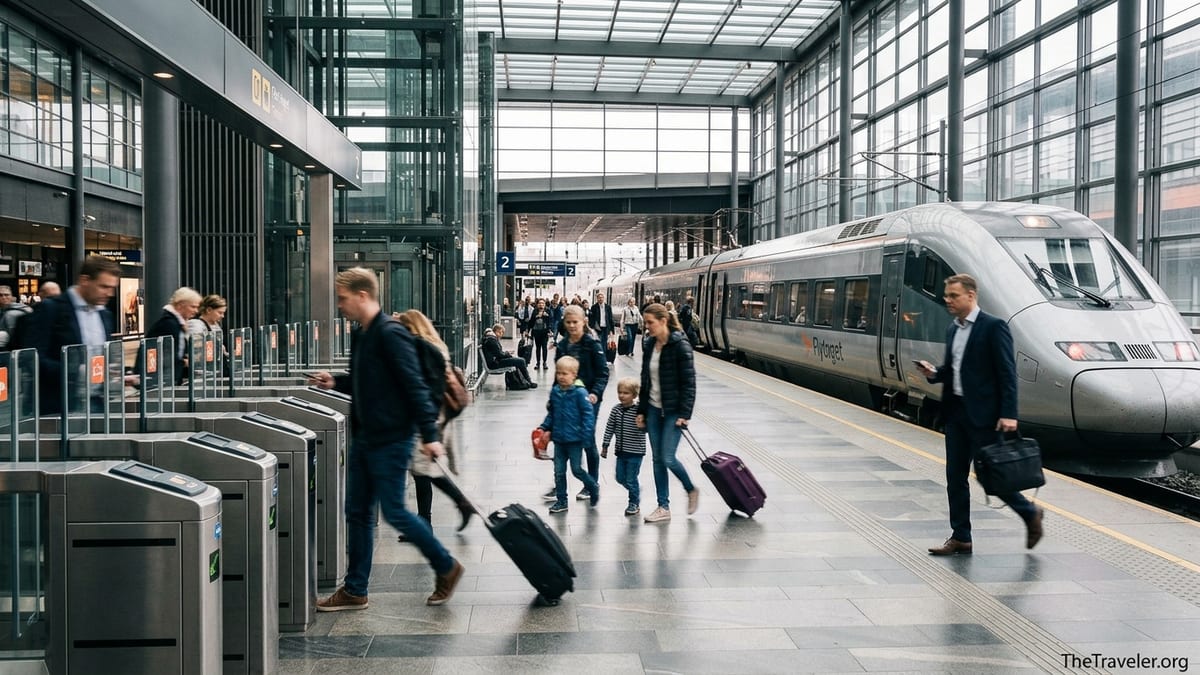
Why Flytoget Is Built for Time‑Pressed Travelers
Flytoget is a dedicated airport express service that runs between Oslo Airport Gardermoen and key stations including Oslo Central (Oslo S), Nationaltheatret and Drammen. In normal conditions the train covers the airport to Oslo S leg in roughly 19 to 22 minutes, which is often about as fast as you can clear the security area and walk to the platform. Trains typically run every 10 minutes for most of the day, with slightly lower frequency later in the evening, so you rarely wait long on the platform.
For many visitors, the biggest advantage is predictability. Road traffic on the E6 motorway between the airport and downtown Oslo can be heavy at rush hour or when there is bad weather. The train avoids that uncertainty. If your evening flight from North America lands 40 minutes late, you can still step off the plane, collect bags and usually be in central Oslo in under an hour from touchdown, which is hard to match by bus or taxi at busy times.
Flytoget is also designed with airport passengers in mind. Trains have wide doors, dedicated luggage racks, power sockets at seats and free Wi‑Fi. Boarding areas in the airport are clearly signposted with their own corridor to platforms 2 and 3, so even first‑time visitors who have never been in Norway before generally find the train within a couple of minutes of exiting customs. All of this is aimed at cutting the “friction time” between stepping off the plane and actually getting into the city.
That speed and convenience comes at a premium compared with ordinary Vy regional trains, which only take a few minutes longer but cost noticeably less. For travelers whose top priority is time rather than price, though, Flytoget is usually the most efficient choice. The good news is that if you understand how ticketing works, you can enjoy the express train without wasting time in lines or fumbling with machines.
Fastest Ways to Buy: App, Contactless Gate or Machine
You can board Flytoget without ever visiting a ticket counter. The three main options are buying via the Flytoget app, tapping a contactless card or device directly at the gate, or using the self‑service ticket machines by the platform. Each suits a different type of traveler and situation, and choosing well can save you precious minutes when you are tired or in a hurry.
The Flytoget app is the most time‑efficient choice for frequent flyers, anyone who likes to plan ahead, and travelers who want receipts stored automatically. Once installed, you can buy a ticket from anywhere, even before your flight boards at your departure airport. When you land at Oslo, you simply walk through the Flytoget corridor, hold your phone screen with the QR code to the gate reader, and proceed straight to the train. Many business travelers flying in on Monday mornings rely on this to go from aircraft to train in under 10 minutes when they have meetings downtown.
If you prefer to keep things simple, contactless payment at the gates is surprisingly quick. You hold your bank card, phone or smartwatch against the reader at the barrier both at the airport and at your destination station. The system calculates the correct fare and charges your card automatically. This is ideal for visitors from regions where contactless transit is common, such as London or parts of North America. It also avoids the need to stand at a machine, interpret Norwegian menu options or handle cash just after landing.
Self‑service ticket machines remain useful when you want a printed ticket or are traveling with someone who does not have a smartphone or contactless card. Machines are located in front of the Flytoget barriers at both Oslo Airport and central stations and offer English language menus. A typical scenario is a family arriving from Asia with grandparents who prefer to carry a paper ticket; the younger adults might use the app or a contactless tap, but buying a traditional ticket for older relatives can be more reassuring. Machines accept most standard debit and credit cards, though cash use in Norway is limited and many machines are card‑only.
Using the Flytoget App to Skip Queues
Installing and setting up the Flytoget app before you travel is one of the simplest ways to reduce airport time. The app is available for both major mobile platforms and allows ticket purchase without standing at a machine or queueing at a counter. Once you create a profile and add a payment method, you can usually buy a ticket in under a minute. Travelers who regularly commute between the airport and central Oslo often purchase their ticket while they are still on the aircraft Wi‑Fi during taxi to the gate.
One practical tip is to complete registration, including any phone number verification and card storage, at home rather than in the arrivals hall. Some users have reported that SMS verification codes can occasionally be slow or that mobile data coverage at the exact spot where they are standing is patchy. If you try to set everything up at the last moment after collecting your baggage, those small delays can be frustrating. By contrast, if you install the app the day before your trip while on home Wi‑Fi, your first experience in Norway is simply tapping “Buy ticket” and walking to the train.
The app also shows departures in real time. This is valuable if you have a tight connection from Flytoget to a long‑distance train at Oslo S or Drammen. For example, if you land at 16:15 and your regional train north to Trondheim departs at 18:02, you can check which Flytoget departure gives you a comfortable buffer. If there is a minor delay on the airport express service, the app will show it, giving you a chance to adjust. This reduces the temptation to sprint through the terminal without need.
Another advantage is easy access to receipts and travel history. If you are a business traveler who needs to claim expenses, the app keeps a record of journeys so you are not hunting for a mislaid paper ticket weeks later. Some travelers also appreciate being able to purchase return tickets in one go, using the same QR code for both legs, which can streamline the trip back to the airport at the end of their stay.
Timing Your Booking: Before You Fly or On Arrival
Because Flytoget runs frequently and does not offer discounted advance fares in the same way as long‑distance rail operators, there is little financial reason to buy your ticket far ahead of time. The main variable is your own peace of mind. Many visitors find that buying in the app shortly before landing or immediately after the aircraft door opens is a nice middle ground: you know your transfer is sorted but you are not locked into a specific departure time.
If you are concerned about flight delays, it can be sensible to wait until your plane is on the ground and taxiing, or even until you have collected your baggage. Flytoget tickets are typically valid for a period rather than a specific departure, but buying only when you know you will make it avoids any risk of mix‑ups. For example, if a winter storm forces your aircraft to circle or divert, you do not want the extra worry of wondering whether a pre‑purchased ticket is still appropriate.
On the other hand, there are situations where buying before you even leave home is useful. Travelers arriving very late at night with young children often prefer to have everything ready so they can move straight through the terminal without pulling out wallets or standing at machines when everyone is tired. In that case, purchasing tickets in the app in the morning before you fly, or saving your card for contactless tapping, can shave five to ten minutes off the evening routine and remove one decision at a time when your energy is low.
For the return journey back to the airport, booking ahead can be more time‑critical. If you have an early‑morning flight, it is usually wise to pick a Flytoget departure that gets you to the airport about two hours before, then allow extra time in case the metro or tram feeding into Oslo S is slower than expected. Many hotels in central Oslo provide printed timetables or have staff who can suggest a suitable departure an hour or two before you plan to leave, but using the Flytoget app the night before ensures you are not guessing in the morning.
Saving Time vs Saving Money: Flytoget or Vy Trains
Flytoget is not the only rail option between Oslo Airport and the city. Vy regional and commuter trains also connect the airport with Oslo S, typically in about 20 to 25 minutes. They run less frequently than the airport express, but for many travelers the difference in travel time is only a few minutes. The main contrast is cost and ticket flexibility rather than pure speed.
In practice, this creates a trade‑off between saving time and saving money. An adult single fare on Flytoget from the airport to Oslo S is higher than on a Vy regional service covering the same distance. Over a short city break, the savings from using Vy trains instead might cover a lunch in a café or entry to a museum. Many budget‑conscious travelers use the local Ruter or Vy apps to buy a standard train ticket that is valid on regular rail services and local public transport, then accept the slightly longer walk through the station and the additional few minutes of travel.
If you have a tight flight connection or are arriving with heavy luggage and simply want the smoothest possible experience, Flytoget remains the better choice for saving time. Its platforms are signposted more clearly, the trains are optimized for luggage space and the departures are more frequent. Someone arriving from New York for a same‑day business meeting in Oslo’s Bjørvika district might reasonably decide that the extra cost is worth it to minimize delays and mental effort.
By contrast, a backpacker with a five‑day stay who is already buying a daily or weekly pass for zones covering both the airport and central Oslo might integrate the airport‑city leg into that broader ticket instead of paying separately for the airport express. That approach does not always save minutes, but it can simplify their budget and remove the need to learn two ticketing systems in a single trip.
Flying With Kids or Groups: Special Ticketing Tactics
Traveling as a family or in a group adds complexity at the airport, and smart ticketing choices can ease that burden. Flytoget offers a particularly family‑friendly policy: children under a certain age travel free when accompanied by a paying adult. This means that a couple arriving with two school‑age children from the United States or the United Kingdom can ride the express train to central Oslo without buying separate child tickets, which both saves money and avoids the logistics of managing multiple QR codes at the gates.
Because of this, many families find Flytoget more attractive despite its higher base fare. The ability to move quickly from customs to the platform, wheel suitcases straight into the carriage and settle children around a table with charging points for tablets can be worth more than the small savings from a slower, cheaper service. To reduce hassle, one adult can use the app or contactless tap to open the gate while the other guides the children through, or staff at the airport can assist in opening wider barriers for strollers.
Groups of adults traveling together, such as friends on a weekend break or colleagues attending a conference, face a different set of decisions. With the Flytoget app, one person can purchase multiple tickets on their device, then either keep all QR codes and walk everyone through in sequence or forward screenshots to each traveler. This is convenient when only one member of the group is comfortable using local payment methods or has mobile data on arrival. It also centralizes receipts if one person is paying on behalf of a company and needs to handle reimbursement later.
For very large groups such as sports teams or tour groups, it may be worth coordinating in advance. Splitting travelers between Flytoget and Vy trains can limit the need for 20 people to queue at the same set of machines, but it requires clear communication so nobody ends up on the wrong train. In these cases, some tour operators prefer to pre‑book transfers by private coach to avoid managing tickets at all, even if that means sacrificing the speed advantage of the airport express train.
Practical Tips for Smoother Station and Platform Navigation
Even the fastest ticketing method will not save you time if you are standing on the wrong platform or wandering the terminal. A little preparation can shave extra minutes off your transfer. At Oslo Airport, follow signs marked “Flytoget” immediately after customs. These lead down a dedicated corridor to the train station area. Flytoget platforms are usually 2 and 3, clearly labelled, and automated gates separate the airport concourse from the tracks. If you already have a ticket or plan to use contactless, you can head straight for the barrier without detouring to the machines.
Keep your phone and payment card somewhere you can reach quickly. It sounds trivial, but many travelers lose time at the gate rummaging through backpacks or coat pockets. Having your QR code already open on the screen or your contactless card in hand makes the process feel more like walking through a subway turnstile than a check‑in experience. If you are traveling with a rolling suitcase and a backpack, consider stopping briefly before the gates to rearrange your hands so you can tap and roll through smoothly.
At Oslo Central Station, pay attention to your onward connection. If your hotel is near the central waterfront or in the Bjørvika or Grønland districts, exiting directly into the main hall and following tram or bus signs may be quicker than detouring through the attached shopping areas. Nationaltheatret and other central stations may be more convenient if your final destination is in western Oslo, so when buying your Flytoget ticket in the app, choose the station that minimizes back‑tracking on local transport.
Finally, build a small buffer into your schedule even though the train is fast. Weather, occasional signal problems or exceptionally busy periods can still cause minor delays. For a European short‑haul flight, arriving at the airport around two hours before departure is usually suitable, which in practice often means catching a Flytoget 2.5 to 3 hours before your scheduled take‑off when you factor in urban transport to the station. Buying your ticket in the app the night before and checking live departure information in the morning can make that timing feel much less stressful.
The Takeaway
Flytoget is engineered to make airport travel feel effortless, and when you combine its speed with smart ticketing choices, it can significantly cut the time you spend between plane and city. Using the Flytoget app or contactless gates instead of queuing at machines is usually the single biggest time saver, particularly if you set everything up before you fly. Families benefit from simple policies that keep children moving without handling extra tickets, while business travelers appreciate real‑time departure information and stored receipts.
Choosing between Flytoget and cheaper Vy trains ultimately comes down to how you value time, comfort and flexibility. If you need the most predictable, luggage‑friendly option, Flytoget justifies its premium for many itineraries. If your schedule is relaxed and budget is tight, regular trains integrated with local tickets can be a smart alternative with only a small time penalty. By understanding these options and planning your booking moment around your own priorities, you can turn the Oslo Airport transfer from a chore into one of the easiest parts of your journey.
FAQ
Q1. Do I need to buy a Flytoget ticket in advance before I land in Oslo?
You do not have to buy in advance. Because Flytoget runs frequently and fares are usually fixed, most travelers simply purchase through the app, at a machine or via contactless payment when they arrive. Buying ahead can be convenient for peace of mind, but it rarely saves money.
Q2. What is the fastest way to pay for Flytoget if I am in a hurry?
For most visitors the quickest option is to tap a contactless bank card, phone or smartwatch at the gate. If you have already set up the Flytoget app, scanning your QR code is similarly fast. Both methods let you walk straight to the platform without stopping at a ticket machine.
Q3. Is the Flytoget app worth installing for a short weekend trip?
If you are comfortable installing apps, it is usually worth it. The app allows quick ticket purchase, shows real‑time departures and stores receipts. For a single round trip, contactless payment may be sufficient, but the app is helpful if you like having all details in one place.
Q4. Can I use the same ticket for both Flytoget and local buses, trams or the metro?
No. Flytoget is a separate airport express service with its own tickets and pricing. Regular public transport tickets sold through local operators cover Vy trains, buses, trams and the metro within defined zones, but they do not include Flytoget, and Flytoget tickets do not work on city buses or trams.
Q5. Is Flytoget always faster than taking a regular Vy train from the airport?
Flytoget is usually a little faster and more frequent than Vy services, with carriages designed around luggage and airport travel. In practice the time difference to central Oslo is often only a few minutes, so if budget matters more than those extra minutes, a Vy train can be a reasonable alternative.
Q6. How early should I plan to arrive at Oslo Airport when using Flytoget for my outbound flight?
A common rule of thumb is to arrive at the airport about two hours before a European flight and earlier for long‑haul. Working backward, many travelers plan to catch a Flytoget around 2.5 to 3 hours before take‑off to allow time for local transport to the station, walking through the terminal and any minor delays.
Q7. What happens if my flight is delayed and I miss the Flytoget I planned to take?
Typically, Flytoget tickets are not tied to a specific departure in the same way as long‑distance train reservations. If your flight is delayed, you generally just board the next suitable train. It is still sensible to check the conditions in the app or on your ticket, especially during unusual disruption.
Q8. Can families with children save time by using Flytoget instead of other options?
Yes. Flytoget’s stations and trains are set up for easy stroller access, wide doors and spacious luggage areas, and children under a certain age travel free with an adult. This reduces both cost and the need to manage multiple tickets, helping families move more quickly through the airport and onto the train.
Q9. Are there staffed counters at Oslo Airport if I have trouble with the machines or app?
Yes, there are staff and information points near the Flytoget gates and platforms who can assist with ticket issues, navigating the app, or helping groups and families through the barriers. However, lines can form at busy times, so using the app or contactless payment usually remains faster.
Q10. Is it possible that Flytoget services will change in the next few years?
Yes, there have been public discussions about integrating Flytoget more closely into the broader regional train network in the coming years. For now, the service continues to operate as an independent airport express, but travelers planning future trips should always check current information shortly before they travel.