


Hamad International Airport in Doha has built a reputation not only as one of the world’s best airports but also as a hub for seriously impressive lounges. Whether you are flying Qatar Airways First Class, holding oneworld status, or simply looking to pay for a more comfortable layover, the choice can be overwhelming. This guide compares the standout lounges at Doha, focusing on real access rules, typical prices where available, and what the experience is actually like in practice.
Get the latest updates straight to your inbox!
Understanding Hamad International’s Lounge Landscape
Hamad International is effectively a one-airline stronghold, and that airline is Qatar Airways. Unsurprisingly, most of the headline lounges here are operated by Qatar Airways and are tailored to its premium passengers. At the top of the pyramid sits the Al Safwa First Lounge, reserved for First Class travelers, followed by the two flagship Al Mourjan Business lounges, South and The Garden. Around these, a second tier of Gold, Platinum and Al Maha lounges serve oneworld status holders and certain premium economy or flexible-fare passengers, plus a small ecosystem of pay-per-use and sleep-focused lounges that help fill the gaps for those flying economy.
For many travelers, the first step is working out which “bucket” you fall into. Flying Qatar Airways or another oneworld airline in First or Business on the day of travel gets you into the best lounges by default, as long as your boarding pass qualifies. Oneworld Emerald and Sapphire status can unlock good but slightly less opulent Qatar Airways lounges, while economy passengers without status will typically rely on paid access to Al Mourjan (when allowed), Al Maha lounges, or independent sleep lounges rebranded under the Sleepover name after the former Sleep n Fly brand.
Because the airport has expanded significantly in recent years, the location of your lounge relative to your gate matters more than at many hubs. The original Al Mourjan Business Lounge South sits closer to A and B gates, while the newer Al Mourjan Business Lounge The Garden is in the north area near the Orchard indoor tropical garden and closer to many C, D and E gates. Choosing the “wrong” lounge can easily add 15 to 20 minutes of extra walking or a tram ride each way, which is worth keeping in mind for shorter connections.
Another key point is that not all premium-sounding lounges at Doha are created equal. The difference between Al Safwa First and the more functional Gold and Platinum lounges, for example, is substantial in terms of food, privacy and design. The following sections walk through each major option, how you get in, and how they compare in real life if you are choosing where to spend a long layover.
Al Safwa First Lounge: The Flagship Experience
Al Safwa is Qatar Airways’ flagship First Class lounge and is widely regarded as one of the most distinctive airport lounges in the world. Architecturally, it feels more like a high-end museum than a typical lounge, with soaring ceilings, large-scale water features and minimalist stone walls that echo Islamic art galleries. In practice, the sense of space and quiet is what sets it apart. Even in busy banks of Doha departures, the lounge rarely feels crowded compared to the business lounges, which can be far livelier.
Access is tightly controlled. In normal circumstances, you need to be traveling in Qatar Airways First Class on an eligible route, or in some cases on a short-haul First ticket that connects to or from long-haul premium cabins. While there have occasionally been paid-access offers for business class or even economy passengers during quieter periods, these are not guaranteed and often come at a high price, reported by some travelers as several hundred US dollars equivalent for a limited stay. It is safer to think of Al Safwa as effectively reserved for ticketed First Class unless you are specifically offered an upgrade at check-in or via the airline’s app.
Inside, the experience is comparable to a top-tier hotel rather than a standard airline lounge. There is an a la carte restaurant with multi-course dining that might include steak, Arabic mezze, and made-to-order breakfast dishes, supported by a high-end wine and champagne list. Quiet rooms with proper beds can be reserved, and there is a spa area where treatments like massages or facials are available at an extra cost. For a traveler on a long overnight layover, the combination of a private room, shower and full meal service can make Al Safwa feel like a short hotel stay entirely within the terminal.
Compared with the rest of Doha’s lounges, Al Safwa’s main advantage is exclusivity. If you are deciding whether to use points or cash to upgrade a sector into First on Qatar Airways, access to this lounge can be a crucial part of the value calculation. A traveler with a six-hour overnight layover who would otherwise pay for a hotel or premium sleep pod may find that upgrading to a qualifying First ticket, even from one leg of the journey, delivers both a better onboard experience and a dramatically more comfortable transit through Doha.
Al Mourjan Business Lounge South: The Original Flagship
The Al Mourjan Business Lounge South is the original Qatar Airways flagship for business class passengers and remains one of the largest business lounges in the world, covering roughly 10,000 square meters across multiple levels. The design emphasizes open sightlines, a central water feature and a calm, almost zen-like aesthetic that contrasts with the bustling duty free area just outside. Seating zones range from dining tables and armchairs to more secluded corners and family rooms, allowing you to tailor your environment to work, rest or conversation.
Access is more restrictive than many travelers expect. Simply holding oneworld Sapphire or Emerald status in economy will not get you into Al Mourjan South. Instead, you generally must be flying Qatar Airways or another oneworld carrier in business class on the day of travel, or holding a qualifying ticket that specifically includes Al Mourjan access. In recent years Qatar Airways has also sold lounge passes to some economy passengers with long connections, sometimes marketed during booking or check-in. Prices can vary by route and demand but reports often suggest a cost in the range of a modest hotel night, making it a considered purchase rather than an impulse add-on.
Inside, the food and beverage offering is a clear step above standard business lounges. The upper-level restaurant provides buffet and limited a la carte service, with dishes that might include grilled meats, fresh salads, pasta, curries and desserts. Downstairs, a more casual deli-style area serves sandwiches, soups and light bites, along with barista-made coffee and a good range of soft drinks. Alcohol is available throughout for eligible passengers. Showers are plentiful but can have short wait times during peak overnight waves when many long-haul flights arrive and depart around the same time.
In practice, Al Mourjan South works best for travelers with outbound or connecting flights from A or B gates, or those who appreciate its calmer, more business-focused atmosphere. If you have a long daytime layover, you can easily treat the lounge as an office: power outlets are widely available, Wi-Fi is strong enough for video calls in most areas and there are several semi-private working pods. Families often gravitate to the dedicated family rooms, which can be reserved on a first-come basis and offer a quiet space away from main seating areas, especially valuable during overnight connections with children.
Al Mourjan Business Lounge The Garden: North Plaza Showpiece
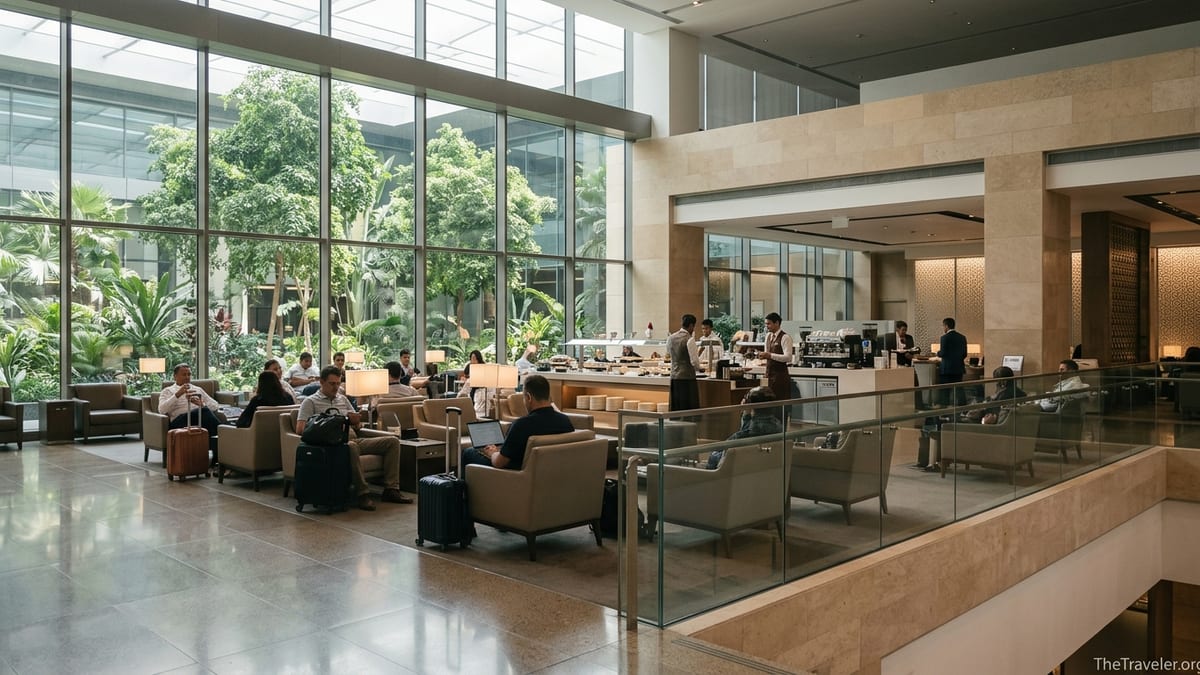
The newer Al Mourjan Business Lounge The Garden is located in the north plaza of Hamad International, overlooking the Orchard, the airport’s indoor tropical garden and retail complex. While similar to Al Mourjan South in overall service level, it offers a different mood. Floor-to-ceiling windows let in natural light, and many seats look directly onto lush planting and tall trees, a welcome contrast if you have already spent many hours in enclosed aircraft cabins. Travelers who prefer a more relaxed, resort-like vibe often gravitate here when time and gate assignments allow.
Access rules mirror those of Al Mourjan South. Business class passengers on Qatar Airways and partner airlines are the primary users, while some economy passengers may be able to purchase access, depending on fare type and booking channel. If you see your boarding pass specifically marked for Al Mourjan or receive an email offer referencing The Garden lounge, you can usually assume access to at least one of the two Al Mourjan spaces. However, because systems and offers change, it is wise to confirm with Qatar Airways staff at a transfer desk if you are unsure which lounge your ticket includes.
On the ground, the key difference for many travelers is crowding and convenience. Because The Garden sits closer to many C, D and E gates and to the Orchard attraction, some overnight banks see this lounge fill up with long-haul transit passengers who have time to wander the retail area. On other days or times, frequent travelers report that The Garden can feel noticeably quieter than the South lounge, especially in the deeper corners away from the main dining sections. The range of hot food, salads and desserts is broadly comparable to South, with menus rotating over time, and there are multiple shower areas spread across the lounge.
If your connection is long enough to explore the airport, a practical strategy is to arrive at The Garden lounge via the north plaza, enjoy a meal with a view of the Orchard and perhaps a quick walk through the garden, then decide whether to move closer to your departure gate later in the layover. For example, a traveler connecting from an Asia to Europe flight with an eight-hour layover might spend the first three or four hours relaxing and working at The Garden before taking the automated people mover back toward A or B gates and switching to Al Mourjan South, especially if the final flight departs near those older concourses.
Qatar Airways Gold, Platinum and Oneworld Status Lounges
Below the Al Mourjan and Al Safwa tier sit several lounges aimed primarily at frequent flyers and flexible-fare passengers: Qatar Airways Platinum Lounge South, Platinum and Gold Lounge North, and Qatar Airways Gold Lounge South. These lounges are important for travelers who are loyal to Qatar Airways or oneworld but are not traveling in business class on every segment. Layouts vary by location, but the overall experience is closer to a high-quality traditional business lounge than to the grand scale of Al Mourjan.
In general, oneworld Emerald and Sapphire members flying in economy or premium economy with Qatar Airways can access one of these status lounges, subject to the detailed rules applied by each airline. For instance, a traveler holding oneworld Sapphire through a partner airline program and flying Doha to Europe in economy on Qatar Airways would typically be directed to one of the Gold or Platinum lounges rather than to Al Mourjan. Exact entitlements can differ slightly depending on how the ticket is marketed and which frequent flyer program you hold, so it is always worth checking your airline’s latest lounge access charts.
Facilities in these lounges usually include hot and cold buffets with Middle Eastern and international dishes, self-serve or staffed bars for soft drinks and alcohol, Wi-Fi, workstations and shower rooms. Seating tends to be more compact than in Al Mourjan, and during peak times the lounges can become busy, particularly in the overnight bank of departures to Europe and early morning departures to Asia. For a typical transit of two to four hours, however, they still offer a major upgrade over the public seating areas, with reliable food and a chance to freshen up.
For status holders deciding whether to chase or maintain oneworld Emerald or Sapphire, it can be helpful to think of these lounges as the baseline benefit at Doha. If your travel pattern is predominantly in economy but with frequent connections through Qatar’s hub, consistent access to showers, hot meals and a quieter environment during layovers can justify pursuing a premium tier, even if you only occasionally fly in business class and access Al Mourjan.
Paid-Access Lounges, Al Maha and Sleepover Pods
Not everyone flying through Doha holds a premium cabin ticket or elite status. For economy travelers willing to pay for extra comfort, the airport offers several options beyond the Qatar Airways-branded lounges. The Al Maha lounges, located in both the north and south areas of the terminal, function as traditional pay-per-use lounges and are sometimes bundled with meet-and-assist services sold as Al Maha Services. Typical inclusions are buffet meals, non-alcoholic drinks, comfortable seating and showers, with stays often capped at around four to six hours depending on the product purchased.
Prices for Al Maha access can fluctuate based on booking channel. Buying access as part of a meet-and-assist package or through a travel agent may cost more but include fast-track immigration or buggy transfers, while walk-up or prebooked lounge access alone can be more modest. For a solo traveler facing a mid-length layover, paying for Al Maha can be a relatively economical way to secure food and a seat compared with splurging on Al Mourjan paid access, which is often priced higher and may be restricted to certain long layovers or specific economy fare types.
The airport is also home to dedicated sleep lounges now operating under the Sleepover brand, a rebrand of the former Sleep n Fly concept. These spaces are designed around pods, cabanas or small rooms with flat or reclining beds, and can usually be booked in hourly blocks. Rough guide prices shared by travelers suggest that a basic pod for four to six hours can cost less than a night in an airside hotel but more than simple lounge access, with private cabins or family rooms priced higher. For someone landing around midnight with a morning departure, a small cabin in the Sleepover lounge combined with a shower and a quick visit to a food court can be a realistic alternative to leaving the airport.
Priority Pass and similar membership programs traditionally partner with at least one or two lounges at Doha, often including a sleep-focused option for limited hours. However, the exact list of participating lounges and guest access rules can change from year to year as contracts are renewed. Travelers holding premium credit cards in the United States, Europe or Asia that include lounge membership should check their provider’s app a week or two before travel to see which Doha lounges are currently eligible and whether any are under renovation or capacity controlled.
Choosing the Right Lounge for Your Itinerary
With multiple lounges available and access rules that can be confusing, the most practical way to choose is to start from your itinerary and time on the ground. If you are flying in Qatar Airways First Class, the decision is straightforward: Al Safwa should be your base whenever it is open and you have enough time to enjoy it. For a three-hour early evening connection, that might mean a full meal in the restaurant and a shower before heading to the gate. For an overnight layover closer to eight hours, booking a quiet room or spa treatment on arrival can turn the transit into a mini-retreat.
Business class travelers have a more interesting decision, especially when connecting between different parts of the network. A passenger arriving from Europe into a B gate with a four-hour connection to Asia from a C gate might opt to spend the first hour in Al Mourjan South, enjoying the upstairs restaurant, then move to The Garden lounge to be closer to the Orchard and final departure gate. Someone connecting on a tighter schedule, for example 90 minutes between an arrival at C gates and a departure from D gates, might head straight to Al Mourjan The Garden to avoid unnecessary backtracking, even if they slightly prefer the ambiance of the South lounge.
Economy passengers without status need to weigh cost versus time. If you have a two-hour connection, it may not be worth paying for any lounge at all once you factor in walking, check-in at the lounge and boarding times. On the other hand, a traveler with seven hours on the ground overnight and a budget for comfort might mix and match: paying for Al Mourjan access if offered at a reasonable price, or choosing a combination of a Sleepover pod for several hours of real rest plus a shorter stint in an Al Maha or Priority Pass lounge for meals and Wi-Fi. In many cases, checking the price of the airside Oryx Airport Hotel and comparing it with lounge or pod costs can also be illuminating for long layovers.
Gate location, walking distance and family needs are also central. Families with young children may find it easier to stay near their next departure gate rather than trekking across the terminal to see multiple lounges, even if the food or ambiance might be marginally better elsewhere. Solo travelers with light hand luggage can treat the airport almost like a campus, exploring the Orchard, visiting both Al Mourjan lounges and then choosing where to spend the bulk of their time once they have a better feel for crowding and noise levels that day.
The Takeaway
Doha’s Hamad International Airport offers one of the most nuanced lounge ecosystems in global aviation. At the summit, Al Safwa First Lounge delivers a museum-like calm and full-service restaurant experience that can redefine what a layover feels like. Just below, the twin Al Mourjan Business lounges, South and The Garden, provide business class passengers with extensive dining, showers and workspaces in two distinct atmospheres linked by the terminal’s ever-growing retail and garden spaces.
For frequent flyers and economy passengers, a mix of Gold and Platinum status lounges, Al Maha pay-per-use spaces and Sleepover sleep pods fills out the options, ensuring that most travelers willing to plan ahead can find a level of comfort that matches their budget and priorities. The key is understanding how your ticket, status and connection time intersect with Doha’s layout, then choosing the lounge that minimizes stress while maximizing real rest or productivity.
If you are connecting through Doha for the first time, treat your lounge strategy as part of your trip planning rather than an afterthought. Check your airline’s lounge access rules, look at a recent map of the terminal to understand where your likely gates and lounges sit, and decide in advance whether you are prepared to pay for upgraded access if offered. With a bit of preparation, Hamad International’s lounges can turn what might have been a long, tiring wait into one of the most enjoyable parts of your journey.
FAQ
Q1. Which is the best lounge at Doha Hamad International Airport overall?
The Al Safwa First Lounge is generally considered the top lounge, but it is usually reserved for Qatar Airways First Class passengers on eligible tickets, with only occasional and expensive paid access.
Q2. What is the main difference between Al Mourjan South and Al Mourjan The Garden?
Al Mourjan South is the original, larger business lounge closer to A and B gates with a more traditional business feel, while The Garden overlooks the Orchard in the north plaza and has a brighter, more relaxed atmosphere near many C, D and E gates.
Q3. Can I access Al Mourjan lounges with oneworld Sapphire or Emerald status when flying economy?
Typically no. Oneworld Sapphire and Emerald members flying economy are usually directed to Qatar Airways Platinum or Gold lounges rather than the Al Mourjan lounges, unless their ticket specifically includes Al Mourjan access.
Q4. Is it possible to buy access to Al Mourjan lounges if I am flying economy?
Sometimes. Qatar Airways periodically sells Al Mourjan access to economy passengers with long connections, often offered during booking or check-in, with prices that can be similar to a midrange hotel night, but availability and cost vary.
Q5. Are there good lounge options at Doha if I only have Priority Pass or a similar membership?
Yes. Priority Pass and similar programs usually partner with at least one or two lounges at Doha, often including an Al Maha or sleep-focused lounge, although the exact options and access rules change over time.
Q6. What should I choose on an overnight layover: lounge access or a sleep pod?
For layovers longer than about six hours overnight, a Sleepover pod or small cabin can offer better real rest than a standard lounge seat, while a shorter overnight connection may be better spent in a full-service lounge with showers and hot meals.
Q7. How early before my flight can I use the lounges at Doha?
Most lounges allow access from the time you complete check-in and security on the day of travel, but some paid-access products and sleep pods are sold in fixed blocks, so check the time conditions when you book.
Q8. Are showers available in all the main lounges at Hamad International?
Showers are standard in Al Safwa, both Al Mourjan lounges and the main Qatar Airways status lounges, though waiting times can occur during peak banks of long-haul arrivals and departures.
Q9. Is lounge access at Doha worth it for a short connection?
For connections of 90 minutes or less, lounge access often provides limited value once walking, check-in and boarding times are considered, but for connections of three hours or more, a lounge can significantly improve comfort.
Q10. Can families with children comfortably use the Doha lounges?
Yes. Both Al Mourjan lounges and several status lounges have family areas or quieter sections, and many families find that access to showers, hot meals and dedicated seating makes long connections with children much easier.