


For many travelers, Paris Charles de Gaulle is synonymous with flying to the French capital. It is the country’s largest airport and the default gateway for most long haul flights. Yet anyone who has faced long lines at immigration, navigated its sprawling terminals with heavy luggage or worried about missed connections knows that CDG is not always the most relaxing way to begin or end a trip. Fortunately, it is far from the only option. Depending on where you are coming from, your budget and your onward plans in France or Europe, several alternatives can make your journey smoother, shorter or simply less stressful.
Get the latest updates straight to your inbox!
Why Look Beyond Charles de Gaulle
Charles de Gaulle handles the bulk of Paris traffic, especially from North America, Asia and the Middle East. That scale brings benefits, like frequent flights and competitive pricing. It also means a higher chance of delays, complex terminal changes and occasional congestion at passport control and baggage claim. If you are landing after a long overnight flight, a one hour queue for border checks, followed by another hour to reach central Paris, can make the first day of your trip feel like a marathon rather than a holiday.
Transfers from CDG into the city are not especially complicated, but they can be time consuming. The RER B suburban train links the airport with central hubs like Gare du Nord and Saint Michel in around 35 minutes once you are on board, but you still need to walk from your gate to the station, navigate ticket machines and manage luggage in busy train cars. Taxis and ride services are easier with baggage, but fixed fares into Paris are high enough that a family of four can easily spend as much on the ride into town as they did on a budget airfare sale.
In recent years more travelers have begun to ask whether CDG is actually the best fit for their specific trip. A couple visiting only central Paris for a long weekend may be better served by a smaller airport that sits closer to the city and has a direct metro line. Families connecting on to Disneyland Paris, the Loire Valley or the south of France might find it easier to fly into a different airport entirely, or even skip flying and arrive by high speed train. Looking closely at your options before you book can shave an hour or more off your arrival day and reduce the number of connections you need to make with luggage in tow.
The good news is that France has invested heavily in both its regional airports and its rail network. Several alternatives to Charles de Gaulle now offer efficient links to Paris and beyond, often with simpler layouts and calmer atmospheres. In some cases you can even land, clear formalities and be on a train or metro into town within half an hour, something that is still difficult at CDG during peak times.
Paris Orly: The Most Convenient Airport for Central Paris
Paris Orly is the second largest airport serving the capital and, for many city breaks, the most convenient choice. Located roughly 14 to 20 kilometers south of central Paris depending on the route, Orly is significantly closer to the city than Charles de Gaulle. For travelers staying near neighborhoods such as Saint Germain des Prés, the Latin Quarter or Montparnasse, that difference can translate into a transfer that is both faster and cheaper.
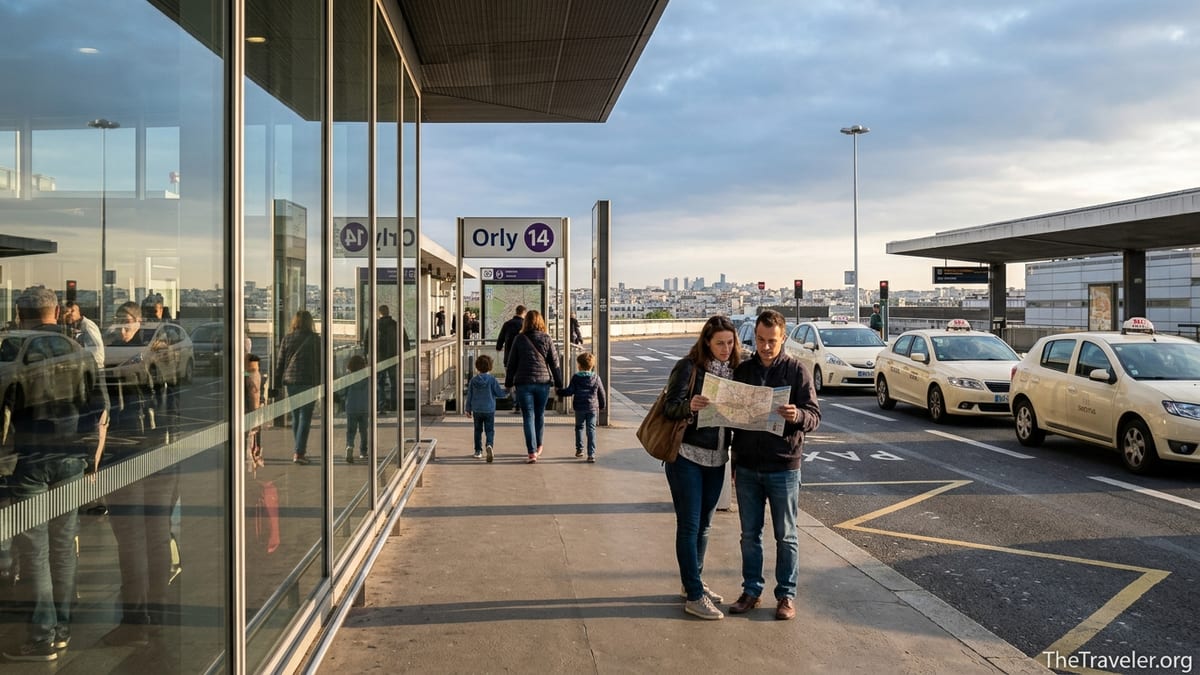
In the last few years, Orly has become even more attractive thanks to improved public transport. The extension of Metro Line 14 now runs directly to Orly, providing a fast, fully automated metro link from the airport to major hubs such as Châtelet Les Halles and Gare de Lyon in roughly 25 minutes. A visitor landing at Orly in the afternoon can swipe a metro ticket, step straight onto Line 14 at the terminal and be walking past Notre Dame or checking into a hotel near the Marais well under an hour after touchdown, even with moderate crowds.
Other options remain available too. The Orlyval light rail shuttle connects the airport with the RER B at Antony station, where travelers can transfer to trains heading into central Paris. A combined airport train ticket or an appropriate day or week pass covers both segments in a single fare. For those who prefer a door to door transfer, regulated Paris taxis operate with fixed fares between Orly and the city, with separate set prices for destinations on the Left Bank and Right Bank. While exact amounts change over time, travelers can currently expect to pay the equivalent of a mid range restaurant meal for a one way trip, which becomes competitive for families or small groups.
Airline choice is of course a key factor. Many domestic French routes and a substantial number of European flights use Orly rather than Charles de Gaulle. For instance, frequent services connect Orly with cities like Nice, Toulouse, Bordeaux and Marseille, as well as popular European destinations such as Lisbon, Madrid and several Mediterranean islands in season. If you are flying from a major European hub and can choose either CDG or Orly at the same fare, it is worth checking your Paris accommodation on a map and seeing whether the south side location of Orly could save you valuable time on arrival and departure days.
Beauvais: Ultra Low Cost Flights With Extra Ground Travel
Paris Beauvais Airport regularly appears in low cost carrier search results labeled as a Paris airport, but in reality it lies about 85 kilometers north of the capital. For many budget conscious travelers it is still a valid alternative to Charles de Gaulle, but only if they factor in the additional time and cost of reaching the city. Airlines such as Ryanair and Wizz Air frequently use Beauvais for flights from secondary cities across Europe, often with attractive headline fares that undercut traditional carriers flying into CDG or Orly.
The backbone of ground transport between Beauvais and Paris is the official shuttle bus that runs directly between the airport and a drop off point near Porte Maillot in the northwestern part of the city. The journey typically takes around 1 hour 15 minutes in normal traffic. Recent price guides indicate a one way adult fare in the mid to high teens in euros per person, with tickets available online in advance or from machines and counters at the terminal. A couple arriving late in the evening might budget around 35 euros in total to reach Paris on this shuttle, while a family of four will quickly notice that the ground transfer can cost more than the flight itself if they secured an ultra cheap promotional fare.
Once at Porte Maillot, passengers transition to the city’s transport network. The area is served by Metro Line 1, which runs east west across central Paris, making it relatively straightforward to reach popular areas like the Louvre, Bastille or La Défense with one or two changes. However, it is important to remember that all of this comes on top of the extra travel from the airport. Someone staying near the Eiffel Tower, for example, should expect close to two hours door to door from Beauvais when including shuttle wait time, the bus journey and a metro transfer.
Because of the distance involved, taxis or private transfers directly from Beauvais into Paris are substantially more expensive than similar rides from CDG or Orly. Online estimates and recent traveler reports suggest typical one way prices deep into three figures in euros, reflecting both the 85 kilometer distance and motorway tolls. As a result, these services make the most sense for small groups who value door to door convenience or have heavy luggage, rather than solo travelers seeking to keep costs low. For many visitors, Beauvais is best viewed as a specialist option: extremely useful if a particular low cost route matches your dates and budget, but not automatically the best choice if you value quick and simple access to the city center.
Regional French Airports Plus High Speed Trains
A less obvious but often very comfortable alternative to flying into CDG is to land somewhere else in France and complete the journey by high speed train. France’s TGV network connects numerous regional cities to Paris in two to three hours or less, offering a seamless link between aircraft and rail platforms at airports such as Lyon Saint Exupéry, Marseille Provence and Bordeaux Mérignac. For travelers planning a wider French itinerary, this approach can significantly reduce connection stress in Paris and may cut total travel time.
Consider a traveler from North America who wants to visit Provence and Paris on one trip. Instead of changing planes at Charles de Gaulle, they could fly into Marseille Provence Airport, spend a few days on the Mediterranean coast and then board a TGV from the nearby station to Paris Gare de Lyon. Typical high speed journeys from Marseille to Paris take around three hours on direct services, bringing passengers into a central station that connects smoothly with Metro Line 1 and Line 14. From there, hotels in the Marais or near the Louvre are only a few stops away, without the need to navigate airport style security or long taxi queues.
Lyon Saint Exupéry is another good example. The airport has its own TGV station, enabling easy transfers to Paris Gare de Lyon in roughly two hours on many services. This can work well for trips that combine business meetings in Lyon with leisure time in the capital. Airlines from across Europe, as well as some long haul carriers, serve Lyon, and catching a TGV after clearing customs can feel much calmer than facing another terminal change and security queue at CDG.
Even if your flight lands at Charles de Gaulle, high speed rail can still serve as an alternative to onward flights or complex itineraries. From Paris’s major train stations, TGV and other fast services radiate out to cities such as Strasbourg, Lille, Rennes, Nantes and Bordeaux. In many cases, city center to city center train times rival or beat domestic flights once you include airport transfers and check in. Travelers who are particularly sensitive to layover anxiety might deliberately book an open jaw ticket, flying into a regional city and out of Paris, knitting the trip together with rail in between.
International Rail: Eurostar and Thalys Instead of Short Flights
For travelers coming from nearby European countries, rail can be a full replacement for flying into Paris at all. High speed trains such as Eurostar and the services formerly branded as Thalys connect the French capital with London, Brussels, Amsterdam and several German cities, among others. These trains arrive directly into central Paris stations like Gare du Nord, eliminating the need for airport transfers and often reducing total journey time door to door.
The classic example is travel between London and Paris. A standard Eurostar journey between London St Pancras and Paris Gare du Nord typically takes around two hours fifteen minutes. While travelers must still check in and clear border controls, these formalities happen at the station, and passengers step off the train just a short metro ride from areas such as Montmartre, Canal Saint Martin or the Latin Quarter. Someone staying near the Opéra district may find that their total travel time from a central London hotel to their Paris hotel is actually shorter by train than by flying into CDG, once airport transfers and security queues are factored in.
The same logic applies to routes from Belgium and the Netherlands. High speed trains link Brussels and Amsterdam with Paris in roughly 90 minutes and three and a half hours respectively, depending on the departure. Given that many low cost flights serving these corridors actually use outlying airports and require additional ground transfers, the simplicity of stepping off a train in the heart of Paris can be a major advantage. Rail operators often release discounted advance fares that compete directly with short haul air tickets, especially outside peak dates and business travel hours.
Another advantage of arriving by train is the luggage experience. There are no separate checked bags or baggage carousels to navigate, and passengers keep their suitcases within sight throughout the journey. This can be particularly reassuring for travelers carrying fragile items, professional equipment or baby gear. For many repeat visitors to Paris who start their trip in neighboring countries, airport alternatives have become the norm rather than the exception, with CDG used mainly for intercontinental journeys.
Le Bourget, Vatry and Other Niche Options
Beyond Orly and Beauvais, there are a few smaller airports in the wider Paris region that occasionally appear in flight searches. These tend to serve specific markets or charter operations rather than mainstream commercial traffic, but understanding their roles can still help travelers decide whether they represent a realistic alternative to Charles de Gaulle.
Paris Le Bourget, located to the northeast of the city, is primarily a business aviation and general aviation airport. It is best known for hosting the Paris Air Show and for handling private jets rather than scheduled passenger flights. For the vast majority of leisure and business travelers booking regular commercial tickets, Le Bourget will not appear as an option, and any suggestion of a transfer there usually indicates a charter or private arrangement.
Paris Vatry, also known as Paris Vatry or Paris Vatry Disneyland in some marketing materials, lies even farther from the capital than Beauvais, in the Champagne region. It has historically handled cargo and occasional low cost or charter services. Some seasonal flights arrive from holiday destinations, and certain budget airlines may advertise it as a Paris gateway. However, road travel from Vatry to central Paris can easily take well over two hours, and public transport options are limited compared with the dedicated shuttle from Beauvais.
These niche airports might suit travelers joining a package holiday that includes direct coach transfers, or those staying in specific areas outside Paris, such as parts of Champagne or eastern Île de France. For most independent visitors whose main goal is to explore central Paris, though, they are not practical alternatives to CDG. Choosing them solely because of a slightly lower airfare can backfire once the time and cost of long overland transfers to the city are added up.
How to Choose the Best Alternative for Your Trip
Deciding which alternative to Charles de Gaulle makes the most sense for your trip requires looking at the full door to door journey rather than just individual flight times. Begin by mapping your accommodation or main destinations within Paris. If you are staying on the Left Bank or in the southern arrondissements, Orly’s direct metro connection and shorter taxi ride can be a strong argument in its favor. Travelers based in the north or northeast of the city might not see such a big difference between CDG and Orly, narrowing the gap.
Next, consider the nature of your flight. Long haul routes from North America, Asia and Africa still overwhelmingly use Charles de Gaulle, which may limit your alternatives. In those cases, it can still be worth pairing CDG with a rail journey or choosing a connecting itinerary that arrives into a regional airport before reaching Paris by train. If your flights are within Europe, however, you are far more likely to be able to choose between Orly, CDG and occasionally Beauvais or a regional city like Lyon or Marseille paired with a TGV.
Budget is another important piece of the puzzle. A ticket that appears cheaper at first glance can turn out to be more expensive once airport transfers are included. For instance, a very low fare into Beauvais might still cost more overall than a slightly higher priced ticket into Orly when you add the shuttle bus, metro tickets and extra time on the road. Conversely, a family of four booking a competitive fare into Orly and then using a fixed fare taxi to their apartment in the 5th arrondissement may find that they save both money and stress compared with separate train tickets and connections from Charles de Gaulle.
Finally, think about your tolerance for complexity and uncertainty. If you are comfortable navigating multiple transport modes, a combination of high speed trains and smaller airports can unlock creative itineraries and less crowded gateways. If you prefer to minimize moving parts, then focusing on a single airport with a straightforward metro or taxi ride might be best, even if it costs a little more. In all cases, checking the latest transport details and approximate fares before you book flights will help you choose the option that fits your specific needs rather than defaulting automatically to CDG.
The Takeaway
For many years, flying to Paris almost automatically meant flying into Charles de Gaulle. That is still the reality for a large share of long haul routes, but travelers now have a richer set of alternatives than ever before. Paris Orly offers a closer, often calmer gateway with a direct metro link to the heart of the city, making it a strong contender for European and domestic flights. Beauvais extends the reach of ultra low cost carriers, provided that visitors understand and accept the longer ground transfer into central Paris.
Beyond the immediate Paris region, regional French airports paired with high speed trains can turn what would have been stressful connections into relaxed, scenic journeys, especially for itineraries that combine multiple cities. International rail from neighboring countries similarly replaces short flights with central station arrivals, trimming overall travel time for many routes. A handful of niche airports exist around Paris, but they tend to serve specialized markets and are rarely the best choice for first time visitors.
The smartest approach is to view Charles de Gaulle as just one option among several. By taking the time to compare Orly, Beauvais, regional airports and high speed rail against your specific dates, budget and plans within France, you can often design a trip that feels smoother from the moment you land. For some travelers that will still mean choosing CDG. For others it may lead to a smaller terminal, a swift metro ride and the satisfaction of arriving in Paris feeling fresh enough to enjoy that first café terrace straight away.
FAQ
Q1. Is Paris Orly easier than Charles de Gaulle for first time visitors?
For many city break travelers, Orly feels easier because it is closer to central Paris, has a simpler layout and now connects directly by Metro Line 14 to key areas in about 25 minutes.
Q2. How long does it take to get from Beauvais Airport to central Paris?
The official shuttle bus from Beauvais to the Porte Maillot area usually takes about 1 hour 15 minutes in normal traffic, plus additional time for the metro or taxi from Porte Maillot to your final accommodation.
Q3. Can I really avoid flying by using high speed trains to reach Paris?
Yes. From cities like London, Brussels and Amsterdam, high speed trains reach Paris in roughly two to three and a half hours and arrive directly in central stations such as Gare du Nord.
Q4. Are flights to Orly usually more expensive than flights to CDG?
Prices vary by route and season. Sometimes CDG has more competition and lower fares, but on many European routes Orly matches or beats CDG once you include the cost of airport transfers.
Q5. Is Beauvais a good choice for a short weekend in Paris?
Beauvais can work if the airfare is very cheap and you accept the longer transfer, but for a brief stay many visitors prefer CDG or Orly to avoid spending several extra hours on buses and trains.
Q6. Which airport is best if I am staying on the Left Bank?
Travelers staying in neighborhoods like the Latin Quarter or Saint Germain often find Orly best, thanks to its location to the south and the quick Metro Line 14 or taxi rides into those areas.
Q7. Are there any real commercial flights into Paris Le Bourget?
Le Bourget is focused on private and business aviation, so it is not used for regular scheduled commercial flights and is rarely relevant for typical leisure travelers.
Q8. Do regional airports plus TGV really save time compared with connecting at CDG?
On many routes they can. For example, flying into Marseille or Lyon and then taking a high speed train to Paris often matches or beats a connection through CDG once airport transfers and layovers are counted.
Q9. Is it worth paying more to avoid CDG if I have a tight schedule?
If you are on a short trip or anxious about missed connections, paying a modest premium for a simpler airport or direct high speed train can be worthwhile, especially when it removes one or two changes with luggage.
Q10. How far in advance should I check transport options before choosing an airport?
It is wise to review current airport transfer choices and approximate fares when you compare flight prices, so that you judge the whole door to door trip rather than just flight times and ticket costs.