


Choosing the right bank in Thailand is a critical practical decision for expats and foreign residents. Local banking conditions have changed significantly since 2024, with tighter compliance rules and more uneven treatment of foreign customers across branches and institutions. Understanding which banks currently serve international clients most effectively, and under what conditions, is essential for anyone evaluating a relocation to Thailand.
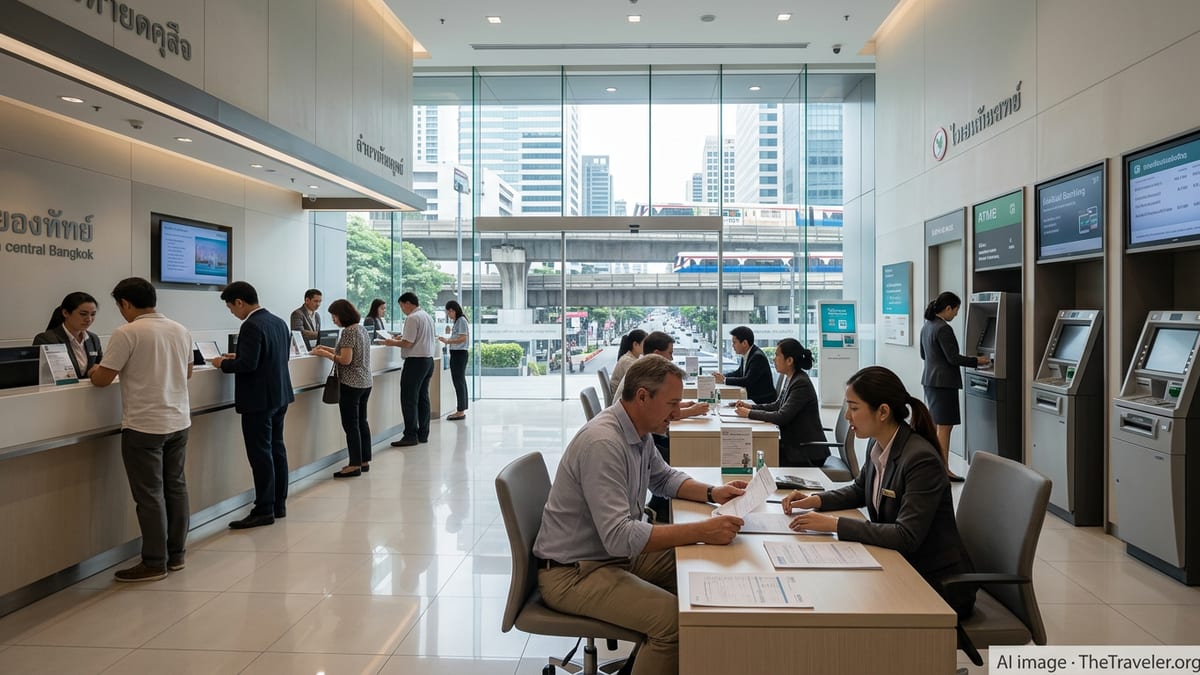
Banking Environment in Thailand for Foreign Residents
Thailand’s banking sector is modern, well capitalized, and increasingly digitized, but expats face a more complex environment than in previous years. Since 2024, banks have tightened customer due diligence in response to international anti–money-laundering standards and domestic regulatory pressure. As a result, “walk in with a passport” account opening is largely over, and requirements are applied more strictly and consistently.
By early 2026, most major retail banks expect foreign applicants to hold a non-tourist immigration status, such as work, education, retirement, or long-term resident visas. Tourist visas and new digital nomad categories are generally not sufficient on their own, even if front-line staff occasionally interpret rules differently by branch. This shift directly affects the feasibility of setting up local payment rails and receiving income for medium and long stays.
In practice, expats who meet visa and documentation thresholds can access a broad range of services: local baht accounts, international transfers, foreign currency deposit (FCD) accounts, debit cards, domestic instant payments, and comprehensive mobile banking. The main differentiators between banks lie in branch network coverage, English capability, digital platforms, flexibility toward foreigners, and fee structures for cross-border flows.
Foreign residents should assume that requirements and internal policies will continue to tighten incrementally. The most resilient strategy is to select a bank that is already comfortable working with international clients, avoid overreliance on a single institution, and ensure documentation is always up to date with immigration status and address records.
Key Criteria for Evaluating Thai Banks as an Expat
For relocation planning, the most relevant evaluation criteria are not marketing claims but operational realities at branch level and in daily use. The following factors are central for foreign residents assessing Thai banks.
First, account opening conditions are decisive. Important elements include whether non-residents or recent arrivals are accepted, which visa classes qualify, whether proof of local address is mandatory, and whether sponsors or employer letters are needed. Some banks explicitly require a minimum remaining visa validity period, often around six months, before opening an account or issuing credit products.
Second, service quality for foreigners must be considered. Useful indicators are the density of branches in expat-heavy districts, the likelihood of English-speaking staff at major locations, the availability of English-language documentation, and the responsiveness of call centers and secure messaging. For many expats, an English-capable mobile app and online banking interface are critical to managing accounts without frequent branch visits.
Third, cross-border capabilities are increasingly important. This includes inbound remittances from common corridors such as Europe, North America, Australia, and regional hubs, as well as outbound transfers for savings repatriation or property payments. Key considerations are transfer fees, foreign exchange spreads, speed of settlement, support for multi-currency accounts, and integration with major global payment platforms.
Finally, expats should weigh risk management factors: how the bank handles inactive accounts, periodic “know your customer” updates, and security features such as biometric verification for high-value transactions. New requirements for in-person identity checks or domestic SIM-linked one-time passwords can be challenging for foreigners who travel frequently or leave Thailand for extended periods.
Bangkok Bank: Broad Network and Non-Resident Options
Bangkok Bank is one of the largest and most established Thai commercial banks and historically has been relatively accommodating toward foreigners. It operates the broadest branch network in the country, which is advantageous for expats who may live outside central Bangkok or major tourist hubs and still want predictable physical access to banking services.
For international clients, a distinctive feature is its foreign currency deposit account specifically marketed to non-residents. This product allows eligible foreigners to hold balances in major currencies rather than only Thai baht, which can reduce foreign exchange exposure for those with overseas income or long-term savings held in Thailand. Typical fees include a percentage-based charge for withdrawals in foreign currency and a fixed fee band for outbound international transfers, meaning that larger transfers can be more cost-efficient per unit than repeated small payments.
Policy tightening since late 2025 and early 2026 has nonetheless affected Bangkok Bank’s reputation as the “go-to” institution for easy foreigner account opening. Reports from relocation advisors and banking guides indicate that standard tourist visas are now generally refused, and branches may require evidence of local residence or a non-immigrant visa before issuing even basic savings accounts. Some flagship branches in central business districts still handle complex foreigner cases, but applicants increasingly need to present complete documentation and be prepared for longer processing.
For expats who can meet the more stringent requirements, Bangkok Bank’s combination of network breadth, non-resident foreign currency solutions, and experience serving international clientele remains appealing. However, from a risk perspective, newcomers should not base a relocation decision solely on legacy perceptions of leniency and should confirm up-to-date branch-level practices before arrival.
Kasikornbank (KBank): Digital Strength and Expat-Focused Offerings
Kasikornbank, usually branded as KBank, has become one of the most popular institutions among tech-oriented expats due to its strong mobile banking platform and frequent recognition in retail banking awards. Its K PLUS app is widely regarded as one of the most user-friendly digital banking tools in Thailand, offering English language support, QR payment integration, and comprehensive transaction history in a mobile-first interface.
KBank actively positions some products toward foreign residents and internationally connected customers. Certain savings accounts feature streamlined requirements for financially established expats, typically expecting a valid passport, proof of local address, a Thai mobile number, and evidence of legal stay such as a non-immigrant visa or work permit. For higher-value clients or holders of premium visas, the bank operates privilege banking desks that can facilitate more complex needs such as investment products and structured remittance arrangements.
From a relocation standpoint, KBank’s key advantages are its digital convenience, competitiveness in everyday foreign exchange for small and medium transactions, and relatively strong English capability in branches located in central Bangkok and other expat hubs. These features lower the friction of integrating into Thai payment systems, including local wallet apps, utility payments, and person-to-person transfers via the national instant payment network.
However, foreign residents should factor in evolving security requirements. Like peer banks, KBank is implementing stricter identity verification for large online transfers and may require biometric enrollment or in-person re-verification after extended periods abroad. For expats who spend significant time outside Thailand, it is important to maintain an active Thai SIM and keep contact information updated to avoid difficulties receiving one-time passwords or complying with updated security checks.
Siam Commercial Bank (SCB): Investment Depth and Foreign Currency Services
Siam Commercial Bank is another leading Thai bank with a significant presence in urban and affluent areas, including many neighborhoods favored by professional expats. It has received regional recognition for private banking and wealth management, making it a frequent choice for higher-net-worth foreign residents and investors with more complex financial needs.
For expats, SCB’s strengths include a relatively sophisticated suite of investment and savings products, which may be attractive to those relocating with substantial capital or planning to invest in Thai markets. The bank offers foreign currency deposit accounts and structured savings products that can accommodate income denominated in currencies such as US dollars or euros, while allowing local spending in Thai baht.
SCB’s branch-based service for foreigners is more concentrated in major cities and high-traffic commercial districts, which can result in better English-language support and staff familiarity with foreign documentation compared with smaller regional banks. Its mobile and online banking platforms provide English interfaces for core functions, although some advanced investment tools may be more Thai-centric.
Policy-wise, SCB applies similar foreigner vetting standards to its peers, generally requiring a valid long-stay visa category or work-related documentation before opening transactional accounts. For premium banking tiers, minimum balance or asset-under-management thresholds may apply, which can be relatively high by local standards but manageable for globally mobile professionals and retirees with significant portfolios.
Other Notable Banks: Krungthai, UOB Thailand and Niche Options
Krungthai Bank, which maintains one of the largest branch networks nationwide, plays a central role in government-related payments and public-sector salary flows. For expats, it can be particularly relevant to those employed by state-linked institutions or living in provincial areas where commercial competition is limited. Branch staff in smaller cities may have less experience with foreign documentation, and English proficiency can be more variable, but the extensive network ensures basic access to cash services and domestic transfers.
United Overseas Bank (UOB) Thailand, which has absorbed the former retail operations of Citibank in the country, is a more niche choice emphasizing service quality and cross-border connectivity. Its heritage in serving internationally active clients means that English-language support is comparatively strong, especially in Bangkok. However, certain premium products and foreigner accounts may carry higher initial deposit requirements, reflecting the bank’s focus on more affluent segments.
Other institutions, including specialized or smaller banks, can occasionally offer attractive niche products such as high-interest savings accounts, co-branded credit cards, or specialized trade finance solutions. For most individual expats, the lack of extensive branch networks and limited experience with foreign resident onboarding reduce their practicality as primary banking partners. Such banks are generally better considered as secondary options once a stable relationship has been established with a major national institution.
Newcomers should also be aware of the role of international digital payment providers. Regulatory developments are gradually integrating these platforms more tightly into Thailand’s supervised financial system, which may affect fee structures and foreign exchange routing. While these services can complement a Thai bank account, they do not fully replace the need for local banking relationships for tasks such as salary receipt, local credit history building, or participation in national payment initiatives.
Account Opening, Documentation, and Typical Costs for Expats
Across banks, documentation requirements for foreign residents are converging toward a relatively strict standard. Applicants should expect to present at least a valid passport, a qualifying visa category, proof of local address, and a Thai mobile phone number. Some banks also request a work permit, employer letter, or evidence of pension income, particularly when issuing credit cards or approving higher transfer limits.
Visa category is often the most important determinant of eligibility. Non-immigrant business, education, retirement, and family visas generally enable account opening, provided remaining validity is sufficient. Tourist visas and short-stay digital nomad visas are now widely excluded in practice, even though formal regulations still allow some discretion. Certain long-term privilege visas and investment visas may grant access to dedicated banking channels with simplified onboarding and higher service standards.
Costs for maintaining a basic savings account and debit card are relatively modest by international standards. Typical fee structures include a small one-off card issuance fee, annual card renewal charges, and low monthly account maintenance fees, which may be waived above minimum balance thresholds. ATM withdrawals at the account-holding bank’s own machines are usually inexpensive, while interbank withdrawals, especially outside major cities, can incur flat fees.
International transfer and foreign exchange costs vary more significantly between banks. Transfers sent via the SWIFT network often involve a combination of sending bank fees, intermediary bank charges, and receiver fees, alongside a foreign exchange margin relative to mid-market rates. Some Thai banks offer preferential FX rates or reduced fees to premium segments or for transfers above certain thresholds, making it worthwhile for expats to negotiate terms if moving substantial funds.
Practical Risk Management for Foreign Residents Using Thai Banks
Beyond choosing an institution, expats should consider operational risks associated with banking in a foreign jurisdiction. A first consideration is regulatory-driven account reviews. Thai banks periodically request updated identification, proof of address, or visa information. Failure to respond can lead to transaction limits, partial freezes, or in extreme cases account closure. Foreign residents who travel frequently should monitor banking messages closely and allocate time during visits to Thailand for any in-person verification requests.
Second, digital access risks need active management. Many Thai banks rely on one-time passwords sent to Thai mobile numbers for online transactions, which can be problematic when a customer is overseas or has changed telecom providers. Maintaining an active Thai SIM and ensuring roaming or alternative authentication options are in place can mitigate the risk of being locked out of critical functions such as international transfers.
Third, concentration risk is underappreciated by many expats. Holding all local funds with a single bank, especially in a foreign regulatory environment where complaint resolution may be more complex, increases vulnerability to operational disruptions, system outages, or institution-specific policy changes. Where feasible, maintaining at least two banking relationships in Thailand, or pairing one Thai bank with a stable international institution, can create useful redundancy.
Finally, foreign residents should understand deposit protection frameworks and product-specific risks. Standard savings and current accounts in licensed Thai banks benefit from statutory deposit insurance up to a defined baht limit per depositor per institution, while investment and structured products carry market risk. For those relocating with significant capital, it may be appropriate to spread large cash holdings across multiple banks or complement Thai deposits with offshore accounts in highly rated jurisdictions.
The Takeaway
Thailand offers a mature, digitally capable banking system, but recent regulatory tightening has materially changed the experience for expats and foreign residents. The era of effortless account opening for short-stay visitors has ended, replaced by more formalized requirements around visa status, address verification, and identity checks.
For individuals considering relocation, this environment is manageable but requires planning. Bangkok Bank, Kasikornbank, and Siam Commercial Bank stand out as primary choices for most foreign residents, each with distinct strengths in network breadth, digital banking, or investment services. Krungthai Bank and UOB Thailand are relevant in specific circumstances, such as employment by state-linked entities or the need for higher-end cross-border capabilities.
Decision makers should integrate banking feasibility into broader relocation assessments. Verifying eligibility with targeted banks in advance, assembling robust documentation, and planning for digital access from abroad can significantly reduce friction during the settlement phase. With appropriate preparation and diversified banking relationships, most expats can achieve reliable day-to-day banking in Thailand and efficiently manage cross-border financial flows.
FAQ
Q1. Can a foreigner still open a Thai bank account on a tourist visa?
In practice it has become increasingly rare. Most major banks now require a long-stay or non-immigrant visa, even if occasional branches make exceptions.
Q2. Which Thai bank is generally considered the most foreigner-friendly?
Bangkok Bank, Kasikornbank, and Siam Commercial Bank are commonly regarded as the most practical choices, with experience handling expatriate clients and English-capable staff in key branches.
Q3. Do expats need a work permit to open a bank account in Thailand?
A work permit is helpful but not always mandatory. Many banks accept other long-stay visa categories such as retirement, family, or education visas, provided documentation is complete.
Q4. Are foreign currency deposit accounts available to non-Thai residents?
Yes, several major banks offer foreign currency deposit accounts that allow expats to hold funds in currencies like US dollars or euros while living in Thailand.
Q5. How much money is needed to open a basic bank account in Thailand?
Minimum opening deposits are usually modest, often in the low thousands of baht, though premium or specialized accounts can require significantly higher initial balances.
Q6. Can foreign residents obtain credit cards from Thai banks?
It is possible, but approval criteria are stricter for foreigners. Banks typically require proof of stable local income, a work permit, or relatively high deposit balances.
Q7. How good are Thai mobile banking apps for English speakers?
Major banks provide English interfaces for core functions, and leading apps such as those from Kasikornbank and Siam Commercial Bank are considered user-friendly for daily transactions.
Q8. What are the typical fees for international transfers from Thailand?
International transfers often involve a sending fee, possible intermediary bank charges, and a foreign exchange margin. Exact costs vary by bank and transaction size.
Q9. Is deposit insurance available for bank accounts in Thailand?
Yes, deposits in licensed Thai banks are protected by a statutory scheme up to a defined baht limit per depositor per institution, though investment products are not covered.
Q10. Should expats rely on only one Thai bank for all their finances?
Relying on a single institution increases operational risk. Many expats choose to maintain at least one additional Thai or international account for redundancy and flexibility.