


San Francisco International Airport handles tens of millions of passengers every year, and a growing share of them are planning overnight stays nearby to catch early departures or recover from late-night arrivals. Whether you are trying to avoid a dawn rush-hour drive, arriving from an overseas red-eye, or deciding between an airport hotel and a night downtown, choosing the right base around SFO can save hours of stress and set the tone for your trip.
Get the latest updates straight to your inbox!
Why Staying Near SFO Can Make Sense
San Francisco International Airport sits roughly 13 miles south of downtown San Francisco, with typical BART or car journeys taking about 30 to 45 minutes depending on the time of day and traffic. That means a 7 a.m. departure can easily translate into a 4 a.m. wake-up if you are staying in the city center. For many travelers, especially families and those coming off long-haul flights, an airport hotel removes that risk and compresses logistics into a short shuttle or AirTrain ride.
Staying near SFO is particularly attractive if you are connecting between long flights, have an early morning international departure, or are traveling with a lot of luggage. Instead of coordinating rideshares in pre-dawn darkness or worrying about BART’s first trains, you can wake up minutes from your terminal and focus on security and boarding rather than the journey to the airport.
Airport hotels around SFO are concentrated in three main areas: the on-airport Grand Hyatt at SFO, a cluster of full-service and limited-service properties along Bayshore Highway in Burlingame, and a group of value-focused hotels north of the airport around South San Francisco and San Bruno. Each area offers a different balance of price, convenience, and neighborhood feel.
While nightly rates fluctuate with season and major events, on most dates you can expect on-airport and waterfront full-service hotels to command a clear premium, midrange chain hotels with shuttles to sit in the middle, and older motels or independent properties to be the lowest-cost options. The trade-off is almost always between how much you value time and sleep versus how tightly you need to control your budget.
Grand Hyatt at SFO: The Ultimate Convenience
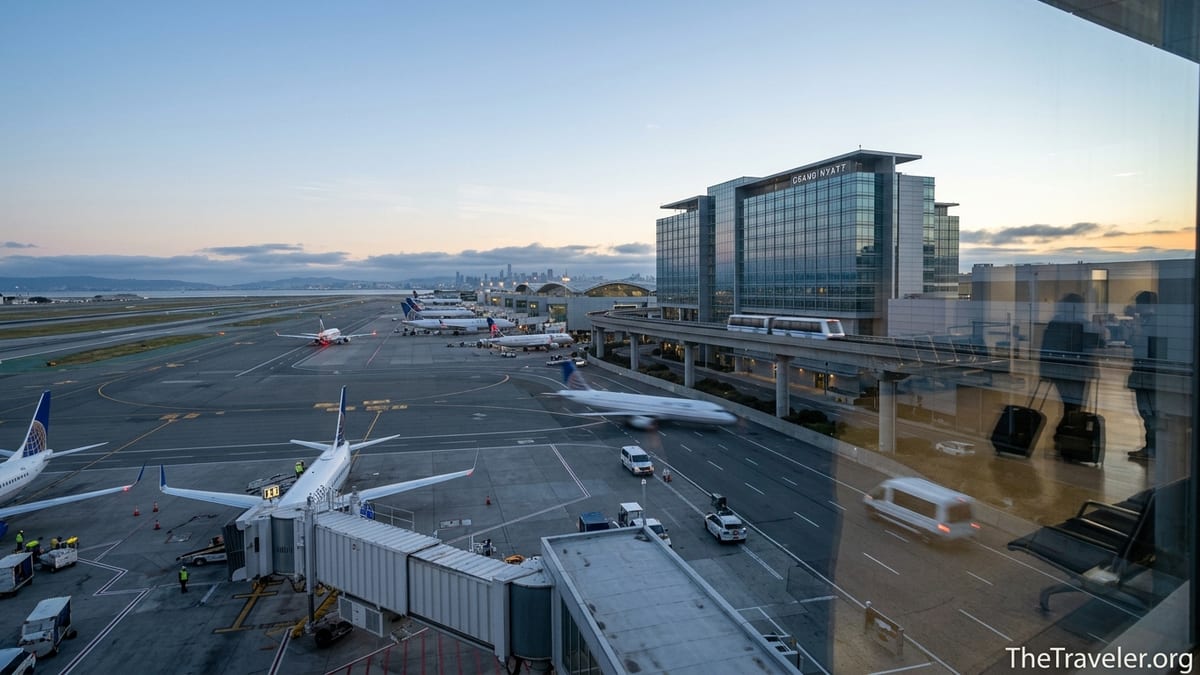
The Grand Hyatt at SFO is the only true on-airport hotel, physically connected to the terminals by the airport’s AirTrain system. The hotel has its own dedicated AirTrain station, labeled “Grand Hyatt at SFO,” on the AirTrain Blue Line, which also serves all terminals, parking garages, the Rental Car Center, and the BART station at the International Terminal. In practice, that means you can step off a long-haul flight, walk or take the AirTrain from your arrival gate, and check into your room in well under 20 minutes without ever stepping outside.
This convenience has helped the Grand Hyatt at SFO earn recognition from aviation and travel organizations, with the airport highlighting it as one of North America’s top airport hotels. Rooms are designed with aviation travelers in mind: many offer floor-to-ceiling windows with runway or bay views, and soundproofing is engineered so that aircraft noise is surprisingly muted. For travelers arriving from Asia or Europe late at night, being able to roll a suitcase straight from customs to a quiet, upscale room can be worth a significant premium.
Rates at the Grand Hyatt at SFO are typically at the upper end of the airport market, often comparable to a four- or five-star property in downtown San Francisco. A business traveler flying in for a morning meeting might choose it to guarantee a full night’s sleep before a 6 a.m. departure, while a family with young children may decide that eliminating an extra shuttle ride or taxi justifies the higher nightly cost. The hotel’s restaurants, bar, and fitness facilities mean you can comfortably eat, rest, and reset without leaving the property.
Another advantage of the Grand Hyatt is its connectivity beyond the airport. From the hotel’s AirTrain station, it is a short ride to the BART station in the International Terminal. From there, BART trains connect directly to downtown San Francisco, the East Bay, and Millbrae, where you can transfer to Caltrain for destinations like Palo Alto and San Jose. For travelers who want an airport base but still plan to spend a day in the city or visit Silicon Valley, this transit link is a practical alternative to renting a car.
Airport Shuttle Hotels: Full-Service Comfort Close to the Terminals
Just south of SFO along Bayshore Highway in Burlingame, a string of full-service hotels offers a mix of airport convenience and bayside setting. Well-known examples include the Hyatt Regency San Francisco Airport in Burlingame, as well as other branded properties clustered along the same road. These hotels are not directly attached to the terminals, but they run frequent airport shuttles that typically take 10 to 15 minutes to reach the terminals depending on traffic and time of day.
The Hyatt Regency San Francisco Airport, often referred to as Hyatt Regency SFO, sits a short drive from the airport and has long been a popular choice for airline crews and business travelers working with companies in the Peninsula technology corridor. Guests generally receive a traditional large-hotel experience: spacious public areas, multiple dining options, meeting rooms, a fitness center, and in many cases outdoor space along the bay. For travelers on early flights, the shuttle schedule is the critical detail to check; most airport hotels publish their first and last shuttle times, and some require a phone call from the terminal late at night.
In this mid- to upper-range category, nightly rates are often more moderate than at the Grand Hyatt at SFO but still above basic motels. A midweek stay during a convention may see prices rise significantly, while a weekend night outside peak season can be noticeably more affordable. A traveler landing at SFO at 11 p.m. from the East Coast, for example, might find that a shuttle hotel offers a good compromise: you still avoid a 40-minute ride into the city at midnight, but you pay less than the on-airport property while retaining a full-service environment.
When comparing shuttle hotels, look carefully at whether the airport transfer is complimentary, how often it runs, and whether it serves all terminals. Some hotels operate shuttles every 15 to 30 minutes during most of the day but reduce frequency very late at night or early in the morning. If your flight is scheduled to arrive close to midnight, account for possible delays and confirm that you can still reliably catch the last shuttle. If you miss the shuttle window, a short rideshare or taxi ride along Bayshore Highway is usually straightforward but adds modest extra cost.
Budget-Friendly Options Near SFO
Travelers watching their budgets closely have several hotel and motel choices around San Bruno, South San Francisco, and the El Camino Real corridor that offer lower nightly rates while remaining within a short shuttle or rideshare trip of the terminals. These properties range from basic chain hotels with free breakfast to independent motels whose main selling point is price and proximity. They are particularly popular with road trippers, solo travelers, and families who prioritize saving on accommodation in order to spend more in San Francisco itself.
One example in the lower midrange is Hotel Aura SFO Airport in San Bruno, which promotes a free airport shuttle and a complimentary continental breakfast served in the morning. Properties like this often sit along El Camino Real or other major arterials within a 10- to 15-minute drive of the airport. Rooms are typically simple but functional, and the immediate surroundings can feel more like everyday suburban California than a tourist district, with local diners, strip malls, and neighborhood services nearby.
Rates at budget-friendly SFO hotels can vary widely with demand, but on many nights they undercut the large full-service hotels by a noticeable margin. For instance, a traveler arriving late and departing mid-morning the next day may find that a basic motel with free parking and shuttle service costs significantly less than a waterfront property. That savings can be meaningful over a weeklong trip or for families needing two rooms. The trade-offs often include older decor, fewer onsite amenities, and sometimes more limited shuttle schedules.
When evaluating budget options, read recent guest reviews for comments about shuttle reliability, cleanliness, and neighborhood noise. Check whether resort fees, parking charges, or airport shuttle fees are added to the advertised rate, as these can narrow the apparent price advantage. If you arrive after the last shuttle or need to leave before it begins in the morning, you may need to factor in the cost of a rideshare or taxi, which can offset some of the savings.
Should You Stay Near SFO or Downtown San Francisco?
Choosing between an airport hotel and staying downtown comes down to your flight time, trip goals, and tolerance for early-morning logistics. For a 6 or 7 a.m. departure, especially on a weekday, an overnight near SFO can be the difference between a short, low-stress morning and a pre-dawn dash across the region. Similarly, if you land late at night from a long-haul international flight, staying near the airport allows you to clear customs, rest quickly, and deal with city transfers the next day when you are rested.
On the other hand, if your flight arrives in the afternoon or early evening and you plan to spend a full day or more exploring San Francisco, staying downtown can be more rewarding. BART connects SFO’s International Terminal directly to several downtown stations, including Powell Street and Montgomery Street, typically in about 30 minutes. Many hotels near Union Square, the Embarcadero, and SoMa are within a short walk of these stations, which can make it easy to reach your hotel without a car.
Cost can push the decision in either direction. During major conventions or holiday peaks, downtown hotel rates can climb sharply, sometimes making airport-area hotels comparatively attractive even after factoring in daily transit costs. At other times, downtown properties may offer weekend or off-season promotions that bring them into line with or below the price of premium airport hotels. A traveler planning only one evening in the city before a late-morning flight might accept a slightly more complex morning commute in exchange for a memorable night near the waterfront or in a lively neighborhood.
A practical approach is to align your hotel choice with how you will actually spend your final or first day. If you will arrive late and leave early with little time for sightseeing, an airport hotel keeps things simple. If you land midday and want to spend the evening enjoying San Francisco’s restaurants or waterfront, staying downtown may provide more value, even if you need to allow extra travel time back to SFO on departure day.
Transit, Shuttles, and Rideshares: How Long Does It Really Take?
Understanding realistic door-to-door times helps you make a better hotel choice. From SFO’s International Terminal, BART trains run directly to downtown San Francisco, with typical travel times of about 30 minutes to the main stations in the city center. Trains generally run frequently during the day and evening, though early-morning Sunday service and late-night frequencies can be reduced, so it is wise to check schedules if your flight is at an unusual hour.
For travelers connecting to the Peninsula and Silicon Valley, the typical public transit route involves taking the AirTrain to the BART station, riding BART one stop to Millbrae, and transferring to Caltrain for destinations like Palo Alto, Mountain View, or San Jose. This trip can be efficient, but connection times vary and may add up to an hour or more door-to-door, especially late at night. If you are choosing a hotel based on access to these areas, it can be helpful to compare transit schedules with the simplicity of a direct rideshare.
Rideshare services and taxis are widely available at SFO and provide door-to-door convenience at a higher but predictable cost. A typical trip from SFO to central San Francisco often falls in a moderate price range, depending on traffic, surge pricing, and time of day. To nearby airport hotels along Bayshore Highway or in South San Francisco, rides are short and usually cost noticeably less than a full trip into the city. For a family of four with luggage arriving close to midnight, a short rideshare to an airport hotel can be particularly appealing after a long flight.
Whatever hotel you choose, build in a buffer for morning departures. Give yourself time to account for shuttle wait times, possible traffic around the terminals, and airport security. For domestic flights, many travelers aim to reach the terminal one and a half to two hours before departure; for international flights, two to three hours is common. Working backward from that target, factor in shuttle or transit times plus a small cushion to reduce stress.
Planning for Early Flights and Late Arrivals
Early flights out of SFO pose particular challenges for travelers staying downtown. Morning road traffic between the city and the airport can lengthen what might otherwise be a 25-minute drive into a 45-minute or longer journey. While BART can be a reliable alternative, you still need to walk or ride from your hotel to the station, account for train frequency, and navigate from the station to your departure terminal. For some, the appeal of waking up already at or near the airport, especially at the Grand Hyatt at SFO or a nearby shuttle hotel, outweighs the allure of a final night in the city.
Late arrivals create a different set of calculations. International flights landing after 10 p.m. may take an hour or more to clear immigration, baggage claim, and customs, particularly on busy travel days. By the time you reach the arrivals hall, regular hotel shuttles may be winding down for the night, and train frequencies may have decreased. In this scenario, being able to hop on the AirTrain to the Grand Hyatt or take a short rideshare to a nearby hotel can feel significantly easier than coordinating a longer trip into downtown.
Families with young children, travelers with mobility challenges, and those carrying heavy or multiple bags often find that airport-area hotels reduce physical strain. Instead of shepherding kids and luggage through multiple train transfers or across busy city streets late at night, you can handle those logistics the next day when everyone is rested. Even for solo travelers, the simplicity of staying near the airport on the arrival or departure night can balance out the cost difference, particularly after long-haul flights.
That said, you can also split your stay for maximum flexibility. One common strategy is to spend the bulk of your nights in a neighborhood that suits your sightseeing, such as Union Square, the Embarcadero, or Fisherman’s Wharf, and reserve an SFO-area hotel only for the final night before an early morning departure. This approach gives you the best of both worlds: immersive time in the city and a low-stress trip to the airport when it matters most.
The Takeaway
Planning where to sleep before or after flying through San Francisco International Airport is about more than just the nightly rate. It is a decision that directly affects how rested you feel, how much time you spend in transit, and how much stress you experience at the beginning or end of your trip. The Grand Hyatt at SFO offers unmatched convenience as the only on-airport hotel, ideal for very early departures, late-night arrivals, and travelers who value direct access to the terminals above all else.
Airport shuttle hotels in Burlingame and along Bayshore Highway deliver a strong middle ground, combining full-service amenities with short transfers, while budget-friendly options in South San Francisco and San Bruno help keep costs in check for those willing to trade some convenience. Downtown San Francisco hotels, connected by BART and rideshares, remain the better choice when your schedule allows for relaxed city time and your flight times are not at the edges of the day.
By weighing your actual arrival and departure times, your tolerance for early starts, and how you plan to use your limited hours on the ground, you can choose an SFO-area hotel that supports, rather than complicates, your journey. With a clear sense of priorities, the choice between airport and downtown becomes less about guesswork and more about crafting the right travel experience for the way you like to move.
FAQ
Q1. Is it worth paying extra to stay at the Grand Hyatt at SFO for an early flight?
For very early departures, especially before 8 a.m., many travelers find the Grand Hyatt at SFO worth the premium because you can reach your terminal in minutes via the AirTrain without relying on road traffic or shuttle schedules.
Q2. How early do airport hotel shuttles start running around SFO?
Most major airport hotels start their shuttles in the early morning, often around 4 to 5 a.m., but schedules vary by property and may be reduced on weekends or late at night, so it is important to confirm exact times with your hotel before booking.
Q3. Can I use BART from SFO if my hotel is near the airport?
BART primarily connects SFO to downtown San Francisco and the East Bay; most airport-area hotels rely on shuttles or rideshares instead, so you would typically use BART only if you are staying downtown or transferring to Millbrae for Caltrain.
Q4. Are budget hotels near SFO safe and reliable?
Many budget properties around South San Francisco, San Bruno, and El Camino Real serve airport travelers regularly; safety and reliability vary by hotel, so reviewing recent guest feedback and checking shuttle details is key to finding a dependable option.
Q5. How long does it take to get from downtown San Francisco to SFO?
On most days, BART from downtown stations to SFO takes about 30 minutes, while car or rideshare times can range from roughly 25 to 45 minutes depending on traffic, with longer times likely during peak rush hours.
Q6. Should I stay downtown if my flight leaves late in the day?
If your departure is in the late morning or afternoon and you plan to explore the city, staying downtown can make sense, as you can enjoy San Francisco in the evening and still have ample time to reach the airport by BART or car the next day.
Q7. Do SFO airport hotels charge for shuttles?
Many airport hotels around SFO offer complimentary shuttles, but some may add fees or limit service hours, so it is wise to confirm whether the shuttle is free, how often it runs, and whether reservations are required.
Q8. Is it practical to stay at an airport hotel and still visit downtown San Francisco?
Yes, it is practical if you are comfortable budgeting about an hour each way for transit; from airport hotels you can use the AirTrain and BART or rideshares to reach downtown, making an airport base workable for short city visits.
Q9. What is the best option for a late-night arrival at SFO?
For flights landing late, staying either at the Grand Hyatt at SFO or at an airport-area hotel with confirmed late-night shuttle or easy rideshare access usually minimizes stress and shortens the time between landing and reaching your room.
Q10. Is splitting my stay between downtown and an airport hotel a good idea?
Splitting your stay is a popular strategy: spend most nights downtown for sightseeing, then move to an SFO-area hotel for the final night before an early departure to simplify your morning and reduce the risk of airport delays.