


San Francisco International Airport has one of the most convenient rail links of any major US airport, but first-time visitors often find BART confusing. This practical guide walks you through every step of using BART at SFO, from finding the station and buying a ticket to choosing the right downtown stop and avoiding common mistakes that can cost you time and money.
Get the latest updates straight to your inbox!
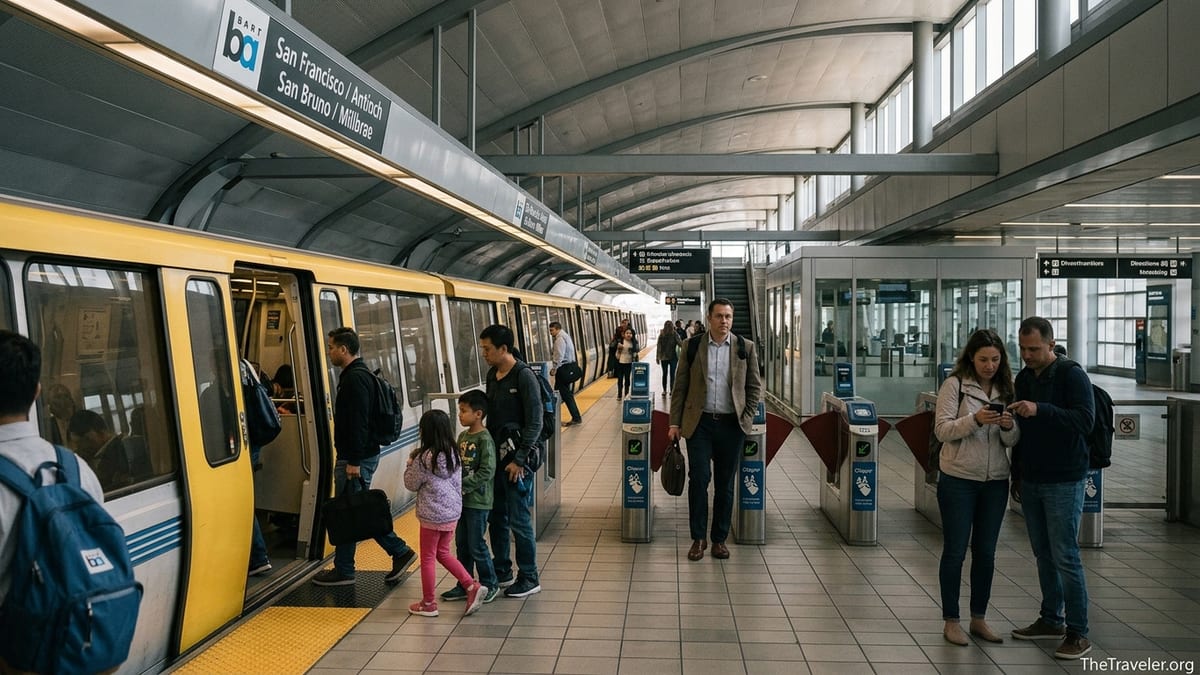
Finding the BART Station at SFO
BART at San Francisco International Airport is located in the International Terminal, attached to Garage G. If you arrive on an international flight, immigration, customs, and baggage claim will all feed you toward the main arrivals hall of the International Terminal, and from there it is a short indoor walk to the BART entrance on the Departures level. Look for the green and blue BART signs and the security-style fare gates beyond them.
If you are arriving on a domestic flight at Terminals 1, 2, or 3, you will typically use the AirTrain people mover to reach the International Terminal and the BART station. In practice this means exiting your gate, following signs for "AirTrain" and riding the Red Line. For example, a traveler landing on Southwest at Terminal 1 would follow the red AirTrain signs, ride to the International Terminal / Garage G stop, then follow the BART icon down one level to the station entrance.
Walking is sometimes possible without AirTrain, especially if you land at Terminal 3, which is physically closest to the International Terminal. Because of ongoing construction at SFO, walking routes can change, and passengers are often routed via covered outdoor sidewalks rather than interior corridors. If your rolling suitcase and jet lag make that sound unappealing, the AirTrain Red Line is fully accessible, free, and frequent, and is generally the simplest way to get to BART from any terminal.
Once you reach the International Terminal, you will pass typical airport retail and check in counters before you see the BART logo and the bank of fare machines directly in front of the station gates. If you are unsure, airport volunteers in red vests and information desks near the escalators can point you toward "BART to San Francisco".
AirTrain Connection: How It Works in Real Life
The AirTrain at SFO is an elevated, driverless tram that runs 24 hours a day between all terminals, parking garages, the rental car center, and the BART connection. It is free to ride and you do not need any ticket or transit card to board. You simply walk onto the platform, wait for the next train, and step inside when the doors open.
For BART, you want the AirTrain Red Line. At a typical domestic arrival, for example at Terminal 2 with Alaska Airlines, you follow overhead signs for "AirTrain / BART" to an escalator or elevator, go up to the AirTrain platform, and board a Red Line train heading to "International Terminal / Garage G / BART". The ride usually takes about 3 to 6 minutes depending on your starting point and whether the train stops first at other terminals or the rental car center.
When the train doors open at the International Terminal station, you step out and follow signs for "BART" and "Garage G". The path leads along a short indoor walkway toward the terminal, and then directly into the BART concourse with ticket machines on the right and fare gates straight ahead. If you are pushing a luggage cart, note that BART escalators can be steep; elevators are available and are a better option for heavy bags.
Because the AirTrain runs on a continuous loop, there is no need to time your arrival precisely. Trains run every few minutes at most times of day, and even during late-night lulls you rarely wait more than 10 minutes. For planning purposes, allow around 15 minutes from your airplane seat to reaching the BART fare machines if your gate is in the same terminal as the International Terminal, and 20 to 30 minutes if you are changing terminals using AirTrain.
Tickets, Clipper, and Tap-to-Pay: How to Pay for BART
BART no longer sells traditional magnetic-stripe paper tickets. Today, most travelers pay in one of three ways: a physical Clipper card, a digital Clipper card in Apple or Google Wallet, or direct tap-to-pay using a contactless bank card or mobile wallet. At SFO, you will see large blue Clipper vending machines alongside BART-branded machines that support both Clipper and contactless payments.
If you are visiting for a few days, a simple option is to tap a contactless credit or debit card directly at the fare gate. Each traveler must use their own card, even children, so a family of four needs four separate cards or devices. When you tap in at SFO and tap out at your destination, the correct fare is automatically deducted. For example, a one-way adult fare from SFO to Powell Street in downtown San Francisco is typically a little over 10 dollars per person, depending on current fare updates.
Travelers staying longer in the Bay Area often prefer a reusable Clipper card. You can buy a plastic Clipper card from machines at the SFO BART station by paying a small acquisition fee plus whatever cash value you want to add. Alternatively, many locals and tech-savvy visitors use the Clipper app to add a digital Clipper card to Apple Wallet or Google Wallet before they even land. This can be handy if you plan to ride multiple agencies such as BART, San Francisco Muni buses and trams, and ferries during your stay.
If you already have a Clipper card from a previous visit, you can simply reload it at the machines or via the app and tap at the gates as usual. Senior, youth, and disabled riders with registered discount Clipper cards receive reduced fares. Children four and under still ride free, but everyone else must have their own payment method to enter and exit BART.
Routes, Downtown Stops, and Travel Times
BART from SFO primarily runs on the Yellow Line toward Antioch and, during parts of the day, the Red Line toward Richmond. Both lines stop at key downtown San Francisco stations, including Civic Center, Powell Street, Montgomery Street, and Embarcadero. For most visitors staying in Union Square or near Market Street, Powell Street is the most convenient stop, directly connected to hotels, shopping, and the cable car terminus.
On a typical weekday daytime trip, the ride from SFO to Powell Street takes around 30 minutes once you are on the train. If you board a Yellow Line train labeled "Antioch," the sequence of central San Francisco stations will be Balboa Park, Glen Park, 24th Street Mission, 16th Street Mission, Civic Center, Powell, Montgomery, and Embarcadero. For example, a traveler whose hotel is near the Moscone Center would ride from SFO to Powell Street, exit through the 4th Street side of the station, and walk about 10 minutes south along the flat streets to their hotel.
Travel times can stretch closer to 40 or 45 minutes late at night or on weekends when trains run less often and may dwell a bit longer at stations. The downtown core is compact, and in many cases you can choose between adjacent BART stations depending on where you are staying. A guest at a Financial District hotel might choose Montgomery Street, while a visitor staying at the Ferry Building end of Market Street might prefer Embarcadero, just one additional stop past Montgomery.
If your destination is not in downtown San Francisco, you can often transfer at one of the downtown stations to another BART line or to Muni Metro light rail lines without leaving the paid area. For instance, someone heading to the Mission District late at night might ride BART from SFO to 24th Street Mission, then walk a few blocks to a bar or restaurant on Mission Street. Someone connecting to Berkeley would ride from SFO to downtown Oakland stations such as 12th Street and then change to a Richmond-bound train if necessary.
Fares and Cost Comparisons
Fares on BART are distance based and can change periodically, so it is best to treat specific amounts as approximate. As of mid 2026, a one-way adult fare from SFO to downtown San Francisco stations like Powell or Montgomery is typically a bit over 10 dollars. Fares to the Mission District are slightly lower, while trips farther out, such as to Berkeley or Walnut Creek, cost more because of the longer distance.
Compared with taxis and ride-hailing services, BART is almost always cheaper for solo travelers and small groups headed to the city center. For example, a typical app-based ride from SFO to a Union Square hotel can range from 35 to 60 dollars before tip and surge pricing, and even more in heavy traffic. By contrast, two people riding BART from SFO to Powell will often pay under 25 dollars total for the pair. For a family of four, costs become closer, and some families still prefer a door to door rideshare for convenience, but budget-conscious travelers can save a significant amount by using BART.
Within San Francisco itself, short BART trips are comparatively inexpensive, but if you plan to move around the city frequently you might combine BART with Muni buses and light-rail lines. Clipper makes these transfers easier, and certain passes such as the Muni-only passes loaded onto Clipper offer unlimited rides on San Francisco buses and trams, while BART within the city is charged separately. Many visitors use BART primarily for the airport and long cross-bay trips, and rely on Muni or walking for shorter inner city journeys.
Do note that there are no traditional paper day passes for unlimited BART rides, and BART does not offer a flat-rate airport express ticket. Instead, your Clipper or contactless card is charged the regular fare from SFO to your destination. If you are on a tight budget, checking the BART fare calculator on the official website just before travel will give you the most accurate up to date estimate.
Operating Hours, Frequency, and Nighttime Considerations
BART trains from SFO generally begin running just before 5 a.m. and operate until around midnight. Service frequency and the pattern of lines can change over the course of the day. During daytime and early evening hours, you will usually find direct trains from SFO to downtown San Francisco every 10 to 15 minutes on the Yellow and Red lines. Late at night and on Sundays, trains run less frequently, sometimes every 20 to 30 minutes.
If your flight is arriving late, it is important to check the time of the last train from SFO. In broad terms, the final departures leave shortly before midnight, but the exact time can vary by day and season and may be affected by planned construction or special events. A traveler landing from an evening transcontinental flight at 11:15 p.m. might still catch the last BART if the plane is on time and bags arrive quickly, but a delay at the gate could mean missing the final departure and having to switch to a taxi, rideshare, or night bus.
Real time departure displays are installed above the BART platform at SFO and in the concourse near the fare gates. These boards show the next several trains, their destinations, and minutes until departure. Many travelers also use the official BART app or third party apps to check schedules while still on the plane or taxiing to the gate. If you are cutting it close for the last train, it can help to sit toward the front of your arriving aircraft, keep your hand luggage compact, and head directly to BART without stopping for food or shopping.
BART does not operate overnight between roughly midnight and early morning. Travelers with very early flights from SFO often find it easier to stay at an airport hotel and take a hotel shuttle or taxi to the terminal, or to use all-night ride-hailing services, rather than attempting to use rail service that is not yet running.
Common Mistakes and How to Avoid Them
One of the most common mistakes at SFO is boarding the wrong direction of BART. The airport station is a terminal, so all departing trains are heading away from the airport, but they do not all go where visitors expect. During certain evening periods, for example, some trains may terminate at Millbrae just one stop away, requiring a transfer to continue north. Reading the overhead displays on the platform carefully and listening to the announcements for “San Francisco / Antioch” or "San Francisco / Richmond" helps ensure that you are boarding a train that will take you all the way into the city.
Another frequent issue is not having separate payment methods for each traveler. Contactless bank cards and mobile wallets cannot be shared through the fare gate, and trying to tap a single phone for two people will either fail or result in only one person being charged. A couple arriving from Europe, for example, might find that they both need either their own physical contactless card or to add separate Clipper cards to each of their phones before they can both pass through the gates.
Visitors also sometimes forget to tap out when leaving BART. Because fares are distance based, the system needs your exit tap to calculate the correct charge. If you simply follow other riders out through the emergency swing gate without tapping, you are technically fare evading and may be subject to fines. Even if there appears to be congestion at the gates, it is important to line up, tap out, and wait for the small doors to open before walking through.
Finally, many travelers underestimate how crowded BART can be during commute hours, especially between 7:30 and 9:30 a.m. and 4:30 and 6:30 p.m. on weekdays. A family with multiple suitcases squeezing onto a peak rush-hour train from SFO to downtown may find it uncomfortable, with limited space for luggage and many standing passengers. If you have flexibility, starting your journey outside the heaviest commute windows makes for a more relaxed ride, and you will have an easier time finding space near the train doors where larger bags can be kept out of the aisle.
The Takeaway
Using BART from San Francisco International Airport is one of the fastest and most economical ways to reach downtown hotels, the Mission District, and beyond. With the station built directly into the International Terminal and a free AirTrain connection from other terminals, the link is more straightforward than it first appears on the map. For many travelers, the door to door time from baggage claim to a Union Square hotel via BART is similar to a car service, and the cost savings can be substantial.
The key to a smooth trip is understanding how to access the station, choosing the right downtown stop, and mastering modern payment options such as Clipper and tap-to-pay. Paying attention to train destinations, checking the schedule of the last departure if you arrive late, and ensuring every member of your party has their own payment method will prevent most common problems. With these practical tips in mind, BART can turn from a source of confusion into one of the easiest parts of your arrival or departure from San Francisco.
FAQ
Q1. How long does the BART ride from SFO to downtown San Francisco take?
The ride from SFO to central downtown stations such as Powell or Montgomery typically takes about 30 minutes once you are on the train. During late nights or weekends, it can stretch closer to 40 minutes because trains run less frequently and may pause longer at stations.
Q2. How much does BART from SFO to downtown usually cost?
Fares change periodically, but an adult one way fare from SFO to downtown San Francisco is generally a little over 10 dollars. The exact price depends on your specific station and any current fare adjustments, so it is wise to check the official BART fare calculator shortly before you travel.
Q3. Can I pay for BART directly with my credit card, or do I need a Clipper card?
You can pay by tapping a contactless credit or debit card, or a mobile wallet like Apple Pay or Google Pay, directly at the BART fare gates. You do not have to buy a separate physical Clipper card, although many frequent riders choose to because it works across many Bay Area transit systems.
Q4. Do children need their own ticket or card to ride BART from SFO?
Children four and under ride BART for free and do not need their own ticket or card. Everyone else, including older children and teenagers, must have their own payment method, whether it is a discount Clipper card, a standard Clipper, or a contactless bank card.
Q5. Which BART station should I use for Union Square hotels?
For most Union Square and central downtown hotels, Powell Street Station is the most convenient choice. It opens directly onto Market Street near 4th and 5th Streets, within a short walk of many major hotels, shopping centers, and the Powell Street cable car turnaround.
Q6. What if my flight arrives after the last BART train?
If your flight lands too late for the final BART departure, your realistic options are a taxi, app based rideshare, or night bus service where available. In this situation, it is usually faster and more straightforward to follow airport signs to the designated rideshare or taxi pick up areas rather than looking for alternative rail options.
Q7. Is it safe to ride BART with luggage from SFO?
Thousands of travelers use BART to and from SFO every day, many with suitcases and backpacks. The trains have open floors and space near the doors where you can stand with your bags. As in any large city, keep valuables close, avoid leaving bags unattended, and consider riding in cars with more passengers if you are traveling late at night.
Q8. Can I use the same card for two people at the BART gates?
No. Each person must have their own payment method and tap separately. A single contactless card or phone cannot be used to pay for multiple riders through the gate in one transaction, so couples or groups should ensure they have enough separate cards, phones, or Clipper cards before reaching the station entrance.
Q9. How often do BART trains run from SFO?
During busy daytime hours, trains to San Francisco typically depart every 10 to 15 minutes. Late at night and on Sundays, gaps can widen to around 20 to 30 minutes. Real time displays at the SFO station and smartphone apps show the next departures so you can time your walk from the terminal.
Q10. Can I connect from BART at SFO to Caltrain for San Jose or the Peninsula?
Yes. BART from SFO runs one stop south to Millbrae, where you can transfer to Caltrain for destinations such as San Mateo, Palo Alto, and San Jose. This connection is useful if you are heading directly from the airport to the Peninsula or Silicon Valley without going through downtown San Francisco.