


San Francisco International Airport can feel confusing the moment you open the Uber or Lyft app. Domestic rideshare pickups are on the roof of a parking garage, international pickups are at a curb on the departures level, and surge pricing can swing wildly depending on when and where you request your ride. This guide walks you through exactly what to do after you land at SFO so you know where to walk, what to expect, and how to avoid paying more or waiting longer than you need to.
Get the latest updates straight to your inbox!
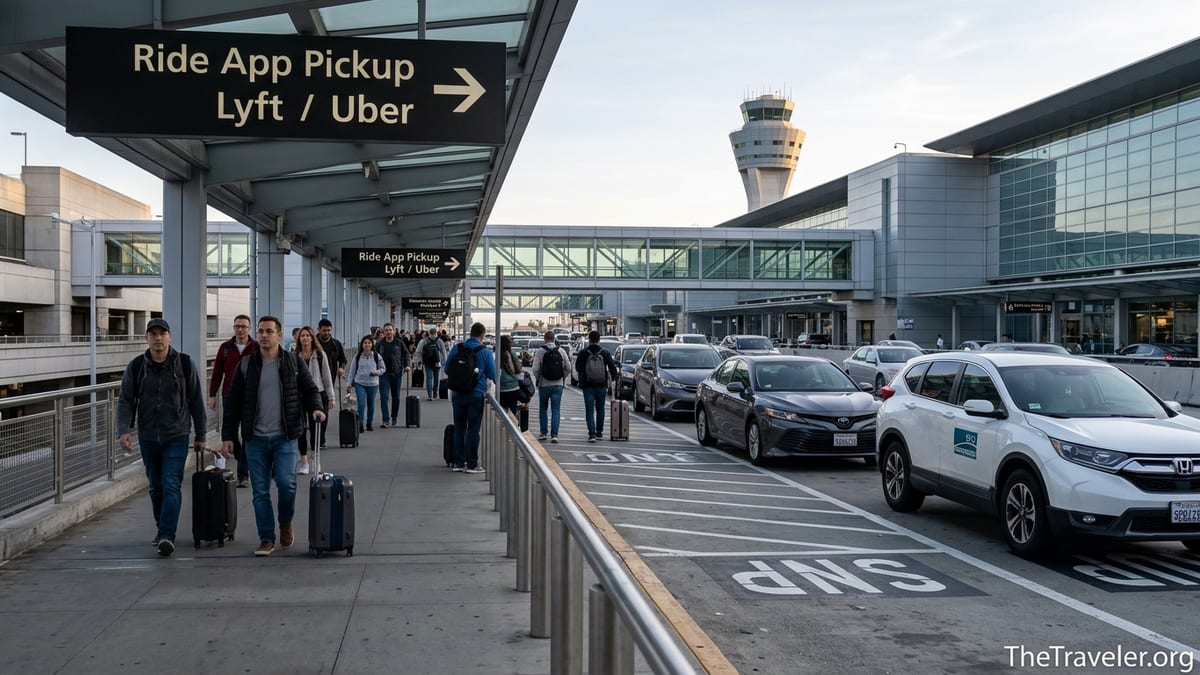
How Uber and Lyft Work at SFO Today
San Francisco International Airport treats Uber, Lyft, and other app-based rides as a separate category from taxis and hotel shuttles. Instead of meeting your driver curbside at baggage claim, most domestic passengers are directed to a designated rideshare level on top of the main parking garage. International passengers, on the other hand, are usually picked up at the departures level curb between marked zones, which is much closer to the terminal doors.
The rules are set by the airport and updated periodically, but as of mid-2026, the basic pattern is stable: if you land at Terminals 1, 2, or 3 on a domestic flight, your Uber or Lyft pickup will be on Level 5 of the Domestic Garage, in color-coded zones such as D, E, or F. If you arrive at the International Terminal, your ride will meet you at the center island curb on the Departures and Ticketing Level, typically signed as zones 14–17. You will see overhead signs inside the terminal pointing to "Ride App Pickup" or simply "Lyft / Uber / Wingz."
For most travelers, this creates a tradeoff. Domestic passengers have a slightly longer walk but a more controlled, less chaotic loading zone on the garage roof. International passengers enjoy a traditional curbside pickup but may find that drivers prefer domestic pickups, especially during busy hours, because they can circle through the garage more easily. Understanding that difference will help you decide whether to request your car right away or walk a bit for a better experience.
In practical terms, expect the app to guide you to the correct general location, but do not rely on GPS pins alone. At SFO, GPS can be imprecise among multiple levels of roadways and garages. Plan to follow the physical overhead signs for "Ride App Pickup" once you have your bags. Think of the app as confirming your zone letter or number, while the airport signage gets you the last few hundred feet to the exact pickup point.
Domestic Terminals: Getting to Level 5 of the Domestic Garage
If you land at Terminal 1, Terminal 2, or Terminal 3, your Uber or Lyft pickup will not be at the arrivals curb. Instead, you will walk from your gate area toward baggage claim, then follow signs that mention "Garage" or "AirTrain" and "Ride App Pickup." Once you are on the baggage claim level, look for overhead arrows to the parking garages. SFO’s domestic terminals are connected to the Domestic Garage by enclosed skybridges that lead directly to Level 5, where both the AirTrain stations and the rideshare zones are located.
As a concrete example, imagine you arrive on a Southwest Airlines flight into Terminal 1. After collecting your suitcase at baggage claim, you will look for signs to the "Garage" or "AirTrain Red Line." Those signs lead you up an escalator or elevator to a mezzanine level, then across a glass-walled bridge into the parking structure. Once inside the garage, keep following the "Ride App Pickup" signs up to Level 5. There you will find painted lanes and columns labeled with letters such as D, E, or F, which correspond to zones you will see in your Uber or Lyft app.
The walk from most domestic gates to the rideshare zones typically takes 5 to 10 minutes if you know where you are going, and closer to 15 minutes if you are traveling with children, carrying heavy bags, or stopping to read signs. At peak times, like weekday evenings between 5 p.m. and 8 p.m., the Level 5 area can be busy, with dozens of cars coming through. The advantage is that the layout is predictable: drivers all come to the same general level, and zones are clearly labeled. Compared with lining up on a crowded curb, many regular SFO travelers prefer this system, even with the extra walk.
When you open Uber or Lyft after landing at a domestic terminal, wait until you are physically on your way to the garage before confirming your ride. If you request a pickup while still at the gate, there is a good chance your driver will arrive long before you reach Level 5. At a busy time, the airport expects drivers to keep moving, so they may cancel if you are not there. A practical pattern is to request your ride when you step onto the skybridge or enter the elevator up to Level 5. That usually gives you a two-to-five-minute buffer that matches the time it takes a driver to circle into the garage.
International Terminal: Curbside Zones 14–17 on Departures Level
Arriving on an international flight is a different experience. After clearing immigration and customs in the International Terminal, you emerge into a public arrivals hall with baggage carts, currency exchange kiosks, and hotel desks. Instead of going up into the garage, you will look for escalators or elevators up one level to the Departures/Ticketing Level. From there, you will exit the main sliding doors toward the roadway and cross to the center island. The airport marks this island for app-based rides with signs showing "Ride App Pickup Zones 14–17" or similar wording.
In practice, this means your Uber or Lyft pickup point is only a few minutes from the customs exit. For instance, if you arrive on a late-night flight from London into International Terminal G, you collect your bags, clear customs, then follow overhead signs that mention "Ticketing" or "Departures." Once you are on that level, you walk straight outside. At the center island, look for posts or signs labeled with zone numbers. Your app will usually show something like "International Terminal Departures Level, Zone 15." You can then wait at the numbered post and watch your driver approach.
Many incoming passengers are surprised to find that the app may estimate a longer wait for rides at the International Terminal compared with the Domestic Garage during busy moments. This happens because a larger share of drivers position themselves near the domestic pickup zones, where demand is steadier throughout the day. If your app is quoting a wait time of 15 minutes or more at the International Terminal, but only 5 to 7 minutes at a nearby domestic zone, it can be worth walking. The International Terminal is physically connected to Terminal 3 by indoor walkways, and that walk usually takes around 10 minutes at an unhurried pace.
For travelers with several large suitcases or those using baggage carts, staying at the International pickup curb may still be better, even with a longer wait. You can roll a baggage cart right to the curb, which is not always allowed in the garage pickup areas. This is useful for families arriving from long-haul flights to Asia or Europe with multiple checked bags. If, however, you are a solo traveler with a backpack landing at 6 p.m. and the app shows heavy surge pricing or long waits at International, you might reasonably decide to walk to Domestic Terminal 3 and request your ride from the Level 5 garage there instead.
Domestic vs International Pickup: Choosing the Best Option
Because SFO’s terminals are linked by both indoor corridors and the AirTrain people mover, you are not locked into using the rideshare pickup associated with your arrival terminal. It is entirely legal and common for people landing at the International Terminal to walk to a domestic zone to request a ride, or for domestic passengers to walk to the International Departures curb. The right choice depends on your luggage, your energy level, and what you are seeing in the apps at that moment.
Consider a typical weekday evening around 7 p.m. If you open Uber at the International Terminal, you might see UberX quoted at around 40 to 50 dollars to downtown San Francisco, with a pickup time of 12 minutes and a small surge multiplier. At the same time, a friend who just landed at Terminal 2 may see 30 to 40 dollars and a 4-minute pickup in the Domestic Garage. If you have only carry-on luggage and are comfortable walking, heading toward Terminal 3 and taking the bridge to the Level 5 pickup zones can save meaningful time and potentially reduce your fare by avoiding an area of heavier demand.
The reverse situation also happens. During very late-night arrivals, say after midnight, international pickups may look more attractive because drivers dropping off departing passengers at that level can accept new international pickup requests almost immediately. In these cases, your app might show a wait of only 3 or 4 minutes from the International Terminal while showing 10 minutes or more for the Domestic Garage. If you have been awake for 12 hours on a long-haul flight, saving that walk and getting curbside pickup can feel well worth it, even if the fare is a few dollars higher.
Always cross-check the pickup label in your app against the physical location you intend to wait at. If the app says "Domestic Garage Level 5, Zone E" but you are standing on the International Departures curb, your driver’s GPS will take them to the garage, not to you. At SFO, mismatches between what the rider thinks they selected and what the app actually shows are a common cause of extra waiting and cancellations. Before you hit "Confirm," read the pickup description line and make sure it matches your plan.
Walking Routes, AirTrain, and Wayfinding Inside SFO
For many travelers, the hardest part of using Uber or Lyft at SFO is not the ride itself but navigating the terminals. The good news is that once you know a few landmarks, the paths are straightforward. The Domestic Garage and its Level 5 rideshare deck sit at the center of the airport, surrounded by Terminals 1, 2, and 3. Each of those terminals connects to the garage via skybridges near security checkpoints B, D, and F. On signs, these bridges are usually associated with the AirTrain station names and walkway symbols.
If you are in Terminal 1 or 2 and you are not sure which way to walk, look up for the red and blue AirTrain icons. Following those icons will take you toward the elevators and escalators that lead to the garage bridges. Once you reach the garage side, you can step out of the AirTrain area and follow the "Ride App Pickup" signs across Level 5 to the correct zone. This method works even if you never ride the AirTrain itself. For instance, a traveler landing on Alaska Airlines at Terminal 2 can simply follow the AirTrain signs without boarding it, cross the bridge into the garage, then follow rideshare signs on Level 5.
If you arrive at the International Terminal and decide to walk to a domestic rideshare zone, you have two main options. The first is the indoor corridor connecting International Terminal G to Terminal 3. From there, you again follow signs to the Domestic Garage and up to Level 5. This is fully indoors and suitable in bad weather. The second option is to take the AirTrain from the International Terminal station to any domestic station. The AirTrain is a free, automated train that circles the airport 24 hours a day, and its platforms are on Level 5 of the same garage that houses the rideshare zones. In practice, many travelers simply walk to Terminal 3 if they are comfortable and use the AirTrain only if they are already on Level 5 or carrying heavier luggage.
Wayfinding signage at SFO has improved in recent years, but first-time visitors still report confusion, particularly around understanding that the rideshare pickup is not at baggage claim. To reduce stress, decide on your route before opening the app. For example, say to yourself: "I will walk to the AirTrain signs, go across the bridge to the garage, then request my car from Zone F." That mental script can make the process feel more intentional. If you get turned around, any airport staff member or information desk can point you toward the AirTrain or the Domestic Garage, which are the key anchors for reaching Level 5.
Understanding Pricing, Airport Fees, and Surge at SFO
Prices for Uber and Lyft at SFO vary by time of day, day of week, and destination, but certain patterns are common. A typical mid-morning UberX ride from SFO to downtown San Francisco might fall in the 35 to 45 dollar range before tip, including the airport’s per-ride fee that is automatically added in the app. During lighter times, such as midafternoon on a weekday, that same trip might drop closer to 30 to 35 dollars. At peak times, including early evening on Fridays or Sundays, fares to the city can climb well above 50 dollars, especially if surge pricing is in effect.
SFO collects a fee on rideshare pickups that is built into the price you see in the app. You will not have to pay this separately, but it is one reason that leaving directly from the airport is usually slightly more expensive than taking the same distance ride from a nearby hotel or transit station. For example, a traveler going from SFO to a hotel in Union Square may see an UberX quote of 45 dollars when departing from the airport, but closer to 30 dollars when requesting a pickup from that same hotel the next day for a similar distance back.
Surge pricing can be particularly noticeable when several large flights arrive at once or when bad weather slows traffic. If you open the app and see that a basic ride type is more than double your usual expectation, it can be worth comparing alternatives. At times, taxis at SFO are competitive with or even cheaper than Uber and Lyft for downtown trips, especially when surge is high. A meter-based taxi fare to central San Francisco may fall in the 45 to 70 dollar range before tip, depending on traffic and final destination, and does not fluctuate due to app-based surge. For very short trips, such as to hotels in nearby Burlingame, taxis may be cheaper once you factor in minimum fares and airport fees on rideshare apps.
One technique some budget-conscious travelers use is to check prices not only from their current terminal but also from alternate pickup points. Because you can freely walk between terminals at SFO, you might find that UberX from the Domestic Garage shows lower surge than the International Terminal at a given moment. If, for instance, the app shows 65 dollars and a 15-minute wait from International but 45 dollars and a 5-minute wait from Domestic, taking 10 minutes to walk or ride the AirTrain to the Domestic Garage can be a rational choice. Be realistic about your energy level and luggage, but know that the option exists.
Alternatives to Uber and Lyft: Taxis, BART, Shuttles, and More
While Uber and Lyft are dominant at SFO, they are not the only options. Taxis queue at center-island stands on the Arrivals/Baggage Claim Level of all terminals. These stands are clearly signposted and staffed, and taxis usually offer the simplest curb-to-curb experience, particularly for travelers with heavy luggage or mobility concerns. For example, a family of four with two checked suitcases and two strollers arriving in Terminal 3 might find it less stressful to step directly into a waiting taxi than to navigate elevators and skybridges up to Level 5 in the garage for a rideshare.
For solo travelers or couples heading to central San Francisco, Bay Area Rapid Transit (BART) is often the best value. The BART station is located at the International Terminal, connected to the terminals by the AirTrain and walkways. Fares depend on destination, but a one-way trip from SFO to downtown San Francisco typically costs a fraction of a rideshare. Travel time is comparable during rush hours because BART bypasses surface traffic. A visitor arriving on a domestic flight can take the AirTrain from the Domestic Garage station to the International Terminal station, walk into the BART area, and be on a train toward the city without ever stepping into a car.
SamTrans buses provide 24-hour local bus service from SFO to parts of San Mateo County and into San Francisco. These buses depart from designated bus stops outside the terminals and are particularly useful for budget travelers or those heading to areas not directly served by BART. Airporters and private shuttle services operate to destinations such as Marin County, Sonoma, and parts of the East Bay, typically picking up from the center islands at the arrivals level in domestic and international terminals.
In recent years, SFO has also seen growth in alternative services, including app-dispatched professional car services and autonomous ride pilots on specific corridors. Some travelers choose car-share or rental cars instead, especially if they plan to explore multiple Bay Area cities over several days. The airport’s Rental Car Center is linked to all terminals by the Blue Line of the AirTrain. While these alternatives have different cost profiles, the key point is that you do not have to rely solely on Uber or Lyft. Comparing options for your specific arrival time and destination can lead to meaningful savings and a better fit for your comfort level.
The Takeaway
Navigating Uber and Lyft pickups at San Francisco International Airport comes down to three essentials: knowing your terminal, understanding where the designated rideshare zones are, and timing your ride request. Domestic passengers in Terminals 1, 2, and 3 head to Level 5 of the Domestic Garage, while international arrivals meet their drivers at the Departures Level center island zones 14–17. Once you internalize that difference, SFO’s layout starts to feel far more manageable.
Real-world conditions such as surge pricing, flight schedules, and weather will shape whether Uber, Lyft, taxis, BART, or another mode makes the most sense at the moment you land. A late-night arrival from Europe with multiple bags may push you toward curbside pickup or a taxi, while a light-traveling business traveler arriving mid-morning might head straight to BART. Checking a couple of options on your phone before committing can turn a stressful arrival into a smooth, predictable step on your journey.
Ultimately, SFO’s design encourages you to think of the airport as a hub where you can choose between rail, bus, taxi, rideshare, and more, all within a few minutes’ walk connected by the AirTrain and enclosed corridors. With a bit of planning, the rideshare system that first feels confusing becomes one of several reliable tools. The key is to stay flexible, read the signs as carefully as you read your app, and choose the combination of cost, comfort, and convenience that fits the trip you are actually taking.
FAQ
Q1: Where exactly do Uber and Lyft pick up at SFO for domestic flights?
For Terminals 1, 2, and 3, Uber and Lyft pick up on Level 5 of the Domestic Garage in marked zones such as D, E, and F, reached via skybridges from each terminal.
Q2: Where do I meet my Uber or Lyft after an international arrival at SFO?
After clearing customs in the International Terminal, go up to the Departures/Ticketing Level and walk to the center island curb, where rideshare pickups use zones 14–17.
Q3: How long does it take to walk from the domestic terminals to the rideshare pickup area?
Most travelers take 5 to 10 minutes to reach Level 5 of the Domestic Garage from baggage claim, though it can be closer to 15 minutes with heavy luggage or young children.
Q4: Can I walk from the International Terminal to a domestic rideshare zone to save time or money?
Yes. You can walk indoors from the International Terminal to Terminal 3 and then to the Domestic Garage, or use the AirTrain to reach Level 5, and request pickup there.
Q5: Is Uber or Lyft cheaper than a taxi from SFO to downtown San Francisco?
At typical times Uber and Lyft can be somewhat cheaper, but during surge pricing a metered taxi may be similar in cost or occasionally less expensive for central city trips.
Q6: When should I request my ride in the app after landing?
Wait until you are on your way to the pickup area, ideally when you reach the skybridge or elevator to Level 5 for domestic flights, or when you reach the departures level for international.
Q7: Can I use a baggage cart all the way to the Uber or Lyft pickup?
At the International Departures curb you can usually roll baggage carts to the pickup point; in the Domestic Garage, rules and elevator dimensions can make carts less practical, so many travelers switch to rolling suitcases.
Q8: What if my driver’s location in the app does not match where I am standing?
Check the pickup description in the app. If it lists "Domestic Garage Level 5" or an international zone but you are elsewhere, adjust the pin or walk to the described location before the driver arrives.
Q9: Are there good alternatives to Uber and Lyft from SFO?
Yes. Taxis serve all terminals at arrivals-level stands, BART trains run from the International Terminal into San Francisco and the East Bay, SamTrans buses connect nearby communities, and shuttles serve select regions.
Q10: How much should I expect to pay for an Uber or Lyft from SFO to downtown?
Exact prices vary, but many travelers see basic rides in the 35 to 50 dollar range to central San Francisco, with higher fares possible during peak or surge periods.