


San Francisco International Airport can be confusing at first glance. Three domestic terminals, one large International Terminal, and a maze of walkways and trains leave many travelers wondering where they should check in, where their bags will appear, and how much time they really need to make a connection. This guide breaks down Terminal 1, Terminal 2, Terminal 3, and the International Terminal at SFO in practical terms, using real airline examples and typical connection scenarios to help you move through the airport with confidence.
Get the latest updates straight to your inbox!
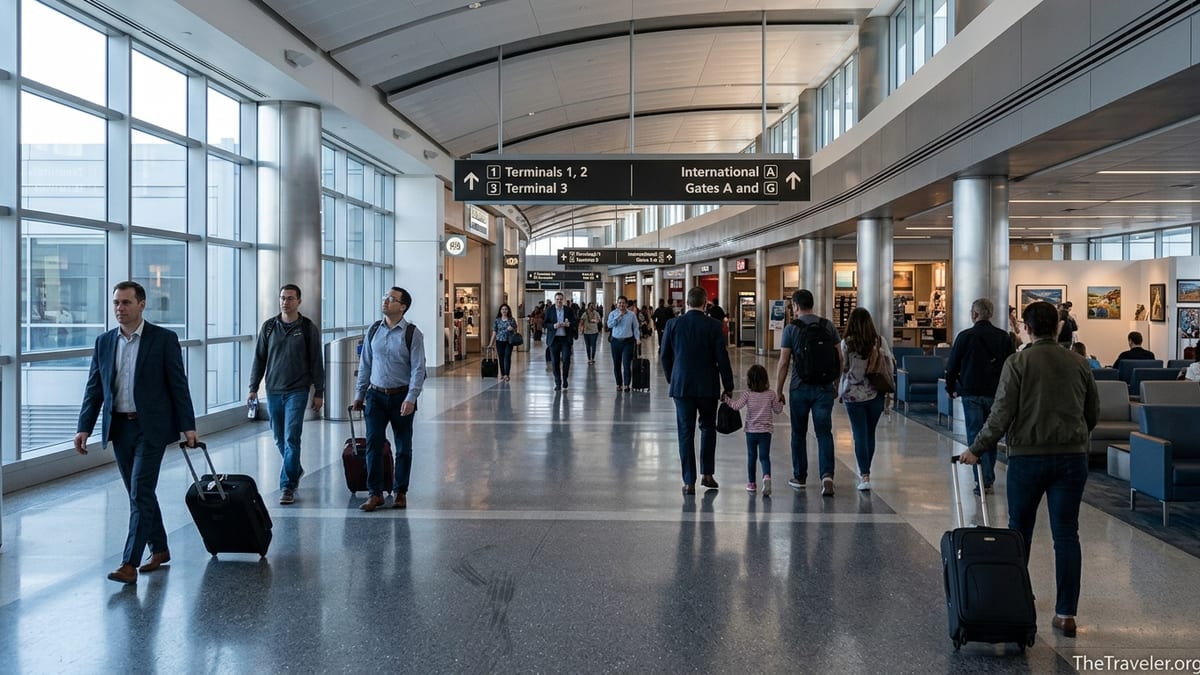
How SFO Is Laid Out: The Big Picture
San Francisco International Airport has four terminals arranged in a rough horseshoe: Terminal 1 (Harvey Milk), Terminal 2, Terminal 3, and the International Terminal, which has two boarding areas labeled A and G. All boarding areas are linked airside by secure walkways, so once you pass security you can walk between any terminal without going through screening again, as long as you stay within the secure zone.
The three numbered terminals are primarily for domestic and pre-cleared international flights, while most long haul international services use the International Terminal. For example, a United flight from San Francisco to New York typically departs from Terminal 3, while a United flight from San Francisco to Tokyo usually departs from International Terminal G. A British Airways or Emirates flight to London or Dubai uses International Terminal A, and an Alaska or American Airlines flight to Los Angeles normally uses Terminal 1 or Terminal 2 depending on the airline.
Landside, SFO’s AirTrain connects all terminals, the parking garages, and the Bay Area Rapid Transit station. The Red Line runs in a loop through every terminal station. If you arrive late at night on a Southwest flight into Terminal 1 and your friend is waiting at Terminal 3, for instance, you can simply follow the signs to AirTrain after baggage claim and ride two stops instead of walking the entire distance with luggage.
Because the terminals are interconnected, airlines sometimes shift operations as construction or gate availability changes. Before your trip, it is worth checking both your booking and the airport’s terminal list to confirm where your airline is currently operating, especially if you are used to flying a carrier like Delta or JetBlue that has moved between Terminal 1 and Terminal 2 in recent years.
Terminal 1: Harvey Milk Terminal for Key Domestic Carriers
Harvey Milk Terminal 1 is one of SFO’s three domestic terminals and has been undergoing a major modernization over the last few years. It is bright, modern, and designed with wide concourses, art installations, and local food outlets. It primarily handles domestic and some short haul international flights on carriers such as American Airlines, Southwest Airlines, JetBlue, and Porter Airlines, with specific allocations shifting over time as more gates open.
Check-in at Terminal 1 is on the departures level, with separate counter zones for each airline. A traveler flying American Airlines from San Francisco to Dallas, for example, will typically check in and drop bags at the American counters in Terminal 1, proceed through the nearby security checkpoint, and then head to the B boarding area. Most Southwest flights to cities like San Diego or Las Vegas also check in and depart from this terminal, which makes Terminal 1 particularly busy at peak domestic times on Monday mornings and Thursday and Friday evenings.
Arriving flights into Terminal 1 use the lower level for baggage claim. If you land on a Southwest flight from Phoenix with checked luggage, you will follow signs for Baggage Claim after exiting the jet bridge, walk down to the baggage hall, and look for the carousel number on the monitors. From there, you can exit to the curb for ride-shares and taxis or follow signs to AirTrain to reach other terminals, the rental car center, or parking garages.
For transfers, the key advantage of Terminal 1 is its airside connections. A traveler arriving on an early morning JetBlue flight from Seattle into B gates can stay past security and walk to Terminal 2 for an Alaska flight, or continue all the way to Terminal 3 to meet a colleague flying United, without ever passing through security again. This is particularly useful if you have a relatively short connection, such as 60 to 75 minutes between a Southwest arrival and an Alaska departure that are ticketed separately.
Terminal 2: Home Base for Alaska and Some American Flights
Terminal 2 is another domestic terminal and is known for its airy design, large art pieces, and family friendly touches. It serves as a primary base for Alaska Airlines at SFO, with additional operations from other carriers such as some American Airlines flights. If you are flying Alaska to cities like Portland, Seattle, or Honolulu, you will almost always check in at Terminal 2.
Check-in here is straightforward, with large self-service kiosks and staffed counters for Alaska at the front of the terminal. A traveler flying Alaska in economy to Seattle, for instance, might arrive two hours before departure, print a boarding pass at a kiosk, check a bag for a typical fee around 30 dollars for the first checked bag, and then head through security to the D gates. Alaska’s lounge, which sells day passes when space permits, is located after security, giving premium and eligible loyalty customers a quieter space before boarding.
Baggage claim for Terminal 2 arrivals is directly below the check-in area. If you arrive on an Alaska flight from Anchorage with ski equipment, you will retrieve your oversized items from the designated area near the standard carousels. After collecting bags, you can reach ride-share pickup zones by following the ground transportation signs or transfer to AirTrain if you are headed to the BART station for a train into downtown San Francisco.
Because Terminal 2 is connected airside to both Terminal 1 and Terminal 3, it is a practical pivot point for connections between different airlines. Someone arriving on an American Airlines flight from Chicago into Terminal 2 and continuing on a United flight from Terminal 3 can walk through the secure corridor between the D gates and the E and F gates, typically in 10 to 15 minutes at a normal pace, as long as both flights are on a single ticket and bags are checked through to the final destination.
Terminal 3: United’s Domestic Hub
Terminal 3 is the main domestic hub for United Airlines at SFO and includes E and F boarding areas with dozens of gates. Most United flights within the United States depart from this terminal, including frequent services to cities like Los Angeles, Denver, Chicago, and Newark. Travelers connecting through SFO on United often spend the majority of their time in Terminal 3, using its wide range of food options, United Clubs, and workspaces.
Check-in for United domestic flights is on the departure level, with separate lines for economy, Premier status travelers, and Polaris or premium cabins. A typical passenger flying economy from San Francisco to Chicago might use a kiosk to print a bag tag, pay the standard checked bag fee if it is not included with their fare or credit card, and then drop the bag at the designated belt before proceeding through security. During busy periods such as Sunday evenings, lines at Terminal 3 security can be long, so following the general guidance of arriving at least two hours before departure for domestic flights is advisable, with more time if you need to check bags.
On arrival, United domestic flights into Terminal 3 direct passengers to the lower level baggage claim, where multiple carousels serve different flights. For example, a late night arrival from Boston might share a carousel with flights from Houston and Seattle. Once you collect luggage, you can head outside to the curb, where ride-shares and taxis line up under marked zones, or walk to the nearby AirTrain station if you are transferring to the rental car center.
Terminal 3’s airside walkway system is especially important for international connections. If you arrive on a United flight from Los Angeles into an F gate and are connecting to a United long haul flight to Tokyo or Frankfurt from International Terminal G, you can walk directly from Terminal 3 to the G gates without leaving security. Many frequent flyers report covering this walk in about 10 to 15 minutes, which makes a 90-minute domestic to international connection quite realistic when flights are on time and bags are checked through on a single United or Star Alliance ticket.
International Terminal: Boarding Areas A and G
The International Terminal at SFO is a large structure split into two main boarding areas: A and G. Boarding Area A primarily serves non United international airlines such as British Airways, Lufthansa, Emirates, Qatar Airways, ANA, EVA Air, and many others. Boarding Area G is largely used by United and its Star Alliance partners for long haul flights to Europe, Asia, and beyond, though exact assignments can vary.
Check-in for most international flights takes place in the International Terminal’s main departure hall. For example, a passenger flying Emirates to Dubai will typically check in at the airline’s counters on the A side. A traveler booked on Lufthansa to Munich or Singapore Airlines to Singapore will also use check-in desks in this main hall, with airline signs and overhead boards indicating the correct island.
International arrivals are handled differently from domestic ones. With the exception of certain pre-cleared flights from Canada or Ireland, arriving international passengers deplane into a sterile corridor leading to passport control and customs. After presenting documents and possibly answering a few routine questions, travelers collect checked luggage from the carousels located after immigration. Only after clearing customs and exiting into the public arrivals hall can they recheck bags for ongoing domestic flights, unless their luggage has already been tagged to the final destination and they are instructed to leave it on the belt.
Connections between the International Terminal and the domestic terminals depend on whether you are landside or airside. Airside, Boarding Area G connects directly to Terminal 3 via a secure walkway, and the terminal loop continues onward to Terminal 2 and Terminal 1. This means a traveler arriving on a United flight from London into G gates can walk through the secure corridors to catch a same ticket connecting flight on Alaska or American in Terminal 1 or 2, provided their bags are checked through and they have been processed correctly at immigration if required. Landside, the AirTrain connects stations near both A and G gates to each domestic terminal for passengers who have not yet gone through security or who have exited the secure area.
Domestic vs International Flights, Check-in and Baggage Claim
At SFO, domestic flights usually operate from Terminals 1, 2, and 3, while most long haul international departures use the International Terminal. However, there are important nuances. Airlines operating to Canada or Ireland sometimes use U.S. preclearance, which means passengers complete immigration before boarding, and these flights can arrive at domestic gates. For example, an Air Canada flight from Vancouver may arrive into a domestic terminal gate, and its baggage claim process will look very similar to a U.S. domestic arrival.
For check-in, the terminal listed on your ticket is your primary guide. If your reservation shows an Alaska Airlines flight from San Francisco to Maui departing Terminal 2, you should go directly to Terminal 2 check-in. If you have a multi segment itinerary, such as a United flight from San Diego to San Francisco followed by a Lufthansa flight to Frankfurt, you will usually check in for both flights and drop your luggage at the first departure terminal, then simply proceed to the correct terminal for your connection following your boarding passes and airport signs.
Baggage claim depends on where you arrive. Domestic flights go to the baggage halls underneath their respective terminals, with clear signs indicating carousel numbers. International flights that require customs and immigration lead passengers first to passport control, then to carousels in the International Terminal’s arrivals area. If you are connecting to a domestic flight, you may need to claim your luggage, take it through customs, and then drop it at a transfer belt or at the check-in area depending on the airline’s process. For instance, a traveler arriving from Tokyo on United into International Terminal G, then connecting to a smaller United flight to Boise, will clear immigration, collect bags, clear customs, and then recheck luggage at the United transfer counter before heading back through security for the domestic leg.
Realistic arrival timing is critical. For a typical domestic flight into SFO with checked luggage, it often takes 15 to 30 minutes from gate arrival to baggage claim and another 5 to 15 minutes for bags to appear, though this can vary with airport congestion. On international arrivals, passengers should expect 45 minutes to over an hour to clear immigration, collect bags, and pass customs before they can recheck or leave the building, especially during busy evening waves from Asia and Europe.
Making Connections and Moving Between Terminals
Because all SFO terminals are connected airside, most ticketed connections between airlines and terminals can be handled by walking through the secure corridors. For example, suppose you arrive on a morning Alaska flight from Portland into Terminal 2 and you are connecting to a United international flight to Sydney from International Terminal G, ticketed on one itinerary. You can land at a D gate, follow signs toward Terminal 3 and the G boarding area, and arrive at your international gate without going through security again, often in 20 minutes or less.
When you are not on a single ticket or your bags are not checked through, you may need to exit to the public side of the airport and use the AirTrain or walk landside. For instance, if you buy one ticket on Southwest from San Diego to SFO and a separate ticket on Emirates from SFO to Dubai, your Southwest flight will likely arrive in Terminal 1 and your Emirates flight will depart from International Terminal A. You will collect your bag at Terminal 1 baggage claim, follow signs to AirTrain, ride to the International Terminal station near A gates, and then check in and clear security again.
Typical minimum connection times at SFO recognize the difference between purely domestic transfers and international connections requiring immigration. A 60 to 75 minute connection from one United domestic flight to another in Terminal 3 is often workable if flights are on time, thanks to the close gate spacing and internal walkways. For international arrivals, such as a flight from Paris into A gates connecting to a domestic flight to Seattle in Terminal 2, two to three hours is usually more comfortable because you must pass through customs, recheck any luggage, pass through security again, and then walk or AirTrain to the correct terminal.
If you have spare time during a connection, the connected airside layout lets you explore multiple terminals without sacrificing security. Travelers sometimes arrive on a domestic flight into Terminal 3, walk to Terminal 2 to visit a specific restaurant or the SFO Museum exhibit, and then continue on to Terminal 1 or back to International G for their next flight. With free airport Wi-Fi and clear wayfinding signage, it is realistic to cover the entire loop in around 30 to 40 minutes at a moderate walking pace.
Practical Tips for Check-in, Security, and Transfers
Planning ahead for check-in and security at SFO can save significant stress. For domestic flights in Terminals 1, 2, and 3, many airlines recommend arriving around two hours before departure, particularly if you need to check bags or travel at peak times. For international flights from the A or G boarding areas, arriving around three hours before departure is generally safer to allow for longer lines at check-in and exit immigration procedures where applicable.
Security checkpoint locations differ between terminals, but once you are through any checkpoint, you gain access to the full airside loop. This means if you encounter a long line at one checkpoint, and your airline and schedule allow, you could enter through a different terminal’s security and then walk to your gate. For example, travelers with TSA PreCheck flying United sometimes choose to use a less busy checkpoint in International Terminal G or Terminal 2, then walk through the connectors to Terminal 3.
For baggage, one of the most practical tips at SFO is to check luggage through to your final destination when booked on one ticket, especially on itineraries connecting a domestic flight in Terminal 3 to an international departure in G or A. This keeps you in the secure area and avoids extra trips to baggage claim. If you are on separate tickets and must recheck bags, build in extra time, particularly if switching from a domestic carrier like Southwest in Terminal 1 to an international carrier such as Qatar Airways in International Terminal A.
Ground transfers between terminals after you exit security are straightforward. The AirTrain Red Line connects all terminals and operates around the clock with short wait times. A typical ride from Terminal 1 to International Terminal G takes only a few minutes. If you prefer to walk, covered sidewalks line the departure and arrival levels between terminals, and many travelers choose to walk between Terminal 1 and Terminal 3 in about 15 to 20 minutes if they are traveling light.
The Takeaway
San Francisco International Airport’s layout can look complex on a map, but once you understand the roles of Terminal 1, Terminal 2, Terminal 3, and the International Terminal, the airport becomes far more manageable. Domestic flights concentrate in the three numbered terminals, United dominates Terminal 3, Alaska is centered in Terminal 2, and long haul international services use the International Terminal’s A and G boarding areas.
Because all terminals are connected airside, most through passengers can make domestic to domestic or domestic to international connections by simply walking between gates, without repeating security. For travelers with separate tickets or those arriving from international destinations that require customs and immigration, landside transfers via baggage claim and AirTrain are still straightforward, provided you allow sufficient time.
Whether you are flying a short hop to Los Angeles or embarking on a long haul journey to Asia or Europe, understanding which terminal handles your airline, where you will check in, and how you will move between terminals turns SFO from an intimidating hub into a predictable and even enjoyable part of your trip.
FAQ
Q1. How do I know which terminal my flight uses at SFO?
Your airline confirmation and boarding pass list the terminal and gate. As a general rule, United domestic flights use Terminal 3, Alaska often uses Terminal 2, and most long haul international flights use the International Terminal A or G, but you should always verify close to departure because assignments can change.
Q2. Can I walk between all terminals at SFO without going through security again?
Yes, once you are through security, all terminals and boarding areas at SFO are connected by secure walkways. You can walk from Terminal 1 to Terminal 2, Terminal 3, and International G and A without leaving the secure area, which is especially helpful for tight same ticket connections.
Q3. When do I need to use the AirTrain instead of walking?
Most able bodied travelers can walk between terminals airside for connections. You would use AirTrain when you are landside after baggage claim, when transferring between terminals with large amounts of luggage, or when heading to or from the BART station, parking garages, or the rental car center.
Q4. How much connection time do I need between domestic flights at SFO?
For domestic to domestic connections on one ticket, 60 to 90 minutes is usually adequate, especially if both flights are with the same airline or alliance. This allows time to walk between gates, use the restroom, and handle minor delays. Very tight connections under 45 minutes can be risky if your arriving flight is late.
Q5. How much time should I allow when connecting from an international arrival to a domestic flight?
For an international arrival into the A or G gates that requires immigration and customs, planning 2 to 3 hours for a connection to a domestic flight is more comfortable. This window covers passport control, baggage claim, customs, baggage recheck, security, and the walk or AirTrain ride to your next terminal.
Q6. If my international flight arrives early, can I stay in the secure area for a later domestic connection?
In many cases you must pass through immigration and customs first, then reenter the secure area for domestic flights. Once you have rechecked any bags and gone back through security, you can remain airside and even walk to other terminals to find food, lounges, or quiet seating while you wait.
Q7. Do all airlines use the International Terminal for overseas flights?
Most long haul international flights use the International Terminal, but some pre-cleared flights from Canada or Ireland may arrive at domestic terminals. United and its Star Alliance partners typically use G gates, while many other foreign carriers use A gates. Always check the terminal information on your booking before heading to the airport.
Q8. Where do I pick up my luggage if I arrive on a domestic flight?
Domestic baggage claim is located on the lower level of each terminal. For example, United domestic arrivals use the carousels under Terminal 3, while Alaska arrivals from cities like Seattle or Honolulu use the baggage hall beneath Terminal 2. Overhead screens list each arriving flight and its assigned carousel.
Q9. What happens to my bags on a domestic to international connection at SFO?
If both flights are on a single reservation and your airline offers through check, your bags are usually tagged to your final international destination and transferred behind the scenes. You simply walk from your domestic gate to the international gate. If you booked separate tickets, you will likely need to collect your luggage and check in again with the second airline.
Q10. Is SFO a difficult airport for first time visitors to navigate?
While SFO is large, it is well signed and designed as a loop, which reduces the risk of getting lost. Clear overhead signs point to each terminal, baggage claim, AirTrain, and security checkpoint. First time visitors who know which terminal their airline uses and allow adequate time for transfers generally find the airport manageable and often appreciate the art, dining, and amenities along the way.