


Lake Bohinj, tucked into Slovenia’s Triglav National Park, feels like the quieter, wilder cousin of nearby Lake Bled. With clear glacial water, uncrowded pebble beaches and mountain trails that begin almost at the shoreline, it is one of the most rewarding bases in the Julian Alps for swimmers and hikers alike. This guide brings together the most useful visitor information right now, from the best natural “beaches” and family friendly swimming coves to classic walks like the Mostnica Gorge and lakeside trail, plus practical details on parking, transport and seasonal conditions.
Get the latest updates straight to your inbox!
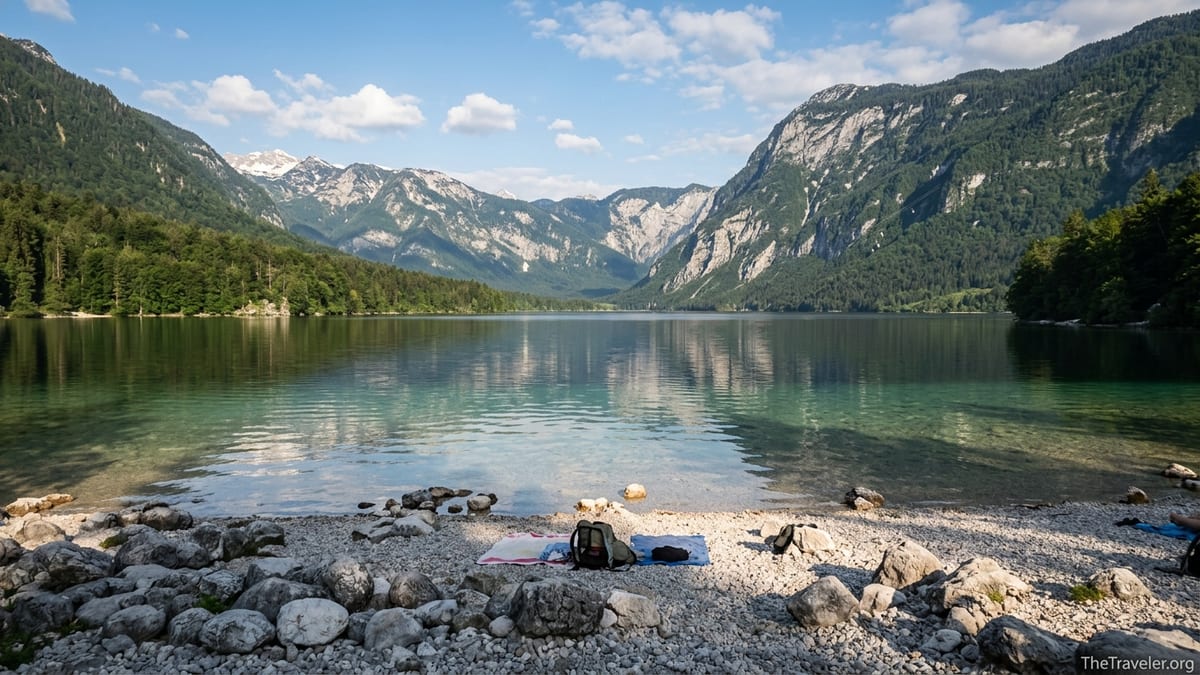
Getting Oriented: Why Lake Bohinj Is Ideal for Swimmers and Walkers
Lake Bohinj is Slovenia’s largest natural lake, stretching roughly 4 kilometers in length inside Triglav National Park. The water is cold but exceptionally clear, fed by alpine streams and underground springs, and in summer it becomes one of the country’s most popular places for swimming, kayaking and paddleboarding. Compared with Lake Bled, there are far fewer buildings right on the shore, so most of the waterfront consists of natural meadows, forest and pebble coves rather than formal, fenced off beaches.
The main settlements you will see on a map are Ribčev Laz at the eastern end of the lake and Ukanc at the western end. Ribčev Laz is where you will find the stone bridge and the Church of St John the Baptist, a cluster of guesthouses, and the most services: the tourist information center, grocery store, rental shops and the main bus stop. Ukanc, by contrast, is a scattered hamlet at the far end of the valley, surrounded by steep slopes of Mount Vogel and Komarča, with easy access to swimming spots, the Savica Waterfall trailhead and the Vogel cable car.
Because Bohinj sits fully inside a national park, there are no private beaches along the lake and the shoreline is open to the public. Instead of one main developed beach, you will choose from a string of informal access points: grassy banks where locals lay towels, shingle coves for families, and small piers where kayaks and rowing boats launch. For walkers, a mostly level trail loops around the entire lake, and within a short bus ride you can reach the famous Mostnica Gorge and Voje Valley, or ride the cable car onto the Vogel plateau for panoramic alpine routes.
Best Lake Bohinj Beaches and Swimming Spots
There are no ticketed beach clubs at Lake Bohinj, but several sections of shore stand out for swimming. One of the most popular and accessible is the grassy area near the bridge in Ribčev Laz. Here you can easily step into the lake via shallow shingle, rent a kayak or stand up paddleboard from nearby operators, and still be just a few minutes’ walk from cafés and the bus stop. In high season, this is the liveliest part of the lake, with families picnicking on the grass and people queuing for boat rentals.
Many visitors looking for more space and quieter water head to the southwest shore between the Vogel cable car station and Ukanc. This stretch has multiple small pebble coves and forest shaded banks where you can spread out a towel and slip into the lake. Parking by the cable car and in designated car parks near Ukanc is paid and can fill quickly on sunny weekends in July and August, so arriving before late morning is wise if you are driving. You will typically find toilets at the cable car base and seasonal snack kiosks, but not continuous facilities along the shoreline, so plan accordingly.
At the very western end, near Ukanc, the lake narrows and the views of the surrounding cliffs become especially dramatic. Here the water can feel slightly warmer by late afternoon after a sunny day, and because the valley closes in, this area is often sheltered from stronger breezes that can ripple the wider, eastern half of the lake. Families appreciate the gently shelving pebble entrances, where children can paddle close to shore while adults swim out toward deeper, cooler water. Do keep in mind that there are no lifeguards on duty, and the lake reaches significant depths close to the center, so weaker swimmers should stay near the shoreline.
Throughout the summer, you will see people scattered along almost the entire northern shore from Ribčev Laz towards Stara Fužina, often choosing tiny informal access points directly off the path. These spots rarely have facilities but can feel wonderfully secluded, especially early in the morning or toward evening when day trippers have left. As everywhere on the lake, you are asked to respect national park rules: no open fires or grilling right on the shore, no motorized boats for visitors, and careful disposal of all rubbish in the bins at main access points or in the villages.
Classic Lakeside Walks and Viewpoints
For many travelers, the most memorable experience at Lake Bohinj is simply walking around the water, watching the light change on the mountains and stopping to swim along the way. A full circuit of the lake on the main trail is roughly 12 kilometers, mostly flat, and usually takes 3 to 4 hours at a relaxed pace. Many people walk one side and then return by boat or bus, turning it into a comfortable half day outing rather than a full loop.
The southern shore offers extended sun and a wilder feel, with fewer buildings and more stretches of forest where the trail runs very close to the water. From Ribčev Laz, you can walk west along this side, pausing at small coves for a swim. The northern shore, by contrast, passes closer to Stara Fužina and has more meadows and open views back across the lake. On this side, you will also find access paths leading up to the village, where you can stop in a café or buy snacks before continuing.
Near Ribčev Laz, a short path leads to the pebbly eastern tip of the lake with one of the most famous postcard views: the stone bridge, church and still water framed by peaks. It is an easy sunset stroll that works for almost every visitor, including families with small children. For a slightly elevated perspective, many travelers take the cable car from Ukanc onto the Vogel plateau. The upper station, at over 1500 meters, offers sweeping views over Lake Bohinj and the surrounding Julian Alps, and several short walking trails fan out from the top, from gravel paths suitable for casual walkers to longer routes toward alpine huts for experienced hikers.
Another gentle option is the Bohinj Valley cycling and walking route that connects Bohinjska Bistrica with Ribčev Laz and Stara Fužina. Even if you do not cycle, sections of this path provide an easy, low traffic way to explore the meadows and villages behind the lake. Rental shops in Bohinjska Bistrica and Ribčev Laz offer regular and electric bikes, which can be a good choice on warm days if you want to combine lake time with a bit of countryside exploration.
Mostnica Gorge and Voje Valley: The Essential Half Day Hike
Just a few kilometers north of Lake Bohinj, above the village of Stara Fužina, the Mostnica River has carved a narrow limestone gorge that is one of the most celebrated easy hikes in the region. Local tourism boards describe the Mostnica Gorge and Voje Valley as among the most beautiful and most visited natural attractions in Bohinj. Well marked paths follow the emerald river through sculpted rock formations, across wooden bridges and up into a wider alpine valley that feels far more remote than its distance from the lake would suggest.
The usual starting point is near Stara Fužina, where you follow signs toward the gorge and cross the so called Devil’s Bridge. From here, a maintained hiking trail runs on either side of the gorge, with several bridges allowing you to swap banks for different views. Various sources describe the walking time through the gorge and on into the upper Voje Valley as between 2 and 4 hours return, depending on how far you go. If you continue all the way to the Voje waterfall and mountain hut, where simple hot meals are often served in season, you should plan on a solid half day including breaks.
Most visitors pay a modest entrance fee in the main season at ticket points near the start of the gorge; revenue goes toward maintaining bridges, signs and safety infrastructure. There is also a road into the Voje Valley that walkers and cyclists can use without passing through the narrowest part of the gorge, but this alternative misses the most dramatic sculpted rock and turquoise pools that appear in almost every brochure. Spring and early summer are particularly impressive, when snowmelt swells the river, but heavy rain can lead authorities to close the gorge trail temporarily for safety, so it is worth checking with the Bohinj tourist office before setting out.
The gorge path is generally considered family friendly, but it is still a mountain trail. Expect uneven ground, tree roots and a few narrow sections where you will want to keep children close. Good walking shoes are advisable, and in wet weather some rocks can be slippery. Because the path runs largely in the shade of forest and rock walls, it can be pleasantly cool even on hotter days, making Mostnica an excellent choice when swimming conditions at the lake feel crowded or too exposed to the sun.
Other Notable Trails: Savica Waterfall and Vogel Plateau
Another classic short outing from Lake Bohinj is the trail to Savica Waterfall at the western end of the valley. From Ukanc you either drive or take a local bus up a narrow road to a large paid car park below the waterfall. From there a waymarked path and a long flight of stone steps lead to a viewpoint that looks directly into the tall, angled cascade plunging into a turquoise pool. The walk is not long, but the steps can feel strenuous, so allowing around 1.5 to 2 hours for the round trip, including photography time and a rest at the top, is realistic for most visitors.
Above Ukanc, the Vogel cable car carries passengers in just a few minutes to a high plateau between approximately 1500 and 1900 meters. This area is home to a ski resort in winter, but in late spring, summer and early autumn it transforms into a popular hiking starting point. From the upper station you will find clearly signed routes ranging from short, mostly level circuits suitable for families to longer hikes toward peaks like Šija or more distant huts. One advantage of starting at Vogel is that you are instantly above treeline and in cooler air, with panoramic views back down to Lake Bohinj and across to other peaks of the Julian Alps.
Weather conditions on the plateau can be very different from those at lake level. Even in July and August, mornings can be cool and storms can build quickly on hot afternoons. Many visitors choose to take the first or second cable car of the day to enjoy clear views and quieter trails, then return to the lake for swimming by mid afternoon. Ticket prices for the cable car can change from season to season and may include combined offers with chairlifts higher on the plateau in summer, so it is wise to check current details with the Bohinj tourist office or official resort information when planning your budget.
For experienced hikers looking for a full day in the mountains, Bohinj is also the gateway to classic routes toward Komna, the Seven Lakes Valley and even Mount Triglav, though those longer itineraries require proper planning, equipment and often overnight stays in mountain huts. Many casual visitors, however, are fully satisfied with the combination of a morning gorge or waterfall walk and an afternoon cooling off in the lake, which makes Bohinj particularly attractive for mixed ability groups and families.
Practical Visitor Information: Getting There, Parking and Seasons
Most international travelers reach Lake Bohinj via Ljubljana. Direct buses run from Ljubljana to Bohinjska Bistrica and on to Ribčev Laz, typically several times a day in the main season, with journey times usually in the range of 2 to 2.5 hours depending on stops. From Bled, regional buses and seasonal shuttles connect to Bohinj in under an hour, which makes day trips straightforward if you are staying near Bled but still want a taste of Bohinj’s quieter atmosphere.
Driving gives greater flexibility, but parking inside the national park is tightly regulated. Around the lake and in Ukanc, most public car parks are paid, often with hourly rates that increase in July and August. Authorities regularly emphasize that roadside parking outside designated spaces is not allowed and can result in fines, especially along the busiest access roads to the lake and Savica Waterfall. A sensible routine is to park once for the day in Ribčev Laz, Stara Fužina or Ukanc, then rely on walking, buses and boats to move around.
Summer is the peak season for both swimming and hiking. Water temperatures in the lake typically remain on the cooler side, but by late July and August many visitors find them comfortable enough for long swims on sunny days. In May, June, September and early October, expect brisker water that is refreshing for short dips but may feel cold for extended swimming. Trails like the Mostnica Gorge are usually accessible from late spring to autumn, though heavy rain or high water can trigger temporary closures. Higher routes from the Vogel plateau or toward mountain huts may still have snow patches well into June.
Outside of July and August, Bohinj feels notably quieter and prices for some accommodations can be lower, though opening hours for seasonal services like rental kiosks and snack stands may be reduced. In winter, the focus shifts to skiing at Vogel and cross country routes in the wider valley. While the lake remains beautiful year round, swimming is then more the domain of dedicated cold water enthusiasts. Regardless of season, it is important to remember that weather in the Alps changes quickly, so packing a light waterproof layer and warm clothing even on seemingly settled days is prudent.
Responsible Enjoyment of Lake Bohinj’s Beaches and Trails
Because Lake Bohinj sits inside Triglav National Park, visitors are asked to follow a set of rules designed to protect the water quality and fragile lakeside habitats. This includes sticking to marked paths, refraining from camping outside designated areas and avoiding open fires or barbecues along the shore or in forest clearings. Wild camping by the lake is not permitted, and local authorities occasionally conduct checks, especially in peak season, to enforce regulations.
If you are swimming from one of the many informal coves, be mindful not to trample lakeside vegetation unnecessarily, and re enter the trail where it is clearly established rather than creating new shortcuts through meadows. When hiking in the Mostnica Gorge or on the Vogel plateau, staying on the intended routes helps prevent erosion and damage to alpine plants. Many trails have interpretive signs explaining local geology, flora and fauna. Taking a few minutes to read them can enrich your understanding of how the landscape has formed and why certain areas are particularly sensitive.
Waste management is a recurring concern around popular natural attractions. Bins are generally available at car parks, bus stops and main access points, but you should be prepared to pack out any rubbish if you picnic away from facilities. Refillable water bottles are useful, as tap water in Slovenia is widely considered safe to drink, including in Bohinj’s villages and accommodation. If you are visiting with dogs, check current rules regarding leash requirements and water access; in many parts of the lake they are allowed, but owners are expected to keep control and clean up after their pets.
Supporting local businesses that prioritize environmental responsibility can also make a difference. Choosing smaller, locally owned guesthouses in villages like Stara Fužina or Ukanc, renting kayaks or bikes from operators who respect park regulations, and using public transport or shuttle services when practical all help reduce pressure on parking and roadside congestion. In return, you often benefit from local advice on quieter swimming coves, current trail conditions and lesser known viewpoints that seldom appear on quick online searches.
The Takeaway
Lake Bohinj is one of those rare alpine destinations where you can spend a morning hiking through a dramatic gorge or up to a viewpoint, then be back at the water’s edge in time for an afternoon swim. Instead of formal resort beaches, you will discover natural coves, meadows and shaded banks that feel more like part of the landscape than separate attractions. Trails range from the flat lakeside circuit to the Mostnica Gorge and Voje Valley, Savica Waterfall steps and higher level walks on the Vogel plateau, so there is something for almost every fitness level.
To make the most of your visit, think in terms of combining experiences. A classic day might start with an early walk through Mostnica Gorge before crowds build, continue with a picnic and swim on the quieter southwestern shore near Ukanc, and finish with a sunset stroll by the bridge and church in Ribčev Laz. Another could involve a cable car ride to Vogel for morning views and short alpine walks, followed by a leisurely boat trip or shoreline walk back to your accommodation. With thoughtful planning and respect for national park guidelines, Bohinj rewards you with clear water, open space and a sense of quiet that is increasingly rare in popular European mountain regions.
FAQ
Q1. Can you swim everywhere in Lake Bohinj or only at certain beaches?
You are generally allowed to swim from most of the natural shoreline, as there are no private beaches, but you should use established access points, avoid damaging vegetation and respect any temporary local restrictions that might be in place near boat piers or protected areas.
Q2. How cold is the water in Lake Bohinj in summer?
Water temperatures vary with weather, but in July and August many visitors find the lake comfortable for regular swimming, especially in the afternoon. Early and late in the season it can feel quite brisk, so shorter dips are more common than very long swims unless you are accustomed to cooler alpine lakes.
Q3. Is the Mostnica Gorge hike suitable for young children?
The Mostnica Gorge path is widely considered family friendly, but it is still a mountain trail with uneven ground and some narrow sections. Children who are used to walking a few kilometers and can follow instructions near drop offs usually manage well, provided adults keep a close eye on them and choose a pace that allows for rest stops.
Q4. Do you need a car to explore Lake Bohinj and nearby trails?
A car gives extra flexibility, but it is not essential. Regular buses connect Bohinj with Ljubljana and Bled, and local services link Bohinjska Bistrica, Ribčev Laz, Ukanc and the Savica Waterfall access road. Many of the main walks, including the lake circuit, Mostnica Gorge and short routes from the Vogel cable car, start directly from bus stops or village centers.
Q5. Are there lifeguards on the beaches at Lake Bohinj?
Lifeguard services are limited, and most of the natural beaches and coves do not have supervision. You should treat the lake as an unsupervised swimming area, stay close to shore if you are unsure of your ability, keep children within reach, and avoid inflatables on windy days when currents and chop can increase.
Q6. When is the best time of year to visit Lake Bohinj for hiking?
Late May to early October usually offers the best conditions for most walking routes, with June, September and early October often providing a balance of milder temperatures and fewer peak season crowds. Higher altitude trails accessible from the Vogel plateau may still have snow into June, so checking recent conditions locally before tackling longer routes is sensible.
Q7. How long does it take to walk around the entire lake?
The full circuit of Lake Bohinj is roughly 12 kilometers and typically takes about 3 to 4 hours at an easy pace without long swimming stops. Many visitors prefer to walk one side, relax and swim, then return by boat or bus to avoid repeating the same stretch and to keep the outing to a comfortable half day.
Q8. Are there places to rent kayaks or paddleboards on Lake Bohinj?
Yes, several rental kiosks and small operators in Ribčev Laz and around the lake offer kayaks, canoes, rowing boats and stand up paddleboards in the main season. Prices and opening hours can vary year by year, so it is a good idea to walk the waterfront or ask at the local tourist information center when you arrive for the most up to date options.
Q9. Is the Vogel cable car worth it if I am not an experienced hiker?
Many non hikers find the Vogel cable car worthwhile for the views alone. From the upper station there are short, relatively easy walking paths and terraces where you can simply sit with a drink and look out over Lake Bohinj and the surrounding mountains without embarking on a long or technical hike.
Q10. Can I combine a visit to Lake Bled and Lake Bohinj in one day?
It is possible to visit both lakes in a single day if you start early, especially if you have a car, but it can feel rushed. Many travelers prefer to spend at least one full day at each lake, using Bled for easier access to restaurants and services and Bohinj for quieter swimming spots, longer walks and a deeper sense of being in the mountains.