


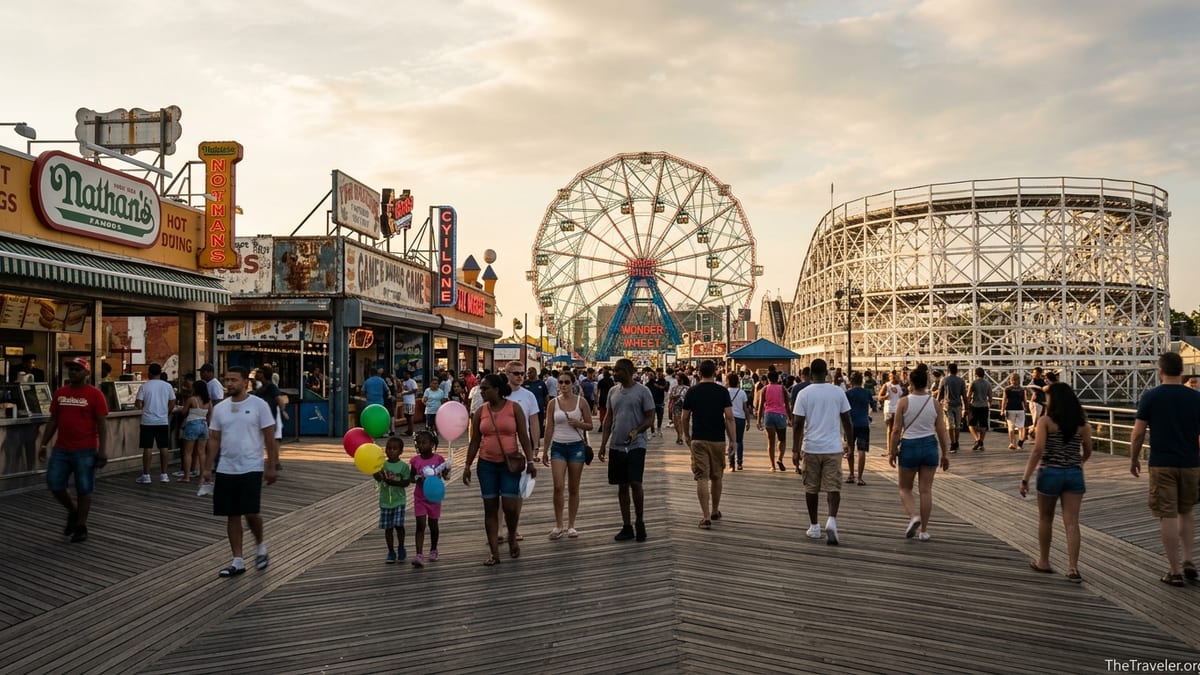
Walk out of the subway at Surf Avenue on a summer weekend and the air at Coney Island hits you all at once: the smell of salt and hot dogs, the clatter of roller coasters, the shouts from game barkers, the thump of Latin music from a portable speaker. For a moment it is hard to pin down the year. The smartphones and wristbands say the 2020s. The wood-plank boardwalk, century-old rides and hand-painted signs insist it could be 1956. That tension is exactly why the Coney Island theme park still feels like Old New York.
A Living Museum of Amusement History
Coney Island’s amusement district is not a single park but a patchwork of independent operators and overlapping gates that evolved over more than a century. In the early 1900s, three great parks shaped the myth of Coney Island: Steeplechase Park, Luna Park and Dreamland. Most of that original fantasy landscape burned or was bulldozed long ago, but enough physical and spiritual remnants survived that a walk along Surf Avenue today still feels like stepping into a living museum. The modern Luna Park, which opened in 2010, consciously nods to its namesake with stylized towers and glowing bulbs rather than sleek corporate minimalism, so the visual vocabulary of Old New York lingers even in newer steel.
The icons that did make it through the fires and the urban renewal years do a lot of the heavy lifting. The Coney Island Cyclone, the wooden roller coaster that opened in 1927 at the corner of Surf Avenue and West 10th Street, still rattles through its 75 foot first drop at about 60 miles an hour, its white latticework structure dominating the streetscape in photographs much as it did in black and white postcards decades ago. The Wonder Wheel, a 150 foot eccentric Ferris wheel that began operating in 1920 and now anchors Deno’s Wonder Wheel Park, spins slowly above the boardwalk with its mix of swinging and stationary cars, a silhouette familiar to generations of New Yorkers. These landmarked rides are not replicas; they are the same machines your grandparents might have queued for.
Even the urban fabric around the rides contributes to the time warp. Low rise buildings clad in corrugated metal or old brick still line Surf Avenue, with faded hand painted signs advertising clams, cotton candy and frozen custard. In between newer thrill rides and game concessions, you see traces of long vanished attractions in ghost signage and odd bits of concrete footing. Travelers who are used to tidy, master planned resort parks in Florida or California often remark that Coney Island looks more like a seaside carnival that never packed up, because in a sense that is exactly what happened.
The Boardwalk That Refuses to Modernize Away Its Soul
One of the strongest hits of Old New York at Coney Island comes from something very simple underfoot: the boardwalk. Officially named the Riegelmann Boardwalk after the Brooklyn borough president who championed it, this broad wooden promenade opened in the 1920s and was designated a New York City scenic landmark in 2018. That status matters. It means any reconstruction has to respect its historic character, and that is precisely what keeps the place from turning into a stretch of generic concrete waterfront.
For travelers, the feel of the boardwalk is specific and sensory. Wooden planks, sometimes replaced in sections with composite designed to mimic the original look, still stretch for miles along Coney Island and Brighton Beach. You can hear the hollow thud of strollers and the slap of flip flops on the boards. On peak summer days, families haul coolers past elderly locals in folding chairs, Russian speakers from Brighton mix with day trippers from Queens and bus tour groups from New Jersey. Street vendors grill shish kebabs or sell coconut drinks in styrofoam cups. It is chaotic, crowded and utterly urban, in a way that mirrors New York’s streets while also feeling distinctly seaside.
Recent capital projects managed by city agencies have focused on rebuilding sections of the boardwalk and nearby beaches for climate resilience, but the public stance has been clear: whatever upgrades happen, the experience should feel like a traditional boardwalk, not a minimalist esplanade. For visitors this translates into a quirky, sometimes patched together environment where painted benches, memorial plaques, vintage style lampposts and weathered rails create a patina of age. As you walk past the New York Aquarium or toward the restored B&B Carousell near the western end, you can imagine flappers in wool bathing costumes making the same stroll a century ago.
Riding the Same Rattling Rides New Yorkers Have Loved for Decades
Nothing channels Old New York at Coney Island more directly than climbing into rides that have been thrilling visitors since long before the jet age. The Cyclone is the clearest example. A ride on this nearly 100 year old wooden coaster is physically different from a modern, glass smooth steel coaster. The train clanks audibly up the chain lift, the structure flexes and creaks, and the tight turns slam riders side to side in a way that feels closer to a 1920s automobile than a futuristic spaceship. You sit in simple two person bench seats with a shared lap bar, not a sculpted over the shoulder restraint. It is noisy, a little rough and deeply analog, which is exactly the appeal.
New York City’s modern building code no longer allows a new timber supported roller coaster of this kind to be constructed from scratch, so the Cyclone occupies a strange category: an operating antique that is functionally irreplaceable. Maintenance teams quietly replace wood and hardware piece by piece behind the scenes, but the overall feel remains resolutely old fashioned. Visitors today pay per ride or use a Luna Park wristband, just as generations before bought individual tickets at small booths, and many locals mark summer by that first seasonal ride in late spring.
Deno’s Wonder Wheel offers a slower but equally historic experience. Some of its cars slide along a track within the wheel as it rotates, creating a swooping sensation that has startled riders since the era of silent films. The structure survived storms, blackouts and the city’s lean years in the 1970s, and the family that has operated it since the 1980s has cultivated its vintage charm rather than chasing the latest technology. Nearby, the dark ride Spook-A-Rama, whose roots go back to the 1950s, still lures kids with a hand painted sign and a simple premise: sit in a rattling car and get startled in the dark. Next to the LED screens and synchronized light packages of new thrill rides, these attractions feel like relics, yet their queues stay surprisingly healthy on summer Saturdays.
For travelers, there is something powerful about riding the same mechanical contraptions you see in archival photographs, not their “inspired by” replacements. Compare that to many modern parks where classic rides have been replaced rather than restored. At Coney Island, part of the thrill is knowing you are sharing not just a view but a bodily sensation with countless New Yorkers back through the decades.
Old School Eats and Sideshow Tradition on Surf Avenue
Food at Coney Island is a direct line to Old New York street life. The most obvious example is Nathan’s Famous at Surf and Stillwell Avenue, the original hot dog stand that grew into an international brand. Nathan Handwerker opened his stand in 1916 with five cent hot dogs, and while prices have changed, the basic ritual has not. Today, visitors still stand in line at the big, neon green and yellow sign, order a hot dog loaded with mustard and sauerkraut, maybe add crinkle cut fries and a lemonade, then precariously balance the cardboard tray as they dodge pigeons on the sidewalk. For around the price of a modest New York lunch elsewhere, you get a meal that tastes remarkably similar to what crowds ate here generations ago.
Surf Avenue and the side streets between the subway and the beach are dotted with other old fashioned options: clam bars serving fried calamari in paper boats, small stands advertising Italian ices, funnel cake and corn dogs, pizzerias with fluorescent lighting and aging linoleum. You will find newer, trend aware vendors too, selling craft beer or vegan tacos, but they coexist rather than replace the unpretentious, cash friendly joints that have anchored the area for decades. Eating here feels different from grabbing a burger inside a global theme park chain because you are engaging with New York’s long history of casual, immigrant driven food businesses.
Coney Island’s sideshow culture adds another layer of continuity. The tradition of live curiosities and variety acts goes back to the early 1900s, when the neighborhood was a laboratory for both technological wonders and human spectacle. Today, travelers can still duck into a sideshow theater off Surf Avenue in summer to see sword swallowers, fire eaters and burlesque performers in shows that intentionally evoke the feel of mid century Coney. The experience can be confronting or exhilarating depending on your comfort level, but it is undeniably rooted in the city’s past as a place where entertainment pushed boundaries.
Even the way barkers call out for customers feels old world. You still hear rapid fire pitches from game operators trying to coax you into popping balloons with darts or tossing rings over milk bottles, using slang and rhythms that would sound familiar to New Yorkers of earlier eras. For many travelers this human patter, as much as the flashing signs, is what makes the area feel like a living stage set of Old New York.
Grit, Crowds and a Democratic Beach Day
A polished, master planned resort might smooth away the very things that make Coney Island feel authentic. Here, a little grit is part of the appeal. Graffiti on shuttered storefronts in the off season, sand tracked across subway stairs, overflowing trash cans after a hot weekend and the occasional waft of city smells mixed with sea air all signal that this is a real New York neighborhood, not a bubble detached from the rest of the city. Visitors who expect the manicured perfection of a cruise ship port sometimes bristle at that roughness. Those who come looking for Old New York often find it reassuring.
The beach itself amplifies that impression. On a humid July afternoon, you will see multigenerational families with elaborate picnic spreads next to teenagers with Bluetooth speakers, fashion forward twenty somethings posing for social media photos, and elderly locals in folding chairs under umbrellas that look like they have been making the same trip since the 1980s. People bring everything from full hot meals to grocery store sheet cakes to the sand, blending traditions from Brooklyn’s Caribbean, Latino, South Asian and Eastern European communities. Lifeguard stands, red and white umbrellas and the grid of wooden jetties stretching into the Atlantic give the shoreline a visual continuity with mid century photographs.
Unlike many resort beaches lined with private condos or hotel loungers, Coney Island’s sandy stretch is public and free to enter. That accessibility has always made it a “people’s playground” for New Yorkers, a reputation that dates back to the days when working class families rode nickel trolleys or elevated trains from crowded tenements for a precious day of sea breeze. Modern travelers picking up a day pass for the subway still follow that pattern, often combining a museum visit in Manhattan with an afternoon at the shore. Sharing that beach with such a cross section of city life can feel like stepping into a time capsule of New York’s democratic spaces.
There is also the weathered romance of the place in the shoulder seasons. Visit on a brisk March afternoon or a sunny but chilly November day and you might find shuttered snack stands, a half empty boardwalk and gulls wheeling over closed rides. The city feels closer in those moments, with the skyscrapers of Lower Manhattan visible faintly to the west on clear days. It is easy to imagine 1940s sailors on shore leave or 1960s teenagers skipping school making similar pilgrimages to the edge of the boroughs.
Old New York Meets New Development
Part of what makes Coney Island’s old time aura so striking is that it exists alongside, and sometimes in tension with, new development. Over the past decade, residential towers have risen behind the amusement district, and chain pharmacies and fast food brands have taken over some corner lots. Luna Park has installed modern steel coasters and high tech thrill rides with digital signage and sophisticated ride systems. The New York Aquarium has expanded with contemporary exhibits and architectural styles that would not look out of place in a global city waterfront district.
Yet the core identity of the amusement zone resists being completely smoothed over. City landmark protections for pieces like the Wonder Wheel, the Cyclone and the Riegelmann Boardwalk ensure that, no matter how many sleek towers appear in the background, the foreground retains its early and mid century silhouettes. Ride operators, family businesses and local advocates have also become more intentional about celebrating the area’s history. Small exhibits by the Coney Island History Project, often installed near the boardwalk or under coaster structures, display vintage photographs, ride seats and signs, helping visitors connect what they see to what once stood on the same ground.
For travelers, the result is a layered experience. You might tap a modern contactless payment for your ride wristband at Luna Park, then step into a wooden coaster train whose layout dates to 1927. You might glance up at a new condo tower while licking salt off your fingers from a paper boat of clams that could have been served in 1935. The juxtaposition can feel jarring at first, but it is exactly this overlay of eras that defines New York itself. Coney Island simply makes those layers more visible than most neighborhoods.
There are ongoing debates about what direction the area should take, particularly as climate change threatens low lying coastal infrastructure and as land values rise. For now, day visitors still find cheap rides on independent kiddie attractions, old arcade cabinets blinking next to newer games and a visual clutter of fonts and colors that speaks to decades of trial and error rather than a single branding guide. That messy continuity is much closer to Old New York’s improvisational spirit than a sterile, fully curated entertainment complex could ever be.
Planning Your Visit Without Breaking the Spell
Experiencing Coney Island’s Old New York atmosphere is partly about timing. On summer weekends, packed trains from Manhattan spill thousands of people onto Surf Avenue at once, and the heat, noise and crowds create a heaving, almost overwhelming environment that mirrors historic descriptions of peak season in the early 1900s. If you want that maximal sensation of humanity and chaos, aim for a sunny Saturday in July or August, from midday into the evening, when rides operate late and the boardwalk stays lively well after dark.
If you prefer to appreciate the historic texture at a slower pace, consider a fair weather weekday in late May, early June or September. Many of the rides and food stands operate on reduced hours outside peak season, so it is worth checking operating calendars before committing, but when everything lines up you can stroll the boardwalk, photograph the Cyclone and Wonder Wheel without dense crowds, and listen to the Atlantic without competing sound systems. In cooler months, the amusement park rides may be closed, yet a winter walk here, bundled in a coat with a hot coffee in hand, can feel like stepping into a black and white photograph of Old New York’s off season.
Practical details help maintain the spell. The subway ride from Midtown Manhattan to Coney Island still takes around an hour, just as elevated train rides did for earlier generations coming from the tenements. Emerging from the Stillwell Avenue station directly onto the Surf Avenue chaos is part of the experience, so resist the temptation to arrive in a private car and park in an indoor garage if you want that full jolt. Comfortable walking shoes are essential; you will cover a surprising distance between the rides, aquarium, beach and side streets. Bring a little cash as well as cards, since some independent game stalls and older concessions still prefer bills for small transactions.
It is also worth planning for small moments that connect you to the past. Allow time to sit on a boardwalk bench and simply people watch, as Brooklyn families, tourists and longtime locals negotiate the shared public space. Ride both a historic attraction like the Wonder Wheel and something newer, then note how your body feels in each. Try at least one old school snack, whether a hot dog, a slice of pizza from a neighborhood stalwart or a paper cup of soft serve. These grounded experiences anchor the more abstract sense of stepping into Old New York.
The Takeaway
Coney Island’s theme park district feels like Old New York not because it is preserved in amber, but because it allows different eras to coexist in full view. Wooden coaster tracks rumble beneath new apartment towers, century old boardwalk planks carry strollers and scooters, neon hot dog signs glow next to digital ride marquees. For travelers used to tightly controlled entertainment environments, that rough edged layering can be surprising. For many New Yorkers, it is precisely what makes the place worth defending.
Spend an afternoon here and you sense the continuity: workers heading to seasonal jobs in faded park T shirts, grandparents pointing out rides they braved as teenagers, children shrieking as the Cyclone drops or as cold Atlantic water hits their ankles. The details shift with time, but the basic pattern of escape and spectacle at the edge of the city endures. As long as the Cyclone clatters, the Wonder Wheel turns and the boardwalk hums with a mix of languages and music, Coney Island will offer visitors a visceral glimpse of Old New York by the sea.
FAQ
Q1. Where exactly is the Coney Island theme park area in New York City?
Coney Island’s amusement area sits along Surf Avenue and the Riegelmann Boardwalk in the southwestern corner of Brooklyn, facing the Atlantic Ocean.
Q2. What are the must ride attractions for a first time visitor?
Most first timers prioritize the Coney Island Cyclone roller coaster, Deno’s Wonder Wheel, a spin on a modern Luna Park thrill ride and a walk on the boardwalk.
Q3. Does Coney Island really feel different from modern corporate theme parks?
Yes. The mix of historic rides, independent food stands, hand painted signs and regular city street life gives it a scruffier, more authentic Old New York feel.
Q4. When is the best time of year to visit for the full atmosphere?
Late spring through early fall offers the fullest experience, with peak Old New York energy on sunny summer weekends when all rides, games and stands are open.
Q5. Are the historic rides like the Cyclone and Wonder Wheel safe?
They are operated under modern safety regulations and inspected regularly, but they feel rougher and more intense than many newer rides because of their age and design.
Q6. Can I enjoy Coney Island in the off season when rides are closed?
Yes. Off season visits offer a quieter, atmospheric glimpse of Old New York, with nearly empty boardwalks, long views of the beach and a more contemplative mood.
Q7. Is Coney Island suitable for families with young children?
It can be very family friendly, with separate kiddie ride areas, plenty of food options and a wide sandy beach, though crowds and noise can be intense on peak days.
Q8. How much should I budget for rides and food?
Costs vary, but a modest visit with a ride wristband or a handful of individual rides plus classic snacks typically runs to the price of a mid range New York outing.
Q9. Is Coney Island safe to visit at night?
On summer evenings the boardwalk and amusement area are usually busy and well lit, though visitors should use normal big city awareness and stick to populated areas.
Q10. How do I get to Coney Island using public transportation?
You can ride several New York City subway lines to the Stillwell Avenue station in Brooklyn, which opens directly onto Surf Avenue a short walk from the rides and beach.