


If you unfold a map of Nice and draw a loose square between Boulevard Victor Hugo, Boulevard Gambetta, Place Masséna and the sea, you land in the Carré d’Or. This “Golden Square” is one of the city’s most coveted areas to stay, promising elegant Belle Époque buildings, easy access to the beach and tram, and a polished city vibe. But is Carré d’Or actually worth it as a base for your French Riviera trip, or are you better off in Old Town, the port or a quieter residential quarter? The answer depends on your budget, travel style and what you want each day in Nice to feel like.
Get the latest updates straight to your inbox!
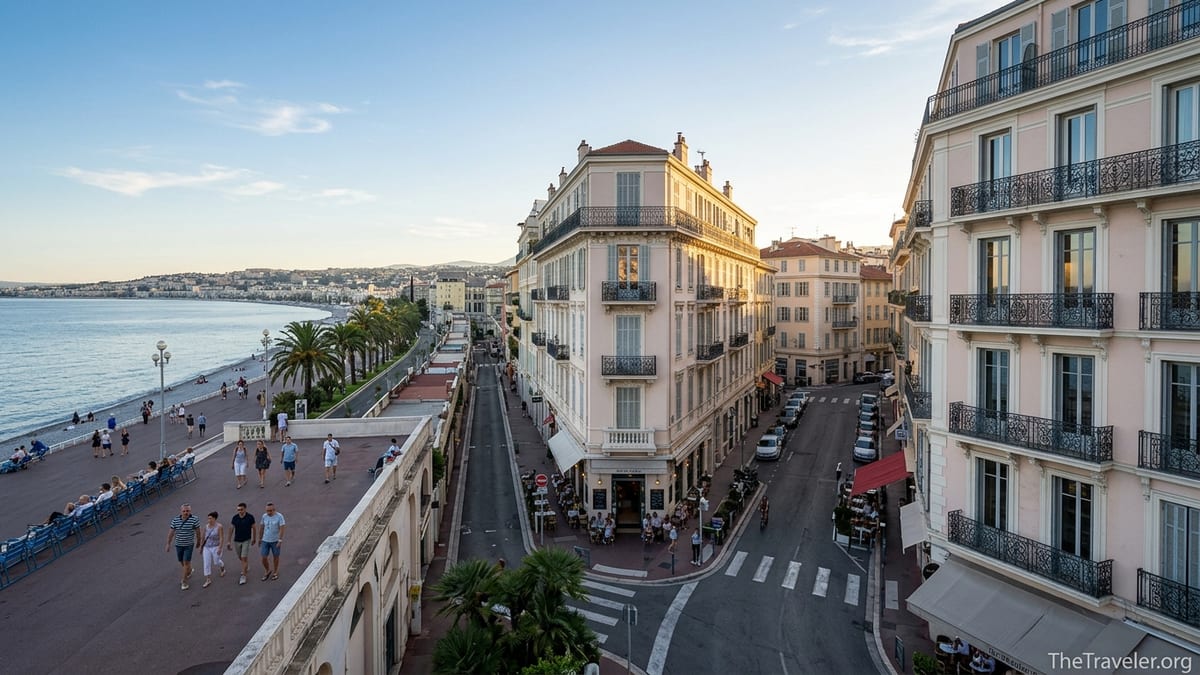
What and Where Exactly Is Carré d’Or in Nice?
Carré d’Or is not an official administrative district but a well-recognised central neighborhood. Local agencies generally place it between Rue Maccarani and Place Masséna to the east, Boulevard Victor Hugo to the north, Boulevard Gambetta to the west, and the Promenade des Anglais to the south. In practice, if you are staying around Rue de France, Rue Masséna, Rue Meyerbeer, or near Jardin Alsace-Lorraine, you are in or right on the edge of Carré d’Or.
The area sits one block back from the famous Promenade des Anglais, the seafront boulevard that runs for about seven kilometres along the Bay of Angels. From most Carré d’Or streets, you can reach the promenade and its pebble beaches in three to seven minutes on foot, simply by walking south. At the same time, Place Masséna and the edge of Old Town are roughly a 10-minute walk east, which keeps you close to the historic core without the constant noise that comes with sleeping in it.
Architecturally, Carré d’Or has a distinctly Belle Époque and early 20th-century feel: cream-coloured facades with wrought-iron balconies, grand staircases and leafy boulevards. Avenue Victor Hugo, for example, is lined with handsome apartment blocks and shaded benches, while quieter residential pockets stretch toward Gambetta. The more touristic side sits closer to Rue Masséna and Rue de France, where outdoor terraces, gelato counters and chain boutiques share space with independent bakeries and wine bars.
Understanding this geography is important when you book. A hotel advertising “Carré d’Or” that is right on Rue Masséna will place you in the liveliest part of the neighbourhood, while an apartment near Boulevard Victor Hugo or Jardin Alsace-Lorraine offers a noticeably calmer base, even though both are technically in the same area.
Access, Transport and Day‑Trip Convenience
One of Carré d’Or’s biggest advantages is how straightforward it is to get in and out of, especially from Nice Côte d’Azur Airport. Tram Line 2 runs directly from both airport terminals to the city centre, stopping at Alsace-Lorraine and Jean Médecin stations, which sit just north of Carré d’Or. The ride from the airport to these stops typically takes around 25–30 minutes, and from the tram stop you are often only a five to 10-minute walk to your accommodation, even with a suitcase.
That same Line 2 continues east to the Port Lympia area, while Line 1 intersects at Jean Médecin and carries you in a U-shaped loop through the northern centre and down to the edge of Old Town. For travellers planning day trips by train, Carré d’Or is also practical: Nice-Ville main railway station is around a 10–15 minute walk from most streets in the Golden Square, or a short hop via tram or local bus. From there, regional TER trains reach Antibes in about 20 minutes, Cannes in roughly 30–40 minutes, and Monaco in around 25 minutes, making Carré d’Or a solid base for exploring the wider Côte d’Azur without a car.
In daily life, this connectivity translates into convenience. A couple spending a long weekend might, for example, have breakfast at a café near Rue de la Buffa, stroll to the tram at Jean Médecin for a morning train to Èze-sur-Mer, climb up to Èze village, then be back on the Promenade des Anglais for a late-afternoon swim, all without ever needing a taxi. Families with strollers benefit from largely flat streets between the promenade, the tram and the station, though pavements can be narrow on some older side streets.
If you are arriving with a rental car, Carré d’Or is less ideal. Street parking is limited and mostly paid, while underground car parks like those near Place Masséna or under the Promenade can be expensive for multi-day stays. In that case, a residential area slightly farther from the sea, where long-term parking is easier, might suit better.
Atmosphere: What It Feels Like to Stay in Carré d’Or
The feel of Carré d’Or changes slightly block by block, but overall it is a polished, fairly upmarket central neighbourhood with a mix of locals and visitors. On Rue Masséna, the main pedestrian street that technically forms part of or borders the area, the energy is busy: restaurant terraces are full, buskers perform in the evenings, and in high season you hear many different languages as tourists walk between the promenade and Old Town.
Two streets north, along parts of Boulevard Victor Hugo, the vibe is much calmer, with residents walking dogs in the early morning and office workers pausing on benches at lunch. The small Jardin Alsace-Lorraine, west of Victor Hugo and still often classed within or adjacent to Carré d’Or, offers lawns, a children’s play area and shade from mature trees. Travellers who choose accommodation near this park often comment that they enjoy being able to dip into the more hectic areas around Rue de France, then retreat to quieter streets for the night.
Noise levels are an important consideration. In summertime and during events like the Nice Carnival in February, terraces on Rue de France and Rue Masséna can stay lively until late, and street musicians sometimes play amplified music. A hotel room or apartment facing one of these pedestrian streets may hear that ambiance until midnight or later, especially on weekends. By contrast, accommodations on cross streets like Rue Cronstadt or Avenue de Suède, or further north toward Victor Hugo, tend to be significantly quieter.
For many visitors, Carré d’Or’s balance is the main draw: it feels “in the city” in a way that the purely seafront promenade hotels sometimes do not, but without the intensity and crowds of staying inside the narrow alleyways of Vieux Nice. Couples on a first trip often describe it as “central but not chaotic,” which is precisely what some travellers want from an urban Riviera base.
Accommodation: Prices, Value and Types of Stays
Accommodation in Carré d’Or spans everything from small studios to grand seafront hotels, but prices are generally higher than in more residential districts north of the station or in the western stretches of the Promenade. A mid-range hotel one block back from the sea may charge noticeably less than a four-star right on the water, yet both will market themselves as Carré d’Or or “near the Golden Square.”
To give a sense of real-world pricing, seafront hotels along the Promenade within the Carré d’Or section sometimes publish winter rates for standard rooms in the low to mid hundreds of euros per night, but in July and August those same rooms can be several times higher, especially with sea views. One long-established Promenade hotel’s 2026 rate sheet lists winter prices for a sea-view junior suite in the mid-600-euro range per night, rising higher in peak season. Just a few streets inland, a well-rated boutique hotel near Place Grimaldi or Rue Meyerbeer might offer a double room in shoulder season in a more moderate band, while simple apartments up toward Victor Hugo or Gambetta can keep costs lower, especially for week-long stays.
Short-term rental apartments are common throughout Carré d’Or, especially along Rue de la Buffa, Rue Molière and side streets between Victor Hugo and the sea. A one-bedroom apartment with a small balcony five to eight minutes from the beach might command a nightly price roughly comparable to a mid-range hotel room, but will give you a kitchen and living area. Travellers who want to shop at the nearby Marché de la Buffa or local supermarkets and cook occasionally often find this good value, particularly for stays of five nights or more.
Luxury seekers will find several higher-end options in or abutting Carré d’Or, including historic palace-style properties on the Promenade, polished boutique hotels on quieter streets like Rue Meyerbeer, and designer apartments with partial sea views. The trade-off for this glamorous location is cost: if you are travelling on a tight budget, you may find that staying slightly further inland in areas like Libération or around the northern part of the tram line gives you more space for less money, even after factoring in tram fares.
Who Carré d’Or Suits Best (and Who Might Prefer Elsewhere)
Carré d’Or tends to work best for first-time visitors, couples, and travellers planning a short to medium stay who want to combine easy beach access with quick connections across the city. A pair visiting for four nights in May, for instance, might appreciate being able to walk to the Promenade des Anglais in five minutes for a morning swim, then stroll 10 minutes to Cours Saleya market in Old Town for lunch, all without needing public transport. In the evening they could return via Place Masséna, pick a restaurant on Rue Masséna or Rue de France, and still be close to their hotel.
It also suits travellers without a car who plan to do multiple day trips by train or tram. Being within a short walk of both Nice-Ville station and the airport tram line removes friction from excursion days. Someone keen to visit Antibes, Cannes and Monaco on separate days can do so easily from a Carré d’Or base without worrying about late-night buses back to a distant suburb.
Families with young children often find the quieter pockets of Carré d’Or convenient, provided they choose carefully. An apartment near Jardin Alsace-Lorraine, for example, gives access to a park, relatively wide pavements and nearby tram stops, while still keeping the beach within easy reach. However, a family pushing a stroller may not enjoy staying above a restaurant terrace on Rue Masséna in August, when closing time can be late and outdoor seating densely packed.
By contrast, travellers who prioritise characterful, historic surroundings over convenience might prefer to base themselves in Vieux Nice, even if that means more noise and steps. Those seeking a more authentically residential feel and lower prices might gravitate toward Libération, Musiciens or Fleurs, all still walkable or an easy tram ride from the centre. And anyone who values absolute quiet, especially at night, may want to stay a little further from the busiest pedestrian strips, even if they remain within the broader Carré d’Or area.
Pros and Cons of Staying in Carré d’Or
Weighing Carré d’Or against other Nice neighbourhoods is ultimately about trade-offs. On the plus side, the area’s location is hard to beat: you are usually within a 5–10 minute walk of the beach, 10–15 minutes of Old Town and the station, and close to the tram network that links airport, port and residential districts. For a three-night city break or a first visit to the Riviera, this centrality can justify the higher room rates, especially if your time in Nice is limited and you want to minimise daily commuting.
The second major advantage is choice. In Carré d’Or you will find everything from small boulangeries on Rue de la Buffa and side streets, to Italian trattorias, Niçoise bistros, cocktail bars and ice cream parlours. Supermarkets, pharmacies and specialist food shops are dotted throughout the area, so you are rarely more than a few minutes’ walk from basic amenities. This density of services makes life easier if you are travelling with children or if you prefer to self-cater some meals.
On the downside, Carré d’Or is popular and can feel crowded in high season. Restaurant terraces along the pedestrian zone may be busy well into the evening, and it is common to hear suitcase wheels on the pavement late at night as new arrivals make their way from tram stops to rentals. Prices for everyday items like coffee, drinks and casual meals can also be slightly higher than in quieter, less touristy quarters. For example, a simple espresso at a café steps from the promenade might cost more than the same drink at a neighbourhood bar up near Libération.
Another consideration is that, while Carré d’Or is elegant and pleasant, it is not the most visually dramatic part of Nice once you step back from the promenade. If your primary goal is to open your shutters directly onto the bay every morning, a seafront hotel is what you are really paying for, and those can straddle several neighbourhood labels. Conversely, if you dream of waking to the scent of a farmer’s market beneath your window and wandering medieval alleys, Old Town is where that atmosphere lives. Carré d’Or sits between these two experiences, offering a balanced but less distinctive sense of place.
How Long to Stay and When Carré d’Or Is Worth the Premium
The shorter your time in Nice, the more Carré d’Or’s convenience tends to be worth its price. For a two or three-night stop on a longer French itinerary, staying within quick walking distance of the beach, tram and Old Town helps you fit more into limited days. You can arrive from the airport via tram, drop your bags and be on the promenade within an hour of landing in many cases, without navigating bus routes or long uphill walks.
For stays of a week or more, especially during peak summer and major events, some travellers begin to feel the cost of Carré d’Or more keenly. A fortnight in a small apartment off Rue de France in July, for example, might cost significantly more than a larger place in Musiciens, Fleurs or further west along the Promenade, even though you can still reach the sea from those areas in under 15 minutes on foot. If you plan to spend long days exploring other Riviera towns, you may decide you do not need to pay extra to be just five minutes closer to the beach each morning.
Seasonality also matters. In quieter months like November or early March, central hotels in Carré d’Or sometimes run promotions that narrow the price gap with other areas. At these times, enjoying a Belle Époque balcony a short stroll from an almost empty promenade can feel like very good value. By contrast, during the Nice Carnival in February or the height of summer in July and August, nightly rates can jump and the streets become busier, which may push some visitors toward neighbouring districts that are slightly calmer.
In deciding whether Carré d’Or is “worth it” for you, think concretely about your daily rhythm. If your ideal day involves walking out of your door and being on the promenade with a coffee five minutes later, returning in the afternoon for a rest, and going out again by foot at night, the extra cost will likely feel justified. If, on the other hand, you will spend most of your time on trains and buses along the coast and value space over centrality, placing your budget into a larger apartment further out can be the smarter choice.
The Takeaway
Carré d’Or is popular for good reasons. It offers one of the best all-around bases in Nice for visitors who want to balance beach time, city wandering and Riviera day trips without a car. With the airport tram line, the proximity of Nice-Ville station, and the short walks to both Promenade des Anglais and Old Town, it delivers straightforward logistics that let you focus more on café terraces and coastal views and less on timetables.
However, its strengths come at a price, both literally and figuratively. Room rates, especially in summer, are higher than in many other parts of the city, and the most central streets can be lively late into the evening. The neighborhood’s look and feel, while elegant, sit somewhere between seafront glamour and old-town charm, which some travellers love and others find slightly anonymous compared with more distinct quarters.
If you are visiting Nice for the first time, staying three to five nights, travelling without a car and prioritising convenience, Carré d’Or is very often worth staying in. For longer, budget-conscious trips, or for travellers who care more about a specific atmosphere than about being in the centre of things, neighbouring districts like Vieux Nice, Libération, Musiciens or Fleurs may offer a better fit. In the end, Carré d’Or is not the only good choice on the French Riviera, but it is one of the safest bets for a smooth, easy introduction to Nice.
FAQ
Q1. Is Carré d’Or a good area for first-time visitors to Nice?
Yes, Carré d’Or is an excellent base for many first-time visitors because it combines quick access to the beach, Old Town and tram network. You can walk to most major sights, reach the airport by tram without changing lines, and get to Nice-Ville station easily for day trips along the coast.
Q2. How far is Carré d’Or from the Promenade des Anglais and the beach?
Most streets in Carré d’Or are one to three short blocks north of the Promenade des Anglais. In practical terms, this means you can usually walk from your hotel or apartment to the pebble beach in around three to seven minutes, depending on your exact location and walking pace.
Q3. Is Carré d’Or noisy at night?
It depends where in the area you stay. Rooms facing busy pedestrian streets like Rue Masséna or parts of Rue de France can be lively until late, especially in summer. If you want quieter nights, look for accommodation on side streets or closer to Boulevard Victor Hugo or Jardin Alsace-Lorraine, which generally see less late-night noise.
Q4. Is Carré d’Or safe?
Carré d’Or is widely considered one of the safer, more comfortable central areas of Nice. Like any busy city centre, you should still take normal precautions against pickpocketing, especially on crowded tram platforms and touristy streets, but most visitors find the area feels secure walking around in the evening.
Q5. How expensive is it to stay in Carré d’Or compared to other areas?
Prices in Carré d’Or are typically on the higher side for Nice, particularly in high season and for seafront or sea-view rooms. You can often find better value by staying a little further from the promenade or in neighbouring districts like Libération or Musiciens, although you will trade some convenience and proximity to the beach.
Q6. Is Carré d’Or better than Old Town for accommodation?
Neither is objectively better; they offer different experiences. Carré d’Or is generally more modern, less cramped and easier for beach access and transport, while Old Town offers atmospheric narrow streets and markets but can be noisier and more crowded. Many first-time visitors choose Carré d’Or for convenience and then spend plenty of time exploring Old Town on foot.
Q7. Is Carré d’Or suitable for families with children?
Yes, especially if you pick a quieter street. Families often appreciate being close to the beach, playgrounds like Jardin Alsace-Lorraine and the tram, without having to navigate steep hills. Choosing an apartment or hotel away from the loudest pedestrian strips usually results in a more restful stay with kids.
Q8. Do I need a car if I stay in Carré d’Or?
No, a car is not necessary and can even be inconvenient because parking is limited and often expensive. From Carré d’Or you can use the tram, buses and regional trains to reach the airport, neighbouring towns and local attractions, which is usually faster and simpler than driving and parking.
Q9. How many nights should I stay in Carré d’Or to explore Nice and the French Riviera?
A stay of three to five nights in Carré d’Or works well for many travellers, giving enough time to explore Nice itself and make one or two day trips to nearby destinations like Antibes, Cannes or Monaco. Longer stays are possible, but you may wish to consider a slightly less central area if you are watching your budget.
Q10. When is Carré d’Or most crowded, and should I avoid it then?
Carré d’Or is busiest in July and August and during major events such as the Nice Carnival in February. At these times, hotel prices rise and streets and restaurants are more crowded. If you prefer a quieter atmosphere and lower prices, consider visiting in late spring or early autumn, when the weather is still pleasant but crowds are thinner.