


Rising above Thessaloniki’s seafront like a stone sentry, the White Tower is the city’s most recognizable landmark and the natural starting point for understanding Greece’s northern metropolis. Part medieval fort, part Ottoman prison and now a modern museum with sweeping rooftop views, it is one of those rare sights that combines atmosphere, history and everyday local life in a single stop. This guide walks you through exactly what to expect, from museum highlights and ticket details to the best photo angles and how to pair your visit with a leisurely stroll along the waterfront promenade.
Get the latest updates straight to your inbox!
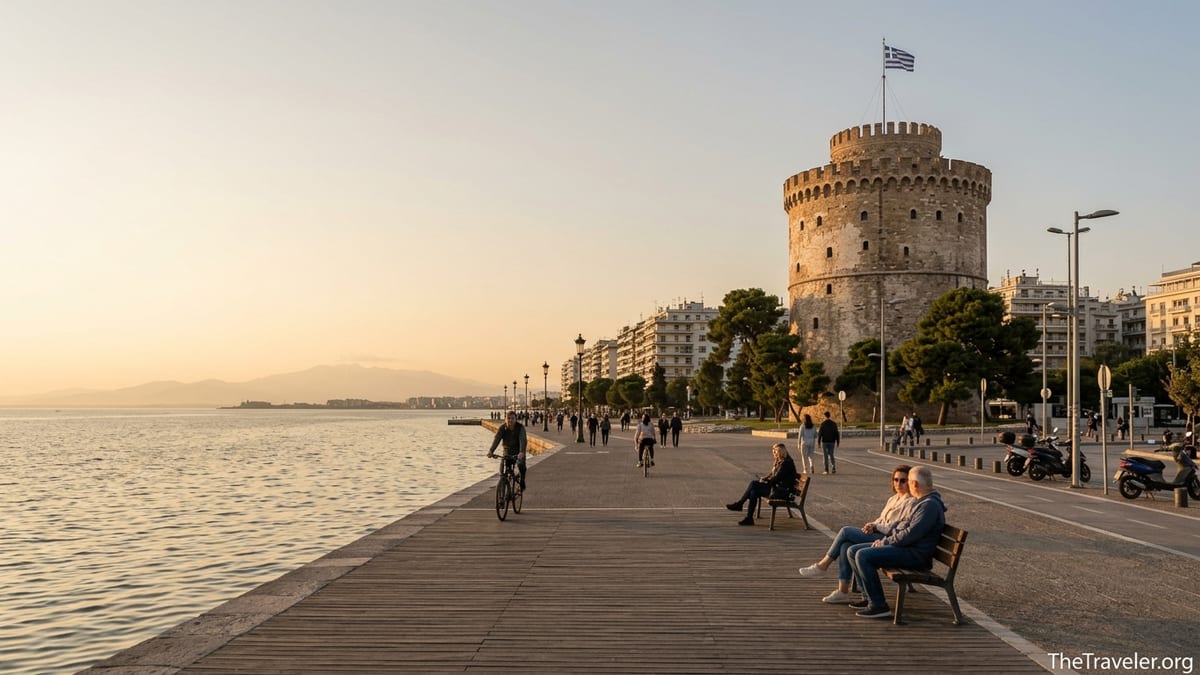
What Is the White Tower and Why It Matters
The White Tower of Thessaloniki is a 15th century fortification built during the Ottoman period to guard the city’s harbor and seafront walls. Today it stands almost alone on the promenade, but it was once part of a defensive chain of walls that enclosed Thessaloniki on three sides. The tower is cylindrical, about 34 meters high with six main floors, crowned by an open rooftop terrace that now offers some of the best panoramic views over the Thermaic Gulf and the city’s urban sprawl.
Over the centuries the building has had multiple names and reputations. In Ottoman times it was used as a prison and execution site, earning grim nicknames that translated as “Tower of Blood” or “Red Tower.” In the late 19th century its walls were whitewashed as part of a symbolic attempt to cleanse its past, and the current name “White Tower” stuck. Locals still meet “at the Tower” as a central rendezvous point, the way people in other cities might say “see you at the cathedral” or “by the main square fountain.”
Today the White Tower functions as both monument and museum, run by the Museum of Byzantine Culture. Inside, a permanent exhibition tells the story of Thessaloniki from its founding under King Cassander in the 4th century BC through Roman, Byzantine and Ottoman eras to the modern Greek city. Because you experience this history as you spiral up through the tower’s stone interior, the building itself becomes one of the main “exhibits,” giving a strong sense of how the seafront once looked and felt when cannons, not cameras, lined these walls.
For most visitors, the White Tower is also their first up-close encounter with Thessaloniki’s waterfront. Step out from the shaded square around its base and you immediately hit the promenade that runs in both directions along the sea. Sailboat bars, buskers, families with strollers, joggers and street vendors all orbit the tower, especially late afternoon and at sunset. It is both a museum and a living part of the city’s daily rhythm.
Visiting the Museum Inside the Tower
Entering the White Tower feels a little like stepping into a stone time capsule. The museum exhibition begins on the lower level and then continues as you climb a gentle series of ramps and staircases up through the six floors. Each level is dedicated to a different theme in the city’s history: Thessaloniki as a Roman port, as a Byzantine religious center, as an Ottoman multicultural hub and as a modern Greek city shaped by refugees and trade. Rather than room after room of glass cases, you find a mix of multimedia displays, models, maps and carefully selected objects.
For example, one floor uses large wall-sized maps and port reconstructions to explain Thessaloniki’s role as a key harbor on the Aegean trade routes. Another focuses on daily urban life, with audio recordings of people describing markets, workshops and neighborhoods in different periods. Families often linger at the interactive screens where children can tap through old city plans or zoom in on details of mosaics and churches they may later visit in town. Because most explanations are available in Greek and English, international visitors can comfortably follow along without needing a guidebook in hand.
The tower’s architecture is part of the experience. The spiral ramp hugs the thick outer wall and the inner space opens down to the lower levels, so you constantly see stone arches, arrow slits and small windows looking out to the sea. On cooler days you can feel drafts through the old masonry, a reminder that this was built as a defensive work rather than a comfortable residence. There are benches on some landings where you can pause, especially useful for anyone who needs to catch their breath while climbing.
Most visits take about 60 to 90 minutes, including time on the roof. If you are combining the tower with the nearby Museum of Byzantine Culture or the Archaeological Museum the same day, plan at least a half day overall. There are no cafés or shops inside the tower itself beyond a small ticket area, so many travelers grab coffee or a koulouri (sesame bread ring) from street vendors around the base before or after their visit.
Views from the Rooftop: What You See
The open terrace at the top of the White Tower is the highlight for many visitors. From here, Thessaloniki’s geography finally makes sense. Looking out over the Thermaic Gulf, you see the curve of the bay and, on clear days, the silhouette of Mount Olympus on the opposite shore. Turn inland and the city rises in layers: the flat modern center behind the waterfront, then the denser apartment blocks climbing up to the old upper town and Byzantine walls on the hills.
Directly below, the promenade runs in a long line to the west along Nikis Avenue towards the port and Aristotelous Square, and to the east it opens into the newer landscaped waterfront gardens stretching to the Concert Hall. You can pick out familiar landmarks easily. The equestrian statue of Alexander the Great stands a short walk to the west, often with school groups clustered around it, while the Zongolopoulos “Umbrellas” sculpture lies further east along the promenade, a favorite subject for photographers at dusk.
The rooftop is open-air with a low parapet, so it can be windy, especially in spring and autumn. In summer the midday sun can be strong; late afternoon and early evening are more comfortable and give better light for photography. Visitors who come around golden hour are often rewarded with soft light on the tower’s stone and warm tones over the water. In winter, the view can feel moody and atmospheric, particularly when low clouds hang over the gulf and the city’s lights start to flicker on before dinner time.
There is no seating on the roof, so expect to stand or lean on the wall while you take in the panorama. Even so, many travelers end up staying longer than planned, tracing walking routes they have already followed or spotting neighborhoods they plan to explore later. The sense of continuity between the ancient harbor defenses under your feet and the modern city buzzing below is one of the most memorable impressions of Thessaloniki.
Tickets, Opening Hours and Practical Tips
The White Tower is managed as a state monument and museum, which means its tickets and opening hours broadly follow the pattern of other Greek archaeological sites and museums. Opening times can vary slightly between summer and winter, but typically the tower opens in the morning and closes in the late afternoon or early evening, with extended hours in the high summer season. It is safest to plan your visit between late morning and mid-afternoon, and to avoid cutting it too close to closing time, as last entry is earlier than the posted closing hour.
Ticket prices are usually aligned with other major museums in Thessaloniki. A standard adult ticket is in the range that visitors expect for a national museum in Greece, with reduced rates for students, young people from EU countries and seniors, and free admission for specific categories such as children up to a certain age and accredited guides. On designated free admission days for Greek state museums, like International Museum Day or certain national holidays, entry to the White Tower may also be free, which can attract more local visitors and school groups.
Many travelers choose to buy a combined ticket that includes the White Tower and the Museum of Byzantine Culture, and sometimes other museums in the same network. This can be good value if you plan a museum-focused day. Combined tickets typically remain valid for several days, so you do not need to see everything on the same afternoon. In busier months such as July and August it is worth checking whether timed entry or online tickets are available to avoid queues, although many visitors still purchase tickets directly at the small booth at the tower’s base.
From a practical standpoint, the interior involves multiple levels connected by ramps and stairways, and there is no large elevator to the roof, so anyone with significant mobility issues may find the climb challenging. Wear comfortable shoes with good grip, particularly in wet weather when stone surfaces can be slick. Inside temperatures follow the season; the thick walls keep it relatively cool in summer compared with the outside heat, but in winter the tower can feel chilly, so bringing an extra layer is sensible. Photography without flash is generally permitted inside, but tripods are usually not allowed for safety reasons, so plan accordingly if you are carrying heavier equipment.
Best Photo Spots In and Around the White Tower
The White Tower is one of the most photographed places in northern Greece, and with good reason. For a classic postcard-style shot, the most popular angle is from the promenade west of the tower, with the cylindrical structure framed by trees and the sea in the foreground. Early morning works well if you want softer light and fewer people; by late afternoon the seafront fills with walkers, street vendors and performers, which adds energy to more candid, documentary-style images.
Another strong angle is from the small park and fountain area inland from the tower, where you can position the tower rising above the tree canopy with bits of city life in the frame: children playing, locals sitting on benches, or cyclists weaving through. Just across the promenade, looking back from the edge of the wooden deck over the water, you can capture the tower with the city’s apartment blocks stretching behind it, emphasizing Thessaloniki’s character as a lived-in port city rather than a museum piece.
Inside, the small windows and arrow slits on each level create natural frames for the seafront and skyline. Many photographers like to shoot through these openings to contrast the rough stone and ironwork with the bright blue of the gulf outside. On the rooftop, a popular composition is to place the curve of the parapet in the foreground leading the viewer’s eye out to the bay, or to shoot along the line of the waterfront towards the port cranes in the distance. Be mindful of wind on the terrace; use a secure strap for your camera or phone, and keep a firm grip when leaning out over the parapet.
When the light starts to soften towards sunset, it is worth walking a few minutes east along the promenade towards the Umbrellas sculpture. From here you can look back and include the tower in a wider panorama of the waterfront, with the promenade’s boardwalk, joggers and cyclists in the foreground. At blue hour, once the sky deepens and the city lights come on, longer exposures can capture reflections on the water, especially from the boats moored near the tower that operate as floating cafés and bars. Even with a simple smartphone camera, steadying your hands on the parapet or railings can significantly improve low-light shots.
Waterfront Walks and Nearby Sights
One of the great advantages of visiting the White Tower is that you step out directly onto Thessaloniki’s waterfront promenade. To the west, a flat walk of about 10 to 15 minutes along Nikis Avenue brings you to Aristotelous Square, the city’s grand central plaza facing the sea. This stretch, often called the old waterfront, is lined with cafés where locals sit with freddo espresso and watch the sunset. You will also see ticket sellers for short boat cruises that depart from near the tower or the square, offering hour-long trips out into the gulf, often with a drink included.
In the other direction, heading east from the tower, the promenade opens into the New Waterfront, a 3.5 kilometer stretch of modern landscaped parks and themed gardens that continues to the Thessaloniki Concert Hall. As you walk, you pass a series of small parks with different atmospheres: playgrounds, water features, quiet lawns and seating areas under pine trees. Families and runners especially favor this side of the promenade. It is easy to turn the tower visit into a relaxed one or two hour walk, stopping at the Alexander the Great statue, then continuing on to the Umbrellas sculpture and beyond.
Behind the tower, just a short walk inland, lie several important museums and green spaces. The Museum of Byzantine Culture and the Archaeological Museum of Thessaloniki are both within 10 to 15 minutes on foot and are logical follow-ups if the tower has sparked your interest in the city’s past. There is also a large park area and open spaces nearby where locals gather, particularly during festivals and public events at the International Exhibition Center.
Practically, the tower area functions as a transport hub. City buses run along the main boulevards behind it, taxis line up nearby, and rental bike schemes sometimes have docking stations along the promenade, making it easy to connect a visit here with other parts of the city. Because the streets behind the seafront can be busy and parking is limited, many visitors find it simpler to walk or use public transport rather than drive right to the tower.
A Short History of the White Tower and Its City
The White Tower’s story reflects Thessaloniki’s layered history. The current structure dates to roughly the 15th century under Ottoman rule, probably replacing an earlier Byzantine tower on the same spot that guarded the harbor and the eastern sea walls. Positioned at the edge of the city’s defenses, it controlled both maritime traffic and access along the waterfront, which was then dominated by fortified walls rather than open promenades.
During the Ottoman period, the tower became notorious as a prison and place of execution. Historical accounts describe it housing long-term convicts and political prisoners, including members of the Janissary corps when they fell out of favor with the sultan. The name “Tower of Blood” or “Red Tower” is thought to come from this era, and stories about chained inmates and mass executions became part of local lore. Although the most sensational legends are hard to confirm in detail, they show how strongly the building was associated with punishment and fear.
In the late 19th century, as Thessaloniki modernized and the Ottoman authorities sought to reshape the city’s image, the tower’s exterior was whitewashed as part of broader renovation works, contributing to its current name. After the city became part of the modern Greek state in the early 20th century, the sea walls were gradually removed and the seafront reconfigured. The tower lost its defensive function but gained a new role as a civic symbol, appearing on postcards, tourist brochures and even logos representing Thessaloniki.
By the late 20th and early 21st centuries, restoration projects transformed the interior into a modern exhibition space. At the same time, the redevelopment of the New Waterfront turned the area around the tower from a partially industrial harbor edge into a pedestrian-friendly promenade with parks and cultural venues. Today, the White Tower no longer stands as a symbol of fear but as a proud emblem of Thessaloniki’s long continuity from ancient port to contemporary cultural city.
Is the White Tower Worth Visiting?
For most travelers, the White Tower is absolutely worth including in a Thessaloniki itinerary, especially if it is your first time in the city. It offers a compact, visually engaging introduction to local history without requiring half a day to explore, and the combination of museum visit and rooftop view makes it feel like good value for the ticket price. Visitors frequently mention that the view from the top helped them orient themselves, making it easier to understand how the waterfront, city center and upper town fit together.
If you are traveling with family, the tower works well as a shared activity. Children often enjoy the climb, the slightly “castle-like” atmosphere and the interactive displays, while adults appreciate the historical context and the chance to linger over the cityscape on the roof. Pairing the visit with an ice cream or snack on the promenade, or a playground stop in one of the nearby waterfront gardens, can turn it into a relaxed outing rather than a rushed checklist stop.
Travelers on very tight schedules sometimes wonder whether to prioritize the tower or other sights. If you only have a few hours in Thessaloniki, you could combine a quick visit inside the tower with a stroll along the waterfront and a coffee on Nikis Avenue, which together give a surprisingly rich sense of the city. If you have deeper interests in archaeology or Byzantine art, you will likely want to combine the tower with the Archaeological Museum and Museum of Byzantine Culture, but the tower remains the most iconic single building in town and the one that many people remember most vividly afterward.
Those who might consider skipping it are visitors who strongly dislike indoor spaces, have significant mobility challenges with stairs, or have already climbed many similar towers in other European cities and feel less need for another. Even then, the area around the base is a pleasant place to sit on a bench, people-watch and take photographs of the tower’s exterior without going inside.
The Takeaway
The White Tower is more than just Thessaloniki’s logo-friendly landmark. It is a compact vessel of history, housing a thoughtfully designed museum that traces the city’s evolution from ancient harbor to modern cultural center. The climb through its stone interior is atmospheric without being overwhelming, and the rooftop terrace delivers a sweeping view that helps visitors understand both the geography and the energy of Greece’s second city.
Because it stands at the hinge point of the old and new waterfront promenades, a visit here naturally extends into a walk along the sea, whether towards the cafés and city buzz of Aristotelous Square or the quieter gardens leading to the Concert Hall. Coffee stands, street musicians, school groups and locals using the promenade for their evening stroll all make the tower feel woven into daily life rather than isolated as a monument.
With reasonable ticket prices, manageable visiting times and convenient connections to nearby museums and parks, the White Tower fits easily into almost any Thessaloniki itinerary. Whether you come for the views, the history or simply to say you have stood at the city’s most famous point, you are likely to leave with a better sense of what makes Thessaloniki distinct: a port city that has faced the sea for centuries and carries its layered past into the present with pride.
FAQ
Q1. Where is the White Tower located in Thessaloniki?
The White Tower stands on the central waterfront promenade at the eastern end of Nikis Avenue, where the old seafront meets the newer landscaped waterfront parks.
Q2. How long does a typical visit to the White Tower take?
Most visitors spend about 60 to 90 minutes inside, which includes time to explore the museum on each level and linger on the rooftop terrace for the views.
Q3. What are the usual opening hours for the White Tower?
Opening hours vary by season, but the tower generally opens in the morning and closes in the late afternoon or early evening, with longer hours in summer.
Q4. Do I need to book tickets to the White Tower in advance?
Many people still buy tickets on the spot, but in high season it is advisable to check if online or timed tickets are offered to reduce waiting times.
Q5. Is the White Tower suitable for visitors with limited mobility?
The tower has multiple levels connected by ramps and stairs, and there is no large lift to the rooftop, so visitors with serious mobility issues may find the climb difficult.
Q6. Are there guided tours available inside the White Tower?
At times, guided tours are offered through the museum or local tour companies, but individual visitors usually explore independently using the bilingual displays.
Q7. Can I take photos inside the White Tower and on the roof?
Photography without flash is generally allowed throughout the museum and on the rooftop terrace, but large tripods or lighting equipment are typically not permitted.
Q8. Is the White Tower a good place to visit with children?
Yes, many families enjoy the tower; children often like the spiral climb, the interactive exhibits and the chance to spot city landmarks from the rooftop.
Q9. What other attractions can I combine with a visit to the White Tower?
Nearby sights include the waterfront promenade, the Alexander the Great statue, the Museum of Byzantine Culture, the Archaeological Museum and the themed gardens of the New Waterfront.
Q10. When is the best time of day to visit the White Tower?
Late afternoon and early evening are ideal for softer light, more comfortable temperatures and especially for enjoying sunset views over the Thermaic Gulf from the rooftop.