


Galata Tower is one of Istanbul’s most photogenic landmarks and a fixture on almost every first-time itinerary. Yet many visitors are surprised by how much the timing of their visit affects both their photos and their overall experience. Light, crowds, weather and even the day of the week can completely change what it feels like to stand on that circular viewing terrace and look out over the Golden Horn and Bosphorus. This guide breaks down the best time to visit Galata Tower for photography and crowd levels, using current 2026 visiting patterns, so you can pick the moment that fits your style rather than leaving it to chance.
Get the latest updates straight to your inbox!
Understanding Galata Tower’s Current Hours and Crowd Patterns
Since its post-restoration reopening to the public in May 2024, Galata Tower has operated with controlled entry and capped visitor numbers per hour. As of mid-2026, published hours typically run from around 8:30 in the morning to late evening, with last entry roughly one hour before closing. Exact times can shift slightly between seasons and special events, so it is worth checking the official listing shortly before you go, especially if you are planning a sunset or night visit when last entry matters most.
Crowd patterns follow a predictable rhythm. On a normal weekday, the quietest period is the first 60 to 90 minutes after opening, when tour buses have not yet arrived and most city tours are still on their morning mosque and palace stops. The late morning window from about 11:00 to 14:00 is busier, especially from April through October. Late afternoon and sunset are the peak visitation times, with queues stretching across the small plaza on popular days. After full dark, numbers drop again, and there is often a more relaxed flow of visitors heading up to see the lights across the city.
Online crowd calendars and recent trip reports from 2025 and 2026 show especially high demand on Friday evenings, Saturdays and public holiday periods. In summer, you can easily wait 30 to 45 minutes to enter if you arrive in the last hour before sunset without a pre-booked time slot. In winter, the pattern is similar but less intense, with shorter lines and a more local crowd. Understanding these dynamics makes it easier to decide whether the best time for you is the peaceful early morning, the golden glow of sunset or the twinkling panorama after nightfall.
Morning Light: Soft Tones, Quiet Streets and Cleaner Air
For many photographers and travelers who dislike crowds, the best time to visit Galata Tower is right after it opens in the morning. In spring and autumn, that usually means entering between 8:30 and 9:00, when the air above the Golden Horn tends to be clearer and you are more likely to see the silhouettes of the Princes’ Islands on the horizon. At this hour, you can often walk straight to the ticket control with little or no queue, even on days when sunset slots are fully booked or lined with tour groups.
Light quality is another strong argument for a morning visit. The sun rises over the Asian side of Istanbul, so from the tower’s viewing terrace you get soft, angled light falling across the domes and minarets of the Historic Peninsula. Details on landmarks such as the Suleymaniye Mosque and Galata Bridge are easier to expose correctly because the contrast is lower than at midday. Photographers using a small mirrorless body with a 24–70 mm lens will find that around 9:00 the city still carries a gentle haze that adds depth without turning into heavy smog, which sometimes builds later in the day during the hotter months.
Mornings also work beautifully if your main focus is street photography in the Galata and Karaköy neighborhoods rather than the view from the top. Streets like Büyük Hendek Caddesi and the cobbled lanes leading up from Karaköy Square are far less busy before 10:00. You can capture scenes of delivery vans unloading, locals heading to work, and cats stretching in doorways beneath the tower without constantly dodging tour groups and tripods. Many local photographers schedule portrait or “flying dress” sessions around Galata just after sunrise because they know that once the cafés fill and tour groups arrive, it becomes much harder to work without intrusions in the frame.
Sunset and Golden Hour: Iconic Views with Serious Crowds
Sunset from Galata Tower is the classic postcard moment and, for many visitors, the main reason they buy a ticket. During golden hour, roughly the last 45 to 60 minutes before sunset, the stone of the tower takes on an amber color and the city’s skyline turns warm and layered. The sun drops over the hills beyond Beyoğlu and Üsküdar, reflecting in the Bosphorus and tracing the outlines of ferries and mosques. Photo agencies regularly use this period to shoot editorial spreads featuring the tower and the Golden Horn because the light is forgiving, flattering and dramatic without being harsh.
The trade-off is crowd pressure. On a clear weekend between May and October, arriving at the tower only 10 or 15 minutes before sunset is almost guaranteed to mean a queue at street level, another small bottleneck at the elevator, and a crowded terrace where people stack two or three deep at the railings. Local guides in 2025 and 2026 commonly recommend arriving at least 45 minutes before the calculated sunset time, and many seasoned photographers aim for a full hour. For example, if sunset is at 20:20 in June, you would want to be through security around 19:15 to secure a good spot along the terrace and to allow for elevator waits.
Sunset also reveals the value of flexible gear and patience. A smartphone can do a respectable job, but a camera with a wider lens, around 20 to 24 mm on full frame, will help you capture both the immediate foreground and the sweep of the Bosphorus and Historic Peninsula. Consider taking a soft cloth to clear sea spray or fingerprints, since you will likely shoot with the sun low in frame. Some photographers bring a small rubber lens hood to block flare when they cannot move freely along the railing. If you are not fond of standing in a crowd, an alternative is to watch the sunset from the Galata Bridge or from a café rooftop in Karaköy that frames the tower against the orange sky, then go up the tower later during blue hour when the pressure has eased.
Blue Hour and Night: City Lights, Long Exposures and Quieter Terraces
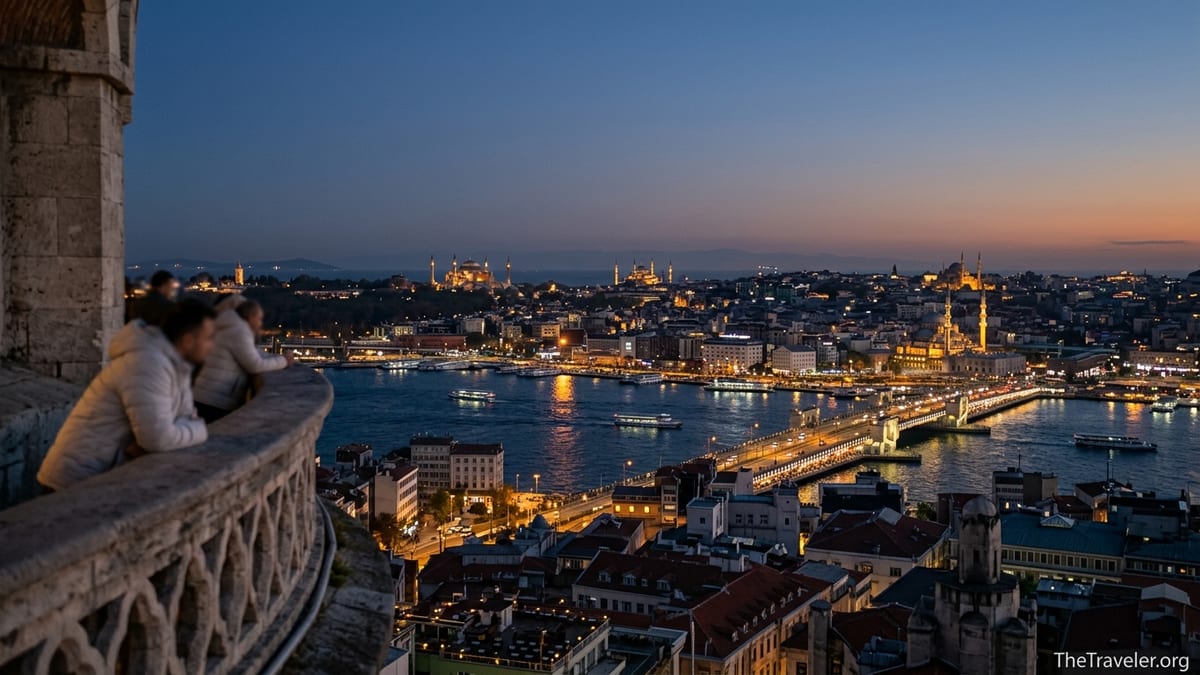
Blue hour, the 20 to 40 minutes after sunset when the sky turns a deep indigo but before it becomes fully black, is a sweet spot for both mood and crowd levels. Many visitors start leaving soon after the sun disappears, so the terrace becomes less congested just as the city lights switch on. The mosques across the Golden Horn glow with warm illumination, ferries trace light paths on the water, and the Galata Bridge becomes a line of car headlights. For photographers, this is the ideal time to capture a balanced exposure where the sky is not yet a featureless black and the artificial lights have begun to sparkle.
By full night, particularly after 21:30 on weekdays, Galata Tower is noticeably calmer. Couples, small groups of friends and solo travelers linger on the terrace, taking in the 360-degree panorama. It is still not empty in high season, but you are more likely to find uninterrupted railing space and time to experiment with your shots. Some visitors report that a nighttime visit in winter feels almost intimate, with crisp air, clear views and just a few other people stepping around the walkway at a slow pace.
For night photography, you will need to adapt to the tower’s practical constraints. Tripods are often discouraged or at least impractical in tight spaces, so a camera with good high ISO performance and a fast prime lens, such as a 24 mm f/1.8, is a real asset. Handheld exposures between 1/30 and 1/60 of a second at ISO values around 3200 to 6400 can still produce crisp images in modern cameras. Even if you are relying on a recent smartphone, using its dedicated night mode and steadying your elbows on the stone railing will dramatically sharpen your results. The payoff is the sight of ferries crossing the dark Bosphorus and the illuminated Galata Bridge snaking across the Golden Horn below.
Weekdays, Weekends and Rainy Days: How Timing Shapes the Experience
Day of the week has a clear impact on both the wait time and the feel of a Galata Tower visit. From Monday to Thursday outside local school holidays, mornings and late evenings are generally relaxed, with only a moderate bump at sunset. Friday evening behaves more like a weekend, as local visitors and domestic tourists join international travelers for after-work outings. Saturdays are typically the most crowded, with long queues building from late morning and peaking around sunset. Sundays can be slightly calmer in the very early hours, but from late afternoon through evening they again become busy with local families and groups.
Weather adds another layer to the timing puzzle. Rainy days or moody, overcast conditions often deter casual visitors, which can work in your favor if your goal is crowd-free photos or a contemplative experience. Light drizzle or patchy clouds in autumn can create striking atmospheres, with shafts of light breaking through over the Golden Horn and reflections glowing on the wet rooftops. A traveler in early November might find that arriving at 9:00 on a grey weekday morning yields almost uninterrupted views from the terrace and soft, diffused light ideal for both skyline and portrait shots.
On the other hand, heavy fog or dense low cloud, which can occur during winter, may obscure much of the view and make the ticket price feel less worthwhile. In those conditions, you might choose to photograph the exterior of the tower and the surrounding streets instead of going up. Seasonal temperatures matter too: in July and August, the exposed terrace can feel hot and humid in the middle of the day, making early morning and late evening even more attractive. In January, cold winds off the Bosphorus can be bracing at night, so packing gloves and a hat will make long exposure sessions much more comfortable.
How Early to Arrive for Better Photos and Less Waiting
How early you should arrive at Galata Tower depends on what you value most: a specific light condition, minimal waiting, or both. For a standard weekday morning visit with photography in mind, a realistic strategy is to reach the base of the tower within the first 30 minutes of opening. If doors open at 8:30, plan to be in the square by 8:20 so you are among the first to enter. This timing greatly increases your chances of stepping onto a relatively quiet terrace, moving freely around the 360-degree walkway, and shooting multiple angles without waiting for gaps in the crowd.
For sunset, a more aggressive buffer is warranted. In high season or on weekends, arriving 60 minutes before the published sunset time is a good rule of thumb. That allows for ticket checks, security, elevator loading and the natural bottleneck where people pause immediately after they step onto the terrace. By giving yourself that margin, you can claim a spot at the railing in the direction you prefer, whether that is south toward the mosques of the Historic Peninsula, east over the Bosphorus toward Asia, or north up the spine of Istiklal Avenue. If you show up only 20 minutes before sunset on a clear Saturday in June, you are likely to spend most of the golden light either in a queue or behind several rows of people.
At night, you can be more flexible. If last entry is at 22:00, arriving between 20:30 and 21:00 usually strikes a balance between seeing the city fully dark and avoiding the crush of sunset. In practice, that means you might stroll up after dinner in Karaköy or Beyoğlu, buy your ticket with a short wait, and enjoy both the tail end of blue hour and the full night scene. Regardless of timing, an often-overlooked detail is the descent: because visitors walk down via the interior stairs, factor in 10 to 20 minutes for a gradual exit, especially if you have mobility issues or are traveling with children.
Positioning, Angles and Practical Photo Tips
Getting the most from Galata Tower is not only about when you visit, but also how you move and where you stand once you are on the terrace. The viewing gallery is a continuous ring with railings, and different sections offer slightly different compositions. Looking south and southeast gives you classic views over the Golden Horn to the domes and minarets of the Historic Peninsula, including Hagia Sophia and the Blue Mosque. Turning east and northeast shows the Bosphorus stretching toward the Black Sea, with ferries, cargo ships and the hills of Asia in the distance. Facing west and northwest reveals the dense streets of Beyoğlu, the spine of Istiklal Avenue and, further out, the modern high-rises of the business districts.
If your priority is classic skyline shots, aim first for the section of terrace looking toward the Historic Peninsula. This is where most visitors head instinctively, so it can become congested near sunset. During quieter times, you can experiment with tighter framings, such as isolating Suleymaniye Mosque above the Golden Horn with a short telephoto lens in the 70 to 100 mm range. If you enjoy including human elements in your compositions, consider facing toward Karaköy and watching for ferries, fishing boats and crowds along the waterfront as the light changes.
For those shooting with smartphones, simple techniques can make a big difference. Cleaning the lens before stepping out onto the terrace, tapping to expose for the brightest part of the sky, and using the built-in ultra-wide mode sparingly all help preserve detail. On many modern phones, switching to a 2x or 3x zoom for a few frames lets you pull out specific landmarks without digital noise overwhelming the image. If reflexive hand shake is a problem, lean your forearms against the stone or metal railing to steady your body, especially during blue hour and night.
Finally, remember that some of your best Galata Tower photos may not be from the top at all. The streets below offer countless framing opportunities, from the classic upward view along the steep, cobbled alley of Büyük Hendek Caddesi to more modern angles from café rooftops in Karaköy. Arriving early in the morning or lingering after dark when the tower is illuminated allows you to shoot these perspectives without constant foot traffic blocking your composition. Combining ground-level shots with images from the terrace will give you a more complete visual story of your visit.
The Takeaway
There is no single “best” time of day to visit Galata Tower that works for every traveler. Instead, each time band offers a distinct mix of light, atmosphere and crowd levels. Early mornings provide soft light, cooler temperatures and the calmest experience, ideal for thoughtful photography and relaxed exploration of the surrounding streets. Sunset delivers the most dramatic views but also the heaviest crowds, demanding advance planning and an early arrival if you want prime positions. Blue hour and night visits reward those who enjoy city lights and are comfortable shooting in lower light, often with fewer people around.
When planning your own visit, match your priorities to the conditions. If you hate queues and prefer subtle images, block off the first hour after opening on a weekday and pair the tower with a walk across the Galata Bridge. If you are determined to capture that golden skyline shot, secure a ticket in advance if possible, reach the base of the tower at least an hour before sunset, and be patient on the terrace. For a more romantic or contemplative mood, aim for blue hour or a clear winter night when the air is crisp and the lights seem to float above the water. With a bit of timing strategy and realistic expectations about crowds, Galata Tower can easily become one of the most memorable moments of your time in Istanbul.
FAQ
Q1. Is morning or sunset better for visiting Galata Tower?
Morning usually offers softer light, clearer air and fewer crowds, while sunset gives the most dramatic colors but also the longest queues and the busiest terrace.
Q2. How early should I arrive before sunset at Galata Tower?
Plan to arrive at least 45 to 60 minutes before the published sunset time on most days, and closer to an hour early on summer weekends or holidays.
Q3. Is Galata Tower very crowded on weekends?
Yes, Saturdays and Friday evenings are often the busiest, especially around late afternoon and sunset, with wait times that can reach 30 to 45 minutes in peak season.
Q4. Are rainy days a bad time to go up Galata Tower?
Light rain and overcast skies can actually create atmospheric photos and thinner crowds, but heavy fog or low cloud may hide much of the view, making the visit less rewarding.
Q5. Can I get good photos from Galata Tower at night?
Yes, night visits are excellent for capturing city lights and ferry trails, especially during blue hour; use a fast lens or your phone’s night mode and steady your arms on the railing.
Q6. Which side of the terrace is best for photos?
For classic Istanbul skylines, face south toward the Historic Peninsula and Golden Horn; for Bosphorus and Asian-side views, turn east and northeast from the terrace.
Q7. Is it worth visiting Galata Tower twice, for both day and night?
If budget and time allow, visiting once in the morning and once around sunset or night offers very different atmospheres and a wider variety of photos and memories.
Q8. What camera gear works best at Galata Tower?
A wide to standard zoom such as 24–70 mm covers most needs; if you shoot at night, a fast wide-angle prime or a modern smartphone with good low-light performance is very helpful.
Q9. Do I need to book Galata Tower tickets in advance?
You can often buy same-day tickets in the morning, but for sunset or busy weekends in high season, reserving a time slot in advance can significantly reduce your waiting time.
Q10. Is it better to photograph Galata Tower from the streets or from the top?
Both are worthwhile: the terrace gives sweeping panoramas, while the surrounding streets, bridges and rooftops provide iconic ground-level views of the tower itself.