


From the balcony of Galata Tower, Istanbul opens up in every direction: mosque domes, freighters on the Bosphorus, ferries cutting across the Golden Horn, and a dense sea of rooftops. This guide focuses on the view itself. Step by step, it explains what you are looking at from the top, how to orient yourself on the narrow circular terrace, and how to pick out famous landmarks like Sultanahmet, Süleymaniye, Galata Bridge, Karaköy, and the Asian-side skyline.
Get the latest updates straight to your inbox!
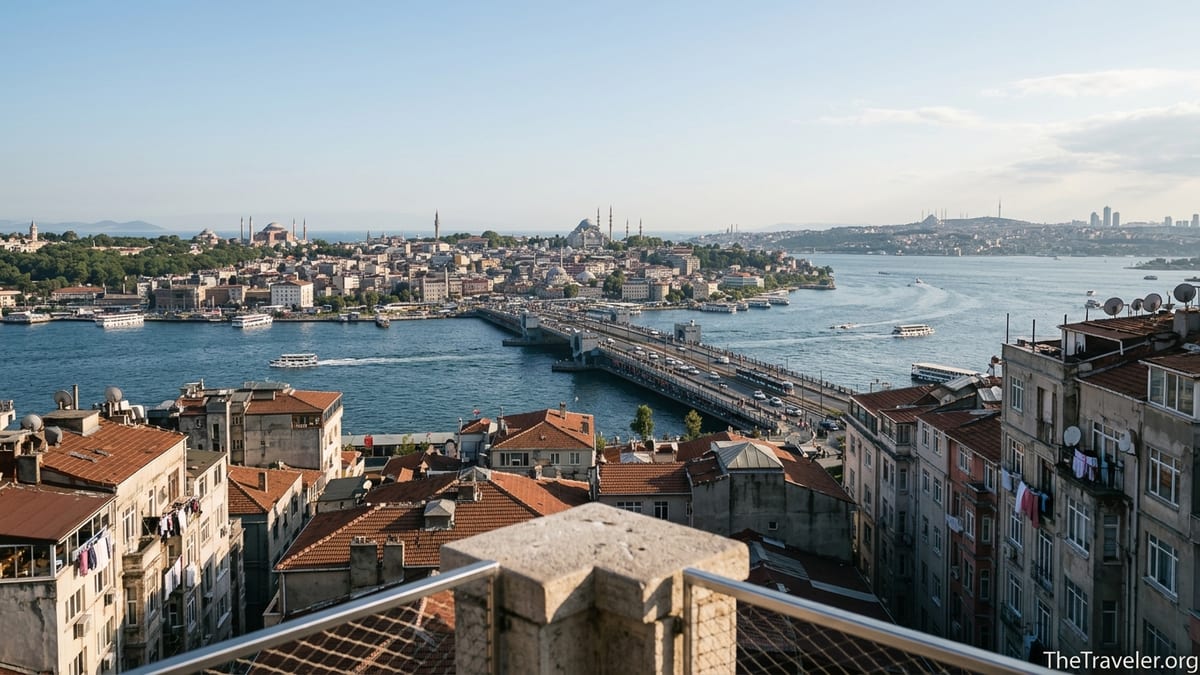
Getting Oriented on the Galata Tower Terrace
Galata Tower rises from the Galata and Karaköy area on the northern side of the Golden Horn, with its observation balcony roughly 50 meters above the surrounding streets. The circular terrace gives a full 360 degree view, but it is quite narrow and can feel crowded at busy times. You usually exit the elevator, climb a short flight of stairs, and are released onto the terrace facing north or northwest, not automatically toward the famous Sultanahmet skyline.
The easiest way to get your bearings is to look for water. If you see a wide, curving inlet lined with piers and ferries below, you are looking toward the Golden Horn. If instead you see a long straight channel stretching off into the distance with large tankers and container ships, you are facing the Bosphorus. On a clear day, you can slowly walk the full circle and match what you see against the landmark boards mounted along the railing that label mosque silhouettes and key points of interest.
Practical detail matters here. In 2026, standard tickets for foreign visitors cost in the region of 900 Turkish lira, and most people want to maximize their time at the top. Crowds thin slightly around late morning and again after the main sunset rush, which can make it easier to pause at each segment of the railing and identify landmarks without being pushed along by selfie-takers.
The Golden Horn: Reading Istanbul’s Inner Harbor
Face south from the tower and you overlook the Golden Horn, the deep estuary that cuts into the city and separates the historic peninsula of Old Istanbul from the northern districts. From Galata Tower, the Horn appears as a wide, glittering curve, edged by the tram lines, mosque courtyards, and ferry piers of Eminönü and Sirkeci on the opposite shore. You will see a steady flow of white city ferries heading deeper into the inlet toward Fener, Balat, and Eyüp, especially on weekday mornings and late afternoons.
From above, you can also spot the sequence of bridges that span the Golden Horn. Closest and most prominent is Galata Bridge, with its double-decker structure and rows of fishermen on top. Slightly further inland stands the Golden Horn Metro Bridge, which carries the M2 metro line and looks like a modern white cable-stayed structure cutting across the water. Even farther up, the older Atatürk Bridge forms another horizontal bar. Seeing these three in line helps you understand how the city has grown along the Horn while still relying on it as a working waterway.
For many visitors, one of the most memorable views is watching sunset over the Golden Horn from Galata Tower. As the light drops, the water darkens to deep blue while the stone façades and roof tiles of the old city turn warm orange. It is an excellent time to photograph ferries leaving Eminönü, with their wake forming bright streaks across the surface. If you own a camera, a 35 to 50 millimeter lens is ideal to capture both the curve of the Horn and the mosques on the skyline without extreme distortion.
Sultanahmet and the Old City Skyline
Looking across the Golden Horn to the south and slightly southeast, you face the most iconic silhouette in Istanbul: the historic Sultanahmet peninsula. From Galata Tower the two most recognizable shapes are Hagia Sophia, with its massive central dome and four minarets, and the Blue Mosque, just slightly to its west, also flanked by slender minarets. On a clear day, their gray domes and pale stone stand out against the Sea of Marmara in the background.
To locate Sultanahmet quickly, scan for the dense cluster of domes near the tip of the old city, almost like a stone crown. Hagia Sophia’s dome appears broader and flatter, while the Blue Mosque has a slightly taller, more layered cascade of smaller domes. Between and around them, you may be able to spot the long courtyard of Topkapı Palace, stretched along the wooded headland, and the low rooflines of the Grand Bazaar area further inland. The old city walls are harder to see from this distance, but the overall shape of the peninsula is clear when you follow the line where land meets sea.
What makes this view especially compelling is how it changes with the season. In winter the air can be sharper, and the details of individual minarets and domes stand out with remarkable clarity. In summer, haze sometimes softens the scene, but you gain a more dramatic sunset, with the mosques turning into dark silhouettes against a red-orange sky. Many visitors time their Galata Tower visit so they can watch the lights turn on across Sultanahmet, with the mosques illuminated in soft gold while call to prayer drifts across the water.
Süleymaniye Mosque and the Northern Old City Ridge
Turn slightly inland from the Sultanahmet view, toward the southwest, and your eye will be drawn to one of the most commanding structures on the skyline: Süleymaniye Mosque. From Galata Tower it stands on a high ridge above the Golden Horn, easily recognized by its single large central dome and four tall minarets. The mosque complex dominates its hill, with a broad courtyard and a sequence of smaller domes cascading down from the main sanctuary.
Below Süleymaniye, the urban fabric is dense: layers of apartment blocks, older wooden houses, and occasional church spires fill the slope toward the water. To the left as you face the mosque, you may glimpse the grey ribbon of the Aqueduct of Valens cutting horizontally across the background. To the right, the district of Eminönü with the New Mosque and the Spice Bazaar pushes toward the piers along the waterfront. The combination of religious, commercial, and residential architecture on this hill captures the blend of old and new Istanbul in a single frame.
This part of the view is particularly interesting if you are planning your days in the city. From Galata Tower you can clearly see how close Süleymaniye Mosque is to the Golden Horn and how the streets fall away behind it toward the university area and the Grand Bazaar. Many travelers pair a morning visit to Süleymaniye, where the rear terraces offer their own panoramic view back toward Galata Tower, with an afternoon stroll down to the water and then across the Golden Horn into Karaköy. Seeing these connections from above makes the walking routes easier to visualize.
Galata Bridge, Karaköy, and the Waterfront Below
When you look almost straight down from Galata Tower toward the south, the busy waterfront districts of Karaköy and the approach to Galata Bridge are directly beneath you. You will notice the compact plaza at the base of the tower, then a network of steep, narrow streets lined with cafés, boutique hotels, and small galleries that funnel down toward the water. Well-known pastry shops and coffee bars cluster in this area, and from above their bright awnings and outdoor tables form a colorful patchwork in the middle of otherwise gray stone blocks.
Further down the slope, the open sweep of the Karaköy ferry piers comes into view. You can usually see at least one or two large white city ferries docked or departing for the Asian districts of Kadıköy and Üsküdar. Along the shore, the tracks of the T1 tram line link Karaköy to Eminönü on the other side of Galata Bridge and then to the tourist areas of Sultanahmet. The bridge itself is easy to pick out: a broad structure with traffic on top, tram and pedestrians also crossing, and restaurant signs glowing along the lower deck.
One useful real-world tip is to take mental notes from this vantage point for later exploration. From the tower you can trace the route of a simple self-guided walk: descend into Karaköy, stop at one of the specialty coffee shops you see from above, continue to the waterside for fresh simit from street vendors near the ferry terminal, then cross Galata Bridge on foot to reach the bazaars of Eminönü. Many travelers enjoy doing this walk at ground level the next morning after first seeing the layout from the tower the previous evening.
The Bosphorus: From Bridges to Princes’ Islands
Turn east and northeast from the terrace and the waterway stretching away toward the Black Sea is the Bosphorus. Compared with the Golden Horn, the Bosphorus is wider and more linear. From Galata Tower you can see large cargo ships and cruise vessels moving along it, as well as the smaller outlines of commuter ferries zigzagging between the European and Asian sides. On clear days, ships appear almost miniature from this height, emphasizing the scale of the strait.
To the northeast, you may spot the distant arcs of the Bosphorus bridges linking Europe and Asia. Their exact visibility depends on haze and time of day, but their silhouettes often appear as thin lines against the hills. Closer at hand, look for Dolmabahçe Palace on the European shore, with its long waterfront façade of light-colored stone, and the green patches of parks along Beşiktaş. These details help you understand how central the Bosphorus is to daily life in Istanbul, not just as a scenic backdrop but as a major transport corridor.
If visibility is exceptionally good, you might be able to see faint shapes of the Princes’ Islands lying out in the Sea of Marmara beyond the mouth of the Bosphorus, although this is not guaranteed. Even without that, the combination of deep blue water, boat traffic, and densely layered neighborhoods on each bank creates classic wide-angle photographs. Travelers using modern phones can switch to a 0.5 or 0.7 times ultra-wide setting to capture both the tower railing in the foreground and the sweep of the strait beyond.
The Asian-Side Skyline: Üsküdar, Kadıköy, and Beyond
One of the most rewarding parts of the Galata Tower view is looking across to the Asian side of Istanbul. Facing east and slightly southeast, you will see the densely built hillsides of Üsküdar, with mosque domes and apartment blocks rising in layers above the shoreline. Ferries from Karaköy and Eminönü arrive and depart constantly here, so if you watch for a few minutes you will see their wakes cutting bright diagonal lines across the Bosphorus.
Further south along the Asian shore, the skyline of Kadıköy is lower but just as busy. You may not be able to distinguish individual streets at this distance, but the overall mass of buildings and occasional tower blocks gives you a sense of a large, lived-in district rather than simply a tourist area. Between Üsküdar and Kadıköy, look for the small islet of the Maiden’s Tower, set just off the point where the Bosphorus opens toward the Sea of Marmara. From Galata Tower it appears as a tiny spike in the water, but it is still possible to pick out its distinctive lighthouse-like form in good light.
Higher on the Asian hills behind Üsküdar, you might notice the slender modern outline of Çamlıca Tower and several television masts, especially in late afternoon when they are backlit by the sun. While the exact details can be hazy, these vertical elements help you trace the ridge of the Asian side. Many travelers use this vantage point to decide later whether to take a ferry across for an evening in Kadıköy’s bar streets or to visit viewpoints like Çamlıca Hill or the new viewing platforms on the tower itself.
Timing, Light, and Practical Viewing Tips
Even though Galata Tower offers the same landmarks at all hours, the quality of the view changes with time of day and weather. Early morning typically brings softer light from the east, which can be ideal for photographing the European side without strong haze. Midday light is harsher but gives crisp detail for urban explorers who want to map out neighborhoods before walking them. Late afternoon and sunset are the most popular times, when the mosques of Sultanahmet and Süleymaniye turn into silhouettes and the sky reflects off the Golden Horn and Bosphorus.
In practice, this popularity means queues. In 2026, you can expect longer waits in high season from late spring through early autumn, especially around the sunset window. Many visitors buy timed-entry tickets through official or authorized channels to reduce the time spent in line. Once on the balcony, patience is important: move slowly with the crowd, but step aside at wider points if you want to linger at a particular view. Because the terrace is narrow, a small shoulder bag is easier to manage than a large backpack, and a lightweight windbreaker is useful on blustery days when the exposed height makes it feel several degrees cooler than street level.
For photography, remember that you are behind a railing and often behind glass on the indoor level. To avoid reflections at night, shade your phone lens with your hand and hold it close to the glass. During the day, turn on grid lines to keep the horizon straight when capturing the Bosphorus or Golden Horn. If you are traveling with children, be aware that adults may crowd in front of them at the railing; consider lifting them briefly or visiting outside the peak hours so they can clearly see the mosques and bridges you are pointing out.
The Takeaway
Galata Tower is more than a simple viewpoint. From its circular terrace, you can read the geography of Istanbul in a single rotation: the curve of the Golden Horn defining the old city’s northern edge, the mosque-dotted ridge of Sultanahmet, the commanding position of Süleymaniye, the workaday bustle of Galata Bridge and Karaköy, and the broad sweep of the Bosphorus dividing Europe from Asia. With a bit of orientation, each of these scenes becomes more than a postcard view and turns into a practical map for the days you will spend at street level.
For travelers willing to plan their timing, use the landmark boards, and move slowly around the terrace, Galata Tower offers one of the clearest, most coherent panoramas of Istanbul available in a single stop. Whether you visit in the clear light of morning or the crowded glow of sunset, the experience of seeing ferries, minarets, bridges, and apartment blocks woven together from above is likely to stay with you long after you have left the tower’s stone walls behind.
FAQ
Q1. What is the best time of day to visit Galata Tower for views?
Late afternoon into sunset is the most atmospheric, with warm light on the Golden Horn and the mosques turning into silhouettes, but it is also the busiest. Early morning offers softer light and fewer crowds if you prioritize space over dramatic color.
Q2. Can I clearly see Hagia Sophia and the Blue Mosque from the top?
Yes, on a normal clear day both Hagia Sophia and the Blue Mosque are easy to spot across the Golden Horn on the Sultanahmet peninsula. They appear as two large clusters of domes and minarets near the tip of the old city, framed by the Sea of Marmara behind them.
Q3. Is the Asian-side skyline really visible, or only in perfect weather?
The hills of Üsküdar and Kadıköy are usually visible, even in slightly hazy conditions, although fine details may fade with distance. On very clear days you can pick out the Maiden’s Tower and the outline of modern structures on the Asian hills much more easily.
Q4. How long should I plan to stay on the viewing terrace?
Most visitors spend about 30 to 45 minutes making a full slow circuit of the terrace, taking photos and identifying landmarks. If you are especially interested in photography or city planning, you might comfortably spend up to an hour observing changes in light and traffic on the water.
Q5. Can I see all the Golden Horn from Galata Tower?
You can see the mouth and much of the central curve of the Golden Horn, including the main bridges and ferry routes. The very upper reaches toward Eyüp may merge into the background on hazy days, but the shape of the inlet and its role in separating the old city from the northern districts are always clear.
Q6. Are tripods or professional camera gear allowed on the terrace?
Small cameras and phones are fine, but full-size tripods and bulky professional setups are often discouraged or not practical because the terrace is narrow and crowded. A compact camera, a smartphone with a wide-angle lens, or a small handheld stabilizer is usually the most realistic choice.
Q7. Is there a good view of Galata Bridge and Karaköy from the top?
Yes, the view straight down toward the water gives an excellent overview of Karaköy’s streets, the ferry piers, and Galata Bridge itself. It is one of the best places to appreciate how closely packed cafés, tram lines, ferries, and pedestrians are in this central part of the city.
Q8. What happens if the weather is foggy or very hazy?
In heavy fog or thick haze, distant landmarks like the Asian-side hills or the Princes’ Islands may be partly or completely obscured. Closer features such as Galata Bridge, Karaköy, and the inner Golden Horn usually remain visible, but the overall panorama is less dramatic. If your schedule is flexible, checking the forecast and choosing a clearer day will improve the experience.
Q9. Can people with a fear of heights still enjoy the view?
Many travelers with mild vertigo manage well because the terrace has a solid stone parapet and metal railing, and you are not looking straight down for most of the circuit. If you feel uneasy, you can step back from the edge or spend more time at the indoor viewing windows, which still offer wide views without the same sense of exposure.
Q10. Do I need a guide to understand what I am seeing?
No guide is strictly necessary. The terrace has information boards pointing out the main landmarks, and with a basic map you can identify most neighborhoods and mosques yourself. That said, a knowledgeable local guide or audio guide can add historical background and anecdotes that bring the panoramas of Sultanahmet, Süleymaniye, and the Bosphorus to life.