


Galata Tower is one of Istanbul’s most recognizable landmarks, but with higher ticket prices, long queues and plenty of free viewpoints in the city, many travelers in 2026 are asking a simple question: is it still worth going up? This guide compares the view, cost, waiting time, balcony space, photo value, museum interior and nearby free alternatives so you can decide whether Galata Tower deserves a spot on your Istanbul itinerary.
Get the latest updates straight to your inbox!
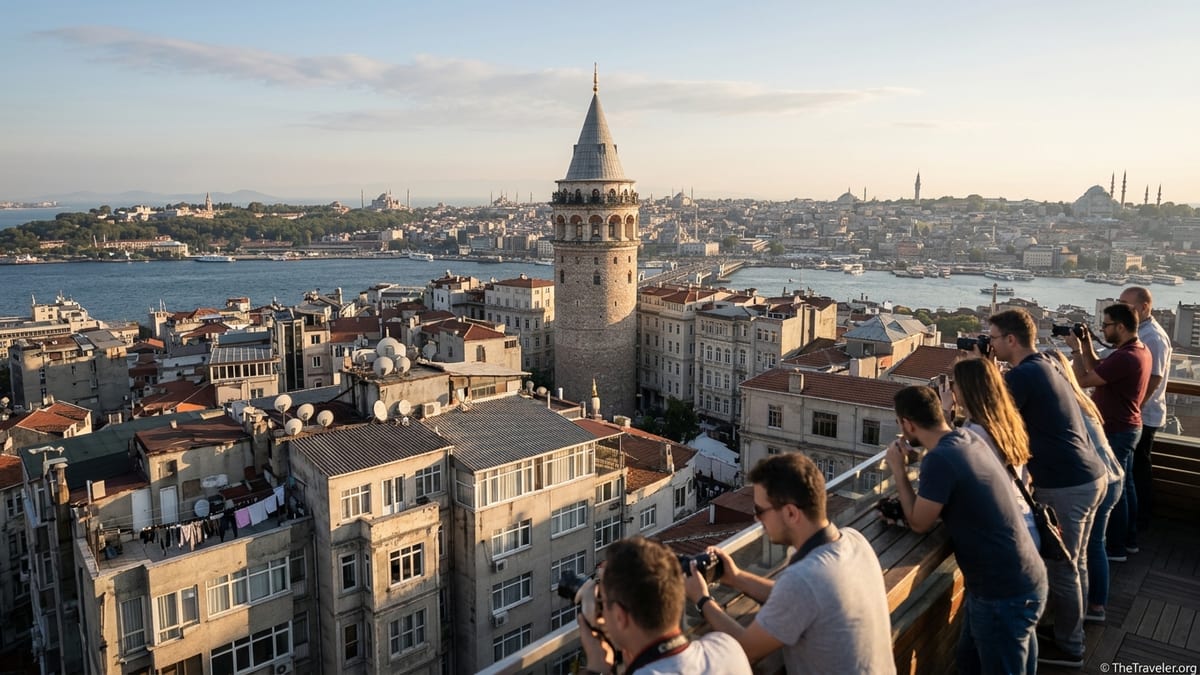
Galata Tower in 2026: What You Actually Get
Galata Tower, officially the Galata Tower Museum, is a 14th‑century stone tower in the Beyoğlu district overlooking the Golden Horn and the Bosphorus. After a major restoration and its conversion into a museum in 2020, it now functions as both a historic exhibition space and an observation platform with a 360‑degree balcony. For many visitors, the promise is straightforward: classic postcard views of Istanbul’s skyline in a single, compact visit.
The typical experience today starts at street level on the narrow Galata Kulesi Square. You pass security, buy a ticket or scan a tourist pass, then take an elevator almost to the top. A final short staircase brings you to the circular outdoor balcony, where you can walk the full loop around the tower for views toward Sultanahmet, the Bosphorus, the Asian side and the Golden Horn. Inside, several floors house exhibitions on the history of the tower, the old Genoese district and the changing city, plus a model of historic Istanbul and small multimedia installations.
In practice, a standard visit lasts about 45 to 90 minutes depending on crowds and how much time you spend in the museum floors. Travelers who go early on a weekday often report spending roughly half an hour total on site, while those who arrive for sunset on a spring or summer weekend can spend that long just in the queue outside. The key in 2026 is understanding what you value most: the view, the photo opportunity, the story of the building or simply being able to say you have been up the tower.
Ticket Price vs Value: Is It Too Expensive Now?
For foreign visitors in mid‑2026, standard adult tickets to Galata Tower are around 900 Turkish lira, with children below a certain age entering free or discounted and Turkish citizens paying less via the national museum system. That means a family of four with two paying adults can easily spend the equivalent of a casual restaurant meal in Istanbul just to go up the tower once. Many budget travelers now describe the price as high compared with what you pay for other local experiences.
To understand value, it helps to compare: entry to major sites like Topkapi Palace Museum or the Basilica Cistern is in the same general range or slightly higher, but these are half‑day experiences with extensive interiors, courtyards and artifacts. By contrast, Galata Tower is a short, focused visit driven mostly by the view and the novelty of the circular balcony. If you are counting every lira, you might prefer to allocate your paid sightseeing budget to places where you can spend several hours, and use free viewpoints for city panoramas.
Where the tower can make sense financially is in combination passes. Several tourist passes and city cards include Galata Tower along with other attractions and public transport. In those cases you are not paying the full 900 lira only for this one site, and the “cost” of the tower visit becomes closer to the price of a drink in a rooftop café. If you already plan to visit multiple museums and use a pass, it is easier to justify fitting Galata Tower into your route.
Ultimately, the ticket feels worth it if you want a concise, structured way to get an iconic view and a short introduction to Istanbul’s urban history. It will feel overpriced if you are mainly interested in a pretty skyline photo and do not care whether it comes from a museum tower or a café terrace.
Queues, Timed Entry and Best Times to Go
Crowd levels at Galata Tower vary dramatically by time and season. In 2026, official visiting hours generally run from morning to late evening, with the tower open every day. Queue data published by visitor information sites and ticket providers show that weekday mornings between opening and roughly 10:00 are usually the quietest, often with minimal waiting. In contrast, afternoons and sunset blocks, especially on weekends and holidays, can see waits of 30 to 60 minutes or more just to buy a ticket and reach the elevator.
One very practical strategy is to buy a timed‑entry ticket online the evening before, which allows you to join a shorter line dedicated to prebooked visitors. Another is to use an Istanbul tourist pass that covers Galata and lets you bypass the main ticket queue. These options do not eliminate waiting entirely, because bottlenecks still occur at security and at the final staircase, but they can cut your total time in line to 10 to 20 minutes even on busier days.
If you are planning around light and temperature, consider the trade‑offs. Early morning visits give you cooler air in summer, softer light and far fewer people, which is ideal if you care about having some space on the balcony. Sunset offers warm colors and dramatic photos but comes with dense crowds pressed along the railing, especially from April to October. Late evening can also work in summer: the city lights are on, the air is more comfortable, and many day‑trippers have gone, so you may find a moderate line and more breathing room on the balcony.
Travelers with limited time in Istanbul should factor these queues honestly. If you are transferring through the city for just one day and already want to see Hagia Sophia, the Blue Mosque and the Grand Bazaar, adding a potential hour of standing outside Galata Tower at sunset may not be the best use of your schedule.
The Balcony Experience: Space, Safety and Photo Angles
The observation balcony is the main reason most visitors go up Galata Tower, so it deserves careful evaluation. The balcony is a narrow circular walkway that runs around the tower just below the conical roof. Railings are chest‑high for most adults, with metal bars that you can shoot photos through. In dry weather and low crowds, it feels safe but tight, similar to being on a wide ship’s rail. During peak times, movement slows to a shuffle, and it can be difficult to pass people who are taking photos.
On a quiet weekday morning you might be able to stop at several points around the circle, rest your elbows on the rail and take your time with photos of the Golden Horn, the Bosphorus and the old city skyline. On a crowded Saturday at sunset, you may find yourself shoulder to shoulder, moving slowly with the flow and waiting for gaps at the best angles. If you are uncomfortable with heights, the balcony can feel exposed, though many visitors who are moderately sensitive to heights report that the sturdy stone wall and railings make it manageable.
From a photographer’s perspective, Galata Tower offers a classic, high‑central vantage point, but not necessarily the most creative angles. You will see ferry wakes carving the Bosphorus, the minarets of Süleymaniye and Sultanahmet rising above the old city and the Galata Bridge stretching across the Golden Horn. For wide cityscapes, a smartphone with a standard or wide lens is enough, while serious photographers often bring a 24–70 mm or similar zoom to capture both broad panoramas and compressed skyline details.
One limitation to be aware of is balcony width. It is narrow enough that tripods are impractical in busy periods, and families with small children should keep them close because excited kids may try to weave ahead in the line. The flooring is solid, but after rain showers, some sections can stay slick, so sturdy shoes help. If your fantasy is a peaceful, meditative moment above the city, aim for off‑peak hours or consider one of the quieter free viewpoints instead.
Museum Interior: Is It More Than Just a Viewpoint?
Since 2020, Galata Tower has been operated as an official museum, with interiors that aim to give cultural and historical context rather than serving purely as a viewpoint. Exhibits on the lower floors typically include panels on the Genoese walls and trade routes, models of historic Istanbul, information about the tower’s use as a watchtower and fire lookout, and the story of figures such as Hezarfen Ahmed Çelebi, the 17th‑century legendary aviator said to have flown from the tower to the Asian side of the city.
For visitors interested in Istanbul’s layered history, these displays can add meaningful value to the ticket. The content is curated with a mix of Turkish and English text, often supported by digital screens and short video segments. You can learn how the district of Galata once stood outside the main city walls of Constantinople, how the tower changed function over centuries and how restoration campaigns have altered its silhouette. It is not an encyclopedic museum like the Archaeology Museums, but it provides a structured narrative in a compact space.
That said, if you are not particularly drawn to museum panels or already feel saturated by information from other sites, you may find yourself walking quickly through these floors to get to the balcony. Many travelers report spending less than 20 minutes in the exhibits compared with most of their time queued for or standing on the observation level. Families with children might appreciate the scale models and visual elements, but young kids often become impatient in the interior sections and want to reach the top as soon as possible.
Think of the Galata interior as a value‑add rather than a standalone reason to visit. If you want a deep dive into Ottoman architecture or Byzantine urbanism, other museums in the city do that better. If you like the idea of combining a strong view with a brief, well‑presented history lesson that ties the panorama to what you are looking at, then the museum concept strengthens the case for going.
Free and Cheaper Viewpoints Near Galata Tower
One of the biggest arguments against paying to climb Galata Tower in 2026 is the abundance of free or low‑cost viewpoints nearby. Within a 10 to 20 minute walk, you can find rooftop cafés, mosque courtyards, bridges and hilltop parks that offer impressive panoramas without a formal ticket. For many budget‑conscious travelers, these spots deliver 70 to 90 percent of the “wow” factor for the price of a tea or nothing at all.
Very close to the tower, several rooftop cafés and hotel terraces in the Galata and Karaköy area offer direct or angled views of both the tower and the old city. Places such as Galata Konak Café and terrace restaurants in nearby boutique hotels routinely attract visitors who order a coffee or breakfast and then spend an hour photographing the skyline. The advantage is that you get both the view and the tower in your frame, something you cannot achieve from the tower’s own balcony.
Walking down to the waterfront, the Galata Bridge gives you long, horizontal views over the Golden Horn toward Eminönü, Süleymaniye Mosque and the historic peninsula. It is completely free and open day and night. Early morning you will see fishermen and ferries against soft light; at dusk, the domes and minarets of the old city light up while ferries crisscross below. The bridge is lower than the tower, so the scale is different, but many photographers prefer this perspective because it captures more of the street life and water activity.
A short tram or taxi ride away, Pierre Loti Hill above the Golden Horn offers another excellent free panorama. You reach it via a cable car or a steep walk, then sit at the historic café terrace overlooking the horn. The view is more focused on the curving inlet and residential hills than on the main monuments, but it still includes distant silhouettes of Galata and the old city. For travelers who enjoy lingering over a tea rather than rushing through a museum queue, Pierre Loti can feel like a more relaxed alternative to Galata’s balcony.
Beyond Galata: Comparing Other Paid Viewpoints
If you are considering Galata Tower primarily as a viewpoint, it makes sense to compare it with other paid or semi‑paid high spots in Istanbul. Several modern rooftops and towers, often connected to hotels or shopping centers, now compete for skyline‑hungry visitors. These include contemporary observation terraces, rooftop bars in Beyoğlu and Karaköy, and high‑floor restaurants in districts like Şişli and Levent. Many of these charge nothing for entry but expect you to order food or drinks instead.
In the old city, the gardens and terraces around Süleymaniye Mosque provide sweeping, elevated views south over the Golden Horn and across the city. While the mosque itself is a religious site and free to enter, some adjacent cafés and terraces below the mosque charge only for what you consume. The angle from here emphasizes the waterway and bridges, with Galata Tower and Beyoğlu forming part of the middle distance, and is especially beautiful around late afternoon when the sun softens.
On the Asian side, hilltop parks like Çamlıca and certain viewpoints in Üsküdar offer wide panoramas of the Bosphorus, the old city and the modern skyline. These require slightly more travel time from Galata but are free and less crowded with foreign tourists. Locals often bring snacks and spend several hours enjoying the view, which can be a more authentic slice of Istanbul life than a quick museum visit.
When you compare the financial cost and atmosphere across these options, Galata Tower stands out as a compact, curated, centrally located experience, but not necessarily as the best pure viewpoint. If your priority is simply to see Istanbul from above once, one of the mosque terraces or hilltop parks might satisfy you. If you want the historically famous tower combined with that view, then Galata still has unique appeal.
Who Should Prioritize Galata Tower – And Who Can Skip It
Not every traveler has the same needs, time or budget. For first‑time visitors to Istanbul with at least two or three full days, Galata Tower can be a worthwhile stop if you go at a less busy time and treat it as part of a wider walk through Beyoğlu and down to Karaköy. You can, for example, start on Istiklal Avenue, detour to the tower in mid‑morning, then continue down to the waterfront and cross the Galata Bridge toward the Spice Bazaar.
Travelers who are especially interested in photography, cityscapes or iconic landmarks often appreciate having the “from the tower” shot in their collection, even if they also visit other viewpoints. In that case, the ticket is part of your creative budget. Likewise, visitors with limited mobility may find the combination of elevator access and single short staircase preferable to climbing long flights of outdoor stairs to reach a mosque terrace or hilltop park.
On the other hand, short‑stay visitors with packed itineraries, budget travelers counting every lira and repeat visitors who have already done Galata in the past may reasonably decide to skip it. Many recent travelers have voiced that spending close to the equivalent of a sit‑down dinner for what feels like a 30‑minute experience is not essential, especially when they can get comparable or more atmospheric views from cafés or public spaces for free.
If you are traveling with small children, very crowd‑averse companions or people anxious about heights, it is also worth questioning whether the balcony will be enjoyable at peak times. You might choose instead to enjoy the tower from below in Galata Square, take photos from a nearby terrace where you can sit, and put that ticket money toward a Bosphorus ferry ride or a more spacious museum.
The Takeaway
So is Galata Tower worth it in 2026? The answer is “it depends on what you want from your time in Istanbul.” If you are drawn to iconic landmarks, appreciate a structured museum experience and can visit early on a weekday or with a timed ticket, the tower still delivers a compelling combination of history and views. You will stand above a city that has been watched from this hill for centuries, with the mosques and straits laid out below you.
If, however, your main goal is simply to enjoy a beautiful skyline without spending much money or waiting in long lines, then nearby rooftop cafés, mosque terraces, bridges and hilltop parks can satisfy that wish at a lower cost and often with a more relaxed atmosphere. The fact that you can photograph the tower itself from those spots is a bonus.
For many travelers, the ideal compromise is to plan Galata Tower as part of a broader Beyoğlu walk and to be honest about their priorities. Book or arrive early, treat the ticket as payment for both a classic view and a compact museum visit, and then use the rest of your day exploring the surrounding streets, cafés and waterfront viewpoints. In a city rich with vantage points, Galata Tower is no longer the only way to see Istanbul from above, but for some it remains the most symbolic.
FAQ
Q1. How much does it cost to visit Galata Tower in 2026?
Ticket prices for foreign adults are around 900 Turkish lira in mid‑2026, with discounts for children and lower prices for Turkish citizens through the national museum system.
Q2. How long do I need for a visit to Galata Tower?
Most visitors spend 45 to 90 minutes in total, including time in the queue, walking through the museum floors and enjoying the balcony view.
Q3. When is the best time of day to avoid queues?
The quietest times are typically weekday mornings from opening until about 10:00, when you may face only a short security wait and can move freely on the balcony.
Q4. Is Galata Tower suitable for people with limited mobility?
There is an elevator covering most of the height, but you still need to climb a short staircase to reach the balcony, and the outdoor walkway is narrow and can be crowded at peak times.
Q5. Can I buy tickets to Galata Tower online?
Yes, you can usually buy timed‑entry tickets online through official channels and approved ticket partners, which helps reduce waiting time at the ticket office on busy days.
Q6. Are there good free alternatives to the Galata Tower view?
Yes, nearby options like Galata Bridge, mosque terraces around Süleymaniye, Pierre Loti Hill and various rooftop cafés in Galata and Karaköy offer excellent free or low‑cost views.
Q7. Is Galata Tower worth it for families with children?
Families who enjoy viewpoints and brief museum visits often like it, but parents should consider the ticket cost, narrow balcony, potential crowds and children’s patience with queues.
Q8. Can I see the tower itself while I am on the balcony?
From the balcony you see the surrounding city, not the tower’s exterior. To photograph the tower in the skyline, you need to visit nearby streets, squares or rooftop terraces instead.
Q9. Are tripods or professional photo setups allowed on the balcony?
The balcony is narrow and often crowded, so tripods and bulky equipment are generally impractical and may be restricted; handheld cameras and phones work best.
Q10. Should I choose Galata Tower or a Bosphorus cruise if I can only afford one?
If you want a single, static city panorama, Galata Tower is better; if you prefer moving views, breeze and a sense of the waterways, a basic Bosphorus cruise usually offers more variety for a similar or lower price.