


I arrived in Anacapri expecting Capri’s trademark chaos in miniature: cruise‑ship crowds, designer bags swinging through narrow alleys, selfie sticks at every scenic overlook. Instead, by my first evening on the western side of the island, I was listening to church bells and cicadas in streets so quiet I could hear my own footsteps. What surprised me most about Anacapri was not the views or the villas, but how deeply, consistently peaceful it felt in the very place I had been warned would be “too touristy” to truly enjoy.
Get the latest updates straight to your inbox!
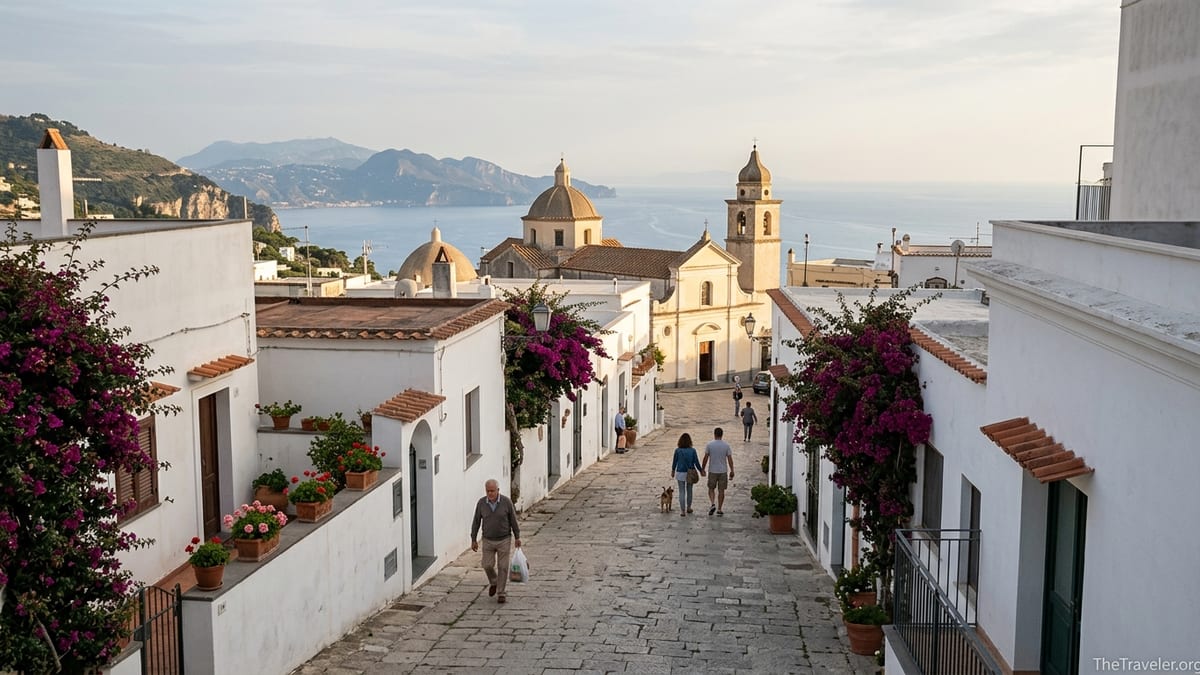
Crossing the Island and Stepping Into a Different Rhythm
The contrast begins before you even arrive. Most visitors first see Capri at Marina Grande, where hydrofoils from Naples and Sorrento spill hundreds of people onto the dock at once. The funicular and buses to Capri Town fill quickly, and the little square known as the Piazzetta can feel like a stage set, with clinking glasses and a constant shuffle of day‑trippers. It is beautiful, but it is not quiet.
Ten minutes and a few hairpin turns later, the bus from Marina Grande pulls into Piazza Vittoria in Anacapri, and the mood changes. The honks and engine noise drop away, replaced by the murmur of conversation and the occasional scooter. The streets leading off the square are largely pedestrian, a tangle of whitewashed alleys that immediately narrow your world to stone, bougainvillea, and the blue strip of sea in the distance.
On my first afternoon I followed Via Giuseppe Orlandi, Anacapri’s main pedestrian spine, expecting the same crush of souvenir shops I had seen below. Instead I found a handful of sandal‑makers cutting leather by hand, a tiny grocery weighing peaches for local residents, and cafes where people lingered over espresso rather than grabbing takeaway. The lack of hard selling is noticeable; you can browse ceramics and linen in relative calm without a chorus of “prego, prego” urging you inside.
By the time I reached the modest little park near the Chiesa di Santa Sofia, the peace felt almost disorienting. Children were riding bicycles in circles while grandparents watched from the benches. A delivery van nosed cautiously through the crowd and disappeared again. It was an ordinary Italian village scene, just happening at the top of a world‑famous island.
The Quiet Lanes Where Capri Still Feels Local
Anacapri’s biggest surprise is how quickly you can step away from anything remotely touristy. A turn off the main street leads into a web of residential lanes where the island’s year‑round population of roughly seven thousand lives behind painted gates. Here, the soundtrack is dogs barking, radios drifting from open windows, and the clack of someone hanging laundry on a terrace.
Walking these backstreets became my favorite daily ritual. One morning I followed a narrow vicolo at random and ended up beside a small vineyard planted between two houses, the vines tied up carefully with blue plastic twine. Another evening, I detoured down a stepped lane and found a tiny shrine set into a wall, with fresh flowers tucked beneath the Madonna. No one else passed me for ten minutes, a rarity in Capri Town in high season.
The village scale keeps traffic at bay. While the main road between Capri and Anacapri can be busy with buses and taxis, much of Anacapri’s historic center is deliberately pedestrian. That makes practical differences: it is safe for children to wander a little ahead, and older travelers can stroll without constantly jumping aside for scooters. Benches and small squares are used as they were meant to be, as places to sit and watch time pass.
Accommodation in these lanes reinforces the calm. Instead of only seeing polished five‑star hotels, you find family‑run guesthouses and small bed and breakfasts hidden behind high walls. In the shoulder seasons, simple but comfortable double rooms can often be found around the 120 to 180 euro mark per night, noticeably less than comparable stays in Capri Town. Many offer tiled terraces where breakfast is served to the sound of roosters or church bells rather than nightclub bass.
Slow Mornings, Empty Trails, and a Chairlift to the Sky
If Capri Town belongs to the evening aperitivo crowd, Anacapri really comes into its own in the morning. By eight‑thirty the light is soft on the white houses, the smell of baking cornetti drifts from bar counters, and the air is still cool enough to walk without hurrying for shade. At Bar Grotta Azzurra near the main street, locals stand at the counter for a quick caffè, while visitors sit on the terrace, unhurried, planning the day’s hike or swim.
Several of Capri’s best walking routes start from Anacapri, and early in the day they are almost empty. One path leads out toward the Migliera viewpoint, where low stone walls frame views across sheer cliffs to the sea. Another follows the old coastal defense line known as the Forts of Anacapri, a trail that threads through Mediterranean scrub and past old military outposts. On both, I walked long stretches without seeing another person, hearing only the click of lizards on rock and waves breaking on the invisible shore below.
Even one of the island’s major attractions feels tranquil here if you time it right. The chairlift to Monte Solaro starts almost beside Piazza Vittoria. In peak season there can be a line by late morning, but arriving when it opens or in the last hour before closing, I found only a handful of people waiting. The single chairs glide silently over terraced gardens and pine trees, gaining nearly 600 meters of elevation in around twelve minutes. Sitting alone with my feet dangling above the island, the only sounds were cicadas and the occasional clink of the safety bar.
At the summit of Monte Solaro, the views over the Faraglioni rock stacks and the Bay of Naples are the dramatic highlight most visitors expect. Yet the most powerful moment was again about quiet. Standing just beyond the terrace of the small bar, the chatter from the tables dropped away and I could hear the wind in the grass as a kestrel hung motionless in the air below me. It felt like the island was taking a breath between ferries.
Peace by the Sea: Punta Carena and Hidden Swimming Spots
Capri’s coastline is famous for its crowded beach clubs and boat tours, but Anacapri offers a gentler way to reach the water. The local bus from Anacapri’s center runs down to Punta Carena, a wide cove dominated by the island’s lighthouse. In summer the main sunbathing platforms can fill up, yet the energy is relaxed compared with the tightly packed loungers nearer Capri Town.
I arrived at Punta Carena in late afternoon, when the rocks were still warm but the sun had softened into gold. Local teenagers were leaping from the lower ledges into the clear water, timing their jumps between boats. A few families had spread towels further back, their coolers wedged safely in the shade of the cliff. The beach club’s music drifted only faintly; mostly I heard the slap of waves against stone and the hum of conversation as people waited for the sunset.
For an even quieter experience, it is worth walking a few minutes away from the main platform along the coastal path. Here the rock shelves are uneven and there are no services, which is precisely why they are often almost empty. I found a flat patch just big enough for my towel, and for half an hour had my own slice of Tyrrhenian Sea, broken only by a fisherman slowly motoring past in a small wooden boat. On an island that sees thousands of day visitors in peak months, that sense of having space can feel almost luxurious.
Boat trips reach Anacapri’s famous Blue Grotto from all over the island, and the immediate area around its entrance can get crowded during midday. Still, staying in Anacapri lets you approach it differently. Early in the day or toward closing time, the road down from the village to the grotto is hushed, and there are moments when the only people at the water’s edge are a couple of staff at the ticket booth and a few swimmers slipping off the rocks into the blue.
Evenings When the Island Finally Exhales
The real revelation, though, comes after the last hydrofoils leave Capri and the day‑trippers file back to the mainland. Capri Town regains some calm at night, but it retains an energetic, dressed‑up buzz around its central square and high‑end restaurants. Anacapri, by contrast, feels like a curtain has dropped between the island’s two personalities.
Just after sunset, shopkeepers along Via Giuseppe Orlandi pull in their displays, and the main sound becomes the scrape of chairs as families settle in for dinner. I dined one night at a modest trattoria a few minutes from the central square, where the owner’s children appeared between tables chasing a football and an elderly couple took their usual corner table without bothering to look at the menu. My grilled local fish arrived simply adorned with lemon and herbs, and the bill, while far from cheap, was gentler than similar meals in Capri Town.
After dinner, I walked home along streets that were almost entirely empty. A few other visitors were strolling with gelato cups in hand, but many of the faces around me were clearly those of residents stopping to chat under streetlights. Church bells from Santa Sofia marked the hour, and somewhere a television game show played behind a half‑open door. It felt like being allowed backstage after the main performance of the island was over.
This softness extends to nightlife, or rather the lack of it. There are no thumping clubs in Anacapri, and only a handful of bars stay open much past midnight. For some travelers that might be a drawback. For others, especially families and couples looking to sleep with their windows open to the night air, it is precisely why they choose to base themselves here. The island’s glamor remains just a ten‑minute bus ride away, but in Anacapri you can choose to hear only the crickets.
Staying in Anacapri: Practical Ways to Find the Calm
The sense of peace in Anacapri is helped by decisions you make before arrival. Where you stay, when you travel, and how you move around the island all shape how quiet your experience feels. Choosing a base in Anacapri instead of Capri Town is the first step, but the details matter too.
Accommodation ranges from small boutique hotels with sea‑view pools to humble apartments tucked behind garden walls. In the shoulder seasons of April, May, late September, and early October, mid‑range hotels with simple pools and breakfast included often price between roughly 180 and 260 euros per night for a double room. More basic guesthouses and agriturismo‑style stays can dip closer to the 130 to 160 euro range, especially if you are content with a room that faces a courtyard rather than the sea.
Location within Anacapri also influences how peaceful things feel. Staying within a five‑minute walk of Piazza Vittoria and the chairlift puts you close to bus connections and restaurants, yet the backstreets here are already quiet once you step away from the main square. If you want near‑total stillness, look at properties a bit further out on the roads leading toward Punta Carena or the countryside above the village. There, the night sky is darker, the cicadas louder, and the only regular traffic sound may be the morning delivery truck.
Transport choices can preserve your calm as well. The local buses linking Anacapri with Capri Town, Marina Grande, the Blue Grotto, and Punta Carena are frequent but small, so they can become crowded at midday. Traveling just after the morning rush to the island’s big sights, or waiting until late afternoon, keeps the crush to a minimum. Taxis and private car services are widely available, and while they are a splurge, a single quiet ride back to your hotel after a long day in the heat can feel worth every euro.
The Takeaway
Capri’s reputation for gloss and crowds is not undeserved, especially in the height of summer. Yet my time in Anacapri offered a parallel truth. On the same rocky island where luxury brands line polished lanes and yachts cluster in the bays, there is another rhythm at work: children cycling in a square at dusk, a farmer watering his lemon trees on a terrace, hikers setting off alone along coast paths with only the sea for company.
What surprised me most was not that such calm exists, but that it remains so accessible. It is a ten‑minute bus ride and a slight change of altitude, from the island’s main square to a village that still feels like a place where people live year‑round rather than a set built for visitors. If you arrive expecting only noise and see‑and‑be‑seen glamour, you may miss it entirely. Come looking for quiet, and Anacapri will show you that even on Italy’s most photographed islands, peace is still possible.
FAQ
Q1. Is Anacapri really that much quieter than Capri Town?
Anacapri generally feels noticeably calmer, with more residential streets, fewer luxury boutiques, and softer evenings, especially once day‑trippers leave the island.
Q2. When is the best time of year to experience Anacapri at its most peaceful?
The quietest periods are usually early spring and late autumn, particularly April, early May, late September, and October, when visitor numbers are lower and temperatures are milder.
Q3. Are there still good restaurants in Anacapri even though it is quieter?
Yes, Anacapri has a solid range of trattorias, wine bars, and pizzerias, many of them family‑run and focused on local seafood, vegetables, and Campanian dishes.
Q4. How long should I stay in Anacapri to appreciate its relaxed pace?
Two full days is the minimum to settle into the slower rhythm, but three to four nights allow time for hikes, swims, and unhurried evenings in the village.
Q5. Is Anacapri a good base for families with children?
Yes, the pedestrian lanes, small playgrounds, and quieter evenings make Anacapri particularly appealing for families who value safety and early nights.
Q6. Will I miss the famous Capri atmosphere if I stay only in Anacapri?
No. Regular buses and taxis make it easy to dip into Capri Town for a few hours, then return to Anacapri when you are ready for space and quiet again.
Q7. Are hotels in Anacapri cheaper than in Capri Town?
In many cases they are somewhat better value for the space and facilities offered, though prices still reflect the island’s overall popularity and season.
Q8. Do I need a car to enjoy Anacapri and the rest of Capri?
No, visitors do not drive rental cars on Capri. Local buses, taxis, and walking paths are more than sufficient to reach Anacapri’s main sights and coastal spots.
Q9. Is Anacapri still peaceful during the peak summer months?
July and August are busier everywhere on the island, but Anacapri’s residential feel, pedestrian lanes, and quieter evenings usually make it less intense than Capri Town.
Q10. What are the best peaceful activities to do in Anacapri?
Popular quiet pursuits include walking the trails to the Migliera viewpoint, taking the early chairlift to Monte Solaro, swimming near Punta Carena, and simply wandering the backstreets at dusk.