


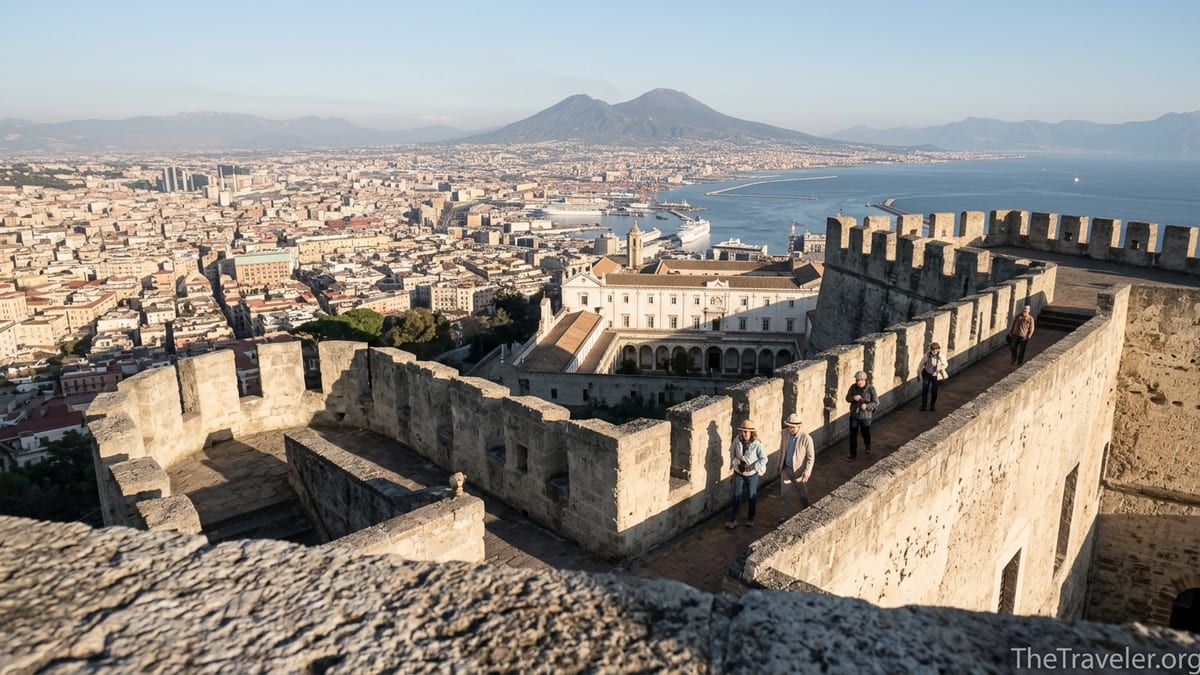
Perched 250 meters above sea level on Naples’ Vomero hill, Castel Sant’Elmo promises some of the most sweeping views in southern Italy. Yet many travelers emerge from its star-shaped walls feeling underwhelmed, sunburned, or frustrated by poor planning. Most of the time, the problem is not the fortress itself but a handful of common mistakes that quietly sabotage the experience. Understanding these pitfalls before you ride the funicular or start the climb can turn a rushed photo stop into one of the most memorable hours of your trip.
Get the latest updates straight to your inbox!
Arriving Too Late and Missing Key Areas
One of the biggest surprises at Castel Sant’Elmo is that the fortress and the on-site museum keep slightly different hours. The castle grounds typically remain open into the early evening, while the Museo del Novecento inside usually closes earlier in the afternoon with last admission about an hour before. Travelers who ride up from the historic center at 4:30 p.m. assuming they can see “everything” before sunset often find part of the complex already shutting down. Reviews frequently mention visitors who got their panoramic photos but never realized there was a modern art museum and historical exhibits tucked into the old barracks.
This timing mismatch matters if you are visiting in autumn or winter, when daylight fades earlier. For example, someone arriving in November at 4:45 p.m. after a day trip to Pompeii may have time only for a hurried lap of the ramparts. The indoor galleries, which explain how this six-pointed star fortress once protected Naples and later became a prison, remain unexplored. To avoid this, treat Castel Sant’Elmo as a proper attraction rather than an afterthought. Aim to be at the ticket office by late morning or early afternoon so you have time for both the views and the exhibits.
Another subtle mistake is not allowing enough buffer for queues or small delays. On busy weekends or the first Sunday of the month, when many Italian state sites offer free entry, you may encounter a short line for security or ticket checks. If you show up fifteen minutes before last entry to the museum, a couple of tour groups ahead of you can mean the difference between getting in and being turned away.
A simple rule of thumb works well: if the museum interests you, plan to arrive at the castle at least two hours before its posted closing time. Start indoors with the Museo del Novecento and exhibition spaces, then finish with a slow circuit of the rooftop terraces. The skyline of Naples and the Bay of Naples will still be there, but the museum doors will not.
Underestimating the Climb and Choosing the Wrong Route
Many people glance at a map, see that Castel Sant’Elmo sits above the Spanish Quarter, and assume they can “just walk up from the center.” Technically, they can. In practice, the climb from areas like Piazza Dante or Toledo involves steep streets, flights of stone steps, and exposed stretches that feel punishing in summer. It is common to see first-time visitors arriving sweaty and exhausted, having spent 30 to 40 minutes trudging uphill before they even buy a ticket.
The smarter option for most travelers is to use the funicular system. The Montesanto funicular is especially convenient: from the lower station near the historic center, it takes just a few minutes to reach Morghen station in Vomero. From there, it is roughly a 10 to 15 minute walk uphill through residential streets to the castle gates. Another alternative is the Funicolare Centrale, connecting Via Toledo with the Vomero shopping streets; from Piazza Vanvitelli you can then walk towards the fortress. A metro Line 1 stop at Vanvitelli also serves this area. These routes drastically reduce the physical effort and make Castel Sant’Elmo accessible even if you are not keen on a long climb.
Realistically, most visitors who regret the walk are those who try to “save money” by avoiding public transport, then end up so tired on arrival that they cut the visit short. A single-ride funicular ticket costs roughly the same as a city metro fare and is often included in day or weekly transport passes. Skipping it is a false economy. If your itinerary has already included a morning walking tour of Spaccanapoli or a long visit to the Archaeological Museum, preserving your energy for the panoramic ramparts will make the entire day more enjoyable.
There is one more route-planning mistake: not checking service disruptions. While the funiculars run frequently, temporary closures for maintenance or strikes do happen. Travelers who assume the Montesanto line will always be operating can find themselves halfway to the station only to discover shuttered gates. If you are visiting on a public holiday or during off-season months, quickly confirming that the funicular is running before you set out saves you from an unexpected extra climb or a scramble for a taxi.
Ignoring Weather, Exposure and What to Wear
On paper, a hilltop fortress sounds breezy and cool. In reality, Castel Sant’Elmo is one of the most exposed major sights in Naples. The wide, pale stone surfaces of the courtyard and ramparts reflect sunlight, and there is very little shade once you are out on the walls. Visitors who arrive in July or August at midday in sleeveless tops, without hats or sunscreen, often cut their visit short because of the heat. It is not unusual to see families retreating to the narrow interior corridors or hugging the few shaded corners while the spectacular views go largely ignored.
Wind can be another surprise. On clear winter days, the visibility from the terrace is extraordinary, with snow sometimes visible on the distant Apennines behind Vesuvius. At the same time, strong gusts whip around the bastions and make it feel much colder than in the streets below. Travelers who came up in light jackets from the relatively mild waterfront find themselves shivering after ten minutes on the open parapet. This is especially true for those who plan to stand still taking panoramic photos or selfies for any length of time.
Practical clothing choices make a big difference. Comfortable shoes with decent grip are essential, not because the paths are technical but because the stone slopes and steps can be smooth and slightly slippery in rain. Leather-soled city shoes, heels or thin flip-flops can make you nervous on the inclines. In summer, bring water; there is not always a convenient café immediately inside the complex, and relying on a single vending machine or a small kiosk can be risky on busy days. In shoulder seasons, a light windbreaker that packs into your bag will let you stay longer on the ramparts even as the temperature drops towards sunset.
Thinking of the castle as “just a viewpoint” encourages people to dress as they would for a ten-minute photo stop, not for an hour of walking on exposed stone. If you instead plan for a short urban hike, you are far more likely to enjoy every corner of the fortress instead of racing around trying to escape the sun, wind or rain.
Only Treating It as a Viewpoint and Skipping the Culture
Ask people what drew them to Castel Sant’Elmo and most will say “the view.” The panorama of Naples, stretching from the port and Castel dell’Ovo to the arc of the bay and Vesuvius, is truly remarkable. Yet a common mistake is heading straight from the ticket turnstiles to the outer walls, snapping half a dozen skyline photos, and leaving again within 20 minutes. By focusing solely on the scenery, visitors miss the fortress’s deeper historical and cultural layers that can enrich their understanding of the city.
Inside the star-shaped bastions, the Museo del Novecento tells the story of 20th-century Naples through painting, sculpture and installations by regional artists. Temporary exhibitions often use the austere spaces of the former prison and military quarters in striking ways, juxtaposing contemporary works with centuries-old masonry. Travelers who assume “Italian art museum” means Renaissance Madonnas or ancient mosaics may not realize that this is one of Naples’ main venues for modern and contemporary art. Those who do step inside often comment that the interplay between the art and the architecture was a highlight of their visit.
The castle’s own history is equally compelling. Originally a medieval fort, it was rebuilt in the 16th century as a cutting-edge defensive structure, later serving as a state prison that held political dissidents and revolutionaries. Several interior courtyards, staircases and vantage points illustrate how the fortress controlled approaches to the city and communicated with other coastal defenses. Signage and exhibits explain how everyday life unfolded for soldiers and prisoners behind these walls, something that is easy to overlook if you treat Sant’Elmo as nothing more than an elevated terrace.
A good way to avoid this “viewpoint only” trap is to pair the castle with the neighboring Certosa di San Martino, the former Carthusian monastery visible just below it. Many guided tours and independent travelers visit both on the same trip up to Vomero. The monastery’s baroque church, cloisters and nativity scene collection offer an intimate, indoor counterpoint to the stark geometry of the fortress above. Together, the two sites tell a richer story of power, faith and art in Naples than either does alone.
Mismanaging Tickets, Costs and Time on Site
On the surface, visiting Castel Sant’Elmo is straightforward: you buy a ticket at the entrance and walk in. In practice, a few common misunderstandings around tickets, passes and timing can cause unnecessary stress. For example, many visitors assume they must book online in advance because they are used to timed-entry systems at busier Italian attractions. When government booking portals or culture websites are temporarily offline, people worry they will not be able to visit at all. In reality, walk-up tickets are the norm here, and even on popular days the fortress rarely reaches capacity in the same way as the major archaeological sites.
Another oversight involves regional museum passes such as the Campania Artecard, which can include Castel Sant’Elmo and Certosa di San Martino among their covered sites. Travelers who purchase these cards with the intention of using them heavily sometimes forget to slot the fortress visit into the validity period, or they visit Sant’Elmo as a standalone attraction in the morning and then discover in the afternoon that the pass would have allowed free or discounted entry nearby. Reading the small print of what your card covers and how many entries it includes can help you structure your Naples days so that Sant’Elmo, the monastery, and perhaps the Archaeological Museum or a site in the historic center all fit efficiently together.
Visitor expectations about how long to spend on site also vary wildly. Some treat it as a 30-minute detour at the end of a shopping session in Vomero, while others allocate half a day. Underplanning often leads to frustration. If you rush, you may walk the main terrace once, barely glance at the displays, and leave feeling the ticket was not good value. If you allow 90 minutes to two hours, there is space for a slow circuit of the bastions, photo stops in multiple directions, a visit to the museum rooms, and a short break to simply sit and take in the scenery.
Finally, many people forget to factor in the journey time back down to the center. If you plan to catch a specific train from Napoli Centrale or an evening ferry, give yourself at least 45 to 60 minutes between leaving the castle and your scheduled departure. That allows for the walk back to Morghen station, waiting for the funicular, possible crowds at peak commuting hours, and a metro or taxi transfer across town. Treating Castel Sant’Elmo as something you “squeeze in” on your way to a fixed onward connection is one of the surest ways to turn an otherwise peaceful visit into a stressful scramble.
Overlooking Practicalities: Food, Facilities and Accessibility
Another frequent complaint from visitors is the lack of clear information about where to eat and what facilities are available around the castle. While Vomero is a lively residential district with plenty of cafés, bakeries and pizzerias, many of them sit closer to the funicular stations and shopping streets than to the actual fortress gate. Travelers who arrive hungry, expecting a full-service restaurant on-site with expansive menus, may be disappointed. You might find a small café or kiosk, but its offerings can be simple and may not operate full hours every day, especially off season.
The best approach is to think of Castel Sant’Elmo as a cultural site, not a dining destination. Eat a light meal or at least pick up snacks and water before you start the uphill walk from Morghen or Vanvitelli. In practical terms, that might mean grabbing a slice of pizza al taglio or a sfogliatella from a local pasticceria near the funicular and tucking it into your bag. Once you are on the ramparts, you will be grateful not to have to rush back down simply because someone in your group is too hungry to enjoy the views.
Facilities are not lavish, but they are present. There are restrooms, and basic visitor services are signposted, yet they may be located inside the complex away from the outer walls. A common mistake is not taking a moment at the entrance to understand the layout and check where the toilets, museum entrance and exits are. This can lead to unnecessary backtracking on sloping paths, which is especially tiring for older visitors or those traveling with small children in strollers.
Accessibility deserves special attention. The fortress sits atop a hill and was never designed with modern mobility needs in mind. There are ramps and elevators in parts of the complex, and some routes are more accessible than others, but not every section of the ramparts may be reachable for wheelchair users or visitors with limited mobility. People who arrive expecting a fully barrier-free loop of the outer walls often feel let down. If accessibility is a concern, it is wise to check the most current information from local tourist offices or the site’s official channels before your visit, and to consider joining a guided visit that knows which paths are most manageable.
Forgetting That This Is Still a Fortress, Not a Theme Park
Because Castel Sant’Elmo is so beloved on social media for its views, some visitors arrive expecting the kind of polished, interpretive experience offered by purpose-built tourist attractions. They are then surprised to find that the castle still feels like a fortress: austere, a little raw, with long stone ramps, heavy doors and large open spaces framed by thick walls. There are information panels, exhibitions and occasional events, but there are also silent corners that feel unchanged for centuries. Those who come in looking for interactive screens and constant entertainment can misread this atmosphere as “empty” or “boring.”
In reality, the sense of scale and space is part of the appeal. The high parade ground, the deep embrasures in the walls and the narrow walkways along the bastions invite you to imagine the building in its military heyday. The lack of aggressive commercial signage and merchandising is a rare luxury in a major European city. It is a place to stroll, observe and reflect, not to be guided through a tightly scripted experience. Visitors who adjust their expectations accordingly often come away describing Sant’Elmo as a welcome contrast to the crowds at more heavily touristed sites.
It is also important to respect that this is still a historic monument. Climbing on parapets for dramatic photos, leaning too far over the walls, or allowing children to run unchecked along high edges is not only unsafe but can draw sharp reminders from staff. Reviews sometimes mention disappointed Instagram seekers whose tripod setups or drone plans were politely shut down. Rules about professional photography, drones and commercial shoots may be stricter than at open public viewpoints, and it is best to verify them beforehand if you have specific plans.
By approaching Castel Sant’Elmo as a living piece of Naples’ defensive history rather than a simple backdrop, you align your expectations with what the site actually offers: space, perspective and a tangible connection to the city’s many-layered past.
The Takeaway
Castel Sant’Elmo rewards travelers who give it time and attention. The biggest mistakes visitors make are less about choosing the “wrong day” and more about underestimating what the fortress is, how exposed it feels, and how it fits into the fabric of Naples. Arriving too late, slogging up on foot instead of using the funicular, focusing only on the view, or assuming full theme-park-style services can all chip away at the experience. Yet with a small amount of forethought, the castle becomes one of the easiest highlights to enjoy in the city.
Plan to reach the hilltop by late morning or early afternoon, use the funiculars or metro to save your legs, dress for wind and sun, and set aside enough time to explore both the ramparts and the museum spaces. Combine the visit with the nearby Certosa di San Martino, and treat yourself to a coffee or pastry in Vomero on the way back down. Do this, and Castel Sant’Elmo will offer not just a postcard-perfect panorama, but a memorable window onto Naples’ history, art and everyday life high above the bay.
FAQ
Q1. How long should I plan for a visit to Castel Sant’Elmo?
Most visitors are happiest when they allow 90 minutes to two hours. That gives you time to walk the ramparts, explore the Museo del Novecento, take photos from different angles and pause to enjoy the views without feeling rushed.
Q2. What is the easiest way to get to Castel Sant’Elmo from the historic center?
The most straightforward route is to take the Montesanto funicular up to Morghen station in Vomero, then walk about 10 to 15 minutes uphill to the castle. Alternatively, you can ride Metro Line 1 to Vanvitelli or use the Funicolare Centrale and walk from the Vomero shopping streets.
Q3. Do I need to book tickets for Castel Sant’Elmo in advance?
In most cases you do not. Tickets are commonly sold on site at the entrance, and the fortress rarely uses strict time-slot entry. Online booking, when available, is more about convenience than necessity, so do not panic if official websites are temporarily down.
Q4. Is Castel Sant’Elmo suitable for children?
Yes, as long as adults keep a close eye on them. Kids often enjoy the open spaces and ramparts, but there are high walls, steep ramps and few barriers that would stop a fast-running child. Plan for sun protection, water and perhaps a snack break so younger visitors stay comfortable.
Q5. Are there places to eat at or near the castle?
Food options inside the complex are limited and may not operate full hours every day. It is wiser to eat before you go up or bring a small snack. In the surrounding Vomero district you will find plenty of cafés, bakeries and pizzerias within a short walk of the funicular stations.
Q6. Is Castel Sant’Elmo accessible for visitors with limited mobility?
Some areas, including parts of the interior and certain viewpoints, can be reached via ramps and elevators, but the site was not originally designed for full accessibility. Sections of the ramparts involve uneven surfaces and slopes. If mobility is a concern, check current accessibility details in advance and be prepared that not every viewpoint may be reachable.
Q7. What should I wear for a visit to Castel Sant’Elmo?
Wear comfortable, closed-toe shoes with good grip and dress in layers. In summer you will want a hat, sunglasses and sunscreen, as the ramparts are very exposed. In cooler months, a windproof layer helps when you are standing on the open walls, where it often feels colder than in the streets below.
Q8. Can I combine Castel Sant’Elmo with other nearby sights?
Yes. The best combination is with the Certosa di San Martino, the former monastery just below the fortress. Many visitors tour the monastery’s church and museum first, then walk up to Sant’Elmo for the views, or reverse the order depending on opening hours and light conditions.
Q9. Is the view still worth it on a cloudy or hazy day?
It can be. On overcast days, details in the distant landscape may be softer, but you still get a strong sense of Naples’ layout, from the dense historic center to the port and the curve of the bay. On very hazy days, focusing on the fortress architecture and the museum can make the visit worthwhile even without postcard-perfect horizons.
Q10. Are there any safety concerns at Castel Sant’Elmo?
The site is generally safe, with staff present and clear pathways. The main risks come from not paying attention near edges, running on sloped stone surfaces, or visiting in extreme heat without water or sun protection. As in any busy city, keep normal precautions with valuables, but inside the fortress itself serious safety issues are rare.