


More news on this day
Air travelers across Brazil are facing a new wave of disruption as major carriers including LATAM, Azul, Gol and Air Europa cancel and reschedule flights from key hubs such as São Paulo, Brasília, Rio de Janeiro and Recife, affecting both domestic shuttles and long-haul international routes.
Get the latest news straight to your inbox!
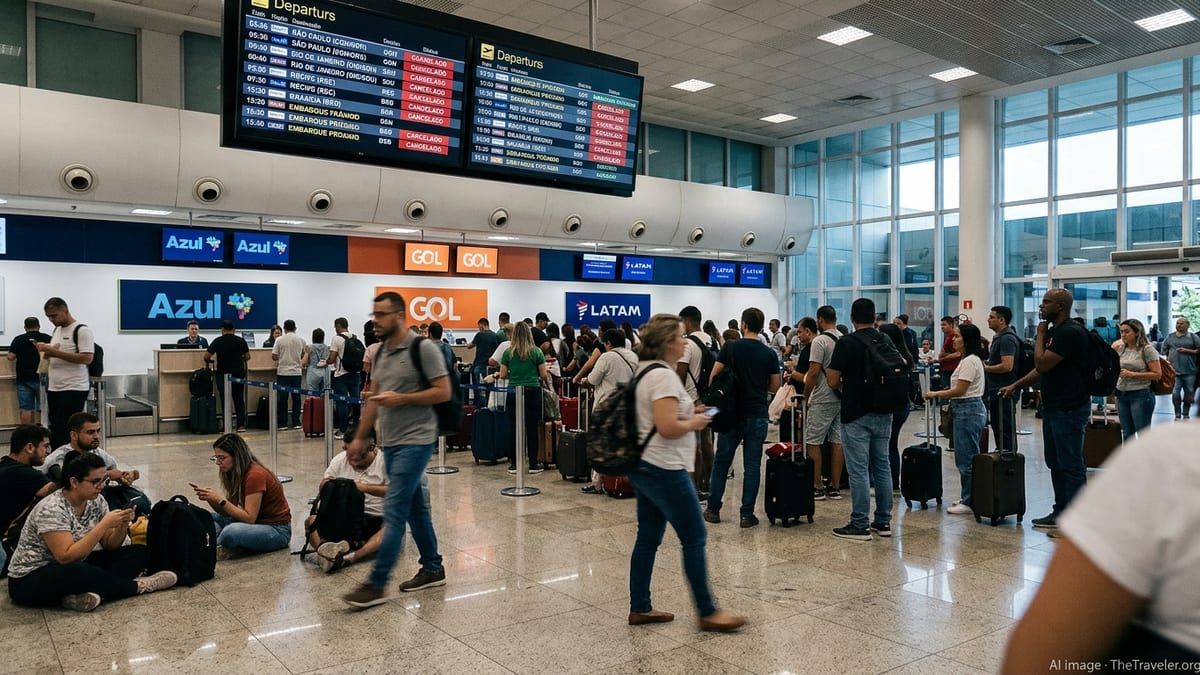
Spike in Cancellations Hits Brazil’s Busiest Corridors
Published coverage from Brazilian media indicates that airlines in the country are canceling a triple-digit number of flights each day, with industry association Abear citing a daily average of around 121 cancellations in late May. The impact is being felt most acutely on high-density routes that link São Paulo, Brasília, Rio de Janeiro and major cities in the Northeast, where carriers typically operate tightly timed shuttle-style schedules.
Recent reports highlight disruptions across São Paulo’s Guarulhos and Congonhas airports, Brasília and Rio de Janeiro’s Santos Dumont and Galeão, as well as Recife, an important hub for connections in the Northeast. On certain days, nearly a dozen departures from these airports have been scrubbed or rerouted within a short time window, forcing airlines to consolidate services and rebook passengers onto later flights.
Operational data from flight-tracking platforms shows that even staple shuttle flights between São Paulo and Rio de Janeiro, as well as trunk routes to Recife and other coastal destinations, have seen sporadic cancellations or extended delays. While the overall volume of flights remains high, the pattern of last-minute changes has added a new layer of uncertainty for travelers planning both domestic jumps and onward international connections.
The disruption is particularly significant on the Rio de Janeiro–São Paulo air bridge and other core domestic corridors that form the backbone of Brazil’s air network. These routes are served by all three major Brazilian carriers and normally see departures spaced just minutes apart, meaning even a small spike in cancellations can cascade quickly through the system.
Fuel Costs and Network Pressures Drive Schedule Cuts
Industry commentary in Brazil links the latest wave of cancellations largely to rising aviation fuel prices and the financial pressure this places on local carriers. According to recent statements from Abear, higher jet fuel costs have pushed airlines to trim frequencies and operate leaner schedules, particularly on routes where margins were already tight.
Airlines have been selectively withdrawing less profitable frequencies, especially in off-peak periods, and concentrating operations on flights with stronger demand. Publicly available information from airline network disclosures shows LATAM, Azul and Gol continuing to prioritize major hubs such as São Paulo, Rio de Janeiro, Brasília and Recife, but with reduced redundancies built into their daily timetables.
Industry filings and financial reports from Azul and other carriers emphasize the importance of maintaining strong connectivity from Recife and other regional hubs to São Paulo and Rio de Janeiro. However, these same documents acknowledge that route structures are being continuously adjusted in response to cost swings and demand shifts, resulting in more frequent timetable changes for passengers.
The combination of higher fuel prices, a competitive domestic market and the need to manage aircraft utilization tightly has created a fragile operating environment. In such conditions, any additional disruption, whether weather-related or technical, can quickly lead to clusters of cancellations across multiple airports on the same day.
Impact on LATAM, Azul, Gol and Air Europa Routes
LATAM, Azul and Gol, which collectively dominate Brazil’s domestic market, have all seen interruptions on routes connecting São Paulo with Rio de Janeiro, Brasília and Recife. Flight-status tools show isolated cancellations and delays on core services such as São Paulo to Rio de Janeiro shuttle flights and evening departures to Recife, underscoring that even flagship routes are not fully insulated from current pressures.
Azul, which has historically maintained a strong presence in Recife and secondary markets, has been particularly visible in recent cancellation tallies. Earlier incidents in April involving a technical issue affecting São Paulo’s airspace led to a cluster of Azul cancellations and diversions in and out of the city, while Gol temporarily suspended operations to its São Paulo airports during that period. Although that specific incident has passed, it illustrates how quickly multiple departures can be wiped from the schedule when conditions tighten.
Gol continues to focus on its extensive domestic network from São Paulo and Rio de Janeiro, but published operational snapshots point to occasional same-day schedule cuts, especially when demand is softer or turnaround windows are compressed. Travelers have reported rebookings and schedule changes on Gol-operated flights linking major capitals and regional centers.
On the international side, Air Europa’s Brazil services are exposed to these domestic disruptions because many passengers rely on connections from cities such as Brasília, Rio de Janeiro and Recife into São Paulo to reach transatlantic flights. When domestic feeder flights on LATAM, Azul or Gol are canceled or delayed, passengers can miss long-haul departures operated by international partners, triggering complex rebooking chains and longer overall travel times.
Domestic and International Travelers Face Knock-On Effects
The operational challenges at Brazil’s busiest airports are rippling out well beyond the immediate cancellations. Travelers connecting through Guarulhos or Galeão on their way to Europe and North America are experiencing tighter margins for making onward flights, particularly when their first leg originates in another Brazilian city and is operated by a different carrier from their long-haul segment.
Reports from passenger forums and consumer-rights services show a rise in claims related to delayed or canceled domestic flights that disrupted international connections, with LATAM, Azul and Gol most frequently involved simply because of their market share. In some cases, travelers are being reprotected on alternative services the same day, while in others they face overnight stays and rerouting through different hubs.
For domestic-only travelers, the main effect has been a reduction in flexibility. Routes that previously offered multiple closely spaced departures during the day now sometimes have wider gaps when one or two flights are removed from the schedule. This can mean longer waits in São Paulo, Brasília, Rio de Janeiro or Recife when a flight is canceled at short notice and the next available departure is already heavily booked.
The situation has also sharpened competition among airlines on high-demand routes. Network information published by carriers highlights how each is working to defend its share in key markets, but with fewer backup options available, even minor schedule changes can quickly spill over into crowded rebooking desks and call centers during peak periods.
What Travelers Should Watch in the Coming Weeks
With jet fuel prices still elevated and carriers signaling ongoing efforts to optimize their networks, observers expect Brazil’s flight schedules to remain fluid into the early winter season. Industry commentary suggests that airlines are closely monitoring load factors and profitability on each route, which could lead to further modest frequency cuts or time adjustments, particularly on domestic sectors with overlapping competition.
Travelers planning trips that involve São Paulo, Brasília, Rio de Janeiro or Recife in the coming weeks may want to allow additional buffer time for connections and monitor their bookings closely in the days leading up to departure. Publicly available flight-status tools and airline notifications are proving especially important, as some cancellations are being made within 24 hours of departure when demand or operational conditions shift.
Analysts note that while Brazil’s major airlines continue to operate robust networks and most flights are taking off as scheduled, the higher baseline of cancellations compared with previous years means that disruptions can be more visible when they cluster around specific airports on a given day. This is particularly true on the busiest domestic corridors that feed international gateways.
For now, there is no clear indication of a sudden return to more generous scheduling practices. Instead, incremental changes, combined with external cost pressures, point to a period in which passengers on LATAM, Azul, Gol, Air Europa and other operators will need to stay alert to updates and be prepared for possible same-day changes on some of Brazil’s most important routes.