


More news on this day
Brussels Airport has rejoined Europe’s international high-speed rail network for the first time since 2015, as a new Deutsche Bahn ICE link to Cologne launches in September 2026 and begins carrying passengers this week, reshaping how travelers connect between western Germany and global flights from the Belgian capital.
Get the latest news straight to your inbox!
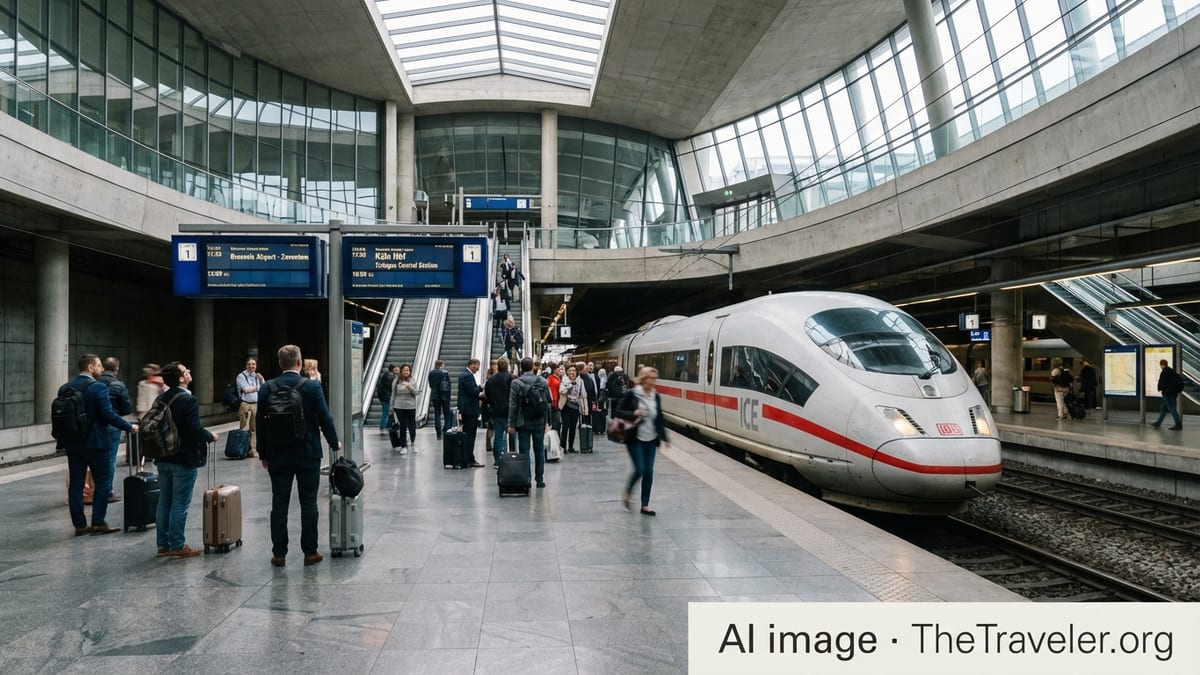
New ICE Route Brings High-Speed Trains Back Under the Terminal
The relaunch of high-speed services at Brussels Airport centers on a new Intercity Express route between Antwerp, Brussels Airport and Cologne. Publicly available information from Brussels Airport and Deutsche Bahn shows that the ICE now runs twice daily in each direction, calling at Antwerpen-Centraal, Brussels Airport-Zaventem, Leuven, Liège-Guillemins, Aachen and Köln Hauptbahnhof. The journey time between the airport and Cologne is around two hours, with trains running on existing high-speed corridors through eastern Belgium and western Germany.
Brussels Airport-Zaventem station sits directly beneath the terminal, allowing passengers to move from platform to check-in in just a few minutes. The airport’s travel information pages highlight that the new ICE service complements the dense network of domestic trains and existing international links via Brussels and Antwerp, restoring a direct high-speed option at the airport after a gap of more than a decade.
Press material from Brussels Airport’s corporate channels notes that the first ICE from Cologne arrived at the airport station on 7 September 2026, formally inaugurating the link and marking the moment the airport rejoined the international high-speed rail grid. Earlier announcements in March had trailed the route as a September launch, with tickets opening several months in advance to capture demand from both business and leisure travelers planning autumn and winter trips.
Rail information published by SNCB International and Deutsche Bahn indicates that the new Antwerp–Brussels Airport–Cologne trains are in addition to existing high-speed ICE and Eurostar services running between Brussels, Cologne and Frankfurt, turning the airport into an intermediate stop on an already busy north–south corridor.
Stronger Air–Rail Integration for Western Germany
The new ICE link is designed to function as more than a point-to-point route. Press releases from Brussels Airport and Brussels Airlines describe a cooperation with Deutsche Bahn that assigns flight numbers to the ICE services, enabling through-ticketing between trains and Brussels Airlines flights. This setup allows passengers from cities in western Germany such as Cologne and Aachen to book a single itinerary that covers both their rail and air segments.
According to published coverage of the partnership, the integrated tickets give travelers a guaranteed connection in case of delays, aligning rail and flight schedules to minimize transfer times at Brussels Airport. The move reflects a broader shift across European aviation and rail operators as they seek to build seamless multimodal journeys and encourage passengers to replace short feeder flights with high-speed train legs.
Travel information from Deutsche Bahn indicates that Cologne remains a key gateway within Germany’s ICE network, offering onward high-speed links to Frankfurt, Berlin, Hamburg, Munich and other major hubs. By tying Brussels Airport into this system, the new route effectively extends the airport’s catchment area deep into Germany, allowing it to compete more directly with rival hubs that also rely on strong rail access.
The arrangement underscores how Brussels Airport is positioning itself as a rail-connected hub similar to Frankfurt and Amsterdam Schiphol, where high-speed trains already play an important role in feeding long-haul flights. Public documents describing the ICE network emphasize that airport stops are increasingly seen as core components of national and international rail strategies.
Expanding Brussels Airport’s Reach Across Europe
Brussels Airport already benefits from a dense domestic rail network linking the terminal to Brussels-North, Brussels-Central and Brussels-South stations, alongside direct trains to major Belgian cities such as Antwerp, Ghent, Bruges, Liège and Namur. The airport’s passenger information shows that six direct trains per hour run between the airport and central Brussels, with additional links to Antwerp and other regional hubs.
From these Belgian interchange points, passengers can connect to Eurostar and other high-speed services toward Paris, London, Amsterdam and further into France and the Netherlands. Previously, international high-speed services such as Thalys served the airport for a limited period, but those operations ended in 2015. The new ICE route therefore represents a return to the airport appearing on Europe’s core high-speed map rather than relying solely on feeder trains to downtown Brussels.
Press material on Brussels Airport’s performance in 2026 notes that the hub offers more than 180 to over 200 direct flight destinations, depending on how seasonal routes are counted, served by dozens of airlines. Bringing high-speed rail directly under the terminal gives passengers from Germany and neighboring regions an additional way to plug into that network without passing through another hub such as Frankfurt or Paris.
For the airport operator, the ICE service also bolsters efforts to position Brussels Airport as the “heart of Europe,” a phrase used in joint material produced with Deutsche Bahn and Brussels Airlines. Maps within these documents illustrate the new line as a spine connecting Cologne, Aachen, Liège, Leuven, Brussels Airport and Antwerp, effectively tying together major economic regions in Belgium and Germany.
Sustainability and the Shift From Short-Haul Flights
Public statements from Brussels Airport emphasize that the ICE connection is part of a broader strategy to promote more sustainable access to the airport. The airport’s mobility pages and neighborhood blog frame the new route as a way for travelers from Germany to choose rail instead of car or short regional flights, particularly on the Cologne–Brussels axis where flight times are short and rail can offer comparable door-to-door journeys.
European transport policy has increasingly encouraged the substitution of rail for short-haul flights where high-speed lines exist, and the new airport–Cologne connection aligns with this direction. Studies and policy documents frequently highlight the lower per-passenger emissions of modern electric high-speed trains compared with regional jets, especially over distances of 200 to 500 kilometers.
The route also supports Belgium’s own efforts to enhance intermodal transport. Information from SNCB International points out that passengers can combine the ICE segment with domestic Belgian trains on a single ticket, simplifying the process of traveling to and from smaller cities that do not have direct high-speed services. For travelers who drive part of the way, Brussels Airport promotes park-and-ride arrangements at rail stations so that the final leg to the terminal can be made by train.
By restoring high-speed services at Brussels Airport, the new ICE corridor offers a concrete example of how European airports can use rail to reduce reliance on short feeder flights while still expanding their reach. For passengers on the Cologne route, the change in 2026 is already transforming travel options, delivering a direct, fast and integrated way to step from train to plane in a single, coordinated journey.
Brussels Airport: New high-speed train to Cologne
Brussels Airport: ICE Cologne–Brussels Airport press release