


From a distance, Cades Cove in Great Smoky Mountains National Park looks like an Appalachian postcard: mist curling over hayfields, a lone white church, deer in the morning light. Up close on a busy Saturday in July, it can feel more like a parking lot wrapped around a meadow. The same wildlife, history, and scenery that make this Tennessee valley irresistible also create some of the park’s worst congestion and crowding. If you have only seen tranquil photos of Cades Cove on social media, the reality of crawling traffic, bear jams, and overflowing parking lots may come as a shock.
Get the latest updates straight to your inbox!
The Most Popular Corner of America’s Most Popular Park
Cades Cove sits on the Townsend side of Great Smoky Mountains National Park, an 11 mile one way loop road that curls around a broad valley surrounded by Thunderhead Mountain, Rich Mountain, and the main Smokies crest. The National Park Service describes it as one of the park’s premier wildlife viewing areas and notes that drivers should allow at least two to four hours to complete the loop, longer if they plan to hike or tour historic buildings. In practice, that “two to four hours” can easily double in heavy traffic.
Great Smoky Mountains is consistently the most visited national park in the United States, drawing well over 10 million visitors per year. Internal park planning documents indicate that roughly half of all visitors make their way to Cades Cove, and independent transportation studies have estimated annual Cove visitation in the low millions. On a clear October weekend, that volume of people funnels onto a single narrow lane of asphalt with a 35 mile per hour speed limit that almost no one actually reaches.
This mismatch between pastoral images and real world visitation sets up many travelers for surprise. A family from Ohio who leaves Pigeon Forge at 10 a.m., expecting a breezy scenic drive before lunch, may find themselves inching past the John Oliver Cabin with the windows down and the engine idling, surrounded by rental SUVs and out of state plates as far as they can see in either direction. The Cove remains beautiful, but the experience can feel more like urban rush hour than wilderness.
The park has acknowledged this tension in its visitor experience planning. Reports on traffic and crowding in Cades Cove include photos of solid lines of vehicles, backed up from the loop entrance across Laurel Creek Road toward Townsend. While the valley’s gentle fields and cabins have not changed much since the 1800s, the access road now lies within a day’s drive of more than half of the U.S. population, and the Cove has become a bucket list stop for tour buses, Instagrammers, and family road trippers alike.
How a Peaceful Loop Becomes a Two Hour Traffic Jam
On paper, Cades Cove Loop Road seems straightforward: one paved, one way lane with pullouts, side roads, and a few opportunities to shortcut the full loop. In reality, the flow of traffic depends almost entirely on driver behavior and a handful of pinch points. The National Park Service warns that traffic is heavy in summer, fall color season, and on weekends year round, and local driving guides routinely advise visitors to “expect delays” and to arrive very early or very late in the day.
A typical scenario unfolds on a sunny July afternoon. Vehicles enter the loop from Laurel Creek Road in a steady stream. Within the first mile, someone spots a white tailed deer grazing near the tree line. Instead of pulling into a designated pullout, two or three cars stop in the travel lane to take photos out the window. Drivers behind them tap their brakes. Within minutes, 30 or 40 vehicles stack up, and the effective speed of the entire road drops to a walking pace.
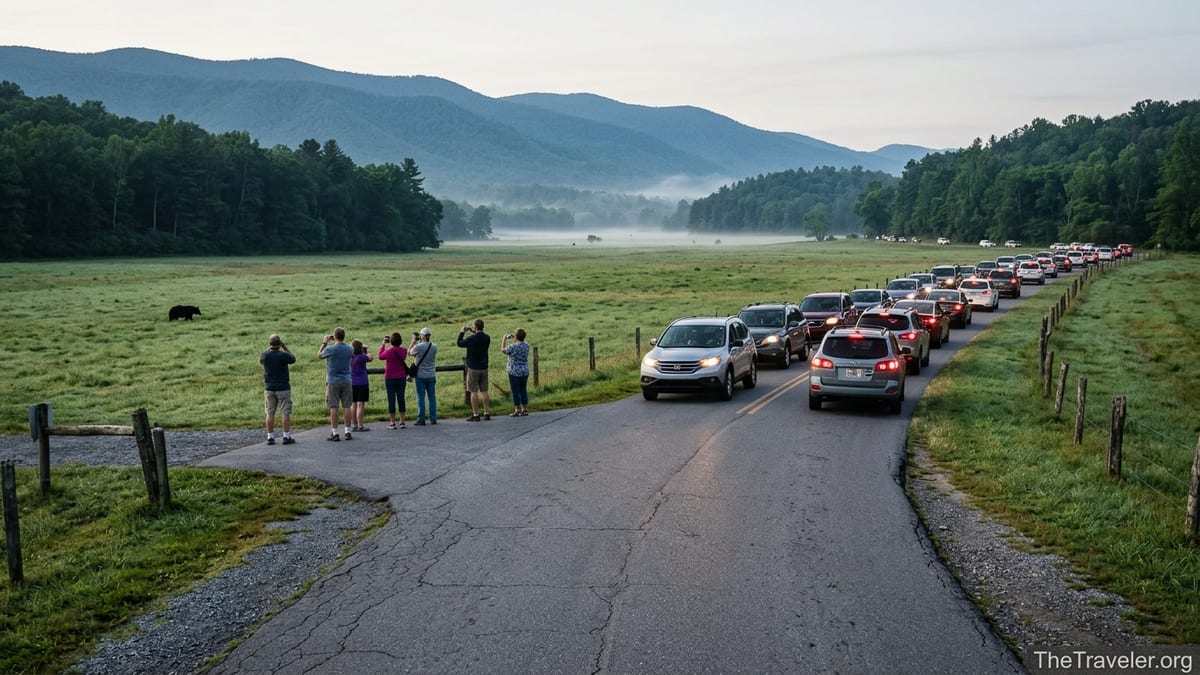
The phenomenon becomes more intense when black bears appear. Travel forums are full of trip reports describing “bear jams” where traffic has come to a complete standstill for 45 minutes or longer because a sow and cubs are foraging within sight of the road. Visitors crowd shoulder to shoulder at the edge of the pavement, some stepping into the road or creeping well within the 50 yard distance the park recommends for bear viewing. Rangers and volunteers then have to move through the gridlocked line, clearing the roadway and urging people back to their cars, which further slows movement.
Even non wildlife delays can be significant. A minor fender bender near the Cable Mill area, a stalled RV on a short grade, or a driver attempting a three point turn in a narrow pullout can choke the one way flow. Because there are limited bypasses and no alternate exit once you commit to the loop, everyone behind the problem is effectively trapped until it clears. Stories circulate of visitors needing three to five hours to complete the 11 miles on peak days, using more fuel idling than driving and nervously glancing at their temperature gauges as they inch along.
Wildlife Encounters: Magical, Crowded, and Sometimes Risky
For many visitors, wildlife is the main reason to brave the crowds. The Smokies are home to one of the densest black bear populations in the East, and Cades Cove’s mix of forest edges, creeks, and open meadows makes it one of the most reliable places in the park to see bears, deer, turkeys, and coyotes. Local outfitters market sunrise bear watching drives, and social media is rich with shots of bears crossing the road against a backdrop of hayfields and blue ridges.
These encounters, however, unfold in an increasingly crowded amphitheater. On a June morning, you might see a mother bear and cubs step out of the woods between the Methodist Church and the Missionary Baptist Church. Within seconds, brake lights ripple down the road, doors open, and a tide of people with phones and long lenses pours into the ditch line. Despite repeated warnings that visitors must stay at least 50 yards away from bears and 50 feet from elk and other large animals, people edge closer for photos, some walking straight across the meadow toward the animals.
Rangers report that this behavior not only creates safety risks for humans but also habituates wildlife to people and vehicles. There have been incidents in which bears have approached or “scratched” vehicles in the Cove, prompting temporary closures of roads such as Rich Mountain Road while wildlife managers attempt to reduce food conditioning and encourage more natural behavior. Each such closure, in turn, removes a pressure valve that might otherwise relieve traffic on the main loop.
Even less charismatic animals can cause friction. Wild turkeys and white tailed deer are common along the loop, and visitors often stop abruptly to photograph them at very close range. The National Park Service has begun emphasizing that “even turkeys” can act aggressively when people crowd them, in an effort to nudge visitors to use pullouts and longer lenses instead of stepping into the roadway. For travelers, the practical lesson is simple: expect wildlife, but also expect company, and plan ways to enjoy sightings without adding to the chaos.
Historic Cabins and Churches with Full Parking Lots
Beyond wildlife, Cades Cove is essentially an open air museum of Appalachian settlement. The loop passes three historic churches, several restored log cabins such as the John Oliver Cabin and the Elijah Oliver Place, a working gristmill at Cable Mill, barns, a blacksmith shop, and multiple family cemeteries. Each site has a small gravel parking area, often with fewer than a dozen spaces, designed for the visitor numbers of decades past.
By mid morning on a busy day, those lots fill quickly. At the Primitive Baptist Church, for example, cars routinely spill out along the shoulder, and passengers dash across the road between gaps in traffic. Tour buses drop groups at the wider stops, and lines form at the restrooms near the Cades Cove Visitor Center. A traveler who imagined quietly reading the inscriptions on century old headstones may instead find a youth group singing on the church steps while other families jockey for position to pose in front of the simple white facade.
The congestion has ripple effects on hiking as well. The Abrams Falls trailhead, reached from a spur road off the loop, is one of the most popular waterfall hikes in the park. On summer weekends, cars line both sides of the access road, sometimes for a quarter mile or more, as the small trailhead lot overflows. Hikers weave between parked vehicles and moving traffic, and rangers periodically close the spur when it becomes unsafe or fully saturated.
For travelers, this means that visiting historic structures in Cades Cove often requires accepting a more social experience than brochures imply. The cabins are still atmospheric, and the churches’ simple interiors tell powerful stories of frontier faith and community, but solitude is rare during peak hours. Those who value quiet reflection tend to fare better right at sunrise, in winter, or by choosing less famous homesteads on the periphery of the loop instead of the marquee stops.
Strategies to Experience Cades Cove Without Losing Your Patience
The good news is that with careful timing and realistic expectations, you can still have a peaceful, even transcendent, experience in Cades Cove. Local lodging operators, guide companies, and the park itself have converged on a few practical strategies that repeatedly prove effective in the real world.
The first and most decisive factor is time of day. The park notes that peak visitation across Great Smoky Mountains typically falls between about 9 a.m. and 2 p.m., and crowding in Cades Cove follows that pattern. Entering the loop at or just after sunrise, especially on a weekday, often means driving long stretches with no one right behind you, with deer in the meadows and low, slanting light on the barns. Many seasoned visitors aim to be at the loop entrance by 6:30 or 7 a.m. in summer and are finishing their drive as the main surge arrives late in the morning.
Late afternoon and early evening can also work well. In July, entering after 4 p.m. often avoids the worst mid day backups, and wildlife activity tends to pick up again as temperatures drop. A family staying in Townsend, for example, might plan a lazy morning, swim, or hike elsewhere, then head into Cades Cove for a 5 p.m. loop, picnic at one of the fields, and exit near sunset.
Seasonal timing matters too. Winter weekdays can be remarkably quiet, with occasional closures for snow or ice. Early spring before school lets out and late November after most leaves have fallen are also comparatively calm. By contrast, October weekends during the peak of fall color and mid summer weekends see some of the heaviest crowding, and visitors during those windows should assume worst case travel times, carry extra water and snacks, and give themselves flexible schedules.
Finally, it helps to plan your mindset. Instead of imagining Cades Cove as a quick scenic drive, treat it as an all morning or all afternoon experience with built in delays. Bring a cooler, binoculars, and something to read for long pauses. Decide in advance that you will use only paved pullouts or parking areas for wildlife viewing, even if that means missing a photo. That small act both reduces the risk of accidents and models better behavior for others, gradually making the experience saner for everyone.
Vehicle Free Wednesdays: The Calm Behind the Chaos
In response to congestion and crowding, Great Smoky Mountains National Park has introduced and then expanded vehicle free days in Cades Cove. In recent years, the loop road has been closed to motor vehicles all day on Wednesdays for part of the main season, generally from spring through late September. On those days, cyclists, runners, and walkers have the entire 11 mile roadway to themselves, aside from park service vehicles and the occasional maintenance truck.
The difference in atmosphere is striking. At 8 a.m. on a June vehicle free Wednesday, you might see a line of rental bikes heading out from the campground store, parents pedaling side by side with kids, and serious road cyclists spinning easily down the hills. The only sounds are birds, voices, and the soft whir of chains. Without idling engines or honking horns, wildlife seems to move more naturally, and people can stop almost anywhere without clogging traffic.
These days are not crowd free. Local runners describe the loop as “filled to the brim” with riders of every skill level on some Wednesdays, especially in summer. Popular pullouts near Cable Mill or the churches can still feel busy, and bike rental lines can be long at mid morning. But the stress is different: instead of worrying about tailgating an RV or being rear ended when you stop for a bear, you are simply managing your own speed and spacing in a flow of human powered visitors.
For travelers, the key is careful planning. The vehicle free schedule changes year by year, and the closure applies from sunrise to sunset or sunrise to mid afternoon depending on the season’s plan. If you drive up from Gatlinburg on a Wednesday expecting a regular scenic drive, you may discover that cars are turned away at the loop entrance until the road reopens. Checking the park’s current Cades Cove page or trip planning resources before you go, and deciding whether you want the vehicle free or vehicle friendly experience, can prevent a frustrating surprise.
Alternatives When Cades Cove Feels Overwhelming
Some visitors emerge from a peak season Cades Cove loop vowing never to return. Others simply decide that next time, they will choose a less crowded corner of the park. Fortunately, the Smokies offer several options that deliver mountain scenery and history with far fewer brake lights.
The park itself suggests roads like the Foothills Parkway, which offers sweeping views of the Smokies from a higher vantage point without the stop and go traffic that defines Cades Cove in summer. Travelers staying in Townsend or Wears Valley can reach sections of the parkway in 20 to 40 minutes by car and then cruise at a steady pace, pulling into overlooks to photograph the layered ridges.
For a quieter auto tour with historic feel, Roaring Fork Motor Nature Trail near Gatlinburg provides a narrow, one way loop through old growth forest with cabins, creeks, and trailheads. It can also be busy, and the road’s drop offs and lack of guardrails command attention, but the overall volume of vehicles is generally lower than Cades Cove. Families who were overwhelmed by bear jams in the Cove often report more relaxed experiences on Roaring Fork, particularly on weekday mornings.
Those who primarily want wildlife viewing might simply adjust where and when they look. Open roadside fields near the Oconaluftee Visitor Center on the North Carolina side, less famous pullouts on Newfound Gap Road, and even the meadows near Cataloochee offer chances to see elk and deer with less crowd pressure. Combined with a short, well chosen hike along a creek or to a waterfall, these routes can provide the sense of intimacy with the Smokies that some travelers hope to find in Cades Cove but miss amid the congestion.
The Takeaway
Viewed from the overlook on Laurel Creek Road, Cades Cove appears exactly as promoted: a serene green bowl framed by smoky ridges, dotted with cabins and churches. That postcard view is real. So are the black bears nosing through berry bushes at dawn, the gobble of wild turkeys across the fields, and the creak of church doors that have swung on their hinges for more than a century.
What the postcard does not show is the reality that this little valley is now the single most popular destination within America’s most visited national park. On many days from late spring through fall, the 11 mile loop is more procession than drive, with traffic measured in hours rather than minutes and every bear sighting triggering a spontaneous traffic jam. The tranquility that travelers crave is still there, but it exists in tension with millions of other people’s desire to experience the same scene.
If you approach Cades Cove with clear eyes, you can thread that needle. Plan around peak hours, understand how vehicle free Wednesdays work, decide in advance how you will behave around wildlife and pullouts, and be willing to bail out to quieter corners of the park if conditions feel overwhelming. Accept that some days, the crowds win, and your loop becomes more sociological study than spiritual escape.
Yet for many, even a slow, crowded loop is worth it the moment a bear crosses the road in front of them or the valley fills with evening light. Cades Cove looks peaceful because, in its bones, it is. Our challenge as visitors is to experience that peace without loving the place to death.
FAQ
Q1. How long does it really take to drive the Cades Cove Loop Road?
Most visitors should plan on at least two to four hours for the 11 mile loop, including brief stops. In peak summer and fall weekends, delays from traffic, wildlife jams, and full parking lots can stretch that to three to five hours. If you only have an hour to spare, it is better to save Cades Cove for another trip.
Q2. When is Cades Cove the most crowded?
The heaviest congestion typically occurs from late spring through October, especially on Saturdays and Sundays between about 9 a.m. and 2 p.m. Holiday weekends, fall color season in October, and mid summer school vacation periods are particularly busy. During those windows, entering at sunrise or late afternoon is your best bet to avoid gridlock.
Q3. What are Cades Cove vehicle free Wednesdays and how do they work?
On designated Wednesdays during the main season, Cades Cove Loop Road is closed to private motor vehicles for most or all of the day. Cyclists, walkers, and runners can use the full 11 mile loop without sharing it with cars, aside from park staff. Schedules change year by year, so visitors should check the current season’s plan before assuming the loop is open to vehicles on a Wednesday.
Q4. Is Cades Cove a good place to see black bears?
Yes, Cades Cove is one of the most reliable places in Great Smoky Mountains National Park to see black bears, especially early in the morning and late in the afternoon. However, sightings are never guaranteed, and visitors must stay a safe distance away, use pullouts instead of stopping in the road, and follow ranger instructions so bears do not become used to people or food.
Q5. Are there ways to avoid the worst traffic in Cades Cove?
You can reduce your chances of gridlock by arriving at or just after sunrise, visiting on weekdays, and avoiding peak holiday and fall foliage weekends. Entering the loop later in the afternoon, carrying extra water and snacks, and being willing to skip a stop when parking lots are full can also make the experience smoother.
Q6. What should I do if traffic comes to a complete stop?
If traffic stops, stay in your lane, keep to the right as much as safely possible, and avoid blocking pullouts. Do not drive into fields or ditches to get around others. Often the delay is due to wildlife or a minor blockage that rangers are already addressing. Turning off your engine during extended standstills and using the time to enjoy the scenery can make the wait more bearable.
Q7. Is Cades Cove suitable for young children and older travelers?
Yes, the loop can be a good option for families with small children and visitors with limited mobility, because much of the scenery and wildlife can be enjoyed from the car. However, the long periods of stop and go traffic can test patience. Bringing snacks, drinks, sunshades, and something quiet for kids to do in the back seat will help everyone cope with slow sections.
Q8. How does Cades Cove compare to other scenic drives in the Smokies?
Cades Cove offers some of the best chances for wildlife viewing and historic buildings in one compact loop, but it is also among the most crowded. Alternatives like the Foothills Parkway and Roaring Fork Motor Nature Trail provide beautiful scenery and old cabins with generally lighter traffic. Travelers who dislike crowds often prefer those routes and reserve Cades Cove for off season visits.
Q9. Can I bike or walk the loop when cars are present?
Yes, you can bike or walk the loop on days when vehicles are allowed, but it is not recommended for everyone. The narrow road, blind curves, and distracted drivers focused on wildlife can make conditions stressful. Many cyclists and runners prefer to use the vehicle free Wednesdays during the main season, when they do not have to mix with heavy traffic.
Q10. Is Cades Cove still worth visiting despite the traffic and crowds?
For many travelers, yes. The combination of a broad mountain valley, historic homesteads, and frequent wildlife sightings is hard to match elsewhere in the region. However, whether it feels “worth it” depends on your tolerance for crowds and your flexibility with timing. If you can visit early, late, or in the off season, you are far more likely to experience the peaceful Cades Cove shown in the postcards.