


More news on this day
The United States has issued a fresh worldwide travel warning for its citizens, highlighting rising security risks linked to the ongoing conflict with Iran and urging Americans overseas to heighten personal safety precautions and closely monitor official guidance before and during trips.
Get the latest news straight to your inbox!
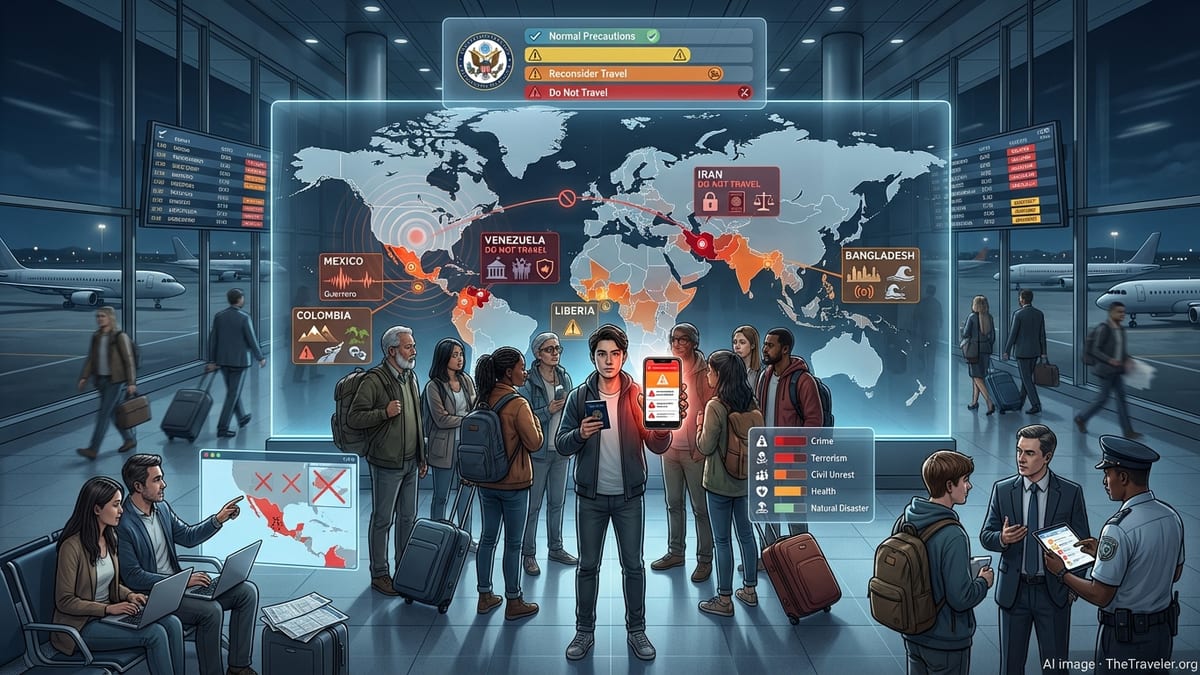
Global security alert targets Americans abroad
Recent updates to U.S. government security bulletins describe a broad worldwide alert aimed at Americans living, working, or traveling overseas. The latest warning, circulated in late July, draws particular attention to the potential for attacks or harassment directed at U.S. citizens and facilities as tensions with Iran remain elevated.
Media coverage of the advisory notes that the alert follows weeks of military activity in the Middle East and public discussion of possible further strikes. Reports indicate that U.S. citizen travelers are being urged to remain aware of their surroundings, avoid large gatherings where possible, and develop contingency plans in case of sudden unrest or transport disruption.
The renewed warning is described as part of the State Department’s ongoing “worldwide caution” messaging, which is periodically updated when the government perceives rising cross-border security risks. While such global alerts are less common than country-specific advisories, they are used when policymakers see a broad, diffuse threat environment rather than one confined to a single destination.
Information made public in recent days emphasizes that the alert is not a blanket ban on overseas travel. Instead, travelers are being advised to calibrate their plans against current conditions, particularly in regions directly affected by the Iran conflict and in areas where allied or proxy groups may be active.
How the latest warning fits into the State Department system
The new alert sits on top of the U.S. government’s four-tier travel advisory framework, which rates individual countries from Level 1, advising normal precautions, to Level 4, recommending that Americans do not travel. Publicly available State Department guidance explains that Level 3 advisories urge travelers to reconsider trips, while Level 4 reflects the highest assessed risk from crime, conflict, or instability.
Recent advisories highlight how quickly conditions can change. In the last several months, the United States has updated guidance for destinations as varied as Saint Lucia, Jamaica, Moldova, and the United Arab Emirates, reflecting evolving concerns over crime, regional tensions, or the threat of armed conflict. Each update feeds into a broader picture of global risk that underpins the new worldwide warning.
Government documentation describing the consular information program notes that analysts draw on reports from diplomatic posts, other U.S. agencies, foreign governments, and open sources when revising advisories. Those updates can range from narrow changes, such as newly identified no-go neighborhoods, to sweeping decisions to elevate an entire country to Level 3 or Level 4.
The latest global alert underscores that even travelers heading to countries with lower-level advisories may encounter secondary effects, such as demonstrations, cyber disruptions, or opportunistic crime targeting foreign visitors. The message encourages Americans to look beyond headline risk ratings and review the narrative sections of each advisory before committing to nonessential travel.
Regional flashpoints shaping the new caution
The current warning is heavily influenced by the Iran conflict and associated instability in parts of the Middle East. Recent media reports on the advisory highlight concerns that Iran-linked or sympathetic groups could seek to target U.S. citizens, facilities, or symbolic locations beyond the immediate battlefield, including in third countries.
Public travel notices for several states in the region already reflect heightened caution, ranging from ordered departures of nonessential U.S. government staff in some countries to strong recommendations that private citizens reconsider or defer travel. Against that backdrop, the worldwide message is intended to capture the risk that an incident in one location could spark follow-on actions elsewhere.
The broader security environment is also being shaped by other crises. Official advisories have in recent years warned Americans about cartel violence in parts of Mexico, political instability in Venezuela, and local crime patterns in a number of Caribbean destinations. While the latest global alert is driven primarily by geopolitical tension, it reinforces a pattern in which multiple, overlapping risks can affect travelers on relatively short notice.
Analysts following these developments stress that the confluence of conflicts, extreme weather events, and intermittent transport disruptions has created a more volatile environment for international travel than in the immediate pre-pandemic period. The new U.S. warning is one of several signals that governments are recalibrating how quickly they communicate emerging threats to their citizens overseas.
Practical implications for Americans with upcoming trips
For leisure and business travelers, the new worldwide warning is most likely to be felt in planning stages and on-the-ground risk assessments rather than through outright bans on travel. Airlines and tour operators are generally continuing scheduled services, but travelers may see more frequent schedule adjustments, last-minute route changes, or security-related airport measures in certain regions.
Travel insurance providers are also closely watching advisory levels. Industry guidance published in late June illustrates that some policies treat a shift to Level 4, or a narrowly defined event such as declared war or terrorism, as a trigger for specific benefits, while others do not. Americans are being encouraged in public advice columns to read both their insurance contracts and the latest U.S. advisories carefully before departure.
Travel experts writing in consumer outlets note that many destinations remain open and welcoming to visitors, and that risk levels can vary significantly within a single country. Even where a national advisory urges increased caution, popular resort areas or business districts may still see strong demand, with local authorities and hospitality providers adding visible security measures to reassure guests.
However, the global tone of the new warning is prompting more travelers to create contingency plans, such as identifying alternate flight routes, registering contact details with consular services, and allowing extra time for security checks. Americans with complex itineraries that cross several regions are being urged in public-facing guidance to monitor developments closely in the days immediately before departure.
Steps travelers can take in response to the warning
Publicly available U.S. government resources emphasize a series of voluntary steps that Americans can take to manage risk under the new warning. These include checking country-specific advisories shortly before travel, enrolling in notification programs that share security alerts, and preparing copies of important documents in case of emergency.
Security guidance frequently shared with the public also recommends basic situational awareness measures, such as keeping a low profile in politically sensitive areas, avoiding demonstrations or large crowds, and knowing how to contact local emergency services. Travelers are encouraged to maintain communication plans with family or colleagues, including agreed check-in times and alternative contact methods if mobile networks are disrupted.
Commentary from travel-industry publications suggests that many frequent travelers are not canceling trips outright but are adjusting behavior, choosing hotels in central, well-lit neighborhoods, and favoring licensed transport providers over informal options. Some are opting for flexible tickets and accommodations that can be changed at short notice if the situation in a destination deteriorates.
As the worldwide warning remains in effect, the key message for Americans appears to be preparation and vigilance rather than panic. The latest alert reiterates that risk is uneven across destinations and that well-informed travelers who follow local guidance and official advisories can still complete many international journeys safely, even amid a more unpredictable global environment.