


More news on this day
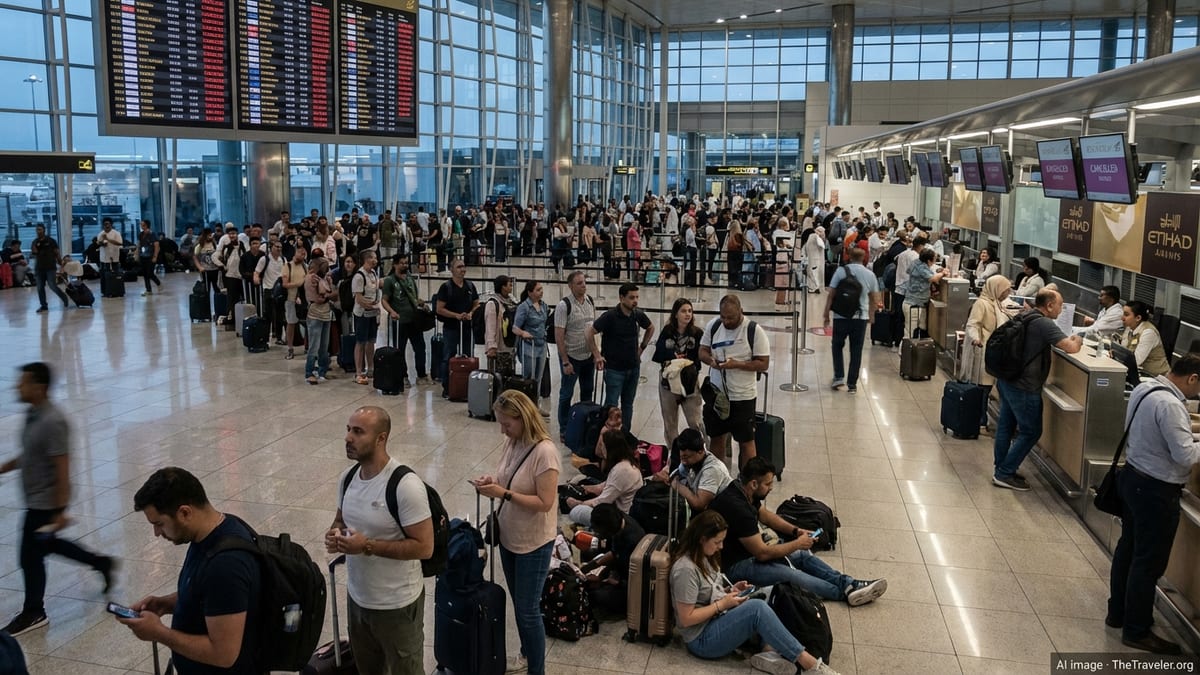
Air travel across the Middle East remains severely disrupted as airlines worldwide cancel flights, trim schedules and reroute services around conflict zones and restricted airspace, creating days of cascading delays for passengers and cargo moving through the region’s key hubs.
Get the latest news straight to your inbox!
Conflict and Airspace Closures Choke Key Regional Hubs
Publicly available aviation and government briefings indicate that a series of airspace closures and security advisories linked to the 2026 conflict involving Iran, the United States and regional allies has sharply curtailed flights across parts of the Middle East. Airspace over Iran and several neighboring states has been periodically restricted, forcing long detours and limiting access to traditional east–west corridors that connect Europe, the Gulf and Asia.
Major hubs such as Dubai International, Abu Dhabi and Kuwait have faced repeated operational constraints since late winter, with periods of near-complete shutdown followed by phased restarts under tighter safety protocols. These interruptions have left airlines juggling complex rescheduling exercises, while passengers transiting through the Gulf have encountered rolling cancellations and extended layovers as carriers attempt to rebuild reliable rotations.
Aviation industry analysis shows that the closure of large swathes of regional airspace has pushed international traffic into a smaller number of approved corridors across the eastern Mediterranean and the Arabian Peninsula. That concentration of flights has increased congestion in neighboring air traffic control sectors and lengthened average flight times, even on routes that continue to operate.
Safety notices from multiple aviation regulators advise operators to avoid parts of the Gulf and adjacent waters, prompting many non-Middle Eastern airlines to suspend services to certain destinations or to operate with reduced frequencies. The result is a fragmented route map in which some airports remain accessible only via lengthy detours while others see service withdrawn entirely until security conditions are reassessed.
Global Airlines Scale Back Routes to Gulf and Levant Cities
According to recent airline statements and media coverage, a growing list of European and Asian carriers has announced extended suspensions or capacity reductions on routes into Gulf and Levant destinations, including Dubai, Riyadh, Jeddah, Doha, Tel Aviv and Beirut. Some airlines that initially planned short-term pauses have repeatedly pushed back resumption dates as the regional security outlook remains volatile.
One major European carrier has kept flights to Beirut suspended into early August and temporarily halted services to Dubai and Riyadh, while indicating that any eventual restart would be at a lower frequency than before the crisis. Other European low-cost and leisure operators have removed Dubai, Abu Dhabi and several secondary Middle Eastern cities from their summer schedules, in some cases until late October, citing ongoing risk assessments and airspace constraints.
Factbox summaries compiled by international news agencies show a patchwork of policies. Several flag carriers are resuming limited operations to select Middle Eastern destinations but are cutting the number of daily flights or dropping certain cities entirely. At the same time, some Gulf-based airlines have restored partial schedules from their home hubs yet continue to avoid particular overflight zones, adding time and fuel burn to long-haul services.
These shifting plans are contributing to a high volume of last-minute timetable changes. Travelers with summer itineraries to or through the region are reporting rebookings onto different routings, overnight connections in alternative hubs, or outright cancellations where airlines judge that reliable operations cannot be guaranteed in the coming weeks.
Knock-On Delays Ripple Across Europe–Asia Networks
Industry data from air navigation and slot-coordination bodies indicates that the Middle East disruptions are reverberating far beyond the immediate conflict zone. With some of the world’s busiest transfer hubs constrained, airlines have been forced to reroute significant portions of Europe–Asia traffic through alternative paths over the Caucasus, Central Asia, North Africa and southern Europe.
These longer routings increase block times and tighten aircraft and crew utilization, leaving less margin in daily rotations. Even minor operational issues, such as weather delays or ground handling bottlenecks, are then more likely to cascade into missed connections and late arrivals. European air traffic statistics for the early summer period point to elevated average delay minutes per flight, with analysts linking a portion of that increase to rerouted Middle Eastern flows crowding neighboring airspace sectors.
Tourism and trade organizations surveying the impact describe difficulty securing viable flight options on some once-routine itineraries that previously transited Gulf or Levant hubs. Travel companies report that group tours and long-haul holiday packages relying on those connections have been postponed, redirected to alternative destinations, or canceled altogether when suitable replacement capacity could not be found at reasonable prices.
Cargo services are facing parallel challenges. With freighter flights and bellyhold capacity in passenger aircraft disrupted, logistics providers note slower transit times and higher costs on lanes linking Europe, Africa and Asia. This affects not only tourism-related goods but also time-sensitive shipments, including manufacturing components and consumer products that typically flow through Middle Eastern gateways.
Passengers Face Cancellations, Lengthy Reroutes and Limited Options
For individual travelers, the operational complexities translate into practical difficulties at the departure gate. Recent coverage from regional outlets describes flights from Gulf airports to neighboring countries being canceled with relatively short notice, alongside reduced frequencies on what were previously multiple-daily connections. Passengers are being offered rebooking on later dates, travel via indirect routings, or refunds, depending on each carrier’s policy and available capacity.
Airlines that have suspended multiple Middle East routes are generally allowing affected customers to change travel dates or destinations without penalty, even if their flights have not yet been formally canceled. However, with school holidays and peak summer demand underway, alternative seats are limited on many days, particularly on routes linking Europe to Asia and Australasia. Travelers report accepting substantial detours, overnight transits in unfamiliar hubs, or multi-stop itineraries to reach their final destinations.
Travel advisories issued by various governments emphasize the need for flexibility, urging passengers to monitor airline notifications closely, allow extra time for connections, and be prepared for itinerary changes. Consumer guidance points to standard passenger rights in cases of cancellation or long delay, although compensation rules can vary significantly depending on the carrier’s home jurisdiction and whether the disruption is classified as outside the airline’s control.
Some tourism boards and industry bodies warn that the uncertainty could dampen late-season bookings to destinations reliant on Middle Eastern transit traffic. While point-to-point travel within relatively stable parts of the region continues, the perception of unpredictability around air routes and schedules is influencing traveler decision-making, with some opting for itineraries that avoid the affected corridors altogether.
Outlook: Prolonged Disruption and a Gradual, Uneven Recovery
Aviation outlook reports produced in the first half of 2026 suggest that the structural impact of the conflict on Middle Eastern airspace could persist well beyond the current peak travel season. Analysts note that even if hostilities ease, regulators and airlines may take a conservative approach to restoring overflight permissions and rebuilding schedules through previously affected corridors.
Forecasts discussed in recent industry briefings describe an international network now funneled through a smaller number of operational routes via the Caucasus, North Africa and parts of the Arabian Peninsula. This configuration is expected to keep flight times longer and operating costs higher for many Europe–Asia services, leaving carriers cautious about reinstating pre-crisis capacity levels in the near term.
Slot coordinators in Europe have already adapted their rules to reflect the volatility, allowing airlines greater leeway to cancel or adjust services linked to the Middle East without jeopardizing long-term access to crowded airports. Governments in major outbound markets are simultaneously reminding airlines of their obligations to care for affected passengers and to provide clear options for rerouting or refunds when flights are withdrawn.
For travelers planning journeys in the coming months, publicly available guidance from both airlines and official travel advisory sites highlights a few consistent themes: check bookings frequently, consider routing options that do not rely on a single vulnerable hub, and anticipate that timetables across the wider Middle East region may change at short notice as the security situation and airspace restrictions evolve.