


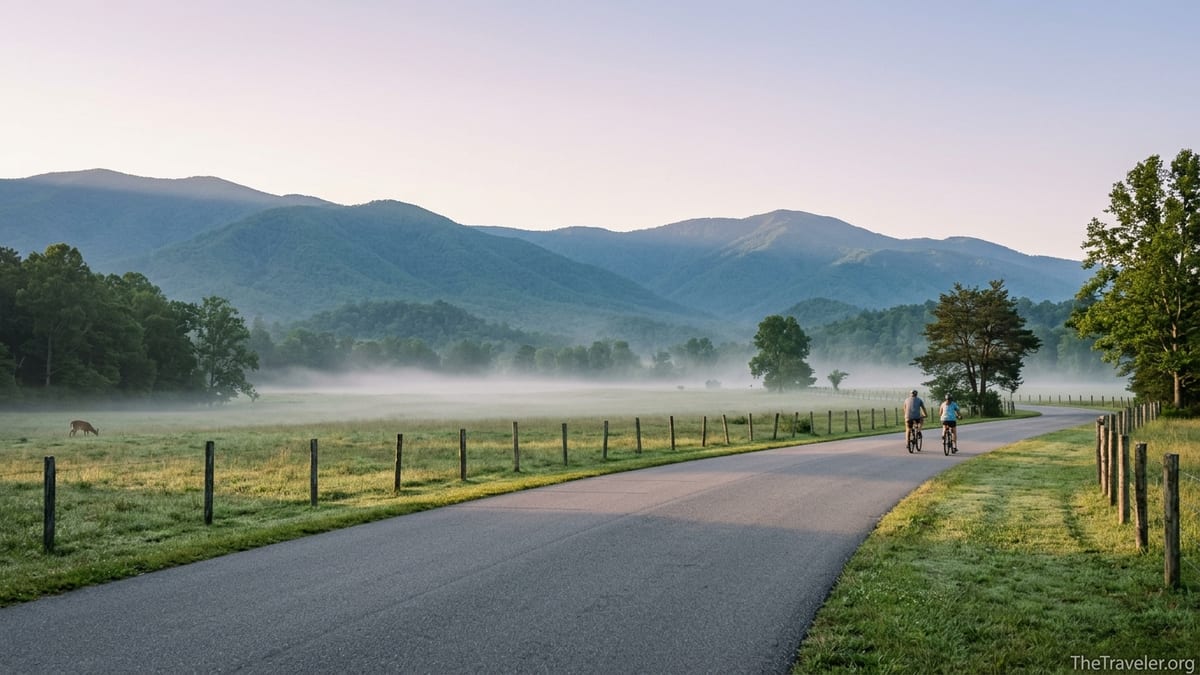
Cades Cove is the most popular place in Great Smoky Mountains National Park, which means it can feel either magical or maddening depending entirely on when and how you visit. Time it right and you can watch deer grazing in misty fields, photograph barns glowing in first light and cycle empty pavement without a single car in your frame. Time it wrong and you may spend three hours trapped in a bumper-to-bumper bear jam. This guide breaks down exactly how to plan your visit for wildlife, fewer cars and the best photo stops, using real-world timing strategies that work in 2026.
Get the latest updates straight to your inbox!
Know the Loop, the Seasons and the New Vehicle-Free Wednesdays
Cades Cove is an 11-mile, one-way scenic loop on the Tennessee side of Great Smoky Mountains National Park, surrounded by a horseshoe of mountains and dotted with meadows and historic cabins. On a busy summer weekend, more than a thousand cars may make that circuit, which is why timing is everything if you want wildlife and clear views instead of taillights. The loop typically opens at sunrise and closes at sunset, but practical access is dictated just as much by seasonal crowds as official hours.
From roughly late May through October, visitor numbers surge, with June, July and October being the most crowded. Midday in peak season, it is common for the loop to crawl at 5 to 10 miles per hour, and one photo-worthy bear can bring traffic to a complete standstill. By contrast, on a cold January weekday, you may drive whole stretches without seeing another vehicle. When you are planning your visit, assume that weekends, holidays and school breaks will dramatically slow your progress, and that weather swings can also change conditions quickly. A foggy autumn morning can burn off to bright sun by 10 a.m., transforming dim, moody scenes into harsh light and heavier traffic.
A key change for planners is the park’s modern approach to vehicle-free days. Great Smoky Mountains National Park now sets aside all-day, vehicle-free Wednesdays in Cades Cove during part of the warm season, generally early May through late September. On these Wednesdays, the loop is closed to private motor vehicles and opened to cyclists and pedestrians from sunrise to sunset. In 2026, the park has announced vehicle-free Wednesdays beginning May 6 and running through September 30. Travelers who want quiet roads, safe family biking and car-free wildlife viewing should seriously consider aligning their visit with one of these midweek dates.
Outside of the vehicle-free window, you will share the loop with cars, buses and RVs, but you can still tilt the odds in your favor. The critical levers are time of day, day of week and season. For example, a Tuesday in late April, starting at sunrise, can feel calm and uncrowded even though it is technically shoulder season, while a Saturday in mid-October at 11 a.m. can feel like a rolling parking lot. Think of your visit less as “a day in Cades Cove” and more as “a strategically chosen two to four hour window inside a specific season.”
Best Times of Day to Actually See Wildlife
Wildlife in Cades Cove follows the same broad rhythm as elsewhere in the Smokies: most animals are most active in the cool hours of dawn and dusk. White-tailed deer move through the meadows at first light, wild turkeys often fan out along the fields just after sunrise, and black bears are most frequently spotted along the forest edges and in berry patches during early morning and late evening. In practical terms, that means your best bet for sightings is from sunrise to about 9 a.m., and again from roughly 5 p.m. until the light fades.
Imagine a July visit based out of Townsend. Sunrise around that time is close to 6:20 a.m. Local photographers and guides routinely recommend being through the Townsend entrance station and on Laurel Creek Road before 6 a.m. so you hit the Cades Cove loop just as the first light touches the valley. That couple from Ohio who leaves their hotel in Pigeon Forge at 8 a.m., stops for coffee and breakfast and rolls into the cove at 10 a.m. is much more likely to see warm pavement and bumper-to-bumper traffic than foraging bears. By contrast, a family that packs breakfast to-go and drives in pre-dawn often reports seeing deer, coyotes trotting along the fields and, in some seasons, multiple bear sightings before 8 a.m.
Season matters too. In late spring and early summer, bears often forage in the open meadows at daybreak, especially when berries are ripening. In fall, the same fields may host bucks in velvet or turkeys scratching through fallen leaves. In winter, when leaves are off the trees, smaller animals such as woodchucks and foxes can be easier to spot along field edges even under bright midday light, simply because there is less vegetation to hide them. However, shorter winter days mean your dawn and dusk windows are compressed. It is worth thinking in terms of specific target windows, such as “on the loop by 7 a.m. in May” or “start a final lap at 4:30 p.m. in October” rather than just “morning” or “evening.”
The other half of wildlife success is learning to slow down. Many first-time visitors drive the entire 11 miles in a single pass, barely pulling off except at obvious cabins. Regulars do the opposite: they inch slowly through key meadows, stop at pull-offs with good sightlines, scan with binoculars and wait. For example, instead of racing past the broad fields soon after the loop begins, you might pull fully off the road, turn off your engine, and spend 20 minutes just watching the tree lines. That waiting is often when a doe slips quietly from the shadows, or a bear appears at the back of the field. Budget your time so that you can afford to linger in one or two promising areas rather than racing the whole loop at once.
How to Avoid the Worst Traffic and Bear Jams
The single biggest complaint about Cades Cove is traffic. On busy days, bear jams can add an hour or more to a single loop. The good news is that with a few strategic choices, you can reduce your time in rolling gridlock. First, visit on a weekday if at all possible. Monday, Tuesday and Thursday are typically lighter than Friday through Sunday once schools are out. In the vehicle-free season, if you want to drive the loop, avoid Wednesdays entirely and aim for Tuesday or Thursday mornings instead.
Next, treat midday like rush hour. The combination of late sleepers, bus tours and day trippers often peaks between about 10 a.m. and 3 p.m., especially in summer and during the October foliage season. If you have only one day, plan a pre-dawn start, then be content to leave Cades Cove by late morning and spend your afternoon elsewhere in the park, perhaps along Little River Road or at Laurel Falls. Travelers who try to “push through” the midday logjam often end up frustrated and exhausted, while those who exit the loop around 10 or 11 a.m. frequently report that they were back in Townsend at lunchtime and had the rest of the day free.
Your choice of base also affects how much traffic you face. Staying in Townsend typically cuts your drive time to the loop entrance to about 25 to 35 minutes and keeps you out of the heaviest Pigeon Forge and Gatlinburg congestion. By comparison, leaving from a Gatlinburg hotel can add 45 minutes or more each way in summer. Many repeat visitors deliberately pick a small riverside motel or cabin along the Townsend stretch so they can access Cades Cove just after sunrise and again shortly before dusk without committing to a long commute.
On the loop itself, use pull-offs generously and respectfully. When traffic backs up around a wildlife sighting, park rangers sometimes need to keep cars moving to prevent accidents and protect the animals. If you spot a bear or deer and want to watch or photograph, pull completely off the road into a designated pull-out instead of stopping in the travel lane. A compact sedan that stops half on the pavement to take a photo can back traffic up for hundreds of yards. Courtesy also extends to pace. If a long line of cars piles up behind you and you prefer to move slowly, look for a safe pull-off where you can let faster drivers pass. This simple habit can shift the whole tone of the drive from tense to relaxed.
Car-Free Wednesdays: Cycling and Walking the Loop
Vehicle-free Wednesdays have become a signature Cades Cove experience. On these days, typically from early May through late September, the park closes the entire 11-mile loop to private motor vehicles from sunrise to sunset. Visitors can walk, run or cycle the loop, listen to birdsong without engine noise and stop freely in the road for photos without worrying about traffic behind them. For many photographers and wildlife watchers, these days offer the rare combination of quiet and safety that is hard to find on standard driving days.
In practice, a typical summer Wednesday might look like this: a couple from Atlanta arrives at the Cades Cove Campground Store by 7 a.m., rents two hybrid bikes with helmets and is pedaling into the mist by 7:30. Rental bikes in recent seasons have cost roughly what you would expect for a half-day outing in a popular national park area, so budget accordingly. Strong cyclists often complete the 11-mile loop in 1.5 to 2 hours without many stops, but most visitors take 3 to 4 hours once you factor in dismounting at churches, cabins and scenic fields. Because there are several short, punchy hills, e-bikes have become increasingly popular; they make it more realistic for mixed-ability families to ride the entire loop.
If you bring your own bikes, plan for parking and timing. On peak Wednesdays in June and July, the main parking lots near the loop entrance can begin to fill by 7:30 or 8 a.m., and latecomers may find themselves parking along Laurel Creek Road and adding extra distance. Families with younger kids often aim for the flatter first segment of the loop, ride out a few miles, then double back instead of committing to the full circuit. Walkers typically cover only small portions of the loop for the same reason; eleven miles on pavement can feel long in summer humidity.
Photographers should weigh the trade-offs carefully. Car-free days are wonderfully quiet, and it is easier to set up a tripod at the edge of the road or in a field turnout without worrying about traffic. At the same time, mid-morning and midday light can still be harsh, and summer haze can wash out the mountain backdrop. Many photographers aim for the earliest and latest light even on vehicle-free days, beginning their ride right at sunrise or starting a final loop around 4 or 5 p.m. to catch golden light on the barns and cabins. Keep in mind that, while the road is free of private vehicles, you may still encounter park service trucks doing essential maintenance, so stay alert.
Iconic Photo Stops: Sparks Lane, Hyatt Lane and Historic Structures
Cades Cove is one of the most photographed valleys in the southern Appalachians, and a few locations have become classic stops for landscape and wildlife images. Two short gravel cut-through roads, Sparks Lane and Hyatt Lane, intersect the main loop and deliver some of the best compositions in the cove. Sparks Lane, closer to the beginning of the loop, is famous for its tree-lined track receding toward the mountains, with fence posts and occasional pockets of fog that catch first light. On a late-May morning, it is common to see tripods lining the edge of the lane as the sun breaks over the ridge, backlighting dew on the grass and sometimes illuminating browsing deer in the fields.
Hyatt Lane, a bit farther along the loop, offers a slightly higher vantage and broader views across the valley toward the surrounding peaks. Photographers often use a medium telephoto lens to compress the rolling fields and distant cabins, creating layered mountain scenes. Both cut-throughs are unpaved and can be rutted after heavy rain, so low-slung cars should go slowly. During wet periods, some visitors choose to walk portions of these lanes rather than drive them, especially if they want to stop frequently to shoot.
The historic structures in Cades Cove are equally photogenic. The John Oliver Cabin near the beginning of the loop is an early-morning favorite, with log walls catching side light and the mountains rising softly behind. The three churches along the loop, including the Primitive Baptist and Methodist churches, work nicely in soft overcast when contrast is lower and white clapboard facades are less prone to glaring highlights. Farther along, the Cable Mill historic area features a working gristmill, blacksmith shop and barns, all framed by split-rail fences and forest. Photographers who arrive here by mid-morning often find fewer crowds than at the opening pull-offs, especially on non-peak days.
Timing your stops is part art, part logistics. If you start the loop at sunrise, consider doing a focused first pass of the early segments, paying special attention to Sparks Lane and the opening meadows while the light is low. You can always loop around again later for the later structures. Many serious photographers run the loop twice in a single morning: first concentrating on dawn fields and distant layers, then a second lap after 8:30 or 9 a.m. focused on cabins, detail shots and shaded creek scenes as the sun climbs higher. Allow elbow room in your schedule to hop out of the car whenever light, mist or wildlife suddenly line up.
Weather, Seasons and Trip Planning Examples
Weather in the Smokies is famously changeable. In summer, humid mornings may begin with ground fog that can completely obscure the distant ridges, then clear quickly once the sun gains strength. That can be a challenge if you came strictly for big mountain views, but it is a gift for moody, layered photos of fields and trees. In fall, fast-moving storms can sweep in and out, leaving dramatic skies over the valley in late afternoon. Winter often brings crystal-clear air after a cold front, tightening contrast on the ridgeline and making long views especially crisp. When you build a Cades Cove day into a larger Smokies itinerary, consider keeping some flexibility so you can swap activities based on the forecast.
Consider a practical example for a June long weekend. A couple from Nashville arrives in Townsend on Friday evening and plans Cades Cove for Saturday. Instead of following the crowd into the loop at 9 a.m., they set an early alarm, load their cooler with breakfast sandwiches and coffee, and are rolling through the Townsend entrance by 5:45 a.m. By 6:20 a.m. they are on the loop, having already passed only a handful of vehicles. They spend the first hour creeping between the opening fields and Sparks Lane, spotting deer and wild turkeys. At 8:30 a.m., they have made it halfway around and stop at the Cable Mill area for a walk. Traffic is thickening in the other direction, so they decide to complete the loop and exit by 10:30 a.m., then spend their midday hours exploring a shaded creek trail elsewhere in the park.
Now picture an October weekday trip for a photography-minded traveler. She books a simple cabin in Townsend for three nights and targets Cades Cove on a Tuesday and Wednesday. Tuesday she drives the loop at dawn, focusing on fall color in the trees and fog in the meadows, then exits around 11 a.m. to scout other locations. On Wednesday, which is vehicle-free, she brings a gravel bike and starts the loop at 7 a.m., stopping freely to photograph golden light on the barns without needing to constantly pull out of the way of cars. By planning specific windows on two different days, she dramatically increases her chances of catching at least one perfect mix of light, foliage and wildlife.
Even short visits can be improved with this mindset. Families passing through the area for just one full day might allocate a morning to Cades Cove and an afternoon to something like the Roaring Fork Motor Nature Trail near Gatlinburg. That way, if they encounter traffic or limited wildlife in the cove, they still experience a different side of the park later rather than spending their entire day stuck on a single road. The key is to treat Cades Cove as a highlight, not a commitment that must consume all your daylight hours regardless of conditions.
Staying Ethical and Safe Around Wildlife
With so much focus on bears and deer, it is easy to forget that Cades Cove is first and foremost wildlife habitat, not a drive-through zoo. Park regulations require visitors to stay at least 50 yards from bears and other large animals, and rangers routinely enforce this rule to protect both people and wildlife. In practice, that means you should use a telephoto lens or binoculars rather than approaching animals on foot. If your presence changes an animal’s behavior, you are too close. For example, if a bear stops feeding on berries and looks repeatedly toward you or moves away because you stepped into the field, you have crossed a line, even if you are technically at some distance.
One common, avoidable problem is traffic stopping in the middle of the road when someone spots wildlife. Not only does this create jams, it also tempts other visitors to spill out of their cars and cluster closer and closer to the animal. A more ethical pattern is to drive past the sighting, find the next safe pull-off, park fully off the pavement and walk back along the shoulder until you have a legal, respectful view. It may cost you a few extra minutes, but it sets a far better example and lowers the risk that rangers will need to close an area or haze an animal just to keep crowds under control.
Feeding wildlife is strictly prohibited, including tossing food to seemingly tame deer or leaving snacks where smaller animals like raccoons can access them. Animals that associate people with food often lose their natural wariness, which can end in painful encounters, property damage and sometimes the animal being euthanized for public safety. A family that leaves a cooler open at a roadside picnic spot may feel they are just being informal, but they are effectively teaching local wildlife that human areas are free buffets. Keep all food stored securely in your vehicle when you are not actively eating, and dispose of trash only in bear-resistant containers provided at major stops like the campground and visitor center.
Finally, prepare for the environment. The loop has very little cell reception, and summer afternoons can turn hot and humid even if the morning felt cool. Carry water, especially if you plan to walk to cabins or along short trails like the path to Abrams Falls, which begins from a parking area off the loop. Wear shoes suitable for gravel and uneven ground; sandals that feel fine in the car can be uncomfortable on the rougher surfaces around historic structures or along Sparks Lane. A small daypack with water, snacks, rain jacket and a basic first aid kit can make even a slow, wildlife-focused visit more comfortable and safe.
FAQ
Q1. What is the single best time of day to drive Cades Cove for wildlife and fewer cars?
The most productive window is usually from sunrise to about 9 a.m. Traffic is lighter, temperatures are cooler and deer, bears and turkeys are more active in the open fields.
Q2. Which day of the week should I choose if I want the quietest experience?
A weekday outside holidays, especially Monday, Tuesday or Thursday, typically provides the calmest experience. During the vehicle-free season, avoid Wednesdays if you plan to drive, and avoid Fridays and weekends if you dislike crowds.
Q3. How do the vehicle-free Wednesdays in 2026 work?
In 2026, the park plans to close the 11-mile loop to private motor vehicles all day every Wednesday from May 6 through September 30. On those days you can walk, run or cycle the loop from sunrise to sunset.
Q4. Can I still see wildlife if I arrive in the middle of the day?
Yes, it is still possible, especially in cooler months, but your chances are lower. Midday in summer often brings heat, haze and heavier traffic. If midday is your only option, focus on scanning shaded forest edges and less congested meadows rather than expecting multiple bear sightings.
Q5. Where are the best spots in Cades Cove for landscape photography?
Sparks Lane and Hyatt Lane are standout locations, offering classic views of tree-lined gravel roads, split-rail fences and mountains. Historic sites like the John Oliver Cabin and the Cable Mill area also provide excellent compositions, especially in soft early or late light.
Q6. Is it worth renting a bike for a vehicle-free Wednesday if I am not very fit?
Yes, many casual riders enjoy the loop. The road has rolling hills but no extreme climbs. You can rent a standard bike or, in some seasons, an e-bike, ride only part of the loop and turn around when you feel ready. Plan extra time for rest and photo stops.
Q7. How long does it really take to drive the full 11-mile loop?
On a quiet winter weekday, you might complete it in 1.5 to 2 hours with a few short stops. On a busy summer or fall weekend with bear jams and frequent photos, it can easily stretch to 3 hours or more. Building in a three-hour window is wise in peak seasons.
Q8. Is it safe to get out of my car to photograph bears if they seem far away?
It can be safe if you remain at least 50 yards away, stay on or near the road and follow ranger instructions. Never approach a bear, never enter a field to get closer and be prepared to retreat to your vehicle if a bear changes its behavior because of you.
Q9. What camera gear works best for Cades Cove?
A versatile kit might include a wide-angle lens for landscapes, a standard zoom for cabins and a telephoto lens for wildlife. Many photographers carry something like a 24–70 mm lens for general scenes and a 200 mm or longer lens for distant animals, along with a sturdy monopod or tripod.
Q10. How should I plan Cades Cove into a short Smokies visit of just one or two days?
Give Cades Cove one focused morning or evening rather than your entire day. Start at sunrise or finish near sunset, then spend your remaining hours on another drive or short hike elsewhere in the park so you are not locked into traffic if conditions are poor.