


More news on this day
Cairo International Airport has crossed the two million passenger mark in a single month, a surge in traffic that is helping EgyptAir, Emirates and Turkish Airlines deepen their networks through the Egyptian capital.
Get the latest news straight to your inbox!
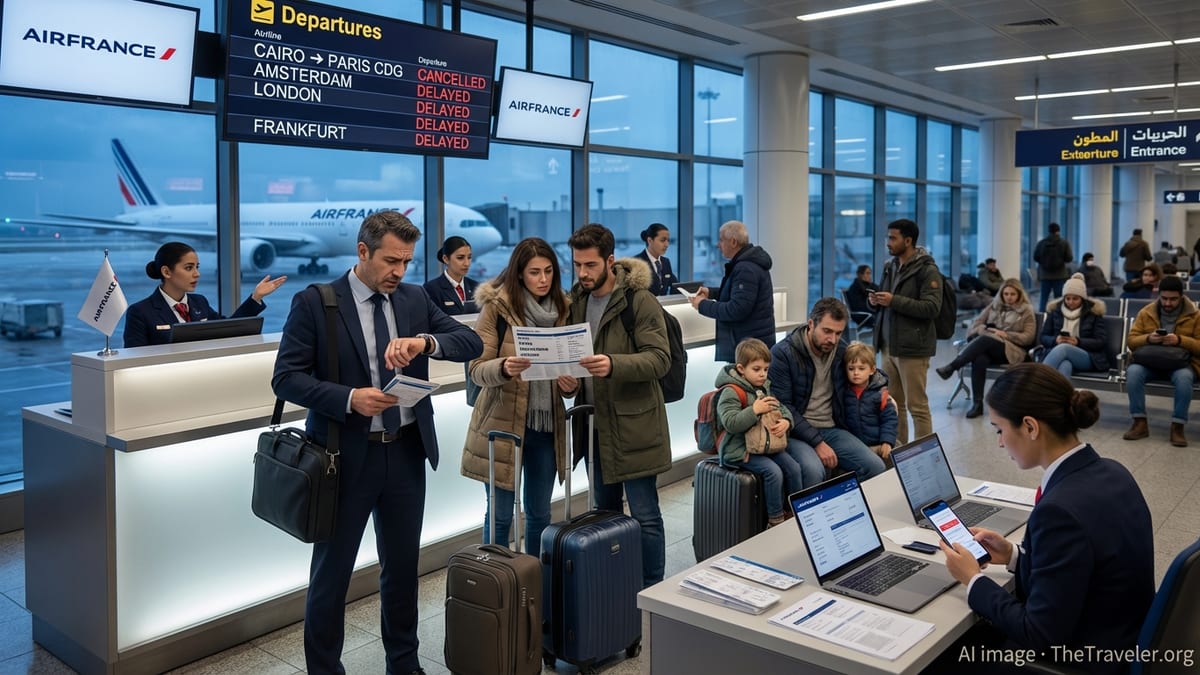
Record Traffic Underscores Cairo’s Hub Ambitions
Recent data show Cairo International Airport handled more than 2.2 million passengers in May 2026, supported by over 17,000 flight movements. The figures confirm a strong upward trajectory after the airport processed about 30 to 31 million passengers in 2025, up sharply from 2024. The latest monthly totals place Cairo firmly among Africa’s busiest hubs and highlight its importance as Egypt’s primary international gateway.
Publicly available statistics point to a steady climb in both arriving and departing traffic, with inbound passenger numbers slightly outpacing outbound flows. Industry observers note that this pattern reflects Egypt’s rebound as a tourism destination, alongside an expanding role as a transfer point between Europe, Africa, the Gulf and North America. The passenger surge is also emerging as a key test of the airport’s recent investments in terminal upgrades and operational technology.
Airport officials have promoted a development strategy centered on modernizing terminals, improving security screening and expanding digital services. Reports indicate that Cairo has rolled out a comprehensive mobile application for travelers and is preparing additional capacity enhancements, including long-term plans for a potential fourth terminal. The current growth spurt is widely seen as an early stress test of these initiatives.
Analysts suggest that sustaining growth at or above current levels would quickly push annual throughput beyond recent records. That prospect is already drawing attention from major carriers that use Cairo as a gateway to the wider region, particularly EgyptAir, Emirates and Turkish Airlines, all of which are adjusting schedules and capacity to capture demand.
EgyptAir Accelerates Long Haul and Fleet Expansion
The national carrier EgyptAir is positioned at the center of Cairo’s traffic boom, using the airport as its primary hub. Network data for 2026 show the airline pressing ahead with an expansion plan that targets roughly 85 international destinations from Cairo, supported by new long haul routes and additional aircraft orders. The strategy is designed to strengthen the carrier’s role in connecting Africa and the Middle East with Europe and North America.
According to published coverage, EgyptAir has filed to launch nonstop services from Cairo to Los Angeles and Chicago, with start dates scheduled in 2026. These flights would mark some of the longest sectors in the airline’s history and significantly broaden its reach into the United States market. Aviation analysts note that such additions rely heavily on robust connecting traffic through Cairo, a requirement that is increasingly being met as passenger numbers climb.
Fleet plans are being reshaped to support this growth. Industry reports describe firm orders and deliveries of Airbus A350-900 aircraft, which are set to replace older widebody jets and offer improved fuel efficiency on long haul missions. Combined with existing Boeing 787 operations, the newer aircraft are expected to help EgyptAir open longer routes while keeping operating costs in check, an important factor as competition intensifies from Gulf and European carriers.
Regional connectivity remains a parallel focus. EgyptAir has been increasing links between Cairo and key markets in North Africa, the Gulf and the Levant, while also adding frequencies to European capitals. The surge in Cairo Airport traffic provides a larger pool of transfer passengers to feed these services, reinforcing the hub-and-spoke model on which the airline’s expansion depends.
Emirates Adds Capacity on the Dubai–Cairo Corridor
Emirates is also responding to stronger demand through Cairo by boosting capacity on the high-traffic Dubai–Cairo route. Publicly reported schedule changes show the airline stepping up from a six-times-weekly operation to daily services from early 2026, with widebody aircraft offering a substantial number of premium and economy seats on each rotation. The added frequencies are timed to connect efficiently with Emirates’ long haul network at Dubai International Airport.
Travel and aviation coverage describes Egypt as a resilient market for the Dubai-based carrier, combining strong leisure demand with business travel and migrant worker flows. The growing volume at Cairo International Airport allows Emirates to sustain high load factors on its flights, while also capturing transfer traffic from secondary Egyptian cities and neighboring countries that route through Cairo.
Industry observers note that Emirates’ growth in Cairo is part of a broader contest among Gulf carriers to consolidate their positions in North Africa. Additional seats on the Dubai–Cairo corridor provide travelers with more options to reach Asia, Australia and the Americas via a single stop in Dubai. At the same time, the higher capacity intensifies competition with EgyptAir on certain long haul flows, particularly where itineraries via Dubai are time competitive with EgyptAir’s emerging nonstop transatlantic services.
The passenger surge through Cairo heightens the importance of schedule coordination between Emirates and its regional partners. The airline’s increased presence not only supports point to point demand but also adds another layer of connectivity for travelers using Cairo as part of a multi-stop journey, further solidifying the airport’s role as a regional crossroads.
Turkish Airlines Builds on Istanbul–Cairo Transfer Flows
Turkish Airlines, which has long used Istanbul as a bridge between Europe, Asia and Africa, is another beneficiary of Cairo’s rising traffic. While the carrier has not announced major new Cairo routes in recent months, published schedules show steady operations on the Istanbul–Cairo sector, with flights timed to feed Turkish Airlines’ expansive international network, including secondary European cities and destinations in Central Asia.
Industry commentary highlights that as Cairo’s total passenger volume grows, transfer flows via Istanbul also gain critical mass. Travelers from Egypt heading to destinations without nonstop service from Cairo often connect through Istanbul, which offers multiple daily departures to many mid-sized cities. This dynamic allows Turkish Airlines to capture a share of Cairo’s growth without necessarily increasing the number of routes, instead relying on aircraft upgauges or tactical frequency adjustments.
In the context of rising competition from Gulf hubs, Turkish Airlines’ position on the Cairo–Istanbul corridor offers travelers an alternative one-stop option to Europe and beyond. Fare data monitored by aviation analysts suggest that pricing on this route remains competitive, reflecting both the strength of demand and the presence of multiple carriers serving overlapping markets.
The broader network effect is significant. As Cairo International Airport processes more than two million passengers in a single month, even modest increases in the proportion choosing Istanbul as a transfer point can translate into higher load factors for Turkish Airlines, reinforcing the business case for continued investment in the route.
Infrastructure and Digital Upgrades Aim to Sustain Growth
The rapid rise in Cairo’s passenger numbers is prompting renewed focus on infrastructure. Government and airport company statements published in recent months outline an aviation overhaul program that includes terminal upgrades, airside improvements and long term capacity expansion. Plans referenced in publicly available documents point to a multi-billion-dollar investment envelope designed to ensure that Cairo can handle future volumes while maintaining service standards.
Shorter term measures center on technology and process improvements. Reports indicate that Cairo International Airport is rolling out an integrated mobile application to assist passengers with check-in, flight information and wayfinding across its terminals. Combined with upgraded security lanes and refurbished departure halls, these initiatives are intended to ease congestion during peak travel periods associated with the current surge.
Analysts caution that sustaining growth above historical averages will require careful management of bottlenecks, particularly at immigration, baggage handling and ground transport interfaces. However, the alignment of rising demand with active investment plans is viewed positively by many in the aviation sector, who see an opportunity for Cairo to strengthen its status as a hub linking Africa, the Middle East, Europe and North America.
For airlines such as EgyptAir, Emirates and Turkish Airlines, the immediate impact of Cairo’s two million plus monthly passengers is clear: fuller flights, stronger connectivity and a more compelling case for route development. How quickly infrastructure and service enhancements keep pace with demand will help determine how much further these carriers can leverage Cairo’s momentum in the years ahead.