


Cairo International Airport is the main gateway to Egypt and, for many travelers, just a brief stop between long-haul flights. With the Pyramids of Giza and the Nile skyline tantalizingly close, it is natural to wonder if a layover is enough time to dash into the city. The honest answer is "sometimes". Whether you can safely visit the Pyramids, Downtown Cairo or the Egyptian Museum during a stopover depends on your passport, ticket type, arrival and departure times, and how much risk you are willing to accept with Cairo’s notorious traffic.
Get the latest updates straight to your inbox!
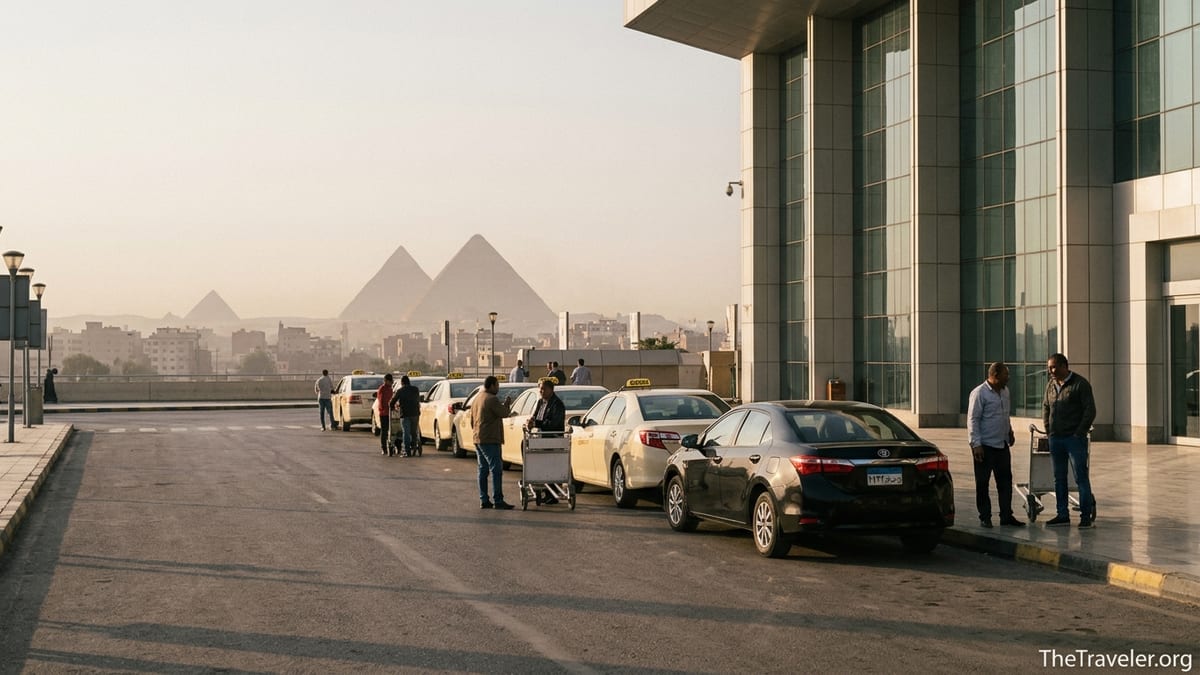
Understanding Cairo Airport and Typical Transfer Times
Cairo International Airport (CAI) sits on the northeastern edge of the city, roughly 30 to 40 kilometers from the main sights most visitors want to see. In free-flowing traffic, the drive from the airport to the Pyramids of Giza can be about 45 minutes by car, and to Downtown Cairo around 30 to 45 minutes. In reality, traffic around Cairo is among the heaviest in the region and it is common for these journeys to stretch to 60 to 90 minutes, especially in rush hours around 08:00 to 10:00 and 16:00 to 20:00.
Recent transfer guides aimed at visitors put the airport to Giza distance at roughly 35 to 45 kilometers, with private drivers quoting journey times of one hour as a baseline and 90 minutes in heavy traffic. A typical prebooked private transfer from CAI to the Giza area in 2026 starts at around 1,000 to 1,200 Egyptian pounds one way, depending on the vehicle class and time of day. Ride-hailing options such as Uber and Careem are usually cheaper, often in the 400 to 700 Egyptian pounds range from the airport to central Cairo in normal traffic.
There are public buses linking the airport with Downtown, usually heading toward Abd El Monem Riad bus station beside Tahrir Square. These can cost only a few Egyptian pounds but are slower and less predictable, especially if you need to make a flight later the same day. To reach Giza by public transport from the airport you would typically combine a bus to central Cairo, then the metro, and finally a taxi. That sequence can easily take two hours or more each way and is unrealistic for short layovers.
The airport itself has three passenger terminals and a smaller seasonal terminal. Most international traffic uses Terminal 2 and Terminal 3. Egyptair and many Star Alliance carriers operate from Terminal 3, which makes airside international-to-international connections relatively straightforward as long as you stay within the transit area. Changing terminals or leaving the secure area means going through immigration and security again, which is where visa rules and timing become critical.
Transit vs Entry: Do You Need a Visa to Leave the Airport?
If you remain inside the international transit area for a same-day connection on a single ticket, you generally do not need an Egyptian visa, whether your layover is two hours or ten. In this case you simply follow “Transit” signs, pass through security screening and wait at your gate. Many airlines coordinate through-checking of luggage, so you do not see your checked bags until final arrival. However, if you want to go landside to visit the city or your bags are not checked through, you will need to meet Egypt’s entry and transit conditions.
Egypt’s visa policy allows many nationalities, including US, most EU, UK, Canadian and Australian passport holders, to obtain a visa on arrival for a stay of up to 30 days. The classic example is a US traveler buying a visa sticker for roughly 25 to 30 US dollars in cash, then proceeding through passport control into Egypt. Other travelers may use Egypt’s e-visa system, applying online before departure and presenting the approval at the border. Some nationalities, particularly from parts of Africa and Asia, must obtain a visa in advance at an Egyptian consulate and cannot rely on visa on arrival; for them, leaving the airport without prearranged documents may not be possible.
The rules for pure airside transit are more lenient than for entry. Current guidance notes that passengers with a transit time between 6 and 48 hours are in principle allowed to leave the airport, but in practice this is only true if they are eligible to obtain an entry visa on arrival or already hold a valid visa. A traveler from a visa-on-arrival country with a 10-hour layover could, for example, purchase a visa at Cairo Airport, pass through immigration and hire a car to the Pyramids, while a traveler from a country that requires an advance visa would need that visa already in their passport before attempting the same plan.
Egyptair has introduced a policy offering a free 8 to 96-hour transit visa to certain passengers flying on its own tickets, obtained from the airline’s transit office on arrival. In practice this scheme is subject to conditions, can change without much notice, and may apply only to select nationalities and itineraries. Some recent travelers with 10 to 12-hour layovers on Egyptair report being able to leave the airport using a free transit permit, while others have been told to purchase a regular visa on arrival or to remain airside. Because of this inconsistency, anyone hoping to rely on the free transit visa should treat it as a bonus rather than a guarantee and check both with Egyptair and with the nearest Egyptian embassy before travel.
Minimum Layover Times: When Is It Realistic to Leave the Airport?
The key question for most travelers is how many hours you need between flights to safely visit the Pyramids, Downtown Cairo or the Egyptian Museum without risking a missed departure. It helps to think in terms of conservative thresholds rather than optimistic best-case scenarios, especially given Cairo’s traffic and sometimes slow airport queues.
For the Pyramids of Giza, travelers should regard six hours as an absolute minimum and ideally aim for eight hours or more between scheduled arrival and departure. A sample calculation illustrates why. Suppose your long-haul flight touches down at 09:00. It may take 30 to 60 minutes to taxi, deplane, buy a visa sticker, pass immigration and customs, even if queues are moderate. You are then at the curb by around 10:00. In light to medium traffic, a prebooked car might reach the Giza plateau parking area in 60 minutes, so you arrive about 11:00. If your onward flight leaves at 17:00, you should be back at the airport no later than 14:30 to 15:00 for security and boarding. That leaves roughly three hours at the Pyramids from 11:00 to 14:00, which is enough for a quick visit but not a relaxed one.
For Downtown Cairo and the Egyptian Museum on Tahrir Square, slightly shorter layovers can sometimes work, because the distance from the airport is less than to Giza. A traveler arriving at 13:00 with a 20:30 departure might realistically clear immigration by 14:00, reach Tahrir around 14:45 to 15:00, spend two to three hours exploring the museum and nearby Nile corniche, then leave Downtown by 17:30 or 18:00 to reach the airport by 19:00. In this case, a 7.5-hour layover allows a brief but satisfying city glimpse. However, if arrival or departure falls into the late-afternoon rush, it becomes much tighter.
Short layovers under six hours are rarely suitable for going into Cairo at all. Even if the math seems possible on paper, the risk of delays at immigration, slow baggage delivery, or an accident on the ring road can quickly eat your buffer. Travelers with separate tickets, no checked-through luggage or a need to collect boarding passes at a landside counter should add at least an extra hour of margin. As a rule of thumb, if you would feel stressed losing 60 to 90 minutes to an unexpected queue, you probably do not have enough time to leave the airport safely.
Getting to the Pyramids During a Layover
For layover visitors determined to see the Pyramids, booking a private transfer or tour is usually the most practical choice. Several local transfer companies advertise airport-to-Pyramids runs, quoting journey times of 60 to 90 minutes each way and starting prices from roughly 1,000 to 1,200 Egyptian pounds for a standard sedan, more for a van or VIP vehicle. These services often include a driver waiting with a sign in the arrivals hall, which can save precious time compared with haggling with taxi drivers outside.
Ride-hailing services are a common option too. Travelers in recent years have reported paying around 350 to 500 Egyptian pounds for app-based rides from the airport to Giza in daytime traffic, a little more at peak times. Uber and Careem both operate in Cairo and allow you to see an estimated fare in advance, which helps avoid misunderstandings. The downside is that you still need to navigate the crowded pick-up areas at the airport and you may face surge pricing at busy times, adding a layer of unpredictability to your schedule.
Public transport to the Pyramids from the airport is theoretically possible but practically unsuitable on a layover. A typical route would involve taking a city bus from the airport to Ramses Station or Tahrir Square, switching to Line 2 of the Cairo Metro, riding to Giza or Sakiat Mekki station, then taking a local taxi to the Pyramids entrance. Even if everything connects smoothly, this can take in the region of two hours each way. The small savings in cost are not worth the increase in complexity and delay when a missed flight could cost hundreds or thousands of dollars.
Once at the Pyramids, you should factor in at least 90 minutes to 2 hours on site for even a very quick visit. Many guided layover tours are designed as 4 to 5-hour excursions including driving time, photo stops at the panorama viewpoint, a walk or short camel ride near the Great Pyramid and Sphinx, and time to buy water or souvenirs. A traveler with a 10 to 12-hour layover could comfortably fit such a tour between flights. Someone with exactly six hours of connection time would likely be rushed from the moment they land to the moment they re-enter security.
Downtown Cairo and the Egyptian Museum on a Stopover
For some travelers, a taste of city life along the Nile is more appealing than racing out to Giza. Downtown Cairo, centered on Tahrir Square, is closer to the airport and offers a dense cluster of landmarks, cafes and atmospheric streets. The historic Egyptian Museum, with its pink neoclassical façade, sits on the northern edge of Tahrir and remains one of the city’s most visited attractions. Although some collections have moved or will move to the new Grand Egyptian Museum near Giza, the Tahrir museum still houses a rich array of pharaonic artifacts and is easily combined with a short stroll around the square.
A taxi or ride-hail from the airport to Tahrir Square typically takes 30 to 60 minutes depending on traffic and route. Recent fare comparison tables for 2026 place Uber rides to central Cairo in the range of 250 to 450 Egyptian pounds for a standard car, with official airport taxis costing somewhat more. Many visitors prefer app-based options because they avoid bargaining, show a route on the map and charge automatically via card or stored payment.
For travelers with 6 to 8-hour layovers arriving during quieter periods, a downtown visit is often more realistic than a Pyramids run. For example, if your flight lands at 09:30, you might be through immigration and in a car by 10:30, arrive around Tahrir at 11:15, spend two to three hours between the museum and a quick lunch overlooking the Nile, then head back to the airport by 14:00 to reach the terminal around 14:45 for a 17:00 departure. This still leaves some cushion for traffic delays but not for major disruptions.
Public buses from the airport to Abd El Monem Riad bus station near Tahrir are an ultra-budget alternative and can cost little more than loose change. For example, a traveler on a long backpacking trip might choose this option during a 12-hour layover to save money, accepting the slower pace in exchange for cost savings. However, the buses can be crowded and infrequent, signage is not always clear to newcomers, and they do not make sense for anyone anxious about cutting it close for a departing flight.
Luggage, Security Checks and Airport Practicalities
One detail that often surprises first-time transit passengers is that Cairo Airport does not have abundant, simple left-luggage lockers inside the secure transit zone. If your bag is checked through to your final destination, that is ideal; you can explore the city with only your carry-on. If, however, you are on separate tickets and must collect your checked bags, you will have to take them through customs and then decide how to store or carry them while you explore.
Some airport hotels and private tour companies offer luggage storage as part of a layover package. For instance, a layover tour operator picking you up at arrivals might store your suitcase in the vehicle or at a nearby facility while you tour the city and then return you to the terminal. This can work well if organized in advance but depends heavily on choosing a reputable provider. Travelers arranging their own trip with a regular taxi or Uber driver will often keep luggage in the car, which may be acceptable for a solo bag but is less comfortable with expensive equipment or several large suitcases.
Security procedures are another time sink to consider. Cairo Airport often has security screening at the entrance to the terminal building itself and again after immigration before you reach the gates. Queues at these checkpoints can be unpredictable, especially at night when multiple long-haul departures cluster together. On the return from the city, international passengers should aim to be back at the airport at least three hours before departure, giving time for security, check-in, immigration exit formalities and a possible secondary screening near the gate.
Finally, while the airport has improved its facilities over the years, the transit experience can still feel chaotic compared with hubs such as Doha or Dubai. Some recent travelers have reported aggressive sales tactics for SIM cards or airport services, and occasional attempts at unofficial “fees” during transit processing. Keeping your boarding pass visible, knowing where your airline’s official transfer desk is, and declining extra services you do not need can help you move efficiently through the terminal.
Managing Risk: Traffic, Timing and Personal Comfort
Even with a valid visa and a long layover, deciding whether to leave the airport is ultimately about risk tolerance. Cairo’s traffic congestion is not just an inconvenience but a structural feature of the city’s daily life. Studies of mobility in Cairo consistently highlight long peak-hour delays and a chronic mismatch between road capacity and the number of cars. For a layover traveler, this means that a drive which took 40 minutes on one trip may take 90 minutes on another, with little warning.
Your arrival and departure times matter. Early morning arrivals between around 04:00 and 06:00 followed by mid-afternoon departures can be ideal for a Pyramids dash, because you may reach Giza before the worst of the morning rush. Conversely, arrivals around 14:00 to 16:00 with evening departures can coincide with the heaviest traffic both into and out of the city. Weekend patterns are also different, with Fridays seeing lighter business traffic in many areas but heavy family traffic in others.
Weather is another subtle factor. In the peak of summer, standing in the open sun at the Pyramids in the early afternoon can be physically draining, especially after a red-eye flight. Someone with an 8-hour layover in August might decide that a shaded museum visit and a Nile-side coffee in Downtown are a better use of limited energy than a hurried pyramid tour in 40-degree Celsius heat. By contrast, a December layover with mild temperatures can make even a short Pyramids stop far more pleasant.
Travel insurance and ticket flexibility should also shape your decision. If you are on a single through-ticket and miss the second flight because of traffic on a self-arranged excursion, your airline may treat you as a no-show. A traveler on flexible tickets or with a later backup connection might be more willing to accept the risk. Families with young children, people carrying expensive photo gear, or anyone anxious about tight timing may prefer a conservative choice, enjoying a good meal at an airport hotel or a short rest instead of rushing into town.
The Takeaway
A layover at Cairo International Airport can be an opportunity to turn a long wait into a glimpse of one of the world’s most storied cities, but only if the pieces line up correctly. For a fast Pyramids visit, you should ideally have at least 8 to 10 hours between flights, be eligible for a visa on arrival or clear transit visa, and arrive outside the worst traffic peaks. Prearranged private transport or a reputable layover tour adds cost but saves confusion and precious minutes compared with negotiating on the curb.
For shorter but still generous layovers of 6 to 8 hours, Downtown Cairo and the Egyptian Museum are often a safer bet than Giza, particularly if your flights arrive and depart in mid-morning or early afternoon. In all cases, factor in airport processing times, possible queues at immigration and security, and the practical question of where your luggage will be while you explore.
If your layover is under six hours, involves separate tickets, or falls at difficult traffic times, the prudent option is usually to stay at the airport. You might book a short-stay room at an airport hotel, enjoy Egyptian food in the terminal, or simply rest before your onward flight. Cairo will still be there on a future trip when you have the luxury of more time.
Ultimately, the decision comes down to how much risk you are comfortable taking with your connection. With realistic planning, enough buffer and a clear-eyed view of Cairo’s traffic and visa requirements, a layover can indeed be your chance to stand before the Great Pyramid or watch the sun set over the Nile before you fly on.
FAQ
Q1. Is a 5-hour layover in Cairo enough time to visit the Pyramids of Giza?
A 5-hour layover is generally not enough for a safe Pyramids visit. By the time you clear immigration, possibly collect bags, drive at least an hour each way and return early for security, there is almost no margin for traffic or delays. Most travelers should treat 8 hours as a safer minimum for Giza.
Q2. Can I leave Cairo Airport during a layover without a visa?
You may stay in the international transit area without a visa if you remain airside between flights, but to leave the airport and enter Egypt you must meet the country’s entry rules. Many nationalities can buy a visa on arrival or use an approved e-visa, while others must obtain a visa in advance. Always check the latest rules for your passport before planning to leave the airport.
Q3. What is the minimum layover time to quickly visit Downtown Cairo or Tahrir Square?
If you hold the right to enter Egypt, a layover of around 6 to 8 hours can be enough for a quick visit to Downtown and Tahrir Square in light to moderate traffic. You should still plan to be back at the airport at least three hours before departure and treat heavy rush-hour traffic as a reason to lengthen your minimum connection or skip the trip.
Q4. How much does a taxi or Uber from Cairo Airport to the Pyramids cost?
Recent fare examples suggest app-based rides from the airport to the Giza area can cost roughly 350 to 700 Egyptian pounds each way depending on time of day and surge pricing. Prebooked private transfers or tours often start around 1,000 to 1,200 Egyptian pounds one way, with higher prices for larger vehicles, guiding services or bundled entry tickets.
Q5. What should I do with my luggage during a layover excursion?
The easiest option is to have your checked baggage tagged through to your final destination so you only carry a small bag into Cairo. If that is not possible, arrange in advance with a layover tour operator, airport hotel or trusted driver who can securely store your luggage while you explore. Leaving valuables unattended in a random vehicle is risky, so be cautious about ad hoc arrangements.
Q6. Does Egyptair really offer a free 96-hour transit visa?
Egyptair has publicized a free 8 to 96-hour transit visa for some passengers, but in practice eligibility depends on your nationality, itinerary and current policies, which can change. Some travelers report using this scheme successfully, while others are told to purchase a regular visa on arrival or remain in transit. You should confirm details with Egyptair and your local Egyptian embassy before relying on it.
Q7. Is it safer to book a layover tour or arrange my own taxi?
A prearranged layover tour or reputable private transfer can be safer and more streamlined, especially for first-time visitors or those with limited time. These services typically include airport pick-up, a planned route and return transfers tailored to your departure time. Independent travelers comfortable with ride-hailing apps may prefer to arrange their own cars, but they assume more responsibility for timing and logistics.
Q8. Can I visit both the Egyptian Museum and the Pyramids on one layover?
Visiting both in a single layover is ambitious and usually requires at least 10 to 12 hours between flights, along with excellent time management and favorable traffic. A typical combined tour might include a quick stop at the museum and a shortened Pyramids visit. Even then, it can feel rushed. For shorter layovers, most travelers are better off choosing either Giza or Downtown, not both.
Q9. What happens if I miss my onward flight after leaving the airport?
If you miss your onward flight because you were outside the airport on a self-arranged excursion, your airline may classify you as a no-show. You could face change fees, fare differences or the need to purchase a new ticket, sometimes at high last-minute prices. Travel insurance may not cover missed connections caused by voluntary sightseeing, so the financial risk is yours.
Q10. Is Cairo Airport comfortable enough to spend a long layover without going into the city?
While Cairo Airport is not as polished as some major Gulf hubs, it does offer cafes, basic lounges, duty-free shopping and nearby airport hotels where you can book a day room. For travelers with short layovers, late-night arrivals, or higher risk aversion, staying at or near the airport, resting and rehydrating is often the most sensible choice, leaving a fuller Cairo experience for a future dedicated trip.