


The Parthenon dominates almost every postcard of Athens, but standing in front of it in person is a very different experience. For first-time visitors, it can also be confusing: Is the Parthenon the same as the Acropolis? Which ticket do you need? Where are the best views, and what should you know about the ongoing restoration works? This guide walks you through the essentials so you can arrive on the rock prepared, understand what you are looking at, and make the most of your time at one of the world’s great archaeological sites.
Get the latest updates straight to your inbox!
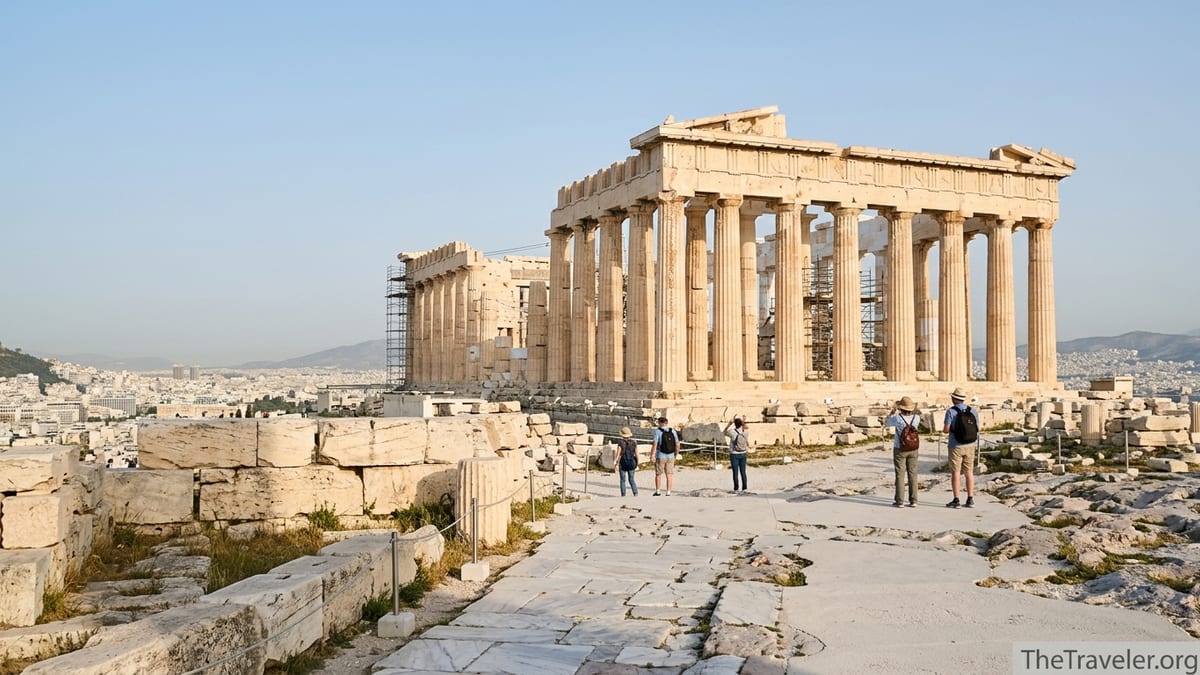
What the Parthenon Is and How It Fits into the Acropolis
The Parthenon is a former temple dedicated to Athena Parthenos, the patron goddess of Athens. Built between 447 and 432 BC during the city’s golden age, it is considered the pinnacle of classical Greek architecture and the most famous example of the Doric order. From the city streets below, many visitors assume that the entire hilltop structure is “the Parthenon,” but in fact the Parthenon is just one building within a wider sacred complex.
The Acropolis is the rocky hill that rises above central Athens, as well as the fortified sanctuary that covers its summit. Inside this archaeological site you will find several major monuments: the Propylaea gateway, the small Temple of Athena Nike, the Erechtheion with its famous Caryatid statues and, at its highest point, the Parthenon itself. When you buy a ticket, you are paying to enter the Acropolis archaeological site, which includes access to all these structures and the surrounding plateau, not a separate ticket just for the Parthenon.
Understanding this distinction helps when planning your day. If your guided tour or audio guide mentions “Acropolis highlights,” it will typically include a walk around the exterior of the Parthenon, views of the Erechtheion, and stops at viewpoints over the Theater of Dionysus and the Odeon of Herodes Atticus on the slopes. You cannot go inside the Parthenon, but you can walk around its perimeter and see the structure from different angles as you follow the main path across the plateau.
For context, the Parthenon was built as part of a wider building program on the Acropolis ordered by the statesman Pericles. Along with nearby structures like the Propylaea and the Temple of Athena Nike, it was designed to project the power and sophistication of classical Athens. Even in its ruined state, the Parthenon’s size, the geometry of its columns, and the fragments of sculpture still in place convey that message very clearly to visitors today.
Location, Entrances and How to Reach the Parthenon
The Acropolis sits almost exactly in the center of modern Athens, slightly southwest of Syntagma Square. Most first-time visitors stay in areas such as Plaka, Monastiraki, Koukaki or near Syntagma, all of which are within walking distance. From Monastiraki Square, for example, it is roughly a 15 to 20 minute uphill walk through the narrow streets of Plaka to the main Acropolis entrance.
There are two principal entrances to the Acropolis site. The main western entrance near the parking area and tour bus drop-off is the one most group tours use. It leads you up through the monumental Propylaea gate and delivers you directly to the main plateau where the Parthenon stands on your right. The southeastern entrance, near the Acropolis Museum and the pedestrianized Dionysiou Areopagitou promenade, tends to be slightly quieter in peak season and is convenient if you are coming from Koukaki or visiting the museum the same day.
From both entrances you will need to walk uphill on stone paths that can be slippery and uneven. Wear closed-toe shoes with good grip; many visitors arrive in smooth-soled sandals from strolling around Plaka and regret it once they hit the polished marble. If you visit in summer, keep in mind that Athens can easily reach daytime highs above 35 degrees Celsius, and the exposed rock of the Acropolis makes it feel even hotter. Many travelers choose an early morning timed slot, such as 8:00 to 9:00, both to avoid heat and to see the Parthenon with fewer crowds.
Public transport access is straightforward. The closest metro stations are Acropoli on Line 2 (Red Line), a short walk from the southeastern entrance, and Thissio or Monastiraki on Line 1 (Green Line) for the western approach. Taxis and ride-hailing services can drop you near either entrance, but traffic is often slower than simply taking the metro and walking the final stretch.
Tickets, Timed Entry and When to Visit
Access to the Parthenon is included in the general ticket for the Acropolis archaeological site. You do not buy a separate “Parthenon ticket.” As of mid 2026, tickets are sold with timed entry slots, particularly in the main tourist season from roughly April to October. These timed entries are designed to spread out the large number of visitors over the day and are now standard practice for major sites across Greece.
You can buy tickets on-site at the official ticket offices or in advance through the Hellenic Ministry of Culture’s e-ticketing system. Travelers who have queued for on-site tickets in high season frequently report long lines, especially late morning after cruise ship groups arrive. Buying a specific timed slot online at least a few days ahead is usually the easiest option if you have fixed dates. Be wary of third-party websites that charge substantial markups by bundling basic admission with minimal “skip the line” services.
Prices vary by season and policy updates, and Greece occasionally introduces special measures such as free-entry days or dynamic pricing for peak hours. Expect that there may be a standard adult price, along with reduced admission for EU students and free or discounted entry for certain age groups or on specific cultural days. Always bring identification if you plan to claim a reduction. If you are traveling with a family or planning to see multiple ancient sites in Athens, check whether any combined site tickets are currently offered and, if so, whether they still represent good value compared with individual tickets on the days you want.
In terms of timing, early morning and late afternoon typically offer the most comfortable conditions and best photography. If you book the first slot of the day, you can often walk up to the Parthenon with relatively open views before the main crowds arrive. Evening slots in summer may allow you to see the warm golden light on the marble, though closing times vary seasonally and staff will begin ushering visitors toward the exits well before official closing. Midday visits in July and August are realistic if that is all your schedule allows, but plan for intense sun and bring a refillable water bottle, hat and sunscreen.
Understanding the Parthenon’s Architecture, History and Sculptures
Standing beside the Parthenon, one of the first things you notice is its scale. Measured at the top step, the building is roughly 69.5 meters long and 30.9 meters wide, with a colonnade of 8 columns on the short sides and 17 along the long sides. The columns are over 10 meters high. The temple is predominantly Doric in style, visible in the stout fluted columns without bases and the triglyph-metope pattern running around the exterior, but it also incorporates Ionic elements, such as the continuous frieze that once circled the upper walls of the inner chamber.
The Parthenon was built to house a monumental statue of Athena Parthenos and to celebrate the city’s power following victories against Persia. Over the centuries, it has served multiple functions: pagan temple, Christian church, and Ottoman mosque. In the late 17th century, an explosion during a Venetian bombardment caused catastrophic damage, blowing out much of the central structure. Later removals of sculpture, most famously by Lord Elgin in the early 19th century, further altered its appearance. Today’s visitor sees a skeleton of columns and beams, with gaps where entire sections of the colonnade and roof once stood.
As you walk around the Parthenon, look up at the pediments at each end where sculpted groups once filled the triangular spaces, and at the metopes along the sides where mythological battles were carved in high relief. Many of the best-preserved surviving sculptures are now displayed in controlled conditions in the Acropolis Museum in Athens and in major European museums such as the British Museum in London. On the monument itself, you will see original blocks alongside lighter-colored replacement pieces that indicate where conservators have stabilized damaged areas.
Even without a guide, it is worth pausing at different corners to notice how the building was engineered to please the eye. The stylobate, or top platform, has a slight upward curve, and the columns subtly lean inward. These refinements, along with carefully calculated proportions, were devised to counteract visual distortions and create an impression of perfect straightness and harmony when viewed from a distance. Many visitors find that returning to the Parthenon at night, when it is illuminated and visible from across central Athens, helps them appreciate just how successful those design choices were.
Ongoing Restoration and What You Can Expect On-Site
The Parthenon you see today is in the midst of a long-term conservation and partial anastylosis project, in which original stones are carefully dismantled, cleaned, fitted with stainless-steel reinforcements, and reassembled. This work has been progressing in phases since the 1970s and is still active in 2026. Recently, major efforts have focused on reconstructing sections of the long north and south colonnades and stabilizing the western facade so that visitors can once again see something closer to the original rhythm of columns.
In practical terms, this means you are likely to see scaffolding, cranes, and teams of conservators at work when you visit. Some sides of the Parthenon may be partially covered, while other angles will be almost free of scaffolding and excellent for photographs. For example, recent phases of work have allowed the western side to appear more complete than it has in roughly two centuries, which many visitors find impressive when compared to older guidebook photos. The restoration is slow by design, as each stone is numbered and studied before being returned to its exact position.
First-time visitors are sometimes disappointed when they encounter scaffolding, but it is helpful to think of it as part of the Parthenon’s story rather than a distraction. Without the decades of conservation work, the structure would be far less stable and more heavily eroded. Informational panels around the site typically explain what phase of the project is underway, and many guided tours now include explanations of how engineers use titanium or stainless-steel dowels and 3D modeling to support the ancient marble without altering its appearance.
Because work areas can shift, fenced-off zones and one-way walking routes may change from season to season. For instance, a path that brought visitors close to the south side one year might be rerouted to protect a new work zone the next. Build a little flexibility into your expectations: focus on walking around the available perimeter, taking in multiple perspectives, and using binoculars or a good zoom lens to inspect details from a distance where necessary.
Best Views, Photography Spots and Nearby Experiences
One of the pleasures of visiting the Parthenon is discovering how many different vantage points you can enjoy within the site itself and around Athens. On the Acropolis plateau, many people like to take photographs from the southwest corner, where you can capture the Parthenon rising behind the foreground ruins and, if you angle your camera slightly, the modern city spilling away in the background. Early morning light from the east or late afternoon light from the west typically gives the marble a warm glow that cameras capture well.
Outside the Acropolis, two classic viewpoints are Areopagus Hill and Philopappos Hill. Areopagus Hill sits just northwest of the main entrance. It is a short scramble up metal steps to a rocky outcrop where locals and visitors gather, especially around sunset, for elevated views across to the Parthenon and the old district of Plaka. Philopappos Hill, a slightly longer walk to the southwest, offers more expansive city panoramas and a more distant but beautifully framed view of the Parthenon atop the Acropolis, particularly in the soft light of late afternoon.
Combining your Acropolis visit with a stop at the Acropolis Museum is strongly recommended. Many visitors choose to book an early morning Acropolis time slot, then walk down to the museum for a late-morning or early afternoon visit when the sun is at its harshest on the hill. In the museum, you can see original sculptures from the Parthenon’s frieze and pediments displayed at eye level, including detailed scenes of processions, gods and mythological battles. Large windows on the top floor frame direct views back to the Parthenon, allowing you to connect the museum pieces with their original positions on the building.
When planning your day, also allow for simple pleasures around the base of the Acropolis. The pedestrian street of Dionysiou Areopagitou is lined with cafes where you can pause for a coffee or a late breakfast before or after your visit. In the evening, roof terraces in neighborhoods like Koukaki, Thissio and Monastiraki offer illuminated views of the Parthenon; many travelers remember a dinner on one of these terraces as vividly as the daytime visit itself.
First-Time Practical Tips for a Smooth Visit
Good preparation can make your first encounter with the Parthenon far more enjoyable. Start with footwear and clothing: the combination of uneven ancient stone, polished marble and steep sections of path makes sturdy shoes a priority. Lightweight trainers or walking shoes with textured soles are ideal. Loose, breathable clothing, a hat and sunglasses will help in the Athens heat, particularly in July and August when temperatures and UV levels are high by late morning.
Bring water and snacks, but remember that food is generally not allowed to be consumed around the monuments themselves. Refillable bottles are convenient, as there are water fountains near some entrances and inside the site where you can top up. Restrooms are located near the ticket checkpoints; there are none directly beside the Parthenon, so plan accordingly, especially if visiting with children. Families often find that scheduling a short break in the shade at the Propylaea or near the Erechtheion helps younger travelers cope with the climb.
Respect for the site is taken seriously. You are not allowed to climb on ruins, sit on fragile blocks, or touch the marble of the Parthenon’s columns and walls. Guards are present throughout the site and will intervene if visitors step beyond barriers or attempt to take prohibited items, such as stones, as souvenirs. Tripods and drones are generally restricted without special permission; most visitors rely on handheld cameras or smartphones. Plan to carry a small daypack rather than bulky luggage, as large bags may be subject to additional checks or refused.
If you are interested in deeper context, consider a guided tour or a high-quality audio guide. Numerous companies offer small-group morning tours that include skip-the-ticket-line service and explanations of the Parthenon’s history, architecture and mythology. Alternatively, the Ministry of Culture has been rolling out a free digital tour guide app, which allows you to explore at your own pace with geolocated commentary. Whatever you choose, skimming a short background article or watching a documentary before your visit will help you appreciate details that can otherwise blend into “just more ruins.”
The Takeaway
For a first-time visitor to Athens, the Parthenon is more than a single photo opportunity at the top of a hill. It is the centerpiece of a broader Acropolis experience that combines ancient engineering, layered history and sweeping views over a modern Mediterranean capital. Knowing that your ticket is for the Acropolis site as a whole, that timed entry slots matter in high season, and that scaffolding is part of an ongoing, decades-long restoration effort will help set realistic expectations.
Approach the visit as a half-day experience rather than a quick stop, wear appropriate clothing and shoes, and plan to see the Parthenon from multiple angles: up close on the plateau, from neighboring hills, and through the lens of the sculptures in the Acropolis Museum. With a bit of preparation, your time among the marble columns can be both comfortable and deeply memorable, anchoring your understanding of Athens and of classical Greece as a whole.
FAQ
Q1. Is the Parthenon the same as the Acropolis?
The Parthenon is one temple located on top of the Acropolis hill. The Acropolis is the entire fortified sanctuary that includes the Parthenon, the Erechtheion, the Propylaea, the Temple of Athena Nike and other structures.
Q2. Do I need a separate ticket for the Parthenon?
No. There is no separate ticket for the Parthenon. A single Acropolis archaeological site ticket covers access to the plateau where the Parthenon stands and to the other monuments on the hill.
Q3. Can I go inside the Parthenon?
Visitors are not allowed inside the Parthenon. You can walk around its exterior along designated paths, view the columns and surviving sculptures from different angles, and see many original carvings in the Acropolis Museum.
Q4. How far in advance should I book Acropolis tickets?
In busy months such as May through September, it is sensible to book a timed-entry ticket at least several days in advance, especially if you want the earliest morning slots. Outside peak season, same-day or walk-up tickets are more feasible but still subject to availability.
Q5. What is the best time of day to visit the Parthenon?
Early morning at opening time usually offers cooler temperatures, softer light and smaller crowds. Late afternoon can also be pleasant, with warm light on the marble, but you must keep an eye on seasonal closing times.
Q6. Will restoration works spoil my visit?
You should expect to see scaffolding and equipment around parts of the Parthenon, but there are usually clear angles for photographs and good views of the structure. Many visitors find it interesting to watch the conservation teams at work and to see newly reassembled sections.
Q7. Are there facilities such as toilets and water near the Parthenon?
Restrooms are located near the site entrances, and there are water fountains inside the Acropolis where you can refill bottles. There are no toilets directly next to the Parthenon itself, so plan breaks before or after walking up to the plateau.
Q8. Is the Parthenon visit suitable for children and older travelers?
Yes, but the climb involves uneven paths and some steep sections. Families with children and older visitors should allow extra time, wear supportive footwear, bring water and schedule rest stops in shaded areas along the way.
Q9. Do I need a guide to understand the Parthenon?
A guide is not essential, but many first-time visitors find a small-group tour or audio guide helpful in explaining the history, architecture and myths represented in the sculptures. Informational signs on-site provide basic context if you prefer to explore independently.
Q10. Can I photograph the Parthenon freely?
Photography for personal use is generally allowed, and most visitors take many photos of the Parthenon and surrounding views. However, tripods, professional equipment and drones are restricted without special permission, and you must avoid crossing barriers or touching the ruins to get a shot.