


North Iceland’s Diamond Circle links some of the country’s most dramatic landscapes into a single touring route, with Dettifoss as one of its undisputed highlights. Together with Lake Mývatn, the whale-watching hub of Húsavík and the horseshoe-shaped canyon of Ásbyrgi, this powerful waterfall draws visitors who often have only a day to spare. This guide explains how to include Dettifoss as a realistic day trip from Akureyri or from the Mývatn area, how long you can expect to spend behind the wheel, and how to pace the day without rushing or driving when overtired.
Get the latest updates straight to your inbox!
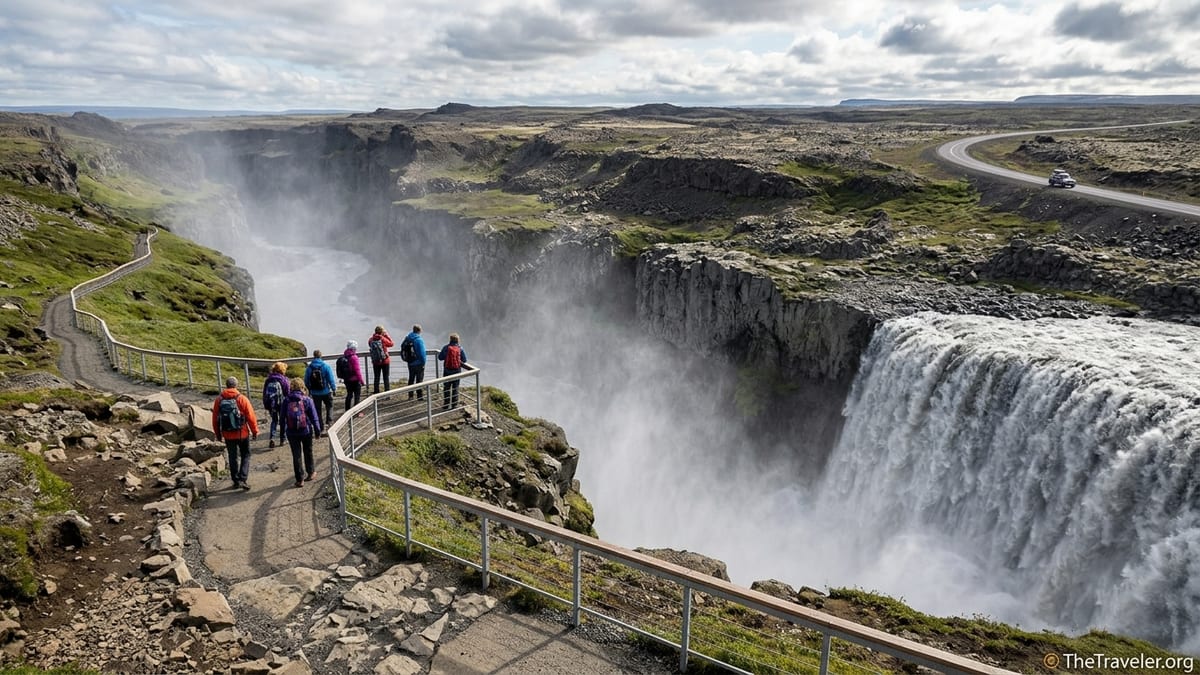
Understanding the Diamond Circle and Dettifoss
The Diamond Circle is a roughly 250 to 300 kilometre touring circuit in North Iceland that links Goðafoss, Lake Mývatn, Dettifoss, Ásbyrgi and Húsavík. Exact distance and driving time vary depending on the precise route, but tourism authorities generally advise treating it as at least a full long day, and more comfortably two days, once stops are included. Dettifoss sits near the eastern side of this loop, in Vatnajökull National Park, and is often combined with nearby Selfoss and Hafragilsfoss.
For most visitors, Dettifoss is approached from the west on paved Route 862, which branches north from the Ring Road east of Mývatn and leads to a year-round car park and walking paths. Official and rental-car guidance typically discourages using the gravel Route 864 on the east side outside of the dry summer months because it is slower, rougher and usually closed or impassable in winter. Current advice from road and tourism authorities is to treat Route 862 as the default for planning and to verify its status daily in winter and early spring, when closures can occur at short notice.
From the Mývatn area, tourism and route-planning resources consistently describe the drive to the Dettifoss west-side car park as around 50 minutes, covering roughly 60 kilometres, in summer conditions at standard speeds. From Akureyri, official regional brochures and car-rental guides usually quote 1.5 to 2.5 hours each way, depending on the route and season, for around 160 to 180 kilometres to Dettifoss on Route 1 and Route 862. These numbers should always be reconfirmed with live navigation and road-condition tools before publication and again by travellers on the day of travel.
Because Dettifoss lies in a sparsely populated highland area, the key questions for itinerary planning are not only distance but also daylight and road surface. In good summer conditions, linking Akureyri, Mývatn and Dettifoss in one long day is realistic for experienced drivers. In winter or during storms, the same loop can be too demanding or impossible. The rest of this guide breaks down options from Mývatn and from Akureyri, for both self-drivers and guided-tour passengers, with a focus on safety and reasonable pacing.
Dettifoss from Mývatn: Self-Drive Planning
Reykjahlíð and the wider Lake Mývatn area are the closest practical bases for Dettifoss. Recent driving guides and tourism materials describe the Mývatn to Dettifoss west-side journey along Route 1 and Route 862 as about 50 minutes in summer, allowing for standard speeds and dry roads. The distance is usually quoted at around 50 to 60 kilometres each way. In winter, you should assume at least an hour or more each way because of snow, ice and slower traffic, and always consult live road-condition updates for Route 862.
For a half-day or three-quarter-day loop, a logical structure is to focus on Mývatn’s geothermal and volcanic sites either before or after Dettifoss. Many travellers spend a morning at Hverir geothermal area, Krafla, or the pseudocraters around Skútustaðir, then drive to Dettifoss for the early afternoon. Others reverse the order to reach the waterfall earlier, then return for a late-afternoon soak at Mývatn Nature Baths. In either direction, you should allow roughly 3 to 4 hours door to door for Mývatn, Dettifoss and Selfoss alone, plus extra time for additional stops.
At Dettifoss itself, most visitors spend about 45 to 90 minutes, including the walk from the car park, views from different angles and photographs. Adding Selfoss, which is reached by a marked walking trail upstream from the Dettifoss viewpoint, typically adds another 45 to 75 minutes at an unhurried pace. Including Hafragilsfoss from the west side takes longer again and is best reserved for those with extra daylight and energy. A realistic half-day Dettifoss-focused outing from Mývatn might involve 2 to 2.5 hours of driving and 1.5 to 3 hours on foot around the falls.
The key decision point for Mývatn-based visitors is how much to try to add around the lake on the same day. If you also want to visit multiple lava formations such as Dimmuborgir, several short walking trails and the Nature Baths, then Dettifoss, Selfoss and Hafragilsfoss together may stretch the day uncomfortably, especially in shorter-day months. In that case, either drop one of the waterfalls or trim the sightseeing around the lake. If you have two nights in the area, many travellers find it more relaxing to dedicate most of one day to Mývatn and a separate half-day to Dettifoss and nearby sights.
Dettifoss from Mývatn: Guided Tour Considerations
Several operators based around Mývatn and North Iceland run Dettifoss or Diamond Circle day tours that start and end in the Mývatn area. Typical summer offerings use small-group minibuses and follow a route that combines Dettifoss and Selfoss with stops at Mývatn highlights such as Hverir, the Mývatn Nature Baths, Dimmuborgir or viewpoints over the lake. In winter, super-jeep tours with experienced drivers commonly replace or supplement minibus options, especially when snow and ice make access more challenging.
As of late 2026, typical Dettifoss and Diamond Circle tours from Mývatn are marketed as full-day experiences of roughly 7 to 9 hours, including hotel pick-up, transport, guided commentary and multiple short hikes. Exact inclusions vary: some itineraries include admission to geothermal baths, while others leave that as an optional extra time permitting. Prices, routes and group sizes can change season by season, so the writer should verify current offerings and costs directly with tour providers and update this guide with a clear verification date.
When assessing guided options, readers should be encouraged to look beyond headline price. Important criteria include maximum group size, the experience of the guide with winter driving in North Iceland, the flexibility to adjust stops based on weather, and clear cancellation and refund policies in case roads to Dettifoss are closed on the day. Language of guiding, included clothing or equipment, and whether food stops are prearranged or at roadside cafés are also relevant questions to clarify before booking.
Guided tours from Mývatn suit travellers who prefer not to drive on snow or ice, those visiting in the shoulder seasons when Route 862 can be partially closed, and anyone who wants detailed commentary about geology and local history. Even in summer, a guide familiar with crowd patterns can help time arrivals at Dettifoss or Hverir to avoid the busiest windows, which can make a notable difference to the experience at these compact sites.
Dettifoss from Akureyri: Is a Day Trip Realistic?
Akureyri is the main hub of North Iceland and a common base for those on shorter itineraries. Regional tourism materials and car-rental guidance usually put the drive from Akureyri to Lake Mývatn at around 1 hour in summer, mainly on Route 1, and from Akureyri to Dettifoss west side at roughly 2 to 2.5 hours in good conditions, covering around 160 to 180 kilometres. Some brochures summarise the full Diamond Circle loop from Akureyri, including Húsavík and Ásbyrgi, as about 310 kilometres and more than 4 hours of pure driving, without stops. In practice, a full loop often stretches to 10 to 12 hours once sightseeing and meals are added.
The crucial question is whether Dettifoss should be treated as a detour from an Akureyri to Mývatn day, or as the far point of a long loop that also includes Húsavík or Ásbyrgi. A moderate and realistic day in summer for confident drivers might involve leaving Akureyri early, stopping at Goðafoss, exploring selected Mývatn sites, continuing to Dettifoss and Selfoss, then returning to Akureyri by the same route. That pattern might involve around 4.5 to 5.5 hours behind the wheel and 4 to 6 hours on foot at viewpoints and short hikes.
Attempting the complete Diamond Circle from Akureyri in a single day is possible in midsummer for experienced, well-rested drivers who are used to long days. However, it can quickly become too ambitious if weather is poor, if multiple long hikes are included, or if daylight is limited. Outside roughly late May to mid-August, it is generally safer to treat Dettifoss plus a selection of other stops as the focus, rather than insisting on ticking every Diamond Circle highlight in one push.
When writing for travellers planning an Akureyri-based day trip, it is important to be frank about total hours behind the wheel. In many cases, those with only one or two nights in Akureyri may be better served by focusing on Goðafoss, Mývatn and nearby attractions, saving Dettifoss for a future visit or a different base. For visitors determined to include Dettifoss, emphasise the need for early starts, realistic pacing, and a willingness to shorten the itinerary on the day if wind, snow or fatigue make the longer loop unsafe.
Dettifoss from Akureyri: Guided Tours and Daylight Considerations
Akureyri hosts a range of tour operators offering Dettifoss and Diamond Circle excursions, often marketed as full-day trips of 9 to 11 hours. Typical formats include small-group minibus tours that visit Goðafoss, key Mývatn sights, Dettifoss and sometimes either Húsavík or Ásbyrgi, depending on the season. In winter, super-jeep and modified 4x4 tours become more prominent, with routes adapted day by day to conditions and limited daylight.
For guided-tour passengers, the main advantages are not needing to drive unfamiliar winter roads and having an expert guide who monitors road and weather updates throughout the day. However, longer tours can still be tiring, with several hours in a vehicle and multiple short walks. Prospective guests should read the detailed description carefully to ensure they understand the length of the day, the amount of walking and whether meals are included or purchased en route.
Daylight length is a central factor in whether a Dettifoss day trip from Akureyri is advisable. Data for Akureyri in 2026 show that around 21 June the region effectively experiences the midnight sun, with more than 23 hours of daylight and functional light all night. By mid-September, typical sunrise is around 06:30 and sunset around 19:40, providing roughly 13 hours of daylight. By mid-November, daylight has shrunk to about 6 to 7 hours, with sunrise around 09:30 to 10:30 and sunset around 15:30 to 16:30, continuing to shorten into December before lengthening again after the solstice.
For safety, writers should recommend that first-time visitors avoid scheduling long rural drives on routes like 862 or the stretches east of Akureyri in the dark, especially at dawn and dusk when animals are harder to see and glare or low sun can be an issue. In late autumn, winter and early spring, it is prudent to confine most driving to the middle of the day and accept that some sights may need to be skipped. When updating this article, the writer should reconfirm sunrise and sunset windows for the key months referenced and adjust guidance if climate trends or timekeeping practices change.
Seasonal Strategy and Road Safety Around Dettifoss
Conditions around Dettifoss and the Diamond Circle vary dramatically with the season. Summer, roughly June to early September, generally offers the most reliable access on paved Route 862, with dry or occasionally wet asphalt and long daylight hours. The east-side gravel road, Route 864, is typically open only in summer and is often described by authorities and experienced drivers as slow and rough even then. In shoulder seasons, heavy rain can damage gravel surfaces and lead to temporary closures.
In winter, Iceland’s Road and Coastal Administration and regional tourism offices emphasise several recurring issues for Dettifoss visitors. Route 862 may be snow-covered or icy even when technically open, and it is not always serviced as frequently as the main Ring Road. Strong winds can create blowing snow and sudden whiteout conditions, while sections of road may be reported as slippery, icy or impassable. Route 864 is usually closed for the winter months and should not be considered an option until official reports confirm it has been reopened and graded.
Winter travellers unfamiliar with Icelandic conditions are consistently encouraged by local authorities and road-safety campaigns to consider guided tours instead of self-driving to Dettifoss. Official winter-driving advice stresses the importance of using a suitable 4x4 vehicle with proper winter tyres, checking both road-condition maps and weather forecasts on the day, and being prepared to cancel or reroute if conditions deteriorate. Video and written material from North Iceland frequently highlight that roads may remain slippery or snow-packed even shortly after ploughing, and that gravel verges can be soft or hiding deep snow.
Throughout the year, wind is a factor around the Dettifoss and Mývatn highlands. Guests should be reminded to open car doors cautiously to avoid damage, secure loose items and dress with windproof layers even in summer. At the falls, staying inside marked paths and barriers is essential, as the combination of spray, wet rock and strong gusts has led to past accidents and near misses. The writer should draw on recent statements or campaigns from Icelandic road and safety authorities when updating this section, summarising key messages without quoting specific websites or phone numbers.
Sample Day Itinerary: Mývatn to Dettifoss and Back
A realistic three-quarter-day blueprint from a base near Lake Mývatn in summer might begin with an unhurried breakfast and departure around 09:00. Travellers could spend the late morning visiting Hverir geothermal field and one or two short stops around the lake, such as a walk among lava formations or a viewpoint over the craters. After a light early lunch, departing the Mývatn area for Dettifoss around 12:30 or 13:00 allows for a comfortable drive along Route 1 and 862, aiming to reach the Dettifoss west-side car park about 50 to 60 minutes later.
From roughly 13:30 to 15:30, visitors might explore Dettifoss and Selfoss at a relaxed pace, following marked trails and taking time for photographs and quiet appreciation of the canyon views. Those with extra energy and long daylight could extend their stay towards 16:00 and consider an additional viewpoint such as Hafragilsfoss, provided they keep a close eye on the clock and the weather. Leaving the Dettifoss area between 15:30 and 16:30 should see travellers back near Mývatn by late afternoon.
The early evening can then be devoted to a soak at Mývatn Nature Baths, arriving between roughly 17:00 and 19:00 depending on season and opening hours. A simple dinner either at the baths’ facilities or in nearby Reykjahlíð rounds off the day, with only short drives remaining to local accommodation. Total driving over this itinerary is around 120 to 150 kilometres and 2 to 3 hours behind the wheel, with 3 to 5 hours of walking and sightseeing broken into manageable segments.
In shoulder seasons or winter, readers should be advised to shift this schedule earlier and to reduce optional stops. For example, starting closer to 08:00 or 08:30, prioritising Dettifoss at midday and leaving more flexibility to skip additional waterfalls or a long bathing stop if snow, ice or fading light make the return journey slower. Above all, the plan should be presented as a template that can be shortened safely, not a checklist that must be completed regardless of conditions.
Sample Day Itinerary: Akureyri – Goðafoss – Mývatn – Dettifoss – Akureyri
From Akureyri in high summer, a full but feasible day might start with departure around 08:00. Driving east on Route 1, most travellers reach Goðafoss in around 40 to 45 minutes, allowing roughly 45 to 60 minutes to walk to viewpoints on both sides of the falls. Leaving Goðafoss around 09:45 or 10:00, they would then continue on Route 1 to the Mývatn area, arriving between 11:00 and 11:15. A short stop at a single Mývatn highlight, such as Hverir or a quick viewpoint over the lake, can fit into an hour around midday without stretching the day too far.
Departing the Mývatn area between 12:00 and 12:30 for Dettifoss via Route 1 and Route 862 should lead to an arrival at the Dettifoss west-side car park around 13:00 to 14:00 in summer conditions. Visitors could then spend roughly 1.5 to 2.5 hours walking to Dettifoss and Selfoss, with time for photos and rest. Aiming to leave the Dettifoss area no later than about 16:00 or 16:30 would set up a return to Akureyri between approximately 18:30 and 19:30, depending on traffic, weather and brief stops.
This itinerary involves around 5 to 6 hours of driving and 4 to 5 hours of sightseeing and short walks, which is a long but manageable day in June or July when there is functional daylight nearly around the clock. In September, with about 13 hours of daylight, it remains realistic if started early and if stops are kept focused. By late October or November, with only 6 to 8 hours of usable light, the same plan would push significant driving into darkness and should generally be discouraged for first-time visitors.
Readers should be reminded that the loop can and should be simplified if conditions demand. Skipping Goðafoss to focus on Mývatn and Dettifoss, or limiting Mývatn to a brief viewpoint stop, can save an hour or more. In winter, treating Dettifoss as an optional extension from Mývatn rather than a fixed goal is a safer way to frame expectations. The article should close by emphasising that the most successful North Iceland itineraries leave room for weather, road closures and human energy levels, with Dettifoss as a memorable highlight rather than a rigid obligation.