


More news on this day
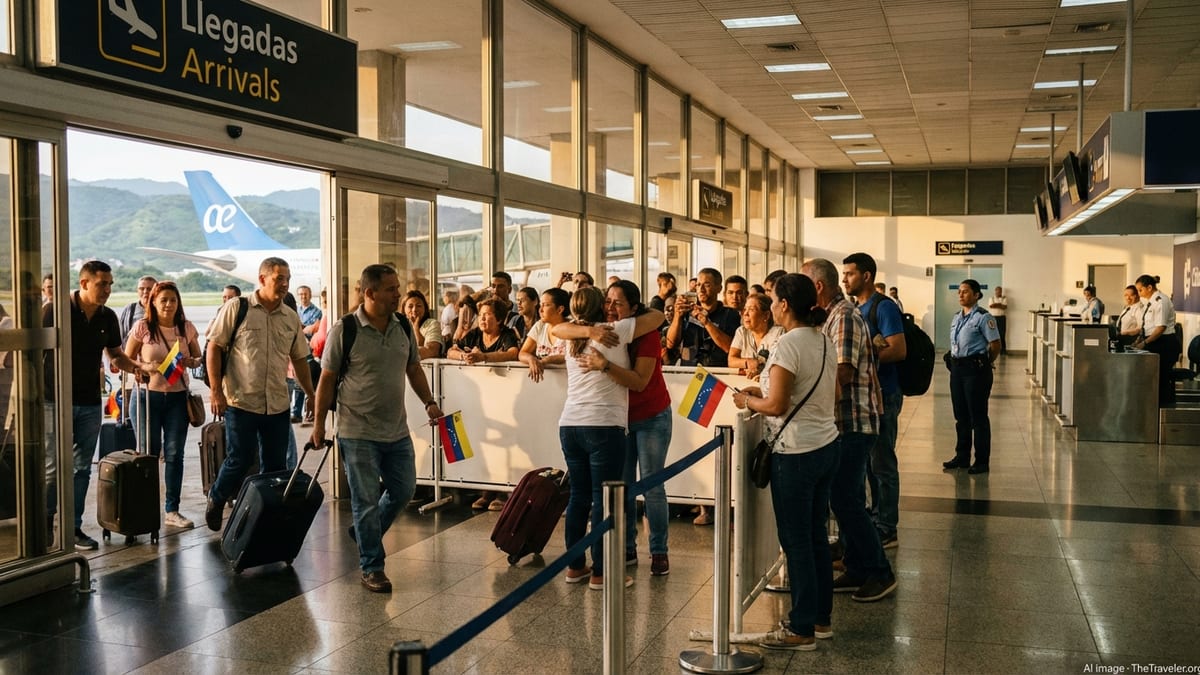
Venezuela’s primary international gateway serving Caracas has restarted limited commercial flights from temporary facilities, signaling a tentative recovery for the country’s battered travel sector just over two months after powerful earthquakes forced a complete shutdown.
Get the latest news straight to your inbox!
From Seismic Shock to Partial Reopening
Simón Bolívar International Airport in Maiquetía, which serves the capital Caracas, halted all commercial traffic after a series of major earthquakes struck north-central Venezuela on June 24, damaging terminals, runways and nearby infrastructure. The seismic sequence, reported at magnitudes above 7, shook the densely populated coastal corridor and disrupted one of the country’s most critical transport links.
Published coverage from aviation and regional outlets indicates that cargo operations were the first to return, with a controlled restart in early August framed as a test of runway integrity and ground systems. Authorities progressively expanded the scope of these flights to include both inbound and outbound cargo, allowing essential supplies and relief material to move more efficiently into the capital region.
On September 1, the hub began receiving domestic and international passenger flights again, operating under strict capacity limits. Reports describe the current phase as a partial reopening focused on restoring a basic level of connectivity while extensive repairs continue across the airfield and terminal complex.
Temporary Terminals and Restricted Capacity
Publicly available information shows that passenger handling has shifted to a set of temporary terminals built within the airport’s parking areas, designed to work as modular structures while the main buildings remain under repair. These provisional facilities include check in counters, basic security screening, waiting areas and shuttle links to aircraft parking positions on the ramp.
Aviation-focused reports indicate that the temporary setup is calibrated to manage roughly 30 to 40 percent of the airport’s pre earthquake passenger capacity. Before the June disruption, Maiquetía routinely handled more than one hundred daily flights, connecting Caracas with major cities across Latin America, North America and Europe.
Operational details shared in industry briefings advise travelers to arrive well ahead of departure time to accommodate additional screening, longer walking distances and bus transfers to and from aircraft. The airport’s main runway system is functioning with restrictions, with at least one runway segment subject to limits as engineering teams complete structural assessments and resurfacing work.
Airlines Gradually Restore Caracas Links
The restart of passenger services has triggered a gradual return by regional and long haul carriers that had either suspended flights or temporarily moved operations to alternate Venezuelan airports. According to recent airline announcements and trade press summaries, carriers such as Avianca, LATAM, Copa Airlines, Air Europa, Iberia and Plus Ultra are among those reactivating routes to Caracas in the first weeks of September.
Industry reports also highlight the role of local operators in reestablishing key regional links, including connections from Caracas to Madrid, Miami and major Caribbean destinations. Schedules for September and October are being rebuilt around the airport’s reduced processing capacity, with frequency increases expected only as additional terminal areas and runway sections return to service.
Analysts tracking the market note that the partial reopening alleviates pressure on secondary airports that had temporarily absorbed Caracas bound traffic during the closure. Facilities in cities such as Valencia, Maracaibo, Barquisimeto, Barcelona and Maracay saw a spike in activity after June as airlines and charter operators improvised alternatives for passengers unable to access the capital’s main gateway.
Travel Recovery Amid Broader Humanitarian Needs
The restart of flights through Maiquetía is emerging as a key element in the wider recovery effort across the La Guaira and Caracas regions. International and regional coverage of the earthquakes has documented substantial damage to housing, roads and public services, with thousands of residents displaced and dependent on ongoing assistance.
Air connectivity plays an important role in sustaining relief operations, from transporting specialized technical teams to moving medical supplies and communications equipment. A United States Southern Command update published in late June described the deployment of an airfield assessment team to Venezuela to help evaluate airport conditions and support the safe reactivation of critical aviation infrastructure.
As commercial air services resume, humanitarian logistics can increasingly be integrated into scheduled flights rather than relying solely on ad hoc or military operated missions. Observers of previous disaster responses in other regions have noted that restoring a country’s main airport often accelerates economic normalization, enabling business travel, tourism and migrant flows to restart.
What Travelers Should Expect in the Months Ahead
For travelers planning itineraries to or through Caracas over the coming months, conditions at Maiquetía remain fluid. Published guidance from airport and aviation sources emphasizes the importance of checking flight status frequently, verifying terminal assignments and allowing extra time for check in and security processes in the temporary facilities.
As of early September, the airport is pursuing a phased restoration plan that aims to bring more terminal space and runway capacity back online between late 2026 and early 2027. Industry coverage suggests that full pre earthquake capacity is unlikely to return immediately, and route recovery will depend on both infrastructure readiness and demand trends in Venezuela’s still fragile economy.
For now, the partial reopening marks a significant psychological and practical milestone. After weeks of isolation and diversions, Caracas once again has a functioning international gateway, enabling family visits, business trips and limited leisure travel to resume. The extent and speed of the rebound will hinge on how quickly reconstruction progresses and how confident airlines and travelers feel about the stability of operations at one of South America’s most closely watched airports.
Aviacionline: Caracas/Maiquetía Airport comes back to life today, two months after the earthquakes
MercoPress: Venezuela's main airport reopens with temporary modules two months after the earthquake
DW: Aeropuerto de Caracas reabre tras graves daños por sismos
Wikipedia: Simón Bolívar International Airport (Venezuela)
U.S. Southern Command: Update on support to Venezuela earthquake relief