


More news on this day
As artificial intelligence tools begin to plan itineraries, answer questions, and even negotiate disruptions on behalf of travelers, a growing body of research and industry data suggests that human expertise is not being replaced so much as redefined. In travel’s latest wave of automation, the competitive advantage is increasingly emerging where intelligent systems and experienced people work side by side.
Get the latest news straight to your inbox!
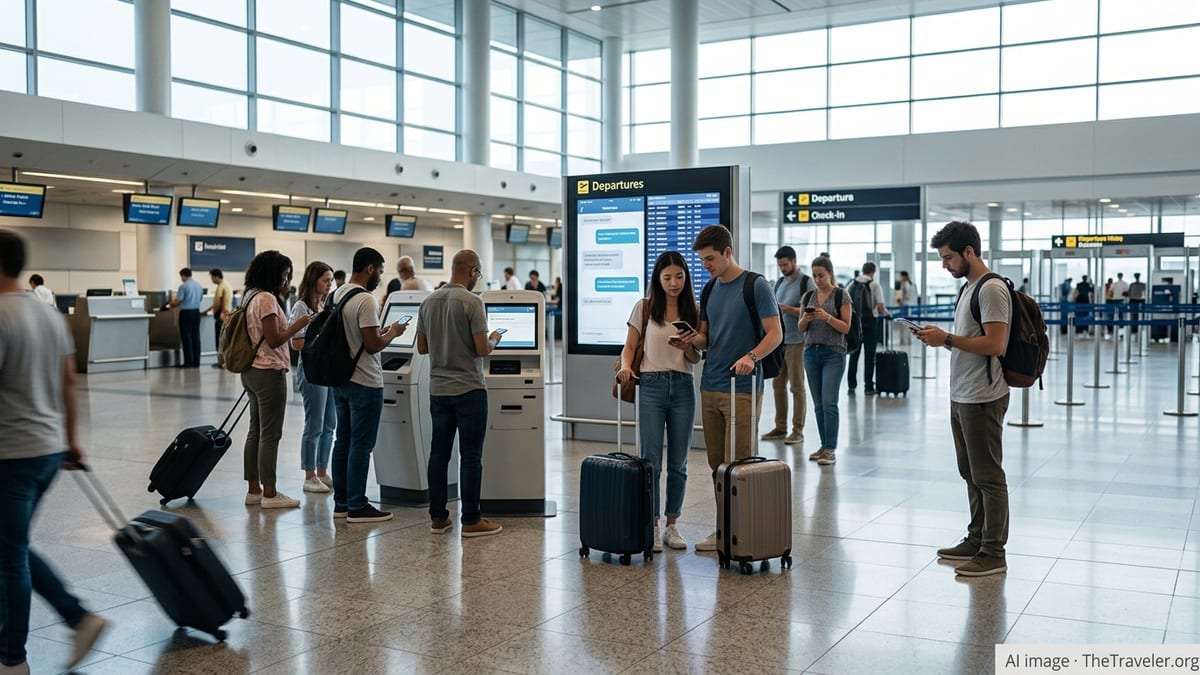
AI Agents Take Over the Routine, Not the Relationship
Travel companies have moved rapidly from basic chatbots to so called agentic AI, systems that can act on a traveler’s behalf across discovery, booking, and service. McKinsey research with Skift describes AI agents capable of designing end to end itineraries, rebooking disrupted flights, and tailoring recommendations at scale, reshaping both customer expectations and the work of front line staff.
Industry forecasts point to these agents becoming the primary interface for many trips. IDC projects that by 2030, roughly half of AI budgets in hospitality and travel will be devoted to personalization, enabling systems that anticipate guest needs and orchestrate options across airlines, hotels, and local experiences. In parallel, analysis of web traffic patterns indicates that a significant portion of online travel browsing is already performed by automated agents acting as proxies for human customers.
Yet the most detailed studies stop short of predicting a fully automated future. Reports emphasize that AI excels at pattern recognition, language generation, and rapid scenario testing, but still struggles with ambiguous goals, incomplete data, and the kind of contextual nuance that defines many real world travel decisions. As a result, the emerging operating model in travel is less about removing humans and more about carefully assigning which tasks are handled by machines and which require expert judgment.
Travelers Embrace AI, Then Ask for a Human Backstop
Surveys show that travelers are experimenting with AI in large numbers, particularly for inspiration and early stage planning. McKinsey analysts report that although fewer than one third of travelers have used generative AI for trip related tasks, a strong majority of those who have say it improved their experience by saving time and broadening options. Travel brands and technology providers now market AI powered concierges capable of summarizing destinations and stitching together routes in seconds.
At the same time, research into customer experience highlights an ongoing trust gap. Skift’s multi year State of Travel analyses note that industry leaders are divided over the risk of losing the human touch as AI spreads, while consumer studies from advisory firms point to persistent concerns around accuracy, personalization limits, and the handling of edge cases such as visa rules, insurance conditions, or multi country disruptions.
Academic work on human AI collaboration in customer support reinforces this tension. Experiments with hybrid systems, where algorithms draft responses and human agents review or intervene in real time, find that users rate outcomes higher when a person retains final responsibility for complex queries. These findings are mirrored in travel case studies, where AI tools deflect routine questions but hand off irregular operations, medical issues, and high value itinerary changes to experienced staff.
Inside the Human in the Loop Travel Playbook
The most advanced deployments in travel now rely on structured collaboration between AI and human experts rather than simple escalation trees. Technology providers describe architectures where digital agents monitor multiple channels, propose actions, and execute straightforward workflows, while human agents oversee exceptions, set guardrails, and refine the system based on what actually happens on trips.
During large scale disruptions, such as weather events or infrastructure incidents, this model has been tested in real time. Coverage of recent crises in corporate travel and aviation shows AI systems triaging rebooking options, checking alternative routes, and initiating hotel searches at machine speed. When constraints collide or traveler profiles are unusually complex, expert agents step in with a consolidated view of options and constraints generated by the AI, shortening decision times while preserving judgment.
Smaller travel businesses are adopting similar approaches. Industry commentary describes independent agencies and niche operators using AI for initial quote generation, policy lookups, and document preparation, then layering human review for feasibility, supplier fit, and destination nuance. Entrepreneurs building human in the loop travel planners report that clients respond positively when itineraries clearly show both algorithmic breadth and human curation, especially for long haul or once in a lifetime travel.
Where Human Expertise Adds Distinct Value
Across these examples, several domains emerge where human experts retain a clear edge. The first is moral and emotional judgment. Travel often involves high stakes, from family emergencies to major financial commitments. Studies of customer satisfaction in service industries indicate that empathy, reassurance, and context aware negotiation remain difficult to simulate convincingly, even as language models improve.
The second is local and tacit knowledge. While AI can aggregate millions of reviews and data points, reports on tourism decision making show that travelers still value insight from advisors who have firsthand familiarity with a destination’s micro seasons, neighborhood feel, or supplier reliability. In these situations, agents use AI to generate options but rely on their own experience to filter what is realistic, safe, and aligned with a traveler’s risk tolerance.
Finally, regulation and liability create a structural role for humans. Academic research on customer support and industry white papers on AI governance stress that organizations must designate accountable decision makers, particularly when advice touches visas, health requirements, insurance coverage, or consumer rights. In many jurisdictions, it is the human travel advisor or manager, not the underlying model, who is responsible when something goes wrong.
Designing Travel Services for a Shared Human AI Future
Analysts tracking AI adoption in travel now frame the debate less as humans versus machines and more as a question of service design. In this view, the strongest propositions are those that make it explicit which parts of the journey are managed autonomously and where a human expert is available, on what terms, and at what cost. Clear expectations help travelers decide when they are comfortable with a purely digital path and when they want human oversight.
Consulting reports and technology vendor roadmaps suggest that this hybrid architecture will become standard over the next three to five years as agentic AI moves from pilots to scaled operations. AI assistants are expected to mediate much of the invisible work in travel discovery, comparison, and booking, while human specialists focus on high touch experiences, complex itineraries, and recovery from disruptions.
For travelers, the practical effect is a shift in where human expertise appears along the journey. Instead of spending hours on basic research or hold times, customers may increasingly reserve human interaction for moments that genuinely require it. In an age defined by intelligent agents, the human advantage in travel is not disappearing; it is concentrating where judgment, trust, and lived experience matter most.
McKinsey & Skift: Remapping Travel with Agentic AI
IDC: Agentic AI Will Redefine Travel and Hospitality in 2026
TechRadar Pro: AI and Travel Disruption
A System for Human AI Collaboration for Online Customer Support
Adobe: State of Customer Experience in Travel and Hospitality