


Landing at Casablanca Mohammed V International Airport can feel overwhelming, especially if it is your first time in Morocco and you are tired from a long flight. The good news is that Casablanca has several reliable ways to reach the city center, from an hourly airport train to a new Aerobus shuttle, classic taxis, app-based rides, and pre-booked private transfers. This guide walks you through each option, with realistic prices, luggage considerations, hotel areas and concrete recommendations based on the time you land.
Get the latest updates straight to your inbox!
Orientation: Airport Layout, Distances and Where You Are Going
Casablanca Mohammed V International Airport (CMN) sits roughly 25 to 30 kilometers south of the city, near Nouaceur. In normal traffic, a direct road transfer to central districts such as the Old Medina, Maarif or Gauthier takes about 35 to 50 minutes. In rush hour, that can easily stretch to more than an hour. Understanding where you are actually staying in Casablanca is essential before choosing your transfer.
Most visitors book hotels or apartments around a few key zones. Near the coast, the Old Medina and Casa Port area is popular for first-timers and cruise passengers. Slightly inland, the Gauthier and Maarif neighborhoods are full of mid-range hotels, cafes and bars. For business travelers, many chain hotels cluster around the Twin Center area and along Boulevard d’Anfa. Casa Voyageurs, the main railway hub, is not a tourist area in itself but is a key node for onward trains to Rabat, Marrakech, Tangier and Fes.
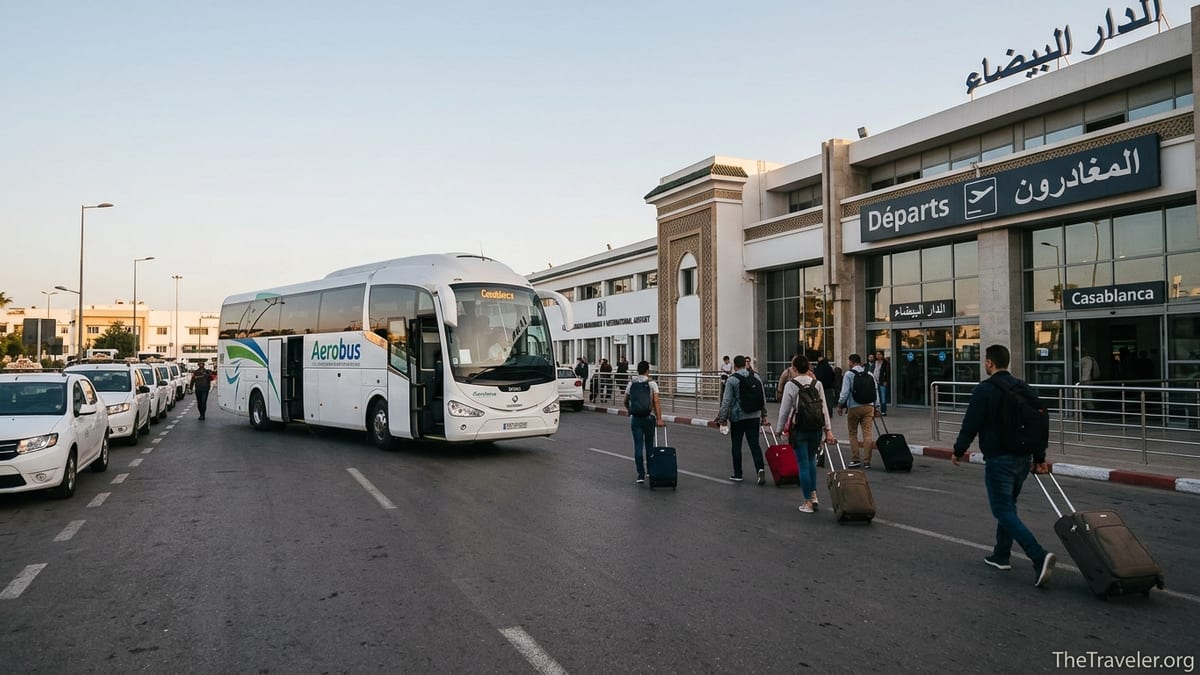
At the airport, arrivals from both major terminals eventually funnel into a common public hall. From here you can reach the ONCF train station in the basement of Terminal 1, the Aerobus stop outside the terminal building, and the main line of white “grand taxis” waiting immediately outside. If you plan to use the train, you follow signs for the train icon and escalators or elevators down. For bus and taxis, you exit at ground level; there are usually staff and signs pointing you in the right direction.
Because CMN is the country’s busiest airport and formalities can take time, especially in the evening, build in a margin between scheduled landing and any onward connections. Immigration can take 30 to 60 minutes in peak times, plus baggage claim and customs. This matters particularly if you are trying to catch the hourly train from the airport or a specific long-distance train from Casa Voyageurs.
Airport Train: Fast, Cheap and Best for Light Luggage
Morocco’s national railway company, ONCF, runs a dedicated airport line from a station directly under Terminal 1 to the city. Trains usually run once per hour, broadly from early morning to late evening, stopping at stations including Bouskoura, Casa Oasis, Casa Voyageurs and Casa Port. Typical journey time to Casa Voyageurs is around 30 to 40 minutes, and to Casa Port about 45 minutes. You buy tickets at staffed counters or from machines in the station hall; payment is in dirhams, so many travelers stop at an ATM in the arrivals area first.
Recent traveler reports and local guides suggest the second-class fare from the airport to main city stations is usually in the range of 45 to 60 Moroccan dirhams per adult. First class, if offered on your departure, costs a bit more but often provides more comfortable seats and quieter carriages. For a solo traveler or couple with rolling carry-ons, this is normally the best value option, especially if you are heading to a hotel near Casa Voyageurs, Casa Port or on the city tram lines.
To understand how this plays out in practice, imagine you land from Paris at 13:15. By the time you clear formalities and reach the station, it might be 14:10. If the airport train leaves at around 14:50, you can comfortably buy tickets, perhaps get a coffee in the small concourse, and still make it. You would be at Casa Voyageurs around 15:30, then a short taxi ride or tram hop from most central hotels. By contrast, in heavy afternoon traffic a taxi over the same distance may take the same or longer and cost several times more.
The main limitations of the train are timing and luggage. Services do not run in the small hours of the night, so it is not suitable if your flight lands after the last departure. Also, while luggage racks exist, the train is not designed like an airport express with huge baggage space. If you are a family with several large suitcases or sports equipment, wrestling everything on and off the train and then into a city taxi can be tiring, especially after a red-eye flight.
Aerobus Shuttle: New, Simple Connection to Casa Port
Casablanca introduced a dedicated Aerobus shuttle service linking the airport and the city center, operated by the local bus company for Casablanca. The Aerobus usually runs around the clock, or close to it, with departures roughly every 25 to 40 minutes, matching peak arrival and departure waves. Buses connect the airport with key city stops, notably Casa Port station in the downtown area, and sometimes intermediate points that are convenient for business districts.
Tickets for the Aerobus are typically about 50 dirhams per person, paid directly to the driver or at a small ticket booth near the bus stop. Compared with the train, the Aerobus has the advantage of more frequent departures and operating later into the night, which is useful if you land around midnight and just missed the hourly train. It also drops you right in the central port area, a short walk or quick taxi to hotels near the Old Medina, the Marina, and central boulevards like Hassan II and Mohammed V.
For example, consider an arrival from London at 22:30. You are through immigration and baggage by 23:30, and the next train slot is questionable if the last service is around this time. Instead, you walk out to the Aerobus stand, board a bus leaving shortly after midnight, and arrive near Casa Port roughly 40 to 50 minutes later. From there you can grab one of the city’s red petit taxis or even walk, if your hotel is nearby and you feel comfortable doing so at that hour.
The main downsides of the Aerobus are similar to any city bus: you share the vehicle with many passengers, there is limited dedicated luggage space, and you still often need a short additional transfer at the city end. During late-night hours, some travelers prefer a door-to-door taxi or private transfer for comfort and security, especially if they are carrying valuables or traveling with children.
Taxis: Flexible Door-to-Door, But Watch the Price
Official airport taxis wait immediately outside the arrivals hall. Most are white “grand taxis” that take passengers directly into the city. Unlike the smaller red city taxis, airport taxis typically operate on fixed or negotiated fares rather than meters. In 2025 and 2026, many independent airport and travel guides report that a typical rate from CMN to central Casablanca is roughly 300 to 400 dirhams, depending on the time of day, exact neighborhood and your bargaining skills.
A concrete example: a couple staying in a mid-range hotel in Gauthier might agree on 350 dirhams with a driver for a late-evening ride, including luggage. They are dropped right at the hotel door in about 40 minutes when traffic is light. The same journey by train plus a city taxi from Casa Voyageurs could cost about 60 dirhams for the train and 20 to 40 dirhams for the city taxi, cheaper but involving more steps and a short walk between modes.
If you decide to use a taxi, it is wise to confirm the price clearly before getting in. Some visitors find it helpful to ask their hotel in advance what an approximate normal fare should be and to have the amount ready in cash. Avoid drivers who refuse to state a price or who suggest surprisingly high figures. Also be aware that while Careem and similar apps operate in the city, there is sometimes visible tension between app drivers and traditional taxis, so do not openly negotiate an app pickup right in the middle of an airport taxi rank.
For groups of three or four with luggage, airport taxis become relatively more economical compared with trains or buses. A family of four might pay around 350 dirhams total instead of four train tickets at around 50 dirhams each plus a city taxi. The private, door-to-door convenience is also valuable if you are traveling with elderly relatives, small children, or significant baggage.
Rideshare Apps: Careem and Local Alternatives
Classic Uber services do not operate in Morocco in the way many travelers expect, but the landscape is evolving. In Casablanca, the most commonly used ride-hailing app is Careem, which is owned by Uber but operates under its own brand and within local regulations and customs. There are also local competitors such as inDrive and sometimes Yango, which work on similar principles of app-based booking and negotiated or pre-set fares.
In the city center, many visitors use Careem to move between neighborhoods, for example from Maarif to the Hassan II Mosque or from Casa Port to the Anfa and Ain Diab coastal areas. Prices vary depending on time of day and demand, but rides across central Casablanca often fall in the range of 25 to 70 dirhams, which is competitive with, and sometimes lower than, hailing a taxi on the street. Car quality and driver professionalism tend to be at least as good as ordinary taxis, though experiences can vary.
Using rideshare apps directly from the airport is more complicated. In practice, travelers report that it is sometimes possible to request a Careem or inDrive car at CMN, but it can cause friction with airport taxi drivers, and pickup points might not be clearly signed. Additionally, regulations and enforcement around ride-hailing are in flux, so what works smoothly one month can become harder the next. For risk-averse travelers arriving with jet lag and heavy luggage, relying on the airport train, Aerobus, an official airport taxi, or a pre-booked private transfer tends to be more straightforward.
If you are comfortable with apps and speak some French or Arabic, one strategy is to take the train or Aerobus into the city, then use Careem for the final leg to your hotel. This reduces exposure to any potential disputes at the airport itself and lets you benefit from app-based pricing and navigation in the city streets, which can be busy and confusing for first-time visitors.
Private Transfers: Easiest With Heavy Luggage or Late-Night Arrivals
For those who prioritize convenience over price, pre-booked private transfers are widely available online and through hotels. In these arrangements, a driver waits for you in the arrivals hall with a sign, helps with luggage, and then drives you straight to your accommodation. Prices vary by company, vehicle type and time of day, but a realistic range for a standard sedan from CMN to central Casablanca in 2026 is often somewhere between 350 and 600 dirhams for up to three passengers.
Consider a family arriving from New York on a late-night flight landing at 00:20. By the time they clear immigration and get their bags, it might be close to 01:30. At this hour, public transport choices are limited and parents may not want to negotiate with taxi drivers with tired children in tow. A pre-arranged transfer at, say, 500 dirhams becomes appealing: they walk out, meet their named driver, and are at a hotel near Casa Port in less than an hour, with car seats already requested if needed.
Private transfers are also useful for travelers continuing directly out of Casablanca. For example, some visitors heading onward to Marrakech by road book a direct airport-to-Marrakech private car, skipping Casablanca city completely. This costs substantially more than going into the city and taking a train, but it saves one hotel night and multiple mode changes. For business travelers on tight schedules, that trade-off can be worthwhile.
The main drawback of private transfers is cost. For a solo backpacker landing at noon, paying 450 dirhams for a private car rarely makes sense when a 50 to 60 dirham train and a short local taxi ride will get you to the same place. But for groups, late arrivals, passengers with mobility issues or travelers carrying equipment such as surfboards or large suitcases, the premium can feel justified.
Choosing the Best Option by Time of Arrival and Hotel Zone
Putting all the options together, the “best” transfer from Casablanca Airport depends heavily on when you land and where you are staying. During daytime hours, roughly 07:00 to 20:00, the ONCF airport train is hard to beat for value and predictability. If your hotel is near Casa Voyageurs, Casa Port, or on the city tram lines radiating from these stations, taking the train and then a short taxi or tram ride is usually both efficient and economical.
If you land in the evening, say between 20:00 and 23:00, you should consider both the train and Aerobus, checking which is due soonest. For hotels in the Casa Port and Old Medina area, the Aerobus dropping you near the port might be more convenient than getting off at Casa Voyageurs and then transferring. For Gauthier, Maarif, and the Twin Center zone, the balance is more even, since you will need a taxi from either Casa Voyageurs or Casa Port, so simply choose whichever combination is faster at your particular arrival time.
Late-night arrivals, particularly between roughly 23:30 and 05:00, shift the equation. After the last train has departed, the main realistic options are the Aerobus, official airport taxis, or a pre-booked private transfer. Solo travelers on a budget might prefer the Aerobus plus a short taxi at the city end. Couples and families, or anyone keen to minimize hassle at 02:00, often lean toward taxis or pre-arranged cars despite the higher cost. For hotels in outer districts such as Sidi Maarouf or near the motorway towards Rabat, taxis and private transfers have a clear advantage, since you avoid multiple segments and late-night changes.
Your hotel zone also matters for longer-term planning. If you are staying near Casa Voyageurs primarily to catch an early-morning train to Marrakech, Rabat or Tangier, then taking the airport train directly to Casa Voyageurs simplifies things: you arrive at the same station where your next-day train will depart. By contrast, if your main interest is seaside Casablanca and you booked a hotel near the Corniche in Ain Diab, a taxi or private transfer might be worth the extra cost to avoid lugging bags through multiple transfers from Casa Port.
Luggage, Comfort and Safety Considerations
Luggage is often the deciding factor between public transport and private vehicles. A solo traveler with a backpack can easily navigate the airport station escalators, find a seat on the train, and then hop into a city taxi at Casa Voyageurs. A couple with two large checked bags and two carry-ons will still manage the train, but it can feel crowded at peak hours. A family of five with strollers, car seats and multiple bags usually fares better in an Aerobus with a dedicated luggage area, or in a private van transfer arranged in advance.
Comfort also matters after a long-haul flight. The train carriages are generally clean, with air conditioning and fixed seating. Aerobus vehicles are modern urban coaches with large windows and seating designed for airport passengers. Taxis can range from newer sedans to older vehicles with more basic interiors. App-based cars booked via Careem or inDrive are often mid-range sedans similar to taxis but sometimes feel newer or better maintained, depending on the driver.
In terms of personal safety, Casablanca is relatively used to international travelers, and airport transfers are a daily routine. Normal big-city precautions apply: keep passports and valuables on your person rather than in easily accessible outer pockets, avoid flashing large amounts of cash, and if arriving very late at night, go straight to your hotel rather than wandering with bags. Many visitors report feeling comfortable on the airport train and Aerobus during their operating hours, as these services are used by locals and travelers alike.
For women traveling alone, especially at night, choosing a more controlled environment such as a pre-booked transfer or a clearly marked Aerobus can provide peace of mind. Some private companies offer the option to request female drivers, and hotels in central Casablanca are used to arranging transfers for solo travelers on late flights.
The Takeaway
The most efficient way from Casablanca Mohammed V International Airport to the city center depends on your priorities. For most daytime arrivals and light luggage, the ONCF airport train is usually the smartest choice: it is affordable, reasonably fast, and links directly to the main hubs of Casa Voyageurs and Casa Port. For those landing later in the evening or wanting a simpler central drop-off, the Aerobus offers a straightforward alternative at a still-modest price.
Taxis and app-based rides become more attractive when you value door-to-door convenience or are traveling in a group, while pre-booked private transfers make particular sense for very late arrivals, families with young children, or anyone carrying heavy or bulky luggage. Thinking ahead about your hotel’s location and your landing time, and having a rough plan for your first hour on Moroccan soil, will help you step out of CMN with confidence rather than confusion.
FAQ
Q1. How long does it take to get from Casablanca Airport to the city center?
The journey from Mohammed V Airport to central Casablanca usually takes around 35 to 50 minutes by road, and about 30 to 45 minutes on the airport train, depending on traffic and your exact destination.
Q2. Is the train from Casablanca Airport safe and easy to use?
Yes, the ONCF airport train is generally considered safe and straightforward. Signs in the arrivals hall guide you to the station under Terminal 1, tickets are sold at counters and machines, and many travelers use this option daily.
Q3. What is the cheapest way to reach downtown Casablanca from the airport?
The airport train is usually the cheapest option for most travelers, with fares commonly in the range of 45 to 60 dirhams per person. The Aerobus is slightly more expensive but still budget-friendly.
Q4. Can I use Uber from Casablanca Airport to my hotel?
Classic Uber service does not operate in Morocco in the way many visitors expect. In Casablanca, people more commonly use Careem or other local ride-hailing apps, but airport pickups can be sensitive because of tensions with taxi drivers, so it is not always the simplest option on arrival.
Q5. How much should I expect to pay for a taxi from the airport to the city center?
Typical fares for official airport taxis to central areas are often around 300 to 400 dirhams, depending on time of day and neighborhood. Always agree the fare clearly with the driver before departing.
Q6. Are there transfer options late at night or very early in the morning?
After the last airport train has departed, late-night options include the Aerobus, airport taxis, and pre-booked private transfers. Public transport is more limited in the small hours, so arranging a taxi or private car in advance is wise for arrivals after midnight.
Q7. Which option is best if my hotel is near Casa Port or the Old Medina?
If your hotel is close to Casa Port or the Old Medina, both the airport train and the Aerobus work well. The Aerobus that terminates near Casa Port can be especially convenient, while the train offers a slightly faster ride if the schedule suits your arrival time.
Q8. What should I do if I have a lot of luggage or am traveling with children?
With heavy luggage or young children, many travelers prefer a door-to-door solution such as an airport taxi or pre-booked private transfer. The Aerobus can also work if you are comfortable handling bags on and off a coach and then taking a short taxi to your hotel.
Q9. Do I need to book my airport transfer in advance?
You do not need to pre-book the train, Aerobus or regular taxis, as they operate on a rolling basis. However, booking a private transfer in advance is recommended for very late arrivals, tight connections, or when you want the certainty of a driver waiting with your name at arrivals.
Q10. Is it better to stay near Casa Voyageurs station for onward travel within Morocco?
If you plan early-morning trains to cities like Marrakech, Rabat, Tangier or Fes, staying near Casa Voyageurs can be practical. The airport train brings you directly to this station, and you can then connect easily to your long-distance train the next day without crossing the city again.