


Landing at Casablanca Mohammed V International Airport after a long flight, most travelers simply want a straightforward ride into the city. Yet between fixed fares, night surcharges, white “grand taxis,” unofficial touts and questions about cash, it is easy to feel uncertain at the curb. This practical guide walks you through exactly how taxis work at Casablanca’s main airport in 2026, what you should expect to pay, how to pay it, and how to handle drivers with confidence, even on a late arrival.
Get the latest updates straight to your inbox!
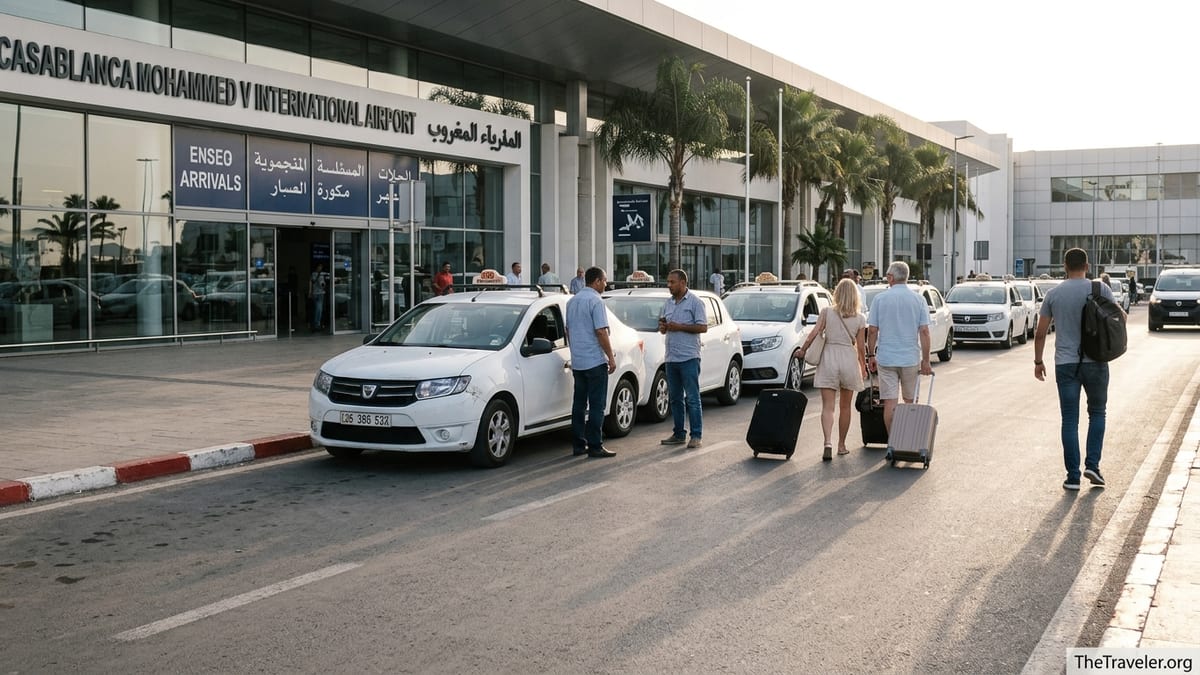
Understanding Casablanca Mohammed V Airport and Its Taxis
Casablanca Mohammed V International Airport (CMN) sits about 30 kilometers southeast of the city center and handles the bulk of Morocco’s long-haul flights. That distance means a taxi is often the most convenient door-to-door option, especially if you are staying in central neighborhoods like Gauthier, Maarif, Racine or near the Old Medina. Trains and shuttle buses exist, but they follow fixed schedules and routes, while taxis are available at all hours and take you directly to your hotel door.
At the airport, official taxis operate from a dedicated rank outside the arrivals halls. They are typically white “grand taxis” licensed to run intercity or airport routes. Unlike the small red “petit taxis” that you will see inside Casablanca itself, these airport taxis have a regulated fare range to the city and do not usually use a meter for the airport run. In practice, travelers in 2026 report paying around 250 to 300 Moroccan dirhams for a daytime ride from CMN to central Casablanca, with somewhat higher prices at night.
Knowing these broad price bands before you land makes a big difference. If an official driver quotes something wildly outside this range for a standard drop-off in the city center, you can push back politely or choose another cab. Conversely, if you are arriving with heavy luggage at 01:00, you should expect to pay more than daytime visitors and factor the regulated night surcharge into your budget.
For context, a taxi ride of 250 to 300 dirhams in Casablanca in 2026 is roughly comparable in cost to a 30-minute airport transfer in many European cities. The main difference is that you will be dealing in cash and negotiating verbally rather than simply watching a meter tick. Once you understand that the airport route has fairly clear, semi-fixed expectations, the process becomes much less intimidating.
Where to Find Official Taxis and How the System Works
After you pass passport control and baggage claim at Mohammed V Airport, you will exit into the public arrivals area. Ignore any unofficial offers you receive inside the terminal, especially from men approaching you near the exit doors with "Taxi? Taxi?" in hand. Walk straight through the sliding doors to the outside forecourt. The official taxi rank is directly outside the arrivals terminal on the ground level, with a clearly marked area where white taxis line up.
At busy times, such as evening arrivals from Europe, you may see dozens of white taxis parked in a line, with a dispatcher or police officer supervising the queue. In some periods, travelers also report an official taxi kiosk just before you step outside, where an attendant notes your destination and issues a ticket indicating an approximate regulated fare. In that setup, you pay the driver directly after the trip, but the printed slip reduces the scope for surprise pricing.
If no kiosk is operating when you arrive, simply walk up to the first taxi in the queue and state your destination clearly in French or simple English, for example: "Hotel Barcelo Casablanca, Maarif" or "Ibis Casa Voyageurs, near the train station." It is perfectly acceptable to ask the driver for the price before you get in. A typical mid-2026 quote for a daytime journey to central Casablanca runs around 250 to 300 dirhams for the whole car, not per person. For a trip to neighborhoods slightly beyond the core, such as Ain Diab on the seafront, the driver may add 50 to 100 dirhams, which is reasonable given the extra distance.
Once you agree on a fare, confirm that the price is for all passengers and luggage, then get in and keep your larger bags either in the trunk or on the seat next to you. If you are uncomfortable with the quoted price, you can step aside and approach another driver. At an international airport like Casablanca, there is nearly always another taxi available within minutes, even late in the evening.
Current Fare Expectations: Day, Night, and Examples
For a standard one-way journey between Mohammed V Airport and central Casablanca in 2026, expect to pay approximately 250 to 300 dirhams during the day for an official grand taxi. This typical price band covers destinations like the Old Medina, United Nations Square, Maarif, Gauthier, the business district around Casa Port and hotels near Casa Voyageurs station. The ride usually takes 30 to 45 minutes, depending on traffic along the highway into town.
Morocco applies an official night surcharge on taxis, and in practice most airport drivers will quote a higher rate after evening hours, often starting around 20:00. For a late-night arrival between roughly 20:00 and 06:00, travelers commonly report fares of about 300 to 400 dirhams to the same central areas. For example, a couple arriving on a 22:30 flight from Paris and staying in a midrange hotel in Gauthier might pay 350 dirhams for a direct door-to-door ride.
Going farther afield from the airport naturally increases the fare. A taxi from CMN to the seaside Corniche and Ain Diab nightlife strip may be quoted at 350 to 450 dirhams, particularly at night, as the driver leaves the highway to navigate city traffic all the way to the coast. If you are heading straight to another city such as Rabat or El Jadida, some airport drivers will offer fixed prices in the 700 to 1,000 dirham range or more, depending on the distance and time of day. In those cases, it is usually worth comparing with the cost and schedule of the train before deciding.
Because Morocco’s fuel prices and cost of living change over time, avoid relying on a very specific number you found in a forum post from years ago. Treat the figures above as realistic current examples gathered from recent traveler reports and local guidance, and always confirm your actual fare with the driver before the car leaves the airport parking area. If your hotel has arranged a private transfer at a flat rate, compare that amount with these typical taxi fares to see whether you are paying a reasonable premium for comfort and predictability.
Cash, Cards and Exchanging Money at the Airport
Most independent taxi drivers at Casablanca Mohammed V Airport are still cash-only in 2026. That means you should plan to have at least 300 to 400 dirhams in local currency before you reach the taxi rank, more if you arrive late at night, have several passengers, or are heading to the seafront or a more distant neighborhood. Drivers generally do not accept euros or dollars at a fair rate, and even if they agree, the conversion will almost always be in their favor.
Inside the arrivals area, just before you exit into the public hall, you will find several ATMs operated by major Moroccan banks as well as currency exchange counters. ATMs tend to offer a better rate than cash exchanges, though your home bank may add withdrawal fees. Many travelers choose to withdraw an initial 800 to 1,000 dirhams on arrival, which comfortably covers the taxi and leaves some cash for a first meal or small purchases in the city.
A few organized taxi kiosks and prebooked transfer services at CMN accept credit or debit cards at a counter inside the terminal, then issue a voucher that you present to the driver outside. This can be useful if your bank card does not work reliably in Moroccan ATMs or if you prefer not to carry much cash. However, the vast majority of ordinary white airport taxis do not have card terminals in the vehicle. You should assume that once you are in the cab itself, you will be paying in dirhams.
To keep things smooth, count out the agreed fare before you reach your destination, and carry small denominations if possible. If your fare is 280 dirhams and you hand the driver a single 300-dirham combination, it is perfectly normal to tell them to keep the change. On the other hand, if you only have a 200 and a 100 note for a 260-dirham fare, do not hesitate to ask politely for 40 back. Preparing the exact or near-exact amount avoids awkward last-minute fumbling at hotel drop-off.
Dealing With Late-Night Arrivals, Luggage and Hotel Drop-Offs
Flights from North America and some European hubs often land in Casablanca late at night or very early in the morning. Arriving at 01:00 with two suitcases can make even experienced travelers feel vulnerable, but in practice the taxi process at CMN is relatively straightforward around the clock if you know what to expect. Official white taxis wait outside the terminal through the night, though the line may be shorter than during daytime peaks.
At night, factor in the higher fare range and expect drivers to quote something closer to 350 to 400 dirhams for central Casablanca. This is not automatically a sign of a scam; it reflects the official night surcharge as well as the fact that the driver is working a less popular shift. As at any time, you should still ask the price up front and confirm that it covers all passengers and luggage. Most drivers will help you load larger suitcases into the trunk and do not charge extra for bags, though a small tip for heavy lifting is appreciated.
Hotel drop-offs are the norm, not the exception. If you are staying at a recognizable property such as Hyatt Regency Casablanca near United Nations Square, Movenpick Casablanca on Avenue Hassan II, or a mid-range business hotel around Casa Port, simply give the hotel name. Many drivers know the main properties by heart, and in other cases they will use their phone’s map. If you are staying in a riad inside the Old Medina where cars cannot enter, the driver will usually take you to the closest gate and point you toward the pedestrian lanes.
For very late arrivals, some travelers prefer to prebook a hotel transfer service so they can walk out with a driver already waiting, holding a sign. This tends to cost more, often 350 to 500 dirhams for central hotels, but you pay online or by card in advance and avoid price discussions after a long flight. If you choose a regular taxi instead, keeping your route simple, having your hotel address printed, and being clear about the fare will give you almost the same level of security at a lower cost.
Avoiding Informal Drivers and Common Taxi Pitfalls
The single most important safety tip at Casablanca Airport is to use only the official taxi rank outside arrivals. Inside the terminal and just beyond the doors, you may be approached by individuals asking where you are going and offering rides “cheaper than official taxi.” These are unlicensed or semi-licensed drivers operating off the books. While many are simply trying to earn extra income, they are outside the normal controls, and disputes over price or route are more likely.
If someone approaches you inside the building and insists on guiding you to their car, a simple "No thank you" and continuing toward the marked taxi area is usually enough. Police and airport security are visibly present near the official rank, and the white cabs there follow clearer pricing expectations. If a tout persists, you can walk back into the terminal or move closer to the police presence until they lose interest. Standing your ground calmly is more effective than engaging in a long argument.
Another frequent pitfall is agreeing to a ride without settling the fare first. For example, a traveler might tell a driver, "City center," and get in the car, assuming the regulated 250 to 300 dirham range. Upon arrival, the driver demands 500 dirhams and claims that this is the normal rate. Prevent this situation by asking "How much to Casa center?" before you sit down. If the driver quotes something that feels slightly above the range you expected, you can either negotiate gently down or simply decide whether the small extra amount is worth arguing over.
Finally, be cautious with unofficial promises of "shared taxis" at the airport, where a driver suggests you wait while he finds more passengers and then charges each of you a lower amount. While shared white grand taxis are a common system for intercity travel from city hubs, the airport is not the best place to navigate this arrangement if you are new to Morocco and tired from a flight. For most visitors, it is safer and less stressful to book the whole taxi for your group from the official rank, pay a clear fixed price, and leave immediately.
Using Taxis Within Casablanca After Your Arrival
Once you are settled in the city, you will mostly use red “petit taxis” for local trips rather than the white grand taxis that serve the airport. Petit taxis are small city cabs limited to three passengers and are supposed to use a meter for journeys within Casablanca. For example, a short ride from the Old Medina to the Casa Port train station might cost around 15 to 25 dirhams, while longer trips across town typically remain under 50 dirhams in normal traffic.
In practice, some petit taxi drivers will try to negotiate a flat fare with tourists, especially near hotels or tourist sites. If the driver refuses to start the meter, you can insist politely by pointing to it and saying "Compteur, s'il vous plaît" or choose another cab. Many locals do exactly this. For airport trips, though, petit taxis are not usually the right tool; most will not leave the city limits for an airport run, and if they do, they may charge close to what a white airport taxi would cost for less comfort.
When planning your departure from Casablanca, you have several choices. One common pattern is to take a red petit taxi from your hotel to Casa Voyageurs or Casa Port station, then connect by train or airport shuttle. Another is to have your hotel arrange a white taxi pickup for a fixed price, similar to what you paid on arrival. A third is to negotiate directly with a white grand taxi parked at major city transport hubs. In all cases, confirming the fare in advance and allowing extra time for traffic will keep stress levels down.
Knowing the difference between the red petit taxis and the white grand taxis will help you make quick decisions: red for short metered city hops, white for airport and intercity fixed-price routes. If a driver offers a deal that does not fit this basic pattern, ask more questions before agreeing.
The Takeaway
Casablanca Mohammed V Airport can feel hectic on first arrival, but the taxi system is simpler than it seems. Official white grand taxis wait at a clearly signed rank outside arrivals, with realistic day fares to central Casablanca in the 250 to 300 dirham range and higher prices at night. You should expect to pay in cash, so withdrawing dirhams from an ATM inside the terminal before you exit is a smart move.
By ignoring informal offers inside the building, asking the fare before you get into any taxi, and confirming that the agreed amount covers all passengers and luggage, you remove most of the common stress points. Whether you are heading to a business hotel near Casa Port, a seaside stay in Ain Diab or a riad on the edge of the Old Medina, your driver will typically know the main landmarks and can drop you close to the door at any hour.
For trips within Casablanca after your arrival, switch to the red petit taxis and aim to use the meter wherever possible. For departures, consider whether a prebooked hotel transfer, a return taxi from the city, or the train best fits your schedule and budget. With these practical details in mind, your first and last kilometers in Casablanca should be as smooth as the rest of your journey through Morocco.
FAQ
Q1. How much should I expect to pay for a taxi from Casablanca Airport to the city center?
Most travelers in 2026 pay about 250 to 300 dirhams during the day for an official white taxi from Mohammed V Airport to central Casablanca, with higher fares at night.
Q2. Do taxis from Casablanca Airport take credit cards?
Ordinary airport taxis are almost always cash-only. Some prebooked transfer services or taxi kiosks in the terminal accept cards, but the driver at the curb usually does not.
Q3. Where exactly do I find the official taxi rank at Casablanca Airport?
After baggage claim and customs, walk out into the public arrivals hall and through the main exit doors. The official white taxis line up at the marked rank directly outside on the ground level.
Q4. Is it safe to take a taxi from Casablanca Airport late at night?
Yes, as long as you use the official taxi rank and confirm the fare before departure. Expect to pay more at night due to the standard surcharge, but licensed taxis operate around the clock.
Q5. Should I tip taxi drivers in Casablanca?
Tipping is not strictly required, but it is common to round up the fare. For example, on a 280-dirham fare you might give 300 dirhams and tell the driver to keep the change.
Q6. Can I pay in euros or dollars instead of dirhams?
Some drivers may accept foreign currency, but the exchange rate will usually not be favorable. It is better to withdraw or exchange enough dirhams in the arrivals area before taking a taxi.
Q7. Are ride-hailing apps like Uber available at Casablanca Airport?
International apps such as Uber do not operate normally in Casablanca, and app-based pickups at the airport face resistance from traditional taxis. Most visitors rely on official white taxis or hotel-arranged transfers.
Q8. Do taxis charge extra for luggage from Casablanca Airport?
There is no separate, formal luggage fee for normal suitcases. Drivers generally include bags in the quoted fare, though a small tip is appreciated if they help with heavy luggage.
Q9. How do I avoid being overcharged by a taxi driver at the airport?
Use only the official taxi rank, ask the price before you get in, know the typical fare range, and politely walk away if a driver insists on an unreasonably high amount.
Q10. Is it better to take a taxi or the train from Casablanca Airport?
A taxi is usually best if you arrive late, have heavy luggage, or want a door-to-door ride. The train is cheaper and convenient by day if your hotel is near Casa Voyageurs or Casa Port station.