


Cebu’s Mactan Cebu International Airport is now a major hub for both domestic and international flights in the Philippines, and its two terminals can easily confuse first-time visitors. Booking a ticket that says simply “Cebu (CEB)” does not tell you whether you should show up at Terminal 1 or the newer Terminal 2, and choosing the wrong one can cost you time, money, and even a flight. This guide explains, in clear and practical terms, how the terminals are split between domestic and international flights, how airlines are assigned, what to do on arrival and departure, and how to recover from a wrong-terminal mistake.
Get the latest updates straight to your inbox!
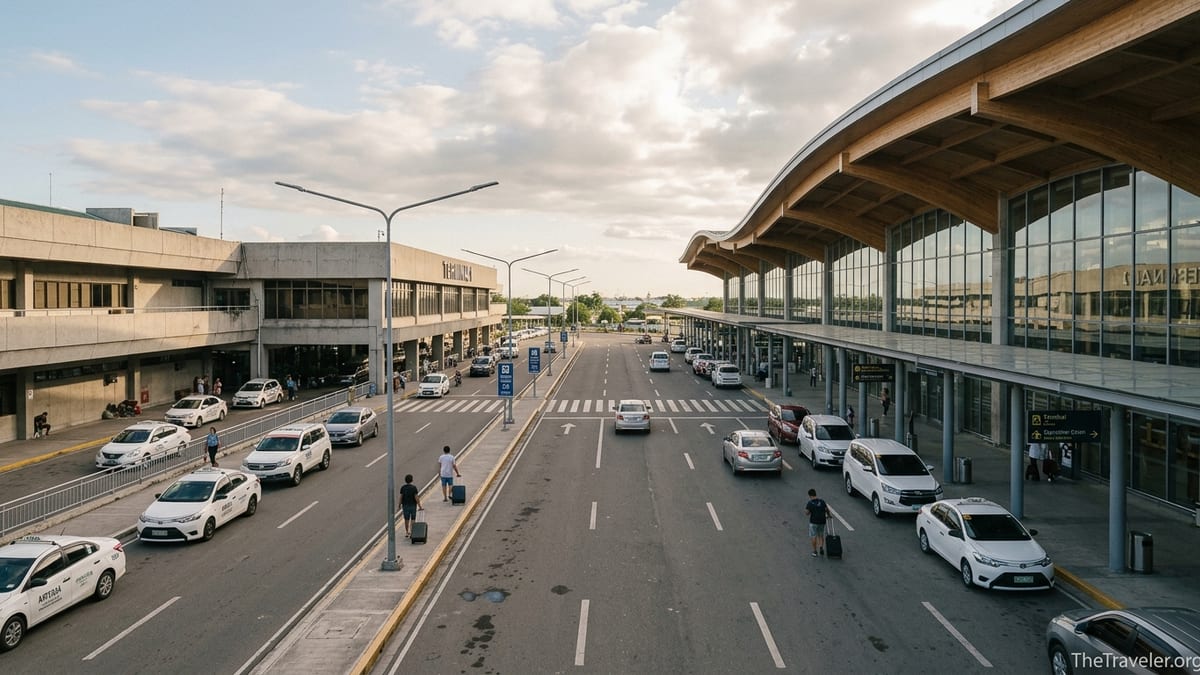
Terminal 1 vs Terminal 2 in a Nutshell
Mactan Cebu International Airport (CEB) has two passenger terminals set a short walk apart on Mactan Island in Lapu-Lapu City. As of mid 2026, the basic split is straightforward: Terminal 1 is primarily the domestic terminal, while Terminal 2 is primarily for international flights. In everyday terms, if you are flying within the Philippines you will almost always use Terminal 1, and if you are flying to or from another country you will almost always use Terminal 2.
Terminal 1 is the older building and now handles the bulk of domestic operations, especially the busy shuttle-style routes to Manila, Davao, Iloilo, Cagayan de Oro, and tourist favorites like Caticlan for Boracay and Bohol-Panglao. Recent operational changes at Mactan have deliberately concentrated domestic capacity here to simplify flows, so most travelers hopping between islands will start and end their journey at T1.
Terminal 2 is the newer, award-winning international terminal with a distinctive timber roof and a much more open, modern feel. This is where you will find check-in and boarding for long-haul and regional flights such as Philippine Airlines to Tokyo or Los Angeles (via Manila), Cebu Pacific to Seoul or Singapore, and foreign carriers like Singapore Airlines, Cathay Pacific, or Qatar Airways. It also hosts immigration, customs, and most international arrivals baggage belts.
There are occasional exceptions, especially during infrastructure work or schedule reshuffles, but these are usually temporary and clearly indicated in your booking. When in doubt, always check the terminal printed or displayed on your e-ticket or airline app right before you travel, as airlines and the airport can adjust assignments for operational reasons.
Which Terminal for My Airline and Route?
For practical purposes, think in terms of where you are flying rather than the brand alone. If your ticket shows a domestic city pair, such as Cebu to Davao, Cebu to Siargao, or Cebu to Caticlan, expect to use Terminal 1. Cebu Pacific and its turboprop arm Cebgo, for example, operate their Cebu hub domestic services from T1, including early morning waves to smaller airports like Surigao, Butuan, and Dumaguete. Philippine Airlines and PAL Express likewise route most of their Cebu-origin domestic flights through T1, whether on jet or turboprop aircraft.
If your ticket shows an international city, such as Cebu to Seoul, Hong Kong, Singapore, or Dubai, assume Terminal 2. Philippine Airlines uses T2 for its international departures and arrivals, including routes like Cebu to Tokyo or Cebu to Seoul, and international Cebu Pacific flights such as Cebu to Hong Kong or Cebu to Bangkok are also typically handled in T2. Foreign carriers serving Cebu, such as Korean Air, Cathay Pacific, or Jin Air, are based exclusively in Terminal 2, since that is where immigration, customs, and quarantine facilities are located.
One point that catches some travelers is that the same airline may use both terminals, depending on the route. A traveler flying Cebu Pacific from Manila to Cebu will arrive at Terminal 1, but the same airline’s Cebu to Hong Kong flight will depart from Terminal 2. Another example is Philippine Airlines: a morning domestic arrival from Davao will use T1, while a same-day onward international flight to Tokyo will use T2. Do not assume that sticking to one airline means staying in one terminal.
Finally, some low-cost or seasonal carriers adjust their Cebu schedules or even pause routes altogether. For instance, an airline may scale back Cebu operations and move aircraft to Manila during certain seasons. This can change which terminal they use or whether they operate from Cebu at all. It is always worth opening your booking in the airline’s official app 24 hours before departure to confirm the current terminal assignment printed against your flight number.
Arrivals: What Happens in Each Terminal
If you land at Terminal 1 on a domestic flight, your arrival process is typically quick. You disembark either by jet bridge or bus, walk through a short corridor directly into the domestic arrivals hall, and head straight to baggage claim. There is no immigration or customs for domestic arrivals, but security still screens bags as you exit to the public area. Outside the glass doors, you will find the usual line of white airport taxis, coupon taxis, and a small stand for ride-hailing pickups like Grab. For many local travelers, the routine is to walk a few minutes to the covered path near Marina Mall to catch cheaper jeepneys or buses into Cebu City.
At Terminal 2, international arrivals follow a longer, more structured path. After disembarking, passengers are funneled to immigration counters where foreign visitors receive entry stamps and Filipino citizens pass through dedicated lanes. Only after immigration do you reach the baggage reclaim area. Customs screening follows, where officers may ask you to pass luggage through X-ray machines or declare high-value goods. This is also where you will see currency exchange booths, SIM card kiosks, and car rental counters, which many first-timers use before stepping into the public arrivals zone.
Transit passengers connecting in Cebu need to be especially aware of their terminal. For example, if you land from Singapore at T2 at 1:00 a.m. and connect to a 4:30 a.m. domestic flight to Siargao at T1, you must clear immigration and customs, exit into the public arrivals area, then move across to Terminal 1 to check in again. Conversely, if you arrive on a domestic Philippine Airlines flight from Davao at T1 and connect onto a PAL flight from T2 to Tokyo on one through ticket, airline staff may sometimes tag your checked baggage through to the final destination, but you still need to transfer physically between terminals and clear exit immigration at T2.
Realistically, crowds and processing times vary by time of day and season. At the height of the dry season, roughly February to May, immigration lines in T2 can take 45 minutes or more when several regional flights land one after another. By comparison, late-evening domestic arrivals in T1 may see you landside with bags in 20 minutes or less. If your connection in Cebu involves crossing terminals, always build in enough buffer to absorb these variations.
Departures: Check in, Security, and Facilities
For domestic departures from Terminal 1, the experience is functional but straightforward. You enter the main departure doors, pass initial security screening, and head to the airline check-in counters, which are usually grouped by carrier and shared among several flights. Budget airlines often encourage online or app check-in, allowing passengers with only hand luggage to skip the counters and proceed directly to the boarding gates. After check-in, you pass through standard security screening into the main departures concourse, where you will find basic food options, coffee shops, convenience stores, and souvenir stalls selling dried mangoes and Cebu lechon in vacuum-sealed packs.
In Terminal 2, international departures feel more spacious and polished. The check-in hall is tall and airy, with clear lane markings for economy, premium, and business class. After dropping bags, you go upstairs through security and then exit immigration. Beyond this point, the airside concourse offers more varied dining, including sit-down restaurants serving Filipino specialties like sinigang and halo-halo, plus international options from fast-food chains and coffee brands familiar to North American and European travelers. There is more duty-free shopping here, with sections for liquor, cosmetics, and local products designed for gift-giving.
Boarding procedures reflect the type of operation. Early morning Cebu Pacific domestic departures at T1 to destinations like Caticlan or Iloilo are often called in quick succession, with passengers walking out to aircraft or using buses to remote stands. At T2, long-haul flights such as Philippine Airlines services to Japan or connections onward to North America board through standard gates with boarding groups and additional exit document checks. If you are used to large, multi-terminal hubs like Manila or Singapore, Cebu’s terminals will feel more compact, but gate changes and boarding announcements can still occur close to departure time, so keep an eye on the monitors.
Practical timing matters. For a straightforward domestic flight from Cebu to Manila in off-peak season, arriving 1.5 to 2 hours before departure at T1 is usually sufficient, especially if you have already checked in online. For international flights at T2, it is safer to allow 3 hours, and during peak holidays like Christmas or Holy Week, even more. These buffers give you room for security queues, immigration backlogs, and the occasional surprise, such as an airline asking to verify your return ticket or proof of onward travel.
How to Transfer Between Terminal 1 and Terminal 2
Terminal 1 and Terminal 2 are located along the same airport road and are close enough for most passengers to walk between them. A covered pedestrian walkway links the two, and many regular travelers simply follow the sidewalk signs, taking about 8 to 12 minutes at a normal pace. If you are arriving with light luggage and are comfortable walking in warm, sometimes humid conditions, this is often the fastest and simplest option, especially in the early morning before the day heats up.
For those with heavy bags, small children, or mobility issues, airport staff and information counters at both terminals can point you to designated transfer points. Over the past couple of years, the airport operator has been enhancing an initiative often branded as a dedicated transfer program, focused on making terminal changes smoother. This includes clearer wayfinding signage, more visible assistance desks, and coordination between ground staff so that through-ticketed passengers are less likely to be stranded between terminals without support. In practice, it still feels less like a metro-style airside connection and more like a guided landside walk or short ride.
Note that Mactan Cebu’s terminals are not currently connected by a large, automated airside transit system like automated trains. In most cases, transfers are landside. That means you exit the secure area of your arriving terminal, move across to the other building, and then re-clear security, and immigration if relevant, before your next flight. This is especially critical for international to domestic transfers: you must always clear immigration and customs at T2 before heading over to T1, even if your bags are tagged through. There is no shortcut that allows you to stay in a sterile international zone and magically appear at a domestic gate.
Because the distance between terminals is modest, typical transfer times for able-bodied passengers with carry-on only are around 25 to 40 minutes from aircraft door at one terminal to gate at the other, assuming minimal queues. When you factor in possible lines at immigration, longer walks from remote gates, or a stop at a check-in counter, realistic planning for a safe international to domestic connection in Cebu should be at least 2.5 to 3 hours. Domestic to domestic transfers within T1, or domestic to international within the same airline group with coordinated schedules, can sometimes be tighter, but shorter self-made connections always carry risk.
Common Wrong-Terminal Mistakes and How to Fix Them
The most frequent mistake at Cebu is simple: turning up at Terminal 2 for a domestic flight or at Terminal 1 for an international departure. This often happens when travelers rely on old blog posts or a friend’s memory from before operations were consolidated, or when they see “International Airport” in the name and assume all flights use the same building. It can also occur with passengers who flew Cebu Pacific internationally last year from T2 and now assume their Cebu to Davao domestic flight leaves from the same place.
If you realize you are at the wrong terminal and still have more than an hour and a half before departure, you usually have time to fix it by walking. For example, if you show a security officer at T2 your Cebu Pacific boarding pass to Caticlan and they tell you it is a domestic T1 departure, you can exit the building, follow the terminal transfer signs along the covered walkway, and reach the correct domestic check-in area in around 10 minutes. Even with a queue at security, most travelers make it if they move promptly and do not stop at shops along the way.
The situation becomes risky when time is tight. Travelers landing internationally at T2 with only an hour to connect to a separately booked low-cost domestic ticket at T1 are particularly vulnerable. Queue unpredictability at immigration or a minor delay in baggage delivery can eat the entire connection window before you even start walking to T1. In these cases, if you miss the check-in cut-off, the airline may treat you as a no-show, and you might need to buy a new ticket on the next available flight, which on popular routes like Cebu to Manila or Cebu to Caticlan can cost significantly more than the original fare.
Another frequent source of confusion is misreading the boarding pass. Some airline apps label the terminal with a small “T1” or “T2” code next to the airport name or even in the fine print under “Airport information.” Travelers who focus only on departure time and gate number may miss this detail. Before you leave your hotel in Cebu City or your resort on Mactan, open your booking and verify both the three-letter airport code (CEB) and the terminal code. If a printed itinerary from a travel agency lacks this information, cross-check it on the airline’s website using your booking reference.
Realistic Connection Scenarios and Planning Tips
To understand how the terminal split affects your journey, it helps to look at real-world itineraries. Consider a traveler flying from Los Angeles to Siargao with a self-planned itinerary: a long-haul flight to Manila, a domestic connection to Cebu, then another domestic hop to Siargao. If the Manila to Cebu leg arrives at T1 and the Cebu to Siargao flight also departs from T1, they never need to see T2 at all. But if they instead choose a routing that goes Los Angeles to Cebu on an international ticket that lands at T2 and then a separate low-cost ticket from Cebu to Siargao from T1, they must clear international formalities and cross terminals, increasing risk if the inbound flight is delayed.
Another common case is a holidaymaker from Singapore who has booked a Cebu Pacific return ticket Singapore to Cebu in T2, and separately booked a domestic Cebu Pacific ticket from Cebu to Boracay via Caticlan. If the schedule gives them only 90 minutes between landing and the domestic departure, they are at the mercy of immigration lines at T2 and any gate-hold delays. A safer choice would be to allow at least 3 hours or, better yet, to book a through-ticket or an itinerary where the airline takes responsibility for the connection. While such through-tickets are not always available with low-cost carriers, full-service airlines sometimes offer combined fares that cover both the international and domestic legs through Cebu.
Families with children or older relatives should plan even more conservatively. Pushing a stroller, shepherding school-age kids, or helping someone who walks slowly between terminals can easily add 10 to 15 minutes to your transfer. If you are traveling during peak holiday seasons, such as Christmas and New Year or the Sinulog Festival in January, flight schedules are busier and airport queues longer. A connection that felt easy in July might feel stressful in late December. It is often worth paying slightly more for connections with generous layover times, especially when crossing from T2 to T1 or vice versa.
Travel insurance can also be a factor. Some policies only cover missed connections if all flights are on one ticket, while others will reimburse extra costs for self-transfer connections if you can demonstrate reasonable planning. Keeping screenshots of your original schedule and any delay notifications can help if you later need to file a claim because a tight international-to-domestic connection through Cebu did not work out as hoped.
The Takeaway
The core decision at Mactan Cebu International Airport is simple: domestic flights almost always use Terminal 1, and international flights almost always use Terminal 2. The complications arise from mixed itineraries, same-airline operations in both terminals, and the need to physically move between buildings for many self-made connections. By double-checking your terminal on the airline’s app, building in realistic transfer times, and being ready to walk between terminals if you arrive at the wrong one, you can turn Cebu from a stress point into a smooth gateway to the Visayas.
Think of Terminal 1 as the busy domestic bus station of the skies, shuttling you to Manila, Davao, Boracay, and beyond, and Terminal 2 as the polished international hall where Cebu connects to the wider world. With this mental map and the real-world examples in mind, you can confidently plan arrivals, departures, and transfers, and avoid the most common pitfalls that catch out unprepared travelers.
FAQ
Q1. How do I know if I should use Terminal 1 or Terminal 2 in Cebu?
Check whether your flight is domestic or international. Domestic routes within the Philippines almost always use Terminal 1, while international flights almost always use Terminal 2. The terminal code is usually printed on your e-ticket or visible in your airline’s app.
Q2. Can the same airline use both terminals at Mactan Cebu Airport?
Yes. Airlines that operate both domestic and international flights from Cebu, such as Philippine Airlines or Cebu Pacific, typically use Terminal 1 for domestic services and Terminal 2 for international services. Always confirm the terminal by flight number rather than relying on the airline name alone.
Q3. How long does it take to walk between Terminal 1 and Terminal 2?
Most travelers can walk between terminals in about 8 to 12 minutes using the covered walkway. If you factor in navigating crowds, elevators, and finding the check-in area, allow around 20 to 30 minutes from one check-in hall to the other, especially with luggage.
Q4. Is there a shuttle between the terminals, or do I have to exit the airport?
Terminal transfers at Cebu are generally landside, meaning you exit the secure zone and move along the airport road between buildings. Walking is common, and airport staff can advise on assistance options for those with reduced mobility. There is no large automated airside train connecting T1 and T2.
Q5. I arrived for my flight at the wrong terminal. What should I do first?
Stay calm, check the time before departure, and verify your correct terminal on your boarding pass or airline app. If you have more than an hour and a half, follow the signs along the covered walkway to the correct terminal and proceed directly to security or check-in. If time is extremely tight, speak to any airline or airport staff member immediately for advice.
Q6. How much layover time do I need when connecting from an international flight to a domestic one in Cebu?
A practical minimum is about 3 hours, to allow for immigration, baggage claim, customs, walking to Terminal 1, and domestic check-in and security. During busy seasons or when traveling with children or elderly relatives, adding extra time is wise.
Q7. Do I need to clear immigration if I am just transiting through Cebu on an international connection?
If you are arriving from abroad and connecting to another international flight in Cebu, procedures depend on your ticket type and airline arrangements. In many cases, you still clear Philippine immigration at Cebu’s Terminal 2. If you are connecting to a domestic flight, you must always clear immigration and customs before heading to Terminal 1.
Q8. Are facilities better in Terminal 2 than in Terminal 1?
Terminal 2 is newer, with a more spacious design, more varied food and shopping options, and larger duty-free stores tailored to international passengers. Terminal 1 is more utilitarian but has been upgraded over time and offers cafes, snack bars, and souvenir shops suitable for short domestic waits.
Q9. If I have separate tickets, will my bags be checked through between terminals?
Usually not. When journeys are booked on separate tickets, airlines often treat them as unrelated trips, and you must collect your luggage at arrivals, carry it to the other terminal, and check in again. Through-checking is more likely on a single ticket within the same airline group, but it is never guaranteed, so always confirm at the originating check-in desk.
Q10. What is the safest strategy to avoid missing a flight due to terminal confusion in Cebu?
Three habits make the biggest difference: confirm your terminal in the airline’s app before you leave for the airport, arrive early enough to absorb delays at immigration or security, and if you are building your own connections, choose longer layovers whenever a terminal change is involved. Treat Cebu’s two terminals as separate airports within one complex, and plan accordingly.