


Moalboal has become the classic first stop for South Cebu trips, thanks to its sardine run, easy reef access, and relaxed beach town vibe. The only puzzle is how to get there efficiently after landing at Mactan Cebu International Airport. This guide breaks down the best real-world routes from the airport to Moalboal, with current options, typical prices, timing, and practical tips on luggage and jet lag so you can decide whether to go direct or overnight in the city.
Get the latest updates straight to your inbox!
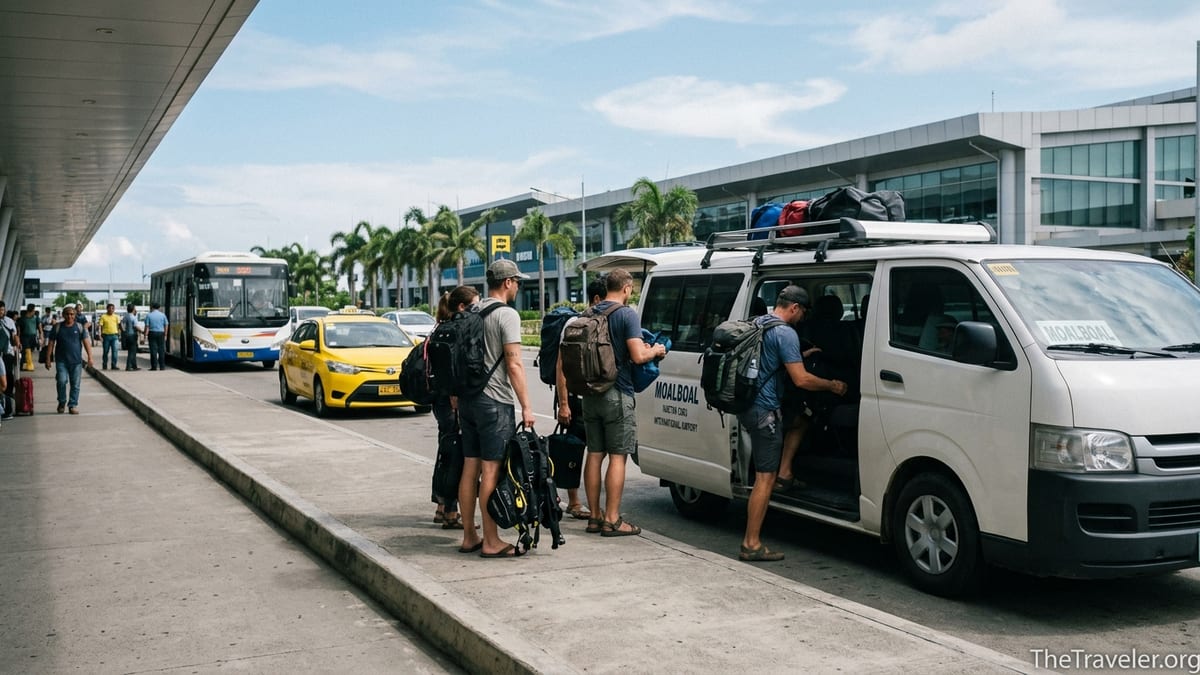
Understanding the Cebu to Moalboal Route
Moalboal sits on Cebu’s southwest coast, roughly 80 to 90 kilometers from Mactan Cebu International Airport, depending on the exact resort you choose. In real driving conditions, that distance usually translates to 2.5 to 4 hours by road, with traffic in Metro Cebu as the main variable. The route always starts by crossing from Mactan Island to Cebu City, then heading south on Natalio Bacalso Avenue toward Barili and the coastal towns of Ronda and Alcantara before reaching Moalboal.
There is no direct public bus or van from the airport to Moalboal. All public routes to the south depart from Cebu South Bus Terminal in Cebu City, not from Mactan. This means you always face a two-leg journey if you are using public transport: airport to the city, then city to Moalboal. Private transfers, on the other hand, run door to door from the airport to your resort in Moalboal and are increasingly popular with divers, families, and small groups.
The final stretch into Moalboal is also important to understand. If you travel by bus or shared van, you typically get dropped on the highway near the Moalboal town center or Gaisano Grand Moalboal. From there, it is another 10 to 20 minutes by tricycle to reach Panagsama Beach or White Beach, where most dive resorts and guesthouses are clustered. Private transfers take you directly to your chosen accommodation, which matters more if you are arriving after dark or carrying bulky bags.
For most travelers planning a South Cebu loop that includes Kawasan Falls, Oslob, or Santander, Moalboal is a strategic first base. That makes your arrival logistics even more critical. Choosing the right route from the airport can set the tone for the rest of your trip, either as a smooth, low-stress start or a long, tiring first day on the road.
Private Transfer: Fastest and Most Convenient Door-to-Door Option
A pre-booked private transfer from Mactan Cebu International Airport to Moalboal is the simplest option if you value comfort and predictability. As of mid 2026, typical one-way rates for a private van are often in the range of about 5,000 to 7,000 pesos for the vehicle, not per person, depending on group size, pickup time, and provider. Some Cebu-based dive resorts and hotels in Moalboal can arrange these transfers directly, while third-party operators and booking platforms also offer airport-to-Moalboal runs with fixed quotes.
Travel time by private car or van is usually around 3 to 3.5 hours in daytime traffic. At quieter times, such as late evening or early morning, some travelers report closer to 2.5 hours. Drivers familiar with the route often schedule a comfort stop at a roadside gas station or convenience store about halfway, where you can use restrooms and grab snacks or coffee. This predictable rhythm is especially useful if you have just come off a long-haul flight or are traveling with children or dive gear.
Private transfers are particularly high-value for certain situations. For example, a group of four divers landing from Singapore in the early afternoon with two large checked bags each and full dive kits might split a private van. The per-person cost can work out closer to that of a public route, but with major advantages: no hauling tanks and heavy bags through the bus terminal, no extra tricycle negotiation at night, and direct drop-off at a resort in Panagsama Beach. Similarly, couples arriving around 21:00 often opt for a pre-booked transfer instead of testing late-night bus schedules.
If you are considering this route, pay attention to details in the offer. Look for flight-aware pickup, where the driver tracks your actual landing time, and ask whether tolls, fuel, and parking are included in the price. Many reputable operators provide the driver’s name and plate number in advance and use modern, air-conditioned vans. For peace of mind, especially in high season from December to April, it is wise to book at least several days ahead and reconfirm a day before your flight.
Taxi or Grab to Cebu South Bus Terminal, Then Bus to Moalboal
The most common budget-friendly route combines a city transfer with a provincial bus. After clearing arrivals, you first travel from Mactan Cebu International Airport to Cebu South Bus Terminal in Cebu City, then board a southbound bus headed past Moalboal. This route is widely used by independent travelers and backpackers because it balances cost and flexibility.
From the airport to Cebu South Bus Terminal, the most straightforward option is a metered taxi or a ride-hailing car from services active in Cebu. In typical daytime traffic, this ride takes around 30 to 60 minutes, though rush hour or heavy rain can stretch it longer. Many recent travelers report taxi fares typically in the few hundred pesos range, often around 250 to 400 pesos depending on route and traffic. Some visitors choose to stop briefly at a mall like SM City Cebu on the way to withdraw cash or buy a local SIM, then continue to the bus terminal.
At Cebu South Bus Terminal, look for Ceres buses and other southbound services marked “Bato via Barili” or similar. These are the buses that pass through Moalboal on the coastal road. Schedules change, but daytime departures are generally frequent, with buses leaving throughout the day. As of 2026, an air-conditioned bus ticket from Cebu South Bus Terminal to Moalboal is typically around 90 to 120 pesos per person. Travel time varies between about 2.5 and 4 hours, depending on traffic and how many intermediate stops the bus makes along the way.
When you board, tell the conductor you are going to Moalboal and confirm where they plan to drop you. Most buses stop along the main highway near the town center or a landmark like Gaisano Grand Moalboal. From there, you will usually find tricycles waiting. Expect to pay a few dozen to around 150 to 200 pesos for a tricycle ride to Panagsama Beach or White Beach, depending on the time of day, distance, and how many people and bags you have. For example, two friends arriving midafternoon with one backpack each might pay a modest tricycle fare to Panagsama, while a group with large suitcases may agree on a slightly higher rate.
Using MyBus and City Transport Before the Southbound Bus
Some travelers prefer to avoid taxis altogether for the airport-to-city leg and instead rely on the MyBus service connecting Mactan Cebu International Airport with SM City Cebu. MyBus is a modern city bus network that runs air-conditioned buses between the airport, SM City Cebu, SM Seaside City, and other key nodes in Metro Cebu. It can be a good option for solo travelers with light luggage who are not in a rush and prefer fixed fares and predictable stops.
A typical pattern looks like this: on arrival, you walk to the MyBus stop at the airport, pay the fixed fare to SM City Cebu, and ride into the city, which can take around 45 minutes to an hour depending on traffic. At SM City Cebu, you can step into the mall to buy a local SIM, grab a quick meal, or withdraw pesos from ATMs. After that, you still need to transfer from SM City Cebu to Cebu South Bus Terminal, usually by taxi or jeepney. The taxi ride from SM City Cebu to the South Bus Terminal is shorter than the airport-to-terminal ride and often costs a few hundred pesos or less.
For budget-focused travelers, combining MyBus with a jeepney can be the cheapest way to get from the airport to the South Bus Terminal, though it adds complexity. For example, a backpacker with one carry-on and no checked luggage might take MyBus from the airport to SM City Cebu, then a city jeepney toward the South Bus Terminal for a small fare, and finally board the Ceres bus to Moalboal. The entire journey can be very affordable, but it involves multiple transfers and navigating local routes, which may not suit everyone, especially after a long flight.
When deciding whether to use MyBus or go directly by taxi or ride-hail, factor in your arrival time and energy level. Morning and midday arrivals with several hours of daylight ahead are more forgiving. Late-afternoon or evening arrivals may be better served by a simpler taxi-to-terminal route or, in some cases, a private transfer directly to Moalboal to avoid arriving very late at your resort.
Travel Time, Luggage, and Jet Lag: How to Choose the Right Option
Beyond price, the key factors in choosing your route are travel time, luggage, and how you expect to feel after landing. A typical public-transport journey from airport to Moalboal via Cebu South Bus Terminal might look like this: 45 minutes to 1 hour from the airport to the terminal, around 30 to 60 minutes waiting for the next bus and buying tickets, 3 to 4 hours on the bus, and finally 10 to 20 minutes by tricycle to your accommodation. That means total door-to-door travel time can easily reach 5 to 7 hours, especially during busy periods.
Luggage matters more than many travelers expect. If you are carrying one backpack and a small daypack, changing vehicles in Cebu City is relatively easy. You can navigate the terminal, queue for bus tickets, and hop into a tricycle at Moalboal’s junction without much hassle. If you are traveling as a couple with two large rolling suitcases and a camera bag, or as a dive group with multiple gear bags, each transfer adds physical effort and the small stress of keeping track of all your items in a busy terminal.
Jet lag and flight schedules also play a role. Imagine landing at 11:00 from a short domestic flight: you have time to clear immigration, pick up luggage, and still comfortably reach Moalboal via the public route during daylight. But if you land at 18:30 from Europe or North America, with a body clock that feels like the middle of the night, the prospect of navigating multiple transfers and arriving in Moalboal past midnight may not be appealing. In such cases, many travelers choose either a private transfer direct to Moalboal or a night in Cebu City followed by an early bus the next morning.
Ultimately, the higher upfront cost of a private transfer can be offset by what you save in time, energy, and stress. For example, a family of five arriving from Hong Kong with two young children might calculate that a private van is only modestly more expensive than multiple bus tickets plus taxis, but significantly easier on tired kids and parents. On the other hand, solo travelers on long multi-country trips often accept the slower, more complex route as a trade-off for saving several thousand pesos.
Should You Go Direct to Moalboal or Stay Overnight in Cebu City?
One of the most common questions is whether to head straight to Moalboal after landing or stay a night in Cebu City. There is no universal answer, but a few guiding scenarios can help. If you land before midafternoon, are reasonably rested, and travel light, going directly to Moalboal via taxi plus bus is usually manageable. You arrive in Moalboal by early evening, have time for dinner at Panagsama Beach, and wake up ready for snorkeling or diving the next morning.
For late arrivals, the calculus changes. Consider a traveler landing at 21:30 on an international flight. By the time they clear formalities and collect bags, it might be 22:30. A taxi to the South Bus Terminal takes at least 30 to 45 minutes even in light traffic, and late-night bus frequencies can thin out. The remaining journey to Moalboal might push arrival to the early hours of the morning. In this scenario, many recent travelers choose one of two options: overnight near the airport or in Cebu City and catch a morning bus, or pre-book a private transfer that drives directly to their Moalboal resort, even if it means arriving after midnight.
Staying overnight in Cebu City can also be a strategic choice if you plan a larger South Cebu itinerary. For example, some travelers book a hotel near Cebu’s ferry terminals because they will later head to Bohol or Negros Oriental. Others use Cebu City as a base to adjust to the time zone, explore local food, and stock up on essentials such as reef-safe sunscreen, dry bags, or spare mask straps before continuing to Moalboal. Major malls in Cebu City have pharmacies, supermarkets, and outdoor stores that can be difficult to replicate in smaller coastal towns.
On the flip side, going direct to Moalboal is often more rewarding if your primary goal is water time. Divers planning multiple days of sardine run dives and Pescador Island trips often prefer to wake up in Moalboal on their first full day in the country, even if it means a slightly longer travel day. In practical terms, you might weigh questions such as: Will I be alert enough to manage a 5 to 7 hour journey after landing? Do I have kids or older family members with me? How comfortable am I arriving in a small town late at night? Answering these honestly will point you to the right choice.
Real-World Routes for Different Types of South Cebu Trips
Because Moalboal is often part of a broader South Cebu route, it helps to match transport choices to your wider itinerary. A common example is the “Moalboal, Kawasan Falls, Oslob, back to Cebu” loop. For a couple on a one-week holiday, a practical pattern might be: arrive at Cebu airport midday, take a pre-booked private transfer directly to Moalboal, spend three nights diving and snorkeling, move on to Badian or Alegria for canyoning near Kawasan Falls, continue to Oslob for whale shark watching, then return to Cebu City by bus or private transfer the day before your flight.
Backpackers on longer trips often reverse the cost convenience equation. One realistic plan might be: land in Cebu, take MyBus to SM City Cebu, overnight at a budget guesthouse near the South Bus Terminal, then catch an early-morning Ceres bus to Moalboal. After a few days on the coast, they may continue south by bus toward Oslob, Santander, and eventually cross by ferry toward Dumaguete and Apo Island. In this scenario, spending extra on a private airport transfer feels unnecessary, while bus tickets keep the budget under control.
Families or small groups combining Cebu with other islands sometimes mix and match. A typical pattern could be: private transfer from the airport to Moalboal at the start when everyone is jet-lagged and carrying maximum luggage, then later budget-friendly buses between Moalboal, Oslob, and Cebu City once everyone has settled in and is carrying fewer supplies. This kind of hybrid approach recognizes that the first and last travel days are usually the most tiring and benefit most from smoother logistics.
Finally, serious divers often book transport through their Moalboal dive resort. Many resorts work with trusted local drivers who know the exact location of properties down narrow neighborhood roads and are used to handling dive equipment. A European dive club, for example, might arrange a package that includes airport pickup in an air-conditioned van, a planned stop at a large supermarket for snacks and bottled water on the way, and door-to-door drop-off at a resort in Panagsama. The total cost is higher than public options but folded into a larger dive package and valued for reliability.
FAQ
Q1. How long does it take to travel from Cebu Mactan Airport to Moalboal?
Typical travel time by private car or van is around 3 to 3.5 hours, sometimes closer to 2.5 hours in light traffic. Using taxi plus bus via Cebu South Bus Terminal usually takes 5 to 7 hours door to door, including waiting and the final tricycle ride to your accommodation.
Q2. How much does a private transfer from the airport to Moalboal cost?
As of 2026, many operators quote around 5,000 to 7,000 pesos one way for a private van from Mactan Cebu International Airport to Moalboal, depending on group size, pickup time, and inclusions. The price is typically for the vehicle, not per person.
Q3. What is the cheapest way to get from Cebu Mactan Airport to Moalboal?
The cheapest realistic route usually combines public transport options: MyBus or a jeepney or taxi from the airport to Cebu South Bus Terminal, then an air-conditioned Ceres bus toward Bato via Barili that passes Moalboal, followed by a tricycle to your beach area. This approach keeps transport costs low but requires multiple transfers and more time.
Q4. Do buses from Cebu City go directly into Moalboal town or the beaches?
Provincial buses generally stay on the main highway and do not drive into Panagsama Beach or White Beach. They usually drop passengers along the Moalboal highway near the town center or a landmark like Gaisano Grand Moalboal. From there you take a tricycle, which typically takes 10 to 20 minutes to reach most resorts.
Q5. Is it safe to arrive in Moalboal late at night?
Many travelers arrive in Moalboal after dark, especially when using private transfers, and report it as manageable. The town is small and used to tourism. However, late-night tricycle availability can be more limited, and navigating unfamiliar side roads is harder in the dark. If your flight lands late, pre-booking a private transfer that drops you at your exact accommodation is often the most comfortable option.
Q6. Can I take Grab or a ride-hailing car directly from the airport to Moalboal?
Ride-hailing services are widely used between the airport and Cebu City but are not always available or permitted for long provincial routes like Cebu to Moalboal. Even when a driver agrees, prices can be unpredictable. Most travelers use ride-hailing only for the airport-to-city leg and switch to buses or pre-booked private transfers for the longer provincial journey.
Q7. How much should I expect to pay for the bus from Cebu South Bus Terminal to Moalboal?
Recent reports suggest that an air-conditioned bus from Cebu South Bus Terminal to Moalboal typically costs around 90 to 120 pesos per person. Fares can change over time, so it is wise to bring small bills and confirm the exact price at the ticket counter before boarding.
Q8. Should I go directly to Moalboal after landing or stay one night in Cebu City?
If you land by late morning or early afternoon, feel reasonably rested, and travel light, going directly to Moalboal is often practical and lets you wake up by the sea. For late-night or very early-morning arrivals, or if you are exhausted from a long-haul flight, spending a night in Cebu City and taking an early bus or private transfer the next day usually makes for a more relaxed start.
Q9. Is there space for large suitcases or dive gear on the bus to Moalboal?
Most southbound buses have luggage space either above the seats or at the front or back of the bus. Travelers commonly bring large backpacks and suitcases on this route. However, if you have multiple big bags or bulky dive equipment, moving them through a busy bus terminal and onto crowded buses can be tiring, which is why some divers opt for private transfers instead.
Q10. Do I need to book bus tickets from Cebu City to Moalboal in advance?
For standard provincial buses from Cebu South Bus Terminal to Moalboal, travelers typically buy tickets on the day of travel at the terminal rather than booking far in advance. Buses run frequently during daylight hours. In peak seasons such as holidays and long weekends, it is wise to go to the terminal earlier, allow extra time for queues, and be flexible about which departure you board.