

More news on this day
China is accelerating a new phase of tourism development in its remote interior, using record-breaking bridges, high-speed railways and even tourist maglev lines to pull adventure-seeking and luxury-minded travelers deep into provinces that were once days away from the global tourist trail.
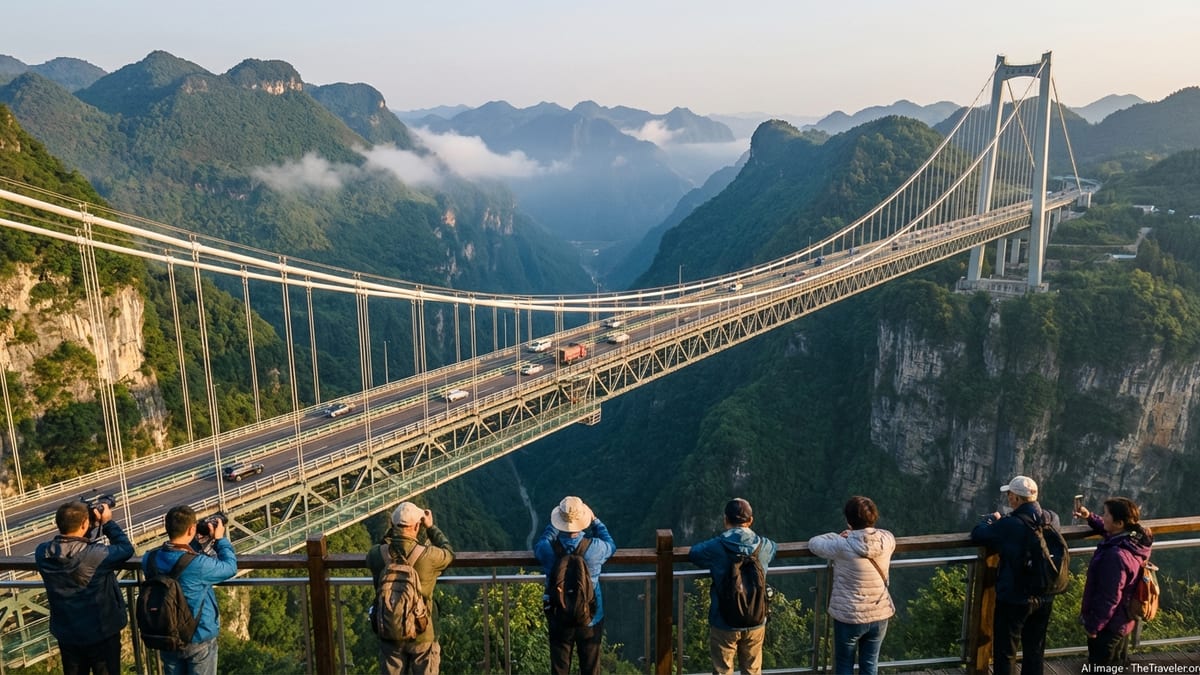
World’s Highest Bridge Turns Guizhou’s Canyons Into a Sky Gallery
In the rugged mountains of southwest China, Guizhou province has become the country’s most striking showcase of “bridge-tourism integration,” a policy that treats transport infrastructure as a destination in its own right. The newly opened Huajiang Grand Canyon Bridge, recognized as the world’s highest, soars roughly 625 meters above the Beipan River, reducing a once two-hour mountain drive to a two-minute crossing and recasting a once-isolated canyon as a magnet for international thrill-seekers and engineers alike.
The suspension bridge, which opened to traffic in late September 2025, is engineered as much for spectacle as for efficiency. Below the highway deck runs a glass skywalk that lets visitors peer straight into the gorge, while a glass elevator carries guests to a panoramic cafe perched on a tower more than 800 meters above the valley floor. Operators are rolling out bungee jumps, slacklines and other extreme-sport experiences designed to attract global adventure travelers who previously bypassed Guizhou’s interior.
Provincial tourism planners say bridges are becoming economic lifelines. Guizhou now counts tens of thousands of bridges, including a large share of the world’s tallest, with scenic routes that link terraced villages, karst peaks and waterfall clusters. Homestays, boutique cliffside lodges and farm-based experiences have sprung up under viaducts and suspension spans, giving international visitors the chance to combine canyon-spanning tech tours with rural stays, hiking and rafting.
For local communities that once depended on subsistence farming, the shift is tangible. Villages flanking new crossings report rising incomes as bridge-view rooms, canyon ziplines and nighttime light shows draw crowds from China’s coastal megacities and, increasingly, overseas markets lured by images of glass decks seemingly suspended in the clouds.
High-Speed Rail Brings Borderlands and Inland Cities Onto Travel Maps
Bridges are only one part of the push. Across China’s vast interior, a new wave of high-speed rail links is repositioning lesser-known cities as fast, comfortable side trips from established gateways such as Beijing, Shanghai and Guangzhou. Recent openings focus on corridors that were historically slow to reach, unlocking landscapes of rice terraces, river gorges and minority cultures for short-stay itineraries.
In Guangxi Zhuang autonomous region, the completion of the Nanning–Pingxiang high-speed railway in December 2025 stitched the regional capital directly to a key border city across 81 kilometers of new track. Designed for speeds of up to 250 kilometers per hour, the line cuts total journey times and has already inspired travel agencies to market weekend cross-border tours to and from Vietnam, turning what used to be an overnight haul into a viable two- or three-day adventure.
Farther north, the Rizhao–Lankao high-speed railway, fully opened in mid-2024, now sweeps passengers from the Shandong coast through Linyi, Jining and Heze to the plains of Henan in just over two hours. While originally conceived to reinforce an inland logistics corridor tied to the busy port of Rizhao, the line is rapidly being packaged as a scenic route in its own right, linking beaches, ancient canal towns and Yellow River culture in a single, multi-stop rail journey for domestic and foreign visitors.
In Hubei province, the Wuhan–Yichang high-speed railway, inaugurated in December 2025, runs at up to 350 kilometers per hour toward the gorges of the upper Yangtze. The route positions the industrial metropolis of Wuhan as a rail gateway to river cruise embarkation points and national parks around Yichang, shrinking transfer times and allowing travelers to swap city skylines for misty canyon cliffs in a single morning.
Maglev Tourism Lines and Airport Connectors Reframe the Journey
China’s push to blend engineering and tourism is also evident in the way travelers now arrive at major hubs. In and around Beijing, the first phase of the Huairou–Daxing Airport intercity railway opened at the end of 2024, providing a 200 kilometer per hour link between the capital’s new southern airport and neighboring Hebei province. When fully completed, it will form a high-speed arc between airports and outlying districts that officials see as a future tourism loop for visiting ski slopes, reservoirs and sections of the Great Wall without navigating city traffic.
In Guangdong province, better known internationally for its factory belts and Pearl River Delta skylines, a short but symbolic maglev line is recasting an inland city as a leisure hub. The Qingyuan Maglev Tourist Line, which began passenger service in January 2025, carries magnetically levitated trains between an intercity rail station and a sprawling resort and theme-park complex at speeds of up to 120 kilometers per hour. Elevated above the Bei River plain, the gliding cars give visitors sweeping views of hot spring districts, karst hills and river rafting stretches as part of the attraction.
Local authorities have branded the maglev as a gateway experience rather than a simple shuttle. Timed connections from Guangzhou mean travelers can leave downtown in the morning, ride a conventional train north, transfer directly to the maglev and arrive at hotel check-in counters before midday. Day passes and family discounts aim to encourage repeat visits, while nearby cave systems and rural guesthouses are being folded into package tours that emphasize the novelty of arriving at a mountain resort by futuristic train.
Industry analysts say such projects reflect a broader strategy: making the transport segment of a trip part of the story. By turning airport connectors, borderland lines and even short resort shuttles into highly designed experiences, planners hope to persuade time-pressed international travelers that China’s inland regions are not just accessible, but effortlessly so.
Adventure, Luxury and Local Life Converge Around New Corridors
The most ambitious of these mega projects aim to satisfy several travel niches at once, blending high-adrenaline experiences, high-end amenities and close contact with local culture. In Guizhou, suspended viewing decks and glass elevators are paired with boutique lodges, hot spring retreats and curated village visits, allowing visitors to follow a day of bungee jumps or cliff walks with chef-led dinners showcasing regional dishes and spirits.
Along new high-speed rail lines, cities and counties are racing to position stations as front doors to curated “one-ticket” experiences that combine scenic park access, heritage sites and homestay networks. In places like rural Shandong and inland Guangxi, local governments are promoting farm experiences, handicraft workshops and food streets immediately around new stations, so that travelers stepping off bullet trains can move directly into walkable neighborhoods instead of faceless transfer hubs.
For international visitors, the convergence of infrastructure and experience means itineraries that once required chartered buses and long highway days can now be built around fast, frequent rail services and engineered viewpoints. A two-week trip might now loop from Beijing to the canyons of Guizhou, onward to border towns in Guangxi and back to coastal cities, with each leg showcasing a different blend of engineering innovation and landscape.
At the same time, officials acknowledge that the challenge is to ensure that mega projects serve communities as much as they impress visitors. Many of the newest bridges, rail lines and maglev routes are accompanied by programs to train local guides, support small guesthouse owners and encourage young residents to stay and build tourism careers in their hometowns. For travelers watching China’s interior come into view from glass walkways and bullet train windows, the transformation is as social as it is structural.