


More news on this day
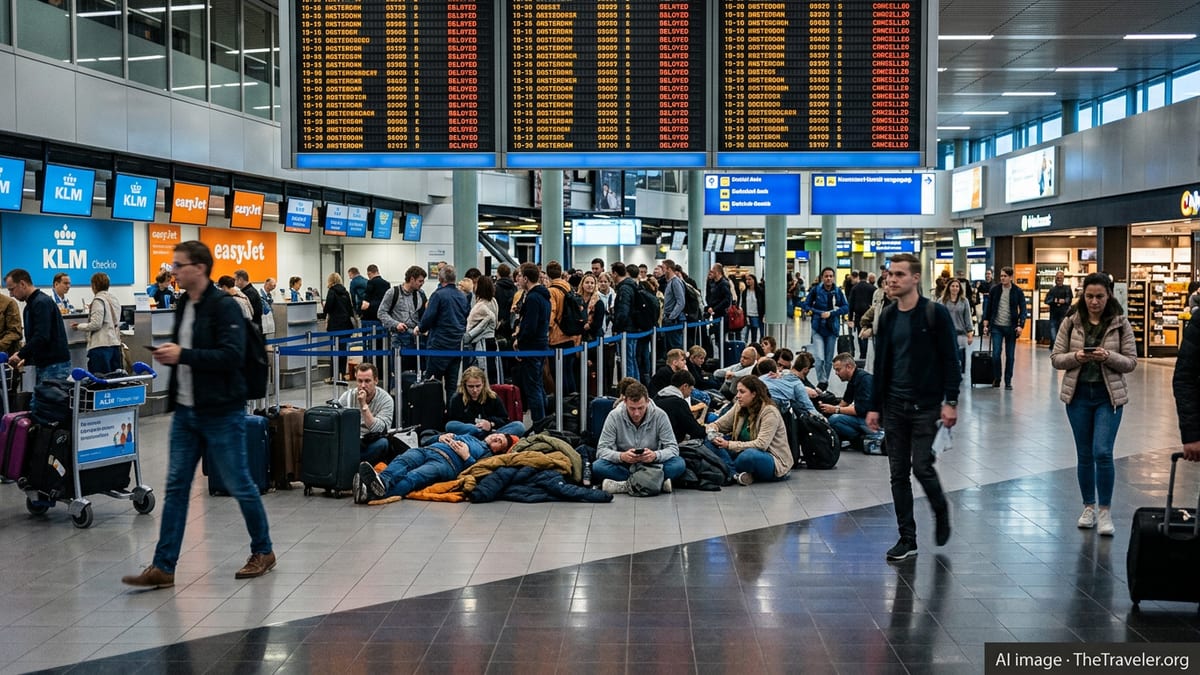
Hundreds of travelers across Europe are facing long queues, missed connections and overnight stays in terminals after widespread flight disruption led to 466 delays and 102 cancellations across several countries, heavily affecting services in Germany, the Netherlands and Belgium and disrupting operations for airlines including Lufthansa, British Airways and easyJet.
Get the latest news straight to your inbox!
Major Hubs in Germany and the Netherlands Under Strain
Publicly available flight-tracking data and regional aviation coverage indicate that the worst disruptions have centered on large hub airports in Germany and the Netherlands, including Munich and Amsterdam. These airports play a critical role in European and transatlantic connectivity, meaning that local problems have quickly rippled out to itineraries across the continent.
Munich, one of Lufthansa’s primary bases, has seen a cluster of cancellations and extended delays on short-haul routes within Europe, as well as knock-on effects for long-haul operations. Data for recent days show multiple Lufthansa services from Munich to secondary European cities either cancelled outright or departing significantly behind schedule, creating difficulties for passengers with onward connections.
Amsterdam Schiphol has also been under pressure, with recent reports describing repeated episodes of congestion, weather-related disruption and staffing challenges that have triggered hundreds of delays and a notable number of cancellations across different days this winter. Low-cost and network carriers alike, including easyJet and British Airways on key city pairs, have been listed among the affected operators.
Because Amsterdam and Munich both act as major transfer points, even a single cancellation can leave passengers bound for destinations in Eastern Europe, the Nordic countries or North America scrambling to rebook, with spare seats limited on alternative departures during busy travel periods.
Lufthansa, British Airways and easyJet Among Airlines Hit Hardest
According to aggregated disruption data and recent analytical reports on European flight performance, Lufthansa, British Airways and easyJet are among the airlines most exposed to the current wave of delays and cancellations. Their extensive networks in Germany, the Netherlands and neighboring countries mean they operate a large share of flights at the most affected hubs.
Lufthansa’s reliance on Munich and other German airports for connecting traffic has amplified the impact. When a feeder flight from a regional airport to Munich is delayed or cancelled, passengers can miss onward long-haul services, resulting in stranded travelers who must be re-accommodated on later flights or rerouted through alternative hubs. Recent traveler accounts circulating publicly describe last-minute cancellations on intra-European segments and difficulties securing timely rebooking due to limited seat availability.
British Airways and easyJet, both significant operators on routes linking the United Kingdom with continental Europe, have also seen schedules disrupted at airports in the Netherlands, Germany and Belgium. Public flight-status summaries from earlier disruption days this season show that these carriers have previously experienced large numbers of delayed departures on popular city links, particularly when weather or congestion reduced runway capacity at major hubs.
Other European airlines, including KLM and Air France, have reported disruptions during recent operationally challenging days as well, highlighting how tightly interconnected schedules across the region can be when conditions deteriorate at even a handful of airports.
Weather, Staffing and Air Traffic Control Pressures Combine
Recent European aviation coverage points to a mix of factors behind the spike in delays and cancellations. Periods of challenging winter weather, including snow, strong winds and low visibility, have reduced runway capacity and forced airlines to trim or reschedule flights at short notice. When de-icing operations are required, turnaround times lengthen, further constraining the number of movements an airport can safely handle.
At the same time, continued staffing pressures in ground handling, security screening and air traffic control have been highlighted as a vulnerability in several European markets. When traffic surges toward peak levels, even a modest shortfall in available personnel can trigger long queues, slower boarding and increased likelihood that flights miss their assigned departure slots.
Air traffic control flow restrictions, particularly in busy airspace over core European countries, can also cascade into airport-level delays. If departures are held on the ground due to congestion further along the route, aircraft and crews may arrive late for subsequent rotations, compounding disruption throughout the day. Analysts note that recovery from such events is often slow, especially when aircraft are scheduled tightly.
These structural pressures have been evident throughout the 2025 to 2026 winter season, with several previous days already marked by high numbers of delayed flights across multiple European countries. The latest tally of 466 delayed and 102 cancelled services appears consistent with this broader pattern of recurrent strain on the aviation system.
Impact on Travelers Across Europe and Beyond
The immediate impact for passengers has been hours spent in check-in lines and at departure gates, along with missed connections and unexpected overnight stays. Travelers on multi-leg itineraries involving Munich, Amsterdam or other affected hubs in Germany, the Netherlands and Belgium are particularly vulnerable, as a single disruption on an early segment can unravel an entire trip.
Public guidance from passenger-rights organizations and consumer platforms emphasizes that even when flights are not cancelled, long delays can cause significant hardship. Families traveling with children, older passengers and those connecting to long-haul services to North America, Africa or Asia may find that alternative options are limited once a disruption day is already under way.
Reports from recent weeks also suggest that communication challenges can worsen the experience. Some travelers have described learning of cancellations late in the process or only by checking flight-status tools themselves, after not receiving timely notifications. Others have reported difficulty reaching customer-service channels during peak disruption periods, when call centers, messaging apps and airport service desks all face heavy demand.
With many flights fully booked in the current travel environment, passengers whose services are cancelled may find that same-day rebooking is not always possible, leading to extended trips and additional out-of-pocket costs for accommodation, meals and alternative transport.
What Passengers Can Do During Widespread Disruption
Consumer advocates and travel-industry commentators consistently advise passengers to monitor flight status closely on disruption-prone days, using official airline channels and airport information displays in addition to third-party tracking tools. Checking in early and allowing extra time at the airport can reduce the risk of missing an unexpectedly rescheduled departure.
Travel experts also highlight the importance of understanding air-passenger rights under European regulations. In many situations, travelers may be entitled to care, re-routing and, in some cases, monetary compensation when flights are significantly delayed or cancelled for reasons within an airline’s control. Even when compensation does not apply, carriers are generally expected to provide clear information about options and assist passengers in reaching their final destinations.
For those planning trips in the coming days, observers recommend building flexibility into itineraries whenever possible, such as avoiding very tight connection times and considering earlier departures on critical travel days. Travelers connecting through major hubs like Munich and Amsterdam may wish to pay particular attention to operational updates, given their central role in the current wave of delays and cancellations.
With 466 delayed and 102 cancelled flights already recorded across several European countries, the ongoing disruption serves as a reminder of how quickly the continent’s tightly scheduled aviation network can seize up, and how important preparation, awareness and clear information are for anyone preparing to travel.