


More news on this day
Rail travel through India’s busy Ghaziabad–New Delhi corridor was severely disrupted after several wagons of a coal-laden goods train derailed in Uttar Pradesh, affecting 53 train services on one of North India’s most important routes.
Get the latest news straight to your inbox!
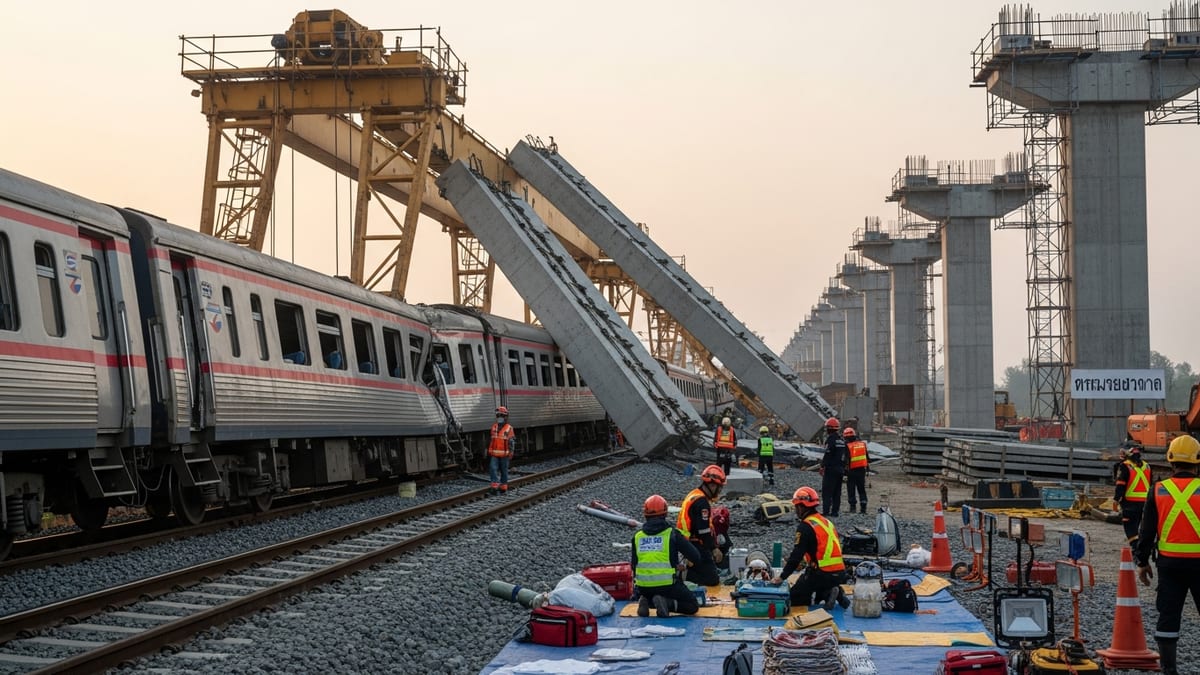
Coal wagons off the tracks on Ghaziabad–New Delhi section
According to published coverage from Indian media and railway updates, six loaded wagons of a coal freight train derailed in the early hours on the Ghaziabad–New Delhi section of the Delhi–Kanpur main line. The incident occurred near Sahibabad, a major choke point for trains running between Uttar Pradesh and the national capital region.
Reports indicate that the wagons left the tracks while the train was traversing a key approach into the New Delhi area, blocking movement on at least one of the main lines. The train was carrying coal, an essential commodity for power plants, adding a freight dimension to an already significant passenger traffic disruption.
Initial coverage notes that there were no injuries reported among staff at the site. However, the positioning of the derailed wagons forced rail managers to halt, divert, or regulate a wide range of long distance and suburban services that rely on this corridor through western Uttar Pradesh.
Railway teams and track machines were deployed to the location to begin clearance and restoration work, but the timing and location of the derailment meant that the morning and daytime schedules for multiple passenger trains were immediately affected.
Fifty three trains cancelled, diverted or partially curtailed
Publicly available information from Northern Railway advisories and news reports shows that a total of 53 trains were impacted by the derailment on the Ghaziabad–New Delhi section. The disruption extended across several categories of services serving both daily commuters and long distance travelers.
Out of the 53 affected trains, reports specify that 24 services were diverted via alternate routes, including the parallel Delhi–New Delhi alignment, to avoid the blocked line near Ghaziabad. Sixteen passenger trains were fully cancelled, primarily those scheduled to pass through the affected stretch during the intensive early morning and forenoon period.
An additional group of trains was partially cancelled, starting or terminating short of their usual endpoints to keep them away from the congestion zone. Several other services headed to or from Anand Vihar and other terminals in the Delhi region were regulated, running behind schedule until traffic could be threaded through the available lines.
The pattern of cancellations and diversions underlines the strategic importance of this corridor, which handles heavy flows between Delhi, Uttar Pradesh and further east. Trains connecting the capital with cities across the Gangetic plain rely on the Ghaziabad gateway, magnifying the effect of any incident on this stretch.
Knock on impact on passengers and travel plans
With dozens of services abruptly altered, travelers across northern India faced extended journeys, missed connections and last minute changes to itineraries. Trains rerouted over longer alignments added extra travel time, while those starting short or cancelled forced passengers to scramble for alternatives at intermediate stations.
Reports from the New Delhi, Ghaziabad and Anand Vihar terminals described long queues at enquiry counters as travelers sought clarity on revised departure times, platform changes and refund options. Many passengers heading toward eastern Uttar Pradesh and Bihar encountered delays as their trains were held back or sent via slower diversionary routes.
The disruption also affected commuters who use local and intercity services between Ghaziabad, the satellite towns of the National Capital Region and central Delhi. Morning office travel windows coincided with the initial response to the derailment, adding to congestion on stations and suburban routes.
Travel and rail enthusiast forums noted that some trains were held at nearby stations for extended periods while dispatchers sequenced traffic around the block. Passengers reported unscheduled halts outside Ghaziabad and on the approaches to New Delhi as the network adjusted in real time to the loss of capacity.
Restoration efforts and focus on safety
Published coverage indicates that railway maintenance teams moved quickly to the site with cranes and track machines to rerail or clear the coal wagons and inspect the permanent way. Restoration priorities centered on reopening at least one line to resume limited operations, followed by full removal of damaged rolling stock and track rectification.
Standard post incident procedures, including checks of rail fastenings, sleepers and signaling equipment, were expected to follow before traffic volumes could be brought back to normal levels. The derailment has renewed discussion about the stress on high density corridors in Uttar Pradesh, where mixed passenger and heavy freight operations run at close headways.
Observers note that coal trains are a vital component of the national freight network, supplying power stations across northern India. Incidents involving such services can have a dual impact: immediate disruption for rail passengers and potential delays in fuel deliveries if loaded rakes are damaged or detained for investigation.
While early reports emphasize that there were no casualties, the event adds to a broader safety conversation around infrastructure upgrades, track renewal and the scheduling of heavy goods trains on already saturated approach lines into major urban centers such as Delhi and Ghaziabad.
Key corridor in Uttar Pradesh under scrutiny
The Ghaziabad–New Delhi route is one of the most intensively used rail sections in northern India, connecting a dense cluster of cities in western Uttar Pradesh with the capital region. Express and superfast trains from states as far as Bihar and Uttar Pradesh’s eastern districts funnel through this chokepoint alongside local and suburban services.
In recent years, infrastructure projects, including additional lines and signaling upgrades, have sought to create more capacity on this stretch. Even so, incidents such as the latest coal train derailment show how a single blockage can ripple across the timetable for an entire day and beyond.
For travelers, the derailment serves as a reminder of the vulnerability of peak season and business hour journeys to infrastructure incidents on key corridors. Travel planners and tourism operators relying on dependable rail connections into and out of Delhi may face short term challenges rebooking guests and adjusting itineraries while the network resets.
As track restoration progresses and services are gradually normalized, attention is likely to remain on how quickly normal patterns are restored and what additional measures might reduce the impact of any future disruptions on this critical Uttar Pradesh link.