


Copenhagen Airport (CPH) is Scandinavia’s largest hub and, at busy times, it can feel like a maze of check-in desks, security lanes and long walks to distant gates. With some planning, though, it is one of Europe’s easier airports to depart from. This guide walks you step by step through a real departure: when to arrive, how check-in and security work, where passport control sits, how the terminals are laid out, and how to make the most of shops, food and lounges before you board.
Get the latest updates straight to your inbox!
When to Arrive and How Departures Work at CPH
Copenhagen Airport operates a single connected terminal building with several piers, but your departure experience will feel very different depending on where you are flying. The airport and local travel tools generally suggest arriving about 2 hours before a Schengen departure, such as flights to Spain or Germany, and about 3 hours before a non‑Schengen departure, such as flights to the United Kingdom or the United States. These are broad guidelines rather than strict rules, but they are a good baseline, especially during peak times like early weekday mornings and Sunday afternoons.
For a concrete example, if you are flying on a 10:00 flight to Paris, arriving at the airport around 08:00 usually gives enough time to check in, clear security, browse duty free and walk to an A or B gate at a comfortable pace. For a 10:00 flight to New York, plan to be at the check‑in area by around 07:00, as you will have both security and non‑Schengen passport control, and your gate will probably be in the farther C, D or F areas.
Security at Copenhagen typically opens early in the morning, around 04:00, to handle the first wave of departures. For some of the very first flights, though, passengers who follow the “three hours early” rule can find themselves simply waiting in the check‑in hall because bag drop and security are not fully open yet. If you have a 05:45 departure to London, arriving around 03:45 rather than 02:30 usually still leaves ample time while avoiding an unnecessary hour standing around in a quiet terminal.
Because waiting times vary by time of day and season, many regular travelers use live wait‑time tools dedicated to Copenhagen Airport. These services let you look up your specific flight and get an arrival recommendation tailored to the actual queue length forecast rather than relying only on generic advice. Checking one of these tools the evening before, or on the way to the airport, can help you decide whether arriving 2, 2.5 or 3 hours early makes the most sense for your departure.
Terminal Layout: Finding Your Way from Train Station to Gate
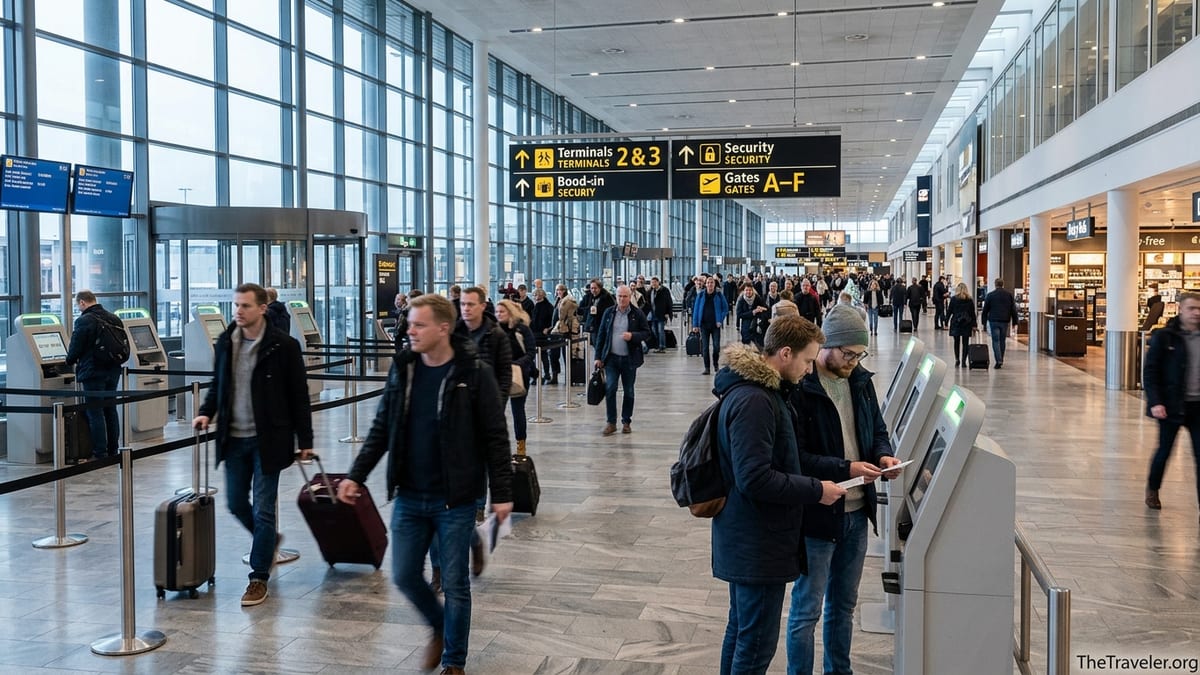
Although signs refer to Terminals 2 and 3, Copenhagen Airport functions as one continuous “under one roof” building. All airlines check in from the same large landside hall, and everyone passes through the same main security area between Terminals 2 and 3 before walking out into a long, shared airside concourse that feeds the A, B, C, D, E and F gate areas. This means that if you are connecting between airlines, you usually do not need to change terminals in the way you might at Paris Charles de Gaulle or London Heathrow.
Most international visitors arrive at the airport by train or metro. The mainline railway station is beneath Terminal 3, reached via escalators from the arrivals and check‑in hall, while the metro station (Lufthavnen) sits right outside the same terminal. If you step off a train from Copenhagen Central, walk straight up into Terminal 3 and you will find the SAS and Star Alliance check‑in islands almost directly ahead and to the left, and a short indoor walk brings you to the Terminal 2 side where many low‑cost and leisure carriers check in.
After check‑in and bag drop, you walk toward the central security zone, which serves all departing passengers. Once through security, you emerge into the main duty free store. From here, turning left generally takes you toward A and B gates (largely Schengen flights within Europe), while continuing straight and then following signs for C, D, E or F leads you toward the border between Schengen and non‑Schengen. Passport control for non‑Schengen departures is positioned here, rather than at each gate, so it becomes an important decision point in your journey to the aircraft.
The distances within CPH are manageable but can be longer than new visitors expect. A walk from the central security exit to some of the farther C and F gates can easily take 15 to 20 minutes at a normal pace, especially if the concourse is busy. If you are traveling with children, heavy hand luggage or limited mobility, it is wise not to leave your gate transfer until the last moment. As a rule of thumb, aim to leave the central shopping area 30 to 35 minutes before boarding time if your boarding pass shows a high‑numbered C or F gate.
Check-In, Bag Drop and Airline Examples
Check‑in at Copenhagen Airport is split mainly between Terminals 2 and 3, but because they sit side by side in the same building you can easily walk between them in a few minutes. Scandinavian Airlines (SAS) and many Star Alliance partners, such as Lufthansa and Swiss, use large zones in Terminal 3 with self‑service check‑in kiosks and automated bag drops. Low‑cost carriers and leisure airlines, including Norwegian, Ryanair’s partner operators and charter airlines, tend to occupy counters in Terminal 2. Overhead screens show airline and destination lists clearly, so even if you are unsure which side you need, you can scan for your flight quickly.
In practice, a traveler flying SAS to Oslo might start at a bank of self‑service machines in Terminal 3, scan their passport, print a bag tag and send a suitcase through an automated bag drop, often within 10 minutes in off‑peak hours. By contrast, a family on a popular summer charter flight to the Greek Islands may face a traditional staffed check‑in queue in Terminal 2. In school holidays, these leisure queues can stretch across the hall, so arriving closer to three hours before departure makes a big difference to stress levels.
Most major airlines open check‑in and bag drop about 2 to 3 hours before departure, sometimes earlier on long‑haul routes. For example, a morning flight to Chicago or Toronto on a partner airline might open bag drop shortly after 06:00, even if boarding does not begin until after 08:30. Online check‑in is widely available, and using your airline’s app to obtain a mobile boarding pass can save valuable time if you are traveling with cabin baggage only. At Copenhagen, there are dedicated fast bag‑drop lanes for passengers who have already checked in online with several carriers, including SAS and some oneworld and SkyTeam airlines, allowing you to bypass the main queues.
Self‑tagging of baggage is common at CPH. If you are not used to it, staff are usually on hand to guide you through printing and attaching tags correctly. Be sure to confirm that any baggage you are checking is labeled through to your final destination, especially if you are connecting to a non‑Schengen flight in another hub. Once your bags are dropped, you can proceed directly toward security, even if there is still a long time before boarding.
Security and Passport Control: What to Expect
The central security area at Copenhagen Airport is directly between Terminals 2 and 3 and serves all passengers. Queues fluctuate with the daily pattern of departures: they are usually longest between around 06:00 and 10:00, and again in late afternoon when business travelers head home and holiday flights depart. Live screens in the check‑in hall show approximate waiting times, and frequent flyers note that an average mid‑day wait outside peak summer can be around 10 to 20 minutes, while early‑morning peaks can be significantly longer.
Copenhagen has been gradually modernizing its security lanes, and many travelers now report a smoother experience with larger trays and more space to organize belongings. At the time of writing, liquids and laptops generally still need to be removed from hand luggage unless a specific lane signage indicates otherwise, so it is safest to pack with the traditional rules in mind: liquids in containers of 100 milliliters or less, all fitting in a single transparent resealable bag of about 1 liter, plus separate bins for laptops and tablets. Fast track security lanes are available for some premium tickets and elite frequent flyers, notably for SAS and several partner airlines, which can significantly reduce wait times in busy periods.
Passport control is only required when you cross the Schengen border. For flights within the Schengen Area, such as to Stockholm, Rome or Lisbon, you go straight from security to your gate with no passport check beyond occasional random spot controls. For flights outside Schengen, including destinations in the United Kingdom, United States and much of the Middle East and Asia, you must pass through a dedicated border control point downstream of security. This is where your passport is scanned and, depending on your nationality, where automated e‑gates may be available.
A typical non‑Schengen experience might look like this: a traveler on a midday flight to London clears security at 10:30 for a 12:05 departure. They spend 15 minutes in duty free and grab a coffee, then follow signs for C gates and reach the passport control area around 11:00. At quiet times, border control may take only five minutes, but in the busy summer late morning wave, queues here can also form. After passport control, the passenger walks another 10 to 15 minutes down the non‑Schengen concourse to reach a gate in the mid‑C range, arriving just as boarding for families and priority passengers is announced.
Food, Shopping and Useful Services Before Departure
Copenhagen Airport’s central airside spine is dense with food outlets and shops, especially in the section immediately beyond security. While exact line‑ups change over time, travelers can expect a mix of international chains and Scandinavian brands. You will typically walk first through a large duty free store selling cosmetics, spirits and confectionery, where common purchases include Danish gin, local aquavit and tins of butter cookies. Beyond this, you encounter fashion and design shops, including brands such as Georg Jensen and Lego, alongside newsstands and travel accessory outlets.
On the food side, there is a spectrum from quick‑service bakeries and coffee bars to sit‑down restaurants. A traveler catching an early flight might stop at a Danish bakery counter for a cinnamon swirl and a filter coffee, paying roughly the equivalent of 50 to 70 kroner, while someone with a longer layover before an afternoon long‑haul flight may choose a brasserie‑style restaurant for an open‑faced smørrebrød and a draft beer, which could easily come to 150 to 200 kroner or more. International chains offer grab‑and‑go salads and sandwiches for around 70 to 120 kroner, useful if you prefer to eat at your gate.
In addition to food and retail, Copenhagen Airport has a range of small services that can make a wait more comfortable. After security you will find scattered charging points, children’s play zones in some areas, and dozens of massage chairs that can be activated for a fee, often paid by card directly at the chair. Before security, smoking is only allowed outdoors in designated zones between the doors of Terminals 2 and 3, while after security, indoor smoking cabins are positioned in selected pier areas. Free Wi‑Fi is available throughout the terminals, and signage is consistently in both Danish and English, which helps first‑time visitors orient themselves.
If you are traveling with special needs or limited mobility, it is important to request assistance through your airline in advance. At the airport, designated meeting points in the check‑in hall and near security are staffed to coordinate wheelchair or buggy assistance through security and to the gate. Families with small children may want to allow extra time to take advantage of family‑friendly restrooms and play areas near the A and B piers, both of which are more compact and easier to navigate than the deeper non‑Schengen sections.
Lounges at Copenhagen Airport: Who Can Use What
Copenhagen Airport offers a mix of airline‑operated and independent lounges on both the Schengen and non‑Schengen sides. Access rules vary by ticket type, frequent flyer status and lounge program, so it is worth checking the specifics of your airline and any membership cards you hold before traveling. Many travelers associate CPH primarily with SAS lounges, but there are also several third‑party options that can be accessed with passes such as Priority Pass or against payment at the door.
On the Schengen side, one of the best‑known facilities is the SAS Lounge complex near the C pier junction, just after security in the Schengen zone. It is used by SAS passengers and certain Star Alliance customers, with access based on cabin class or frequent flyer status. For those without included entry, SAS sells day access on many itineraries for a fee that is typically in the low hundreds of Danish kroner, which covers food, drinks, workspaces and Wi‑Fi. Travelers report that the lounge can be very busy in the early morning when multiple departures leave within a short window, but mid‑day it may feel much quieter.
Independent lounges such as the Aspire Lounge and the Carlsberg Aviator Lounge give another option for travelers flying with a wide range of airlines. These lounges are usually located airside in the Schengen zone, reached from the central concourse, and can often be accessed through membership programs like Priority Pass and DragonPass or by paying at the door. Typical walk‑in prices range roughly between 200 and 300 kroner per person, with variations depending on day, time and how you book. These spaces generally provide a buffet of snacks, soft drinks, beer and wine, plus seating with power outlets and quieter corners than the crowded main concourse.
For non‑Schengen travelers, the Eventyr Lounge sits airside beyond passport control, near some of the C gates used for long‑haul flights. This stylish space is known for its panoramic runway views and is used both by premium passengers from airlines such as British Airways, Emirates, Qatar Airways and Turkish Airlines and by holders of certain lounge memberships and bank cards. Some travelers pay a one‑off entry fee, which is typically somewhat higher than the Schengen lounges, reflecting its position as the airport’s flagship independent non‑Schengen lounge.
A practical example: a traveler flying economy with a low‑cost carrier to Amsterdam might use a Priority Pass card to enter the Aspire Lounge in the Schengen area, spending two hours there catching up on emails, having a light meal and charging devices before walking 10 minutes to a B gate. Another traveler on a business‑class ticket to Dubai could have access included to the Eventyr Lounge beyond passport control, where they might shower, enjoy a hot buffet and watch aircraft movements before leaving the lounge about 35 minutes before boarding is due to start.
Smart Boarding Strategies and Gate‑Area Tips
Boarding at Copenhagen Airport is handled directly at the gates, without separate holding pens or secondary security screening at most European departures. Gates in the A and B areas, which serve many short‑haul Schengen flights, are relatively close together and often share seating areas, while C, D, E and F gates can be spread across longer piers with more walking involved. Boarding typically begins about 30 to 40 minutes before departure for short‑haul flights and up to 45 to 60 minutes before departure for wide‑body long‑haul services, though procedures vary by airline.
If you are traveling light with only cabin baggage, you can afford to stay in the central shopping area a little longer, but it is wise to keep an eye on the live departure screens. Copenhagen sometimes changes gates within the same pier shortly before boarding, especially when previous flights are delayed. A traveler with a 12:00 flight to Helsinki, for instance, might see the gate switch from A14 to A12 at 11:20, requiring only a short shift of seating but reminding you why it is risky to settle too early at a distant F gate unless your flight is already shown as “Go to gate.”
At heavily used destinations, airlines often board in groups: premium cabins and top‑tier frequent flyers first, then passengers in numbered groups based on seat row or fare type. If you are in one of the later groups but carrying a roll‑aboard suitcase, arriving at the gate at least 10 to 15 minutes before your boarding group is called gives you a better chance of securing overhead bin space near your seat. Travelers who cut it fine sometimes find that their bags must be checked at the gate even if they meet cabin size rules, simply because the bins are full.
Families with young children and travelers requiring assistance are usually invited to board early from a designated area near the gate podium. Seating in some gate zones is limited, especially in older parts of the B and C piers, so in peak periods you may find people standing in the corridors once the fixed seats are taken. If sitting while you wait is important, look for quieter seating clusters just beyond your gate, or consider spending your final half hour in a nearby café and walking back once the first boarding call is made.
The Takeaway
Departing from Copenhagen Airport is straightforward once you understand its single‑terminal layout and the sequence of check‑in, central security, optional passport control and often lengthy walks to distant gates. Aim for about 2 hours before departure for most Schengen flights and around 3 hours for non‑Schengen long‑haul services, adjusting this based on your need to check bags and the time of day you are flying. Using online check‑in and live security‑wait tools, plus allowing a generous margin for walks to C, D, E and F gates, can turn what might feel like a stressful sprint into an unhurried stroll.
Make strategic use of the airport’s facilities: grab a bakery breakfast before an early flight, explore Scandinavian design shops if you have extra time, or retreat to a lounge for quieter work or rest if your ticket or memberships allow. Above all, keep an eye on the departure screens, remember that passport control sits between Schengen and non‑Schengen zones, and start heading to your gate a little earlier than instinct suggests. With these habits, Copenhagen becomes one of Europe’s easier major airports to navigate on departure.
FAQ
Q1. How early should I arrive at Copenhagen Airport for departure?
For most Schengen flights, arriving around 2 hours before departure is usually sufficient. For non‑Schengen and long‑haul flights, plan on 3 hours, especially at busy times such as early mornings, Sunday evenings and school holidays.
Q2. Is Copenhagen Airport difficult to navigate for first‑time visitors?
CPH is compact compared with some major hubs, and everything is under one roof, but walks to distant C, D, E and F gates can take 15 to 20 minutes. Following the clear English signage and leaving the central shopping area in good time makes navigation straightforward even on a first visit.
Q3. Do I need to go through passport control for all international flights?
You only pass passport control when leaving the Schengen Area. Flights to Schengen destinations like Germany, Spain or Italy involve security only, while flights to non‑Schengen countries such as the United Kingdom, United States or many Middle Eastern destinations require you to clear passport control after security.
Q4. What are security wait times like at Copenhagen Airport?
Security waits vary by time of day and season. Mid‑day off‑peak waits can be as short as 10 to 20 minutes, while early‑morning waves can be longer. Live displays in the check‑in hall and external wait‑time tools give an up‑to‑date picture, so checking just before you travel helps you decide whether to arrive a bit earlier than the standard 2 or 3 hours.
Q5. Are there good food options after security?
Yes. Immediately after security you pass a large duty free store, then a mix of cafés, bakeries, casual eateries and sit‑down restaurants. Options range from quick coffee and pastries costing roughly 50 to 70 kroner to full meals at Scandinavian and international restaurants that may cost 150 kroner or more per person.
Q6. Which lounges can I use at Copenhagen Airport?
Lounges include SAS‑operated spaces on the Schengen side and several independent lounges such as Aspire, Carlsberg Aviator and Eventyr. Access depends on your ticket class, frequent flyer status and memberships like Priority Pass or DragonPass, or you can usually pay an entry fee at the door if capacity allows.
Q7. How much does lounge access typically cost at CPH?
Walk‑in prices at independent lounges commonly range from roughly 200 to 300 Danish kroner per adult, depending on lounge and time of day. Some airline lounges also sell one‑time access in a similar price band to eligible passengers, while holders of certain credit cards and lounge programs may enter without paying on the day.
Q8. Is there free Wi‑Fi at Copenhagen Airport?
Yes. The airport offers free Wi‑Fi throughout the terminals, both before and after security. Once connected, you can browse, use messaging apps and check boarding information without using mobile data, which is especially helpful for visitors from outside the EU.
Q9. How long does it take to walk from security to the gates?
From the central security exit, nearby A and B gates are often reachable in about 5 to 10 minutes, while some C, D, E and F gates can take 15 to 20 minutes at a normal walking pace. If you are traveling with children, heavy bags or reduced mobility, allow extra time and consider requesting assistance through your airline in advance.
Q10. Can I sleep or rest comfortably at Copenhagen Airport before an early flight?
There are no dedicated sleeping pods in the main terminal, but you will find seating areas in both the landside check‑in hall and the airside concourses, and some travelers rest across a row of chairs during overnight or early‑morning waits. For true rest, many passengers choose the airport hotel connected to Terminal 3, which offers proper beds and showers within a short indoor walk of the check‑in area.