


Copenhagen Airport (CPH), also called Kastrup, is Scandinavia’s busiest hub and for many travelers the first taste of Denmark. It is compact, well signed, and generally efficient, but it can still feel overwhelming on a first visit, especially at peak times. This guide walks you step by step through how the airport is laid out, how to get to and from the city, what to expect on arrival and departure, where to sleep, where to relax in lounges, and the small details that make a first time at CPH much smoother.
Get the latest updates straight to your inbox!
Understanding Copenhagen Airport: Layout, Terminals and Airlines
Copenhagen Airport has three passenger terminals, but as a first time traveler you will mostly deal with Terminal 2 and Terminal 3. Terminal 1 was used for domestic flights and regional traffic and is no longer in regular use, so almost all commercial flights now depart from and arrive at T2 and T3. The two active terminals are physically connected in one long building, which means you can walk between them inside without going outdoors, and the check in and security areas effectively function as one shared complex.
Airlines are divided between the terminals, but you should always follow the information on your ticket and the departure screens. Scandinavian Airlines (SAS), Norwegian, and many European carriers typically use Terminals 2 and 3, while a range of other European and long haul airlines operate from the same shared building. For example, a SAS flight to Stockholm might depart from a B gate after security near Terminal 3, while a Ryanair or Transavia flight will usually use gates in the A pier closer to Terminal 2. The important point is that you check in in the correct area at curbside, but once you are through security the gate areas are continuous and signed by letter (A, B, C) rather than by terminal number.
The airport is divided into Schengen and non Schengen zones. Flights within most of Europe use the Schengen area, where you will not pass passport control when flying between Denmark and another Schengen country such as Germany or Spain. Flights to the United States, United Kingdom, Canada, the Gulf, or Asia use the non Schengen zone, which you access after a passport check near Pier C. This matters for lounge choice and timing, since some lounges are only in the Schengen area and one of the flagship lounges sits in the non Schengen section overlooking the long haul gates.
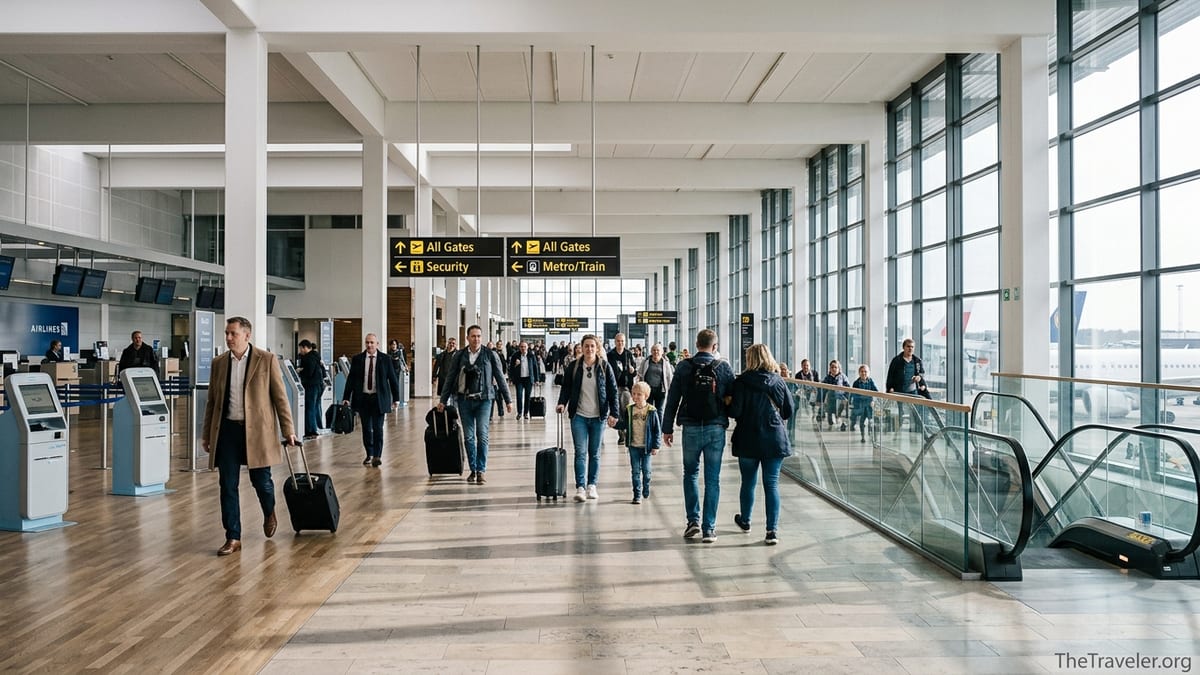
Signs in the terminal are bilingual in Danish and English, and wayfinding is intuitive by color and clear pictograms. If you become disoriented, look up for the black and yellow signs that point to “Baggage claim,” “Metro,” “Train,” and “All gates.” Distances are relatively modest compared with major hub airports; walking from the central security area near T3 to the furthest C gates usually takes around 10 to 15 minutes at a normal pace, so you rarely need internal transport beyond your own feet.
Arrivals: From Landing to the City Center
On arrival, you exit the aircraft via an airbridge or occasionally a short walk to the terminal. Follow the yellow “Baggage claim/Exit” signs; you will either go straight toward baggage reclaim for Schengen flights, or pass through passport control first if you flew in from a non Schengen country such as the United States or the United Kingdom. Passport lines are often moderate but can spike when several long haul flights arrive at once, so if you have a tight onward rail connection keep that in mind.
The baggage claim halls sit directly beneath the main terminal. Carousels are clearly numbered on overhead screens, and luggage for European flights often arrives within 10 to 20 minutes, though arrivals from long haul destinations at busy times may take a bit longer. Customs is typically a simple walk through the green channel if you have nothing to declare. There are restrooms, ATMs, and a staffed information desk in arrivals in Terminal 3, and you will also see a small supermarket style shop and several cafes if you want to grab a bottle of water or a snack before leaving the building.
Most first time visitors head straight from Terminal 3 to the city center, and Copenhagen makes this unusually easy. The main rail and metro hub is built directly into Terminal 3. If you walk straight ahead after exiting customs you will see ticket machines and the entrance to the railway platforms one level down for regional trains, and an escalator up to the M2 metro line. Regional trains run to Copenhagen Central Station in about 13 to 15 minutes, while the metro runs every few minutes with a similar journey time to central stops like Kongens Nytorv. A single ticket to the city center falls into the common four zone fare; prices rise over time, but you can assume you will pay roughly the equivalent of a few US dollars for the one way trip, which is significantly cheaper than a taxi.
Taxis wait just outside the arrivals hall at Terminal 3. The ride into central Copenhagen typically takes 20 to 30 minutes outside rush hour and naturally costs more than public transport, but it can be worth it with heavy luggage or late at night. Rideshare apps operate within Denmark under various models, but traditional metered taxis remain the most common option at the airport. If you are heading across the Öresund Bridge to Malmö in Sweden, look for the regional Öresund trains downstairs, which run directly from the airport station to Malmö and beyond without requiring you to change trains in Copenhagen.
Departures: Check In, Security, Shopping and Boarding
For departures, you can access both Terminal 2 and Terminal 3 from the curb or the connected train and metro station. Airlines are generally assigned specific check in zones. SAS, for instance, uses large, clearly branded areas with self service bag drop machines and staffed counters in both terminals, while airlines like KLM, Lufthansa or British Airways occupy their own counters nearby. Electronic check in kiosks are common, and you can usually print boarding passes and baggage tags there before using automated bag drop belts.
Security screening is centralized; you follow the “Security” signs from either terminal and enter one of several screening lanes. At busy early morning waves, especially on weekdays when business travelers are heading to European capitals, queues can get long. The airport regularly posts estimated waiting times on screens, but it is sensible for first time travelers to arrive at least two hours before a European flight and at least three hours before a long haul departure. You must remove laptops and large electronics from bags unless directed otherwise, and you are subject to standard European liquid rules with containers of 100 milliliters or less in a clear plastic bag.
Once you clear security, you enter a long duty free and shopping zone that serves both Terminal 2 and Terminal 3 departures. There is a full range of Scandinavian and international brands, from Danish design shops and Lego outlets to international cosmetics and electronics retailers. Food options range from quick grab and go bakeries to sit down restaurants and coffee bars such as Copenhagen Coffee Lab and local chains selling open sandwiches and pastries. Prices at airport cafes are higher than in the city, but still comparable to many other European hubs, so it can be convenient to eat here if you have a short layover.
Boarding gates are grouped by letter. A gates are closest to Terminal 2, B gates sit roughly in the middle, and C gates extend into the long pier that serves many non Schengen flights. Boarding usually starts 30 to 45 minutes before departure for European flights and earlier for long haul services. Self boarding gates are increasingly common, where you scan your own boarding pass to open the barrier. Make sure you are in the correct zone if your boarding pass lists a sequence or group number, as some carriers such as Norwegian and SAS now use staggered boarding to speed up the process.
Getting To and From the Airport: Metro, Train, Bus and Taxi
The simplest and fastest way for most visitors to travel between Copenhagen Airport and the city is by metro. The M2 line terminates at the airport’s Lufthavnen station, which is located at the far end of Terminal 3 on the upper level. Trains run every few minutes for most of the day and evening, less frequently late at night, and the journey to central stops like Nørreport or Kongens Nytorv takes around 15 minutes. The metro is driverless, clean, and well lit, and is easy to use even with moderate luggage, thanks to level boarding and wide doors.
Regional trains are the best choice if you are heading to Copenhagen Central Station, to Malmö in Sweden, or further into Denmark. The airport railway platforms sit directly below Terminal 3 and are accessed by escalators and elevators. Trains to Copenhagen Central typically take about 13 to 15 minutes and run throughout the day, continuing beyond the central station to cities such as Odense or Aarhus. If your hotel is near the main train station or you are catching an onward intercity or international train, this is usually the most convenient option.
Public buses connect the airport with various suburbs and parts of the city, but for a first time visitor staying centrally, metro or train is usually easier. There is also a free internal terminal bus operated by the airport that links the main terminals with remote parking areas like P1, P15, P17 and P19. This shuttle is useful if you have parked a rental car in one of the long term car parks and need to get back to your vehicle on departure or after returning a hire car.
Taxis queue outside the arrivals hall at Terminal 3, clearly signed and marshaled. Fares are metered and include the bridge toll if you are traveling to Sweden. As an example, a typical fare to a central hotel near City Hall Square can often fall in the range of several hundred Danish kroner, depending on traffic and time of day. Credit cards are widely accepted in taxis, as they are across Denmark. If you prefer to prebook, many taxi companies allow you to reserve by app or phone for a specific pickup time in front of the terminal, which can be reassuring on an early morning departure.
Hotels, Lounges and Places to Relax
If you need to stay overnight at the airport, the easiest option is the large hotel directly connected to the terminal via a covered walkway. This full service property sits just off Terminal 3 and offers standard rooms as well as day rooms that can be useful for travelers with long daytime layovers who want a proper bed and shower without going into the city. It is common, for instance, for someone arriving on a red eye flight from North America and catching an evening flight to Asia to book a day room to sleep and freshen up before heading back to the terminal.
Several other hotels sit within a few minutes’ drive, including midrange chains and budget friendly properties close to the airport and the nearby highway. Many of these offer shuttle buses or easy access by local bus or short taxi ride. For travelers with very early departures, staying near the airport can simplify the morning routine, especially in winter when it is still dark at commuter times.
Copenhagen Airport has a strong selection of lounges relative to its size, which is welcome if you value a quieter space to work, eat, or shower. In the Schengen area near the A and B gates you will find lounges operated by SAS and independent operators such as Aspire, Carlsberg Aviator, and CPH Apartment. These typically offer self service buffets with light meals, beer and wine, soft drinks, coffee machines, and work areas with power outlets. Many accept access programs such as Priority Pass or sell entry at the door for a fee in Danish kroner, subject to capacity.
For non Schengen departures, the most notable option is a large lounge located above the C pier near gates in the mid 20s. It has floor to ceiling windows with runway views and offers showers, hot food, and quiet seating zones, and functions as the contract lounge for premium passengers on various long haul carriers as well as card holders from certain lounge programs. This lounge is only accessible after passport control, so you must clear that step before you can enter. As of 2026, the airport is also in the process of refreshing and expanding several lounge spaces, so it is a good idea to double check current opening hours and access rules close to your travel date, as these can change.
Parking, Car Rental and Driving
Travelers arriving by car will find a range of parking options signed by “P” plus a number. The airport operates several multi level garages and open air lots, from premium short stay parking close to the terminals to more economical long stay options farther away that are linked to the terminal by the free terminal buses. For example, P4 and P7 are typically closer to the terminal, while P15, P17 and P19 sit farther along Kystvejen and rely on the shuttle bus. Pricing varies by distance and booking method, and advance online reservations often come with a noticeable discount compared to drive up rates, especially during school holidays.
Car rental desks are concentrated in a dedicated car rental center a short walk or shuttle ride from the terminals. Major international brands such as Avis, Hertz, Europcar and Sixt operate fleets here, along with regional providers. After completing paperwork, you usually collect the vehicle from a multi story parking structure nearby. Returning the car typically involves following clear “Rental car return” signs from the highway into the airport area, then taking a short shuttle or walk back to Terminal 2 or 3.
Driving in and out of the airport is straightforward. CPH sits on the island of Amager, directly connected to Copenhagen by motorways and to Sweden via the Öresund Bridge. Clear green motorway signs point toward the city center, Malmö, and other Danish cities. However, for many visitors staying in Copenhagen proper, renting a car is not necessary. The city has excellent public transport and is very walkable and bike friendly, and parking in the city can be expensive. A car makes more sense if you plan to explore the Danish countryside or visit smaller towns such as Roskilde or Helsingør during your stay.
First-Time Traveler Tips and Real-World Scenarios
One of the easiest mistakes for first time visitors at Copenhagen Airport is underestimating walking times to the far C gates, especially for non Schengen flights. A practical approach is to aim to be through security at least an hour before departure, then check the departure screens for your gate and walk there without lingering too long in the central shopping area. For example, if your flight to New York boards at gate C31 at 14:20, plan to clear security by around 13:00, pass passport control by 13:15, and be at the gate by 13:40, leaving a comfortable buffer for last minute restroom stops or a quick coffee.
If you are connecting at CPH, the airport is usually an easy place to change planes, but tight sub one hour connections can be stressful if your inbound flight is delayed. Imagine arriving from Paris into a B gate at 10:05 with a connection to Oslo departing from an A gate at 10:45. In theory, you remain within the Schengen zone and do not clear passport control, so it is just a matter of walking across the pier and perhaps going through a quick security check if you arrive from certain locations. In practice, long lines at the central security recheck points or crowded gate corridors can eat into your time. In such situations, walk briskly, follow the blue “Transfer” signs, and ask airport staff for assistance if you are worried about missing your flight, as they can sometimes direct you to faster lanes.
Because Denmark is highly cashless, you can rely on cards for almost everything at the airport, from ticket machines in the train and metro station to coffee bars and duty free shops. This is useful in real world scenarios like landing late at night when currency exchange counters are closed. With a standard Visa or Mastercard, you can buy a train ticket to Copenhagen Central Station within a couple of minutes at the purple or red ticket machines next to the escalators, without needing to withdraw local currency.
For families, Copenhagen Airport is relatively child friendly, with play areas and child focused shops in the departure zone. If you are traveling with a stroller, you can usually keep it to the gate for many airlines, then collect it either at the aircraft door or on the baggage belt on arrival. It can be helpful to pack essential items such as snacks, a change of clothes, and small toys in a cabin bag you keep under the seat, rather than in a suitcase that might be checked through.
The Takeaway
Copenhagen Airport combines the scale of a major international hub with the walkability and clarity of a smaller field. For first time travelers, understanding the basic layout of Terminals 2 and 3, the split between Schengen and non Schengen areas, and the simplicity of the metro and train links into the city removes much of the anxiety around arrival and departure. Add to that the choice of lounges, on site hotel options, and a straightforward parking and rental car setup, and CPH becomes one of the easier European gateways to navigate.
If you allow a bit of extra time at peak hours, follow the clear signage, and make use of the excellent public transport into central Copenhagen, your first experience at Kastrup is likely to feel smooth and surprisingly relaxed. Whether you are connecting north toward Scandinavia, crossing the Öresund toward Sweden, or heading straight into the city to explore, this airport guide gives you the practical grounding to move through Copenhagen Airport with confidence.
FAQ
Q1. How long does it take to get from Copenhagen Airport to the city center?
In normal conditions, both the metro and regional trains take around 13 to 15 minutes from the airport station at Terminal 3 to central Copenhagen stops such as Copenhagen Central Station or Nørreport.
Q2. Should I take the metro or the train from the airport?
If your hotel is near Copenhagen Central Station or you are catching another train, the regional train is most convenient. If you are staying near Kongens Nytorv, Nørreport or other metro served areas, the M2 metro is usually easiest.
Q3. How early should I arrive at Copenhagen Airport before my flight?
For flights within Europe, plan to arrive about two hours before departure. For long haul flights outside Europe, three hours is a sensible buffer, especially at busy morning and late afternoon peaks.
Q4. Is Copenhagen Airport easy to navigate for a first time traveler?
Yes. Terminals 2 and 3 are connected in one building, signage is clear in Danish and English, and walking distances are manageable. Most travelers manage their first transit at CPH without difficulty.
Q5. Are there airport hotels at Copenhagen Airport?
There is a full service hotel directly connected to Terminal 3 by a covered walkway, plus several other hotels within a short drive. Many travelers with early flights or long layovers choose these for convenience.
Q6. Do I need cash at Copenhagen Airport?
In most cases no. Credit and debit cards are widely accepted for transport tickets, shops, cafes, and taxis. ATMs are available, but many visitors never use cash during their entire stay.
Q7. What lounges are available at Copenhagen Airport?
Copenhagen Airport offers airline operated lounges such as those used by SAS and several independent lounges like Aspire and Carlsberg Aviator in the Schengen area, plus a large lounge above the C pier for non Schengen departures. Access depends on your ticket, status, or lounge membership.
Q8. Is there free Wi Fi at Copenhagen Airport?
Yes, the airport provides free Wi Fi in the terminal buildings. Most lounges, cafes and the connected hotel also offer complimentary Wi Fi for guests.
Q9. How does parking work at Copenhagen Airport?
The airport has multiple parking zones from premium short stay garages near the terminals to cheaper long stay lots linked by a free shuttle bus. Booking in advance online often lowers the price.
Q10. Is it worth staying in an airport lounge at CPH during a layover?
If you have a layover of several hours, value quiet space, or want access to showers and food, a lounge can be worthwhile. For very short connections under about 90 minutes, most travelers prefer to head straight to their gate instead.