


I thought I knew Culebra. I had already spent days shuttling between Flamenco, Tamarindo and Zoni, lulled into thinking all of Puerto Rico’s little islands worked roughly the same way. Then I stepped off a boat onto Culebrita, an uninhabited cay that belongs to the Culebra National Wildlife Refuge, and realized this was a different kind of trip. No kiosks, no music drifting from a bar, no road, no houses. Just white sand, blinding water and the quiet pressure of needing to have brought everything you would need for the day.
Get the latest updates straight to your inbox!
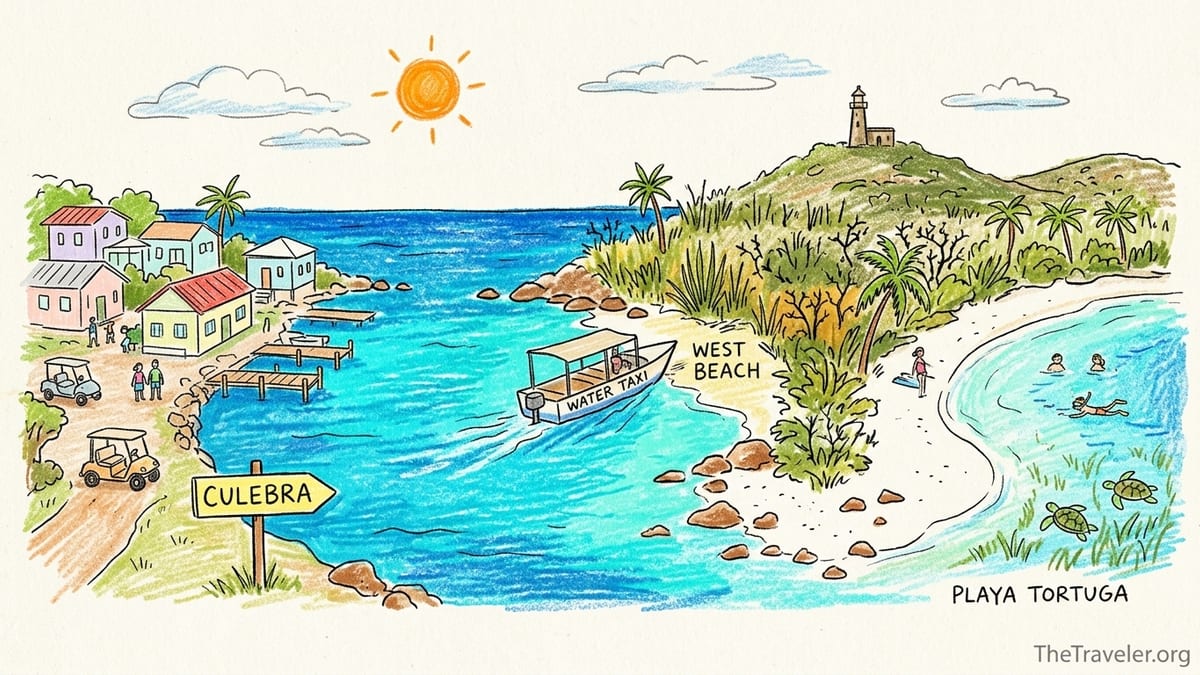
Understanding Culebrita: An Uninhabited Refuge, Not “Another Beach”
The first surprise about Culebrita was how final the silence felt when the boat engine cut off. On Culebra itself, even at relatively quiet beaches, there is always some background noise: a generator from a food stand at Flamenco, a radio on Tamarindo, a truck on the nearby road. On Culebrita there was none of that. The only sounds were wind, water and the pop of small waves on the hull. It hits you immediately that you are not just at another beach but inside a protected wildlife refuge where the human footprint is intentionally limited.
Officially, Culebrita is part of the Culebra National Wildlife Refuge, administered by the U.S. Fish and Wildlife Service. Public use is restricted to hiking, beach use and wildlife observation from sunrise to sunset, and it is reachable only by boat. There is no legal camping, no overnight stays, and no infrastructure beyond the old lighthouse on the hill and the faint trail system that leads there. The refuge guidance is clear: arrive by boat, leave at sunset, and bring your own drinking water, food and sun protection because none of that exists on the island itself.
Compared with Culebra, where the ferry docks in Dewey, there are guesthouses, grocery stores and jeeps for rent, Culebrita feels more like landing on a sandbar at the edge of nowhere. On Culebra, if you forget sunscreen you can duck into a colmado near the dock; if you stay too long at the beach, you can catch a publico or call a taxi. On Culebrita you misjudge your needs once and you are stuck for the entire day with whatever you did or did not pack. That sense of self‑reliance shapes every minute of the visit.
What makes this difference even sharper is that Culebrita sits so close to Culebra. The boat ride is only about 15 minutes from Dewey, yet in that quarter hour you move from a small, lived‑in island to an uninhabited cay whose primary purpose is to shelter seabirds and sea turtles, not entertain humans. It forces you to slow down, pay attention and tread more carefully than you might on a standard resort excursion.
Arranging the Boat: Water Taxis, Small Groups and Sticker Shock
The logistics of getting to Culebrita were my next surprise. On paper it looked simple: get to Culebra, then book a water taxi or small boat tour. In practice, it felt closer to arranging a private expedition than buying a beach ticket. There is no public ferry to Culebrita. Access is either on your own vessel or by arranging a licensed boat based in Culebra.
In Dewey, the small town where the Culebra ferry lands, captains advertise Culebrita runs on dockside boards and in guesthouse lobbies. At the time of my visit, water taxis such as H2O Water Taxi and Cayo Norte Water Taxi were running shared trips for about 55 to 70 dollars per person round trip, depending on the season and whether basic beach gear or lunch was included. That meant our family of four was looking at 220 to almost 300 dollars for a simple day out. Coming off a 2.25 dollar government ferry ride from the main island of Puerto Rico, the jump felt steep.
The flip side of that cost is intimacy. Our boat to Culebrita had eight passengers plus the captain and mate. Instead of a packed catamaran party cruise, it felt like joining a small expedition. We met at the dock in Dewey mid‑morning, signed a standard liability waiver on a clipboard, and listened as the captain went over the refuge rules: no collecting shells or coral, no feeding wildlife, no alcohol on the beach, pack out every scrap of trash. He emphasized that we would be on our own once he dropped us, with a set pickup time in the afternoon and a warning that if weather worsened he might call everyone back early.
For travelers used to the structure of mainland tours, it is important to understand that most Culebrita operators treat you like competent adults. The captain will usually point out where the trail to the lighthouse starts, where the tide pools known as Las Jacuzzis are, and where he has seen turtles recently, but then you are free to disperse. There are no loudspeakers, no fixed itinerary and often no guide walking with you. That freedom is part of the appeal but it also demands a bit more planning and situational awareness than a typical beach day on Culebra.
The Boat Ride: Fifteen Minutes That Reset Expectations
Our ride out of Dewey began as many Caribbean transfers do: a short shuffle along the dock with dry bags, snorkel fins and a cooler, then a careful step into a fiberglass boat bobbing against its fenders. The captain gunned the engine as we cleared the harbor, and the view of Culebra’s low green hills slid behind us. Within five minutes, the pastel houses of town were gone, replaced by open water and the outline of Culebrita’s rocky shore growing sharper ahead.
It is not a long trip, but in that 15 or so minutes you feel Culebra fall away. The captain throttled down once to point out a line of birds diving over a bait ball, then again near a floating patch of sargassum where a green turtle briefly surfaced before disappearing. With no other boats in sight, it looked almost implausible that such empty water lay so close to one of Puerto Rico’s most talked‑about islands.
As we rounded Culebrita’s western tip, the water shifted abruptly from deep blue to electric turquoise. The captain explained that we would land on West Beach, a narrow strip where the boats line up with their sterns toward the sand. Playa Tortuga, the famous turtle beach, awaits on the island’s opposite side. This was the first operational difference from Culebra: there is no dock like at Flamenco or ferry pier. To reach shore you either step carefully down a swim ladder into knee‑deep water or swing off the side and wade in with your bag lifted chest‑high.
Stepping into that water was a jolt. It was warmer than I expected yet so clear that my toes were visible as if magnified through glass. A faint current pushed around the hulls, and the sand beneath my feet shifted with every small wave. With only a handful of other boats moored in the bay, the setting felt intimate, almost fragile, as if one big party boat with loud music could overwhelm it in seconds.
First Impressions on Landing: Beauty, Heat and the Reality of No Services
My first instinct on reaching the West Beach sand was to look for the usual beach cues: a trash can, a path marked with a sign, some sort of hut selling drinks. There was none of it. Instead there were tangled low trees, a narrow sandy path cutting across to the other side of the cay, and a reminder from our captain to remember precisely where the boat was anchored because every one of the white vessels looked the same from the trail.
The heat hit next. On Culebra, even at Flamenco’s exposed curve, you can duck into a kiosk for a cold drink or shade beneath a palm near the parking lot. On Culebrita, the sun feels more direct. With no tall palms lining the West Beach and only scrub and low trees beyond, there is very little overhead shade at midday. We were grateful to have brought wide‑brimmed hats, rash guards and a beach umbrella the captain loaned us. A couple who had packed only towels and sunscreen ended up crouched against a single shrub’s shadow by noon, faces pinking while they waited for the return boat.
The absence of infrastructure changes small routines. There is no restroom, so boat captains quietly explain their preferred system for “ocean bathroom breaks” away from shore. There are no vendors renting loungers, which means if you want a chair, you bring a folding one from Culebra or book with an operator who includes them. When we unpacked our lunch, there was no picnic table, so we set up our cooler on the sand and ate next to a hermit crab that seemed more curious than afraid.
That lack of amenities also affects safety. There is no lifeguard at Playa Tortuga or the tide pools, no ranger patrolling like at some mainland parks. When a fellow visitor scraped their shin on a rock near Las Jacuzzis, the only first‑aid available came from the small kits the captains kept on their boats. It was a reminder that out here, being prepared is not an optional extra; it is part of the responsibility of stepping into a protected, lightly managed space.
Crossing to Playa Tortuga: A Different Side of the Cay
The walk from West Beach to Playa Tortuga takes about 10 to 15 minutes, but it feels longer in the midday heat. The narrow trail cuts through scrub and patches of cactus, rising gently before dropping down to the northern shore. The surprise for me was how wild the center of the island felt. Away from the white sand, Culebrita is all low, thorny vegetation, lizards that skitter out of your way and the occasional brown pelican gliding low overhead.
As we crested the last rise and Playa Tortuga came into view, everyone on the path stopped talking at once. The bay is a near‑perfect crescent of pale sand with water that fades from pale jade to clear cobalt. From above it almost looks like a child’s drawing of a beach. Turtles sometimes rest in the seagrass beds just offshore, and the whole curve of the bay sits inside the boundaries of the national wildlife refuge, which has helped keep the water quality high and large developments away.
Despite its reputation, Playa Tortuga was not crowded during our visit. A dozen or so people were scattered along the sand, most clustered under the few patches of natural shade at the back of the beach. A couple of boats sat offshore at anchor, their passengers swimming to and from the beach. Compared with Flamenco on a weekend, where rows of umbrellas line the shore and music blares from multiple speakers, the quiet here felt almost exaggerated.
From the first step into the water, the clarity was striking. Tiny fish hovered over patches of seagrass and ripples of sand were visible several meters out. It was tempting to forget that this clarity, and the turtles that give the bay its name, rely on visitors staying within marked swim areas, avoiding trampling the seagrass and keeping distance from any turtles or rays encountered. The refuge status is not a backdrop; it is the reason the place still looks this way.
Snorkeling and Marine Life: What I Actually Saw
One of the biggest questions I had before going was whether the stories about turtles everywhere at Playa Tortuga were real or exaggerated. In the water, the answer leaned toward real. Within the first half hour of snorkeling along the eastern side of the bay, I saw two green turtles grazing calmly in the seagrass, surfacing briefly for air before dipping back down. Later in the afternoon, another larger turtle glided beneath me in slightly deeper water, accompanied by a small school of yellow tangs.
The rest of the marine life matched what other Culebra snorkelers had described: schools of blue tang and sergeant majors near rockier outcrops, a few parrotfish crunching on coral, and clusters of small reef fish along scattered hard structures. Coral growth was present but not spectacular compared to world‑class reef sites; what stood out more was the water clarity and the relative abundance of turtles and rays. On one pass close to the western rocks, I spotted a southern stingray half buried in the sand, its outline visible only when it flicked its tail.
Snorkeling here felt different from doing the same from shore in Culebra. At Tamarindo, for example, you can exit the water, walk a few minutes and be back at your rental jeep with a cooler waiting in the trunk. On Culebrita, your base is the towel‑and‑umbrella camp you carried yourself. When your mask fogs or you get chilled, you rest under the limited shade you created. That sense of being tethered to your own preparations changes how long you stay in the water and how carefully you watch the weather building on the horizon.
One practical note: the entry at Playa Tortuga is mostly soft sand, but closer to the rocky edges there are scattered urchins and sharper stones. I was glad to have brought light neoprene booties. Another snorkeler who went in barefoot near the rocks came out with a minor sea urchin spine in their heel, which the boat crew helped remove. The incident reinforced how a small piece of gear can make the difference between an easy day and an uncomfortable one when there is no clinic a few minutes away.
Living Without Infrastructure: Food, Water, Shade and What I Wished I Had Packed
It took precisely two hours for my initial confidence in our packing list to crumble. We had followed the refuge advice and brought water, food and sun protection, but once the sun climbed high and the sand began radiating heat, our careful calculations felt optimistic. Our family of four had brought about a gallon and a half of drinking water for roughly six hours on the island. By early afternoon, after snorkeling, hiking to the tide pools and walking back, we were already rationing sips.
Being on an uninhabited cay means there is no corner store to bail you out and no restaurant to stretch your supplies. On Culebra, I had grown used to the safety net of grabbing an extra bottle at the colmado or ordering a plate of mofongo at a beachside shack. On Culebrita, that option does not exist by design. If I could redo the day, I would pack at least one full reusable bottle per person plus an extra shared bottle, even if that meant carrying a heavier backpack.
Food was another learning curve. We had packed sandwiches, fruit and snacks from a grocery in Dewey, keeping them cool with a few ice packs in a soft cooler. By midday, the sun had turned the sand into a low‑level oven and the ice packs were puddles. The fruit was fine, but the sandwiches had warmed to the edge of what felt comfortable in the heat. Next time I would favor items that can handle hours at warm temperatures: tortillas with nut butter, nuts, crackers, firm fruit, and more packaged snacks than I think we will need.
Shade may be the most underestimated need on Culebrita. Natural shade along Playa Tortuga is limited to a few scraggly spots at the back of the beach, and they fill quickly on busy days. Our captain had warned us and lent a collapsible umbrella and two beach chairs. I was thankful for a light beach tent another family brought from the mainland, which created a cool pocket the children used for breaks. Items I wished I had: a second umbrella or compact shade structure, a thicker sarong or sheet to drape over the bags, and a small battery‑operated fan to take the edge off the still midday air.
How Culebrita Compares Emotionally to Staying on Culebra
Spending several days on Culebra before visiting Culebrita provided a useful contrast. On Culebra, evenings revolved around simple pleasures: walking from a guesthouse near Dewey to pick up empanadillas from a food truck, watching the sunset near the ferry dock, or driving a rented golf cart back from Zoni as goats wandered along the roadside. Even the quieter beaches felt integrated into daily life, with local families unpacking chairs and coolers next to visiting travelers.
Culebrita felt different, almost like entering a separate mental space. There were no houses or roads as a backdrop to the sand, no music from a nearby bar, no smell of frying fish drifting along the shore. Once the boat dropped us and headed back toward Culebra, the sense of isolation settled in. It was beautiful, but it also carried weight. We found ourselves speaking more softly, picking up stray bits of trash that had washed ashore and being more deliberate about where we stepped on the trail.
That psychological shift is part of what makes an uninhabited cay worth the extra effort. The absence of ordinary tourist infrastructure leaves room for other things to surface: the shapes of clouds building over Vieques in the distance, the constant movement of pelicans working the shoreline, the slow crossing of a single turtle’s head through the clear water. There is no agenda beyond what you set for yourself, and no one selling you an upgrade or an added excursion.
At the same time, the lack of infrastructure demands a certain respect. On Culebra, a missed alarm might mean losing an hour of beach time. On Culebrita, failing to listen when your captain sets a firm return time could mean watching your ride disappear around the point. The margin for error in a place without permanent staff or services is narrower, and feeling that margin under your feet changes how you move through the day.
The Takeaway
Culebrita turned out to be less a side trip from Culebra and more a different category of travel altogether. It is not a place you wander into on a whim between errands, and it is not a beach where you can show up with just a towel and a wallet. The combination of refuge rules, lack of services and boat‑only access requires forethought and a willingness to carry what you need and nothing more.
In return, you get hours of clear water at Playa Tortuga, the quiet of a nearly undeveloped shoreline and the chance to see turtles graze in shallow seagrass without a crowd pressing around them. You also get small lessons in self‑reliance: how much water you really drink under a Caribbean sun, how to set up your own shade, how to plan your snorkeling around your own energy instead of a tour schedule.
If you already love Culebra’s beaches and want to see what they looked like before roads and kiosks, a day on Culebrita is worth the extra cost and effort. Just remember that visiting an uninhabited cay is a privilege, not a right. Treat the refuge rules as the minimum, pack more water and shade than you think you need, tread lightly in the water and on the trails, and you will leave with memories that feel very different from a standard beach outing.
Walking back to the boat in the late afternoon, sand still warm underfoot and the bay beginning to glow with softer light, I realized the biggest surprise was not the turtles or the water color. It was how quickly the absence of infrastructure made room for something else: a quieter, more attentive way of being on a beach, shaped as much by what is not there as by what is.
FAQ
Q1. Do I need a tour or can I visit Culebrita on my own?
Most visitors reach Culebrita with a licensed water taxi or small boat tour based in Culebra. Unless you have your own seaworthy boat and local knowledge, arranging a ride with an established operator is the safest and most practical option.
Q2. How much does a day trip to Culebrita cost?
Shared water taxis from Culebra to Culebrita usually run in the range of about 55 to 70 dollars per person round trip, depending on the operator, season and whether they include extras like beach chairs, umbrellas or snacks.
Q3. Are there any bathrooms, shops or restaurants on Culebrita?
No. Culebrita is an uninhabited cay inside the Culebra National Wildlife Refuge. There are no bathrooms, no kiosks, no restaurants and no shops. You must bring all your water, food and supplies and pack out all trash.
Q4. What are the official visiting hours and rules?
Public areas of Culebrita that are open to visitors operate from sunrise to sunset. The refuge does not allow camping or overnight stays, and activities are limited to things like hiking, beach use and wildlife observation. Visitors are expected to bring their own drinking water, food and sun protection and to avoid disturbing wildlife.
Q5. Is the snorkeling at Playa Tortuga good for beginners?
Yes, the shallow sand and generally calm conditions in the bay can work well for confident beginners, especially near the center of the beach. However, there are no lifeguards or facilities, so beginners should use flotation if needed, stay close to shore, and always snorkel with a buddy.
Q6. Will I definitely see sea turtles?
There is a good chance of seeing turtles because Playa Tortuga sits near seagrass beds that they use for feeding, but there are no guarantees. Even when turtles are present, you should keep a respectful distance, avoid chasing them and never try to touch or feed them.
Q7. What should I absolutely not forget to pack?
Plenty of drinking water, strong reef‑safe sunscreen, a hat, sun protective clothing, snacks or lunch that can handle the heat, and some form of shade such as an umbrella or small beach tent are essentials. A basic first‑aid kit and dry bags for electronics are also very useful.
Q8. Is the hike to the lighthouse or tide pools difficult?
The walk to the old lighthouse is a short but exposed hike on a rough trail that can feel strenuous in the midday sun. The route to the tide pools known as Las Jacuzzis involves uneven, sometimes slippery rocks. Neither is technically challenging for fit visitors, but both require good footwear, sun protection and awareness of changing sea conditions.
Q9. How does Culebrita compare to beaches on Culebra like Flamenco?
Flamenco and other Culebra beaches have parking, food kiosks, occasional lifeguards and easier access. Culebrita offers a wilder experience with clearer sense of isolation, but absolutely no services. It feels more like a small expedition than a casual beach stop.
Q10. Is Culebrita suitable for children and older travelers?
Culebrita can be a memorable outing for families, but only if everyone is comfortable with the boat ride, walking on uneven trails and a full day without facilities. For young children or older travelers, extra shade, hydration, and realistic limits on hiking and snorkeling time are important to keep the day enjoyable and safe.