


More news on this day
Passengers traveling between Australia and New Zealand on June 10 are facing widespread disruption, with publicly available flight-tracking data indicating 249 delayed services and three cancellations affecting major hubs in Melbourne, Sydney and Auckland and involving carriers including Virgin Australia, Jetstar, Qantas, Air New Zealand and several smaller operators.
Get the latest news straight to your inbox!
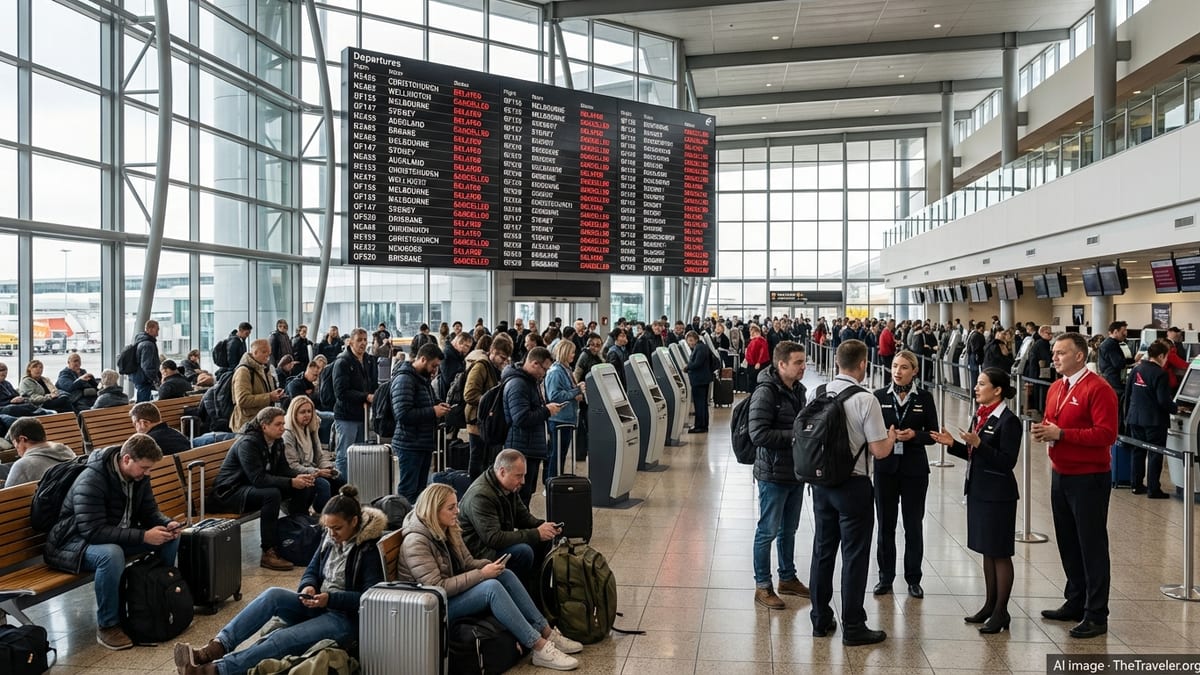
Wave of Delays Across Key Trans-Tasman Routes
Real-time aviation trackers and airport information boards on Wednesday point to a difficult day across the busy trans-Tasman and domestic networks, with delays concentrated on services linking Melbourne, Sydney and Auckland as well as several secondary cities. The pattern shows extended turnaround times and rolling knock-on delays, rather than a single isolated incident, contributing to a backlog that is affecting passengers from early morning through the evening peak.
Melbourne and Sydney, Australia’s two largest aviation gateways, appear to be bearing the brunt of the disruption. Flights shuttling between the cities and onward to Auckland and other New Zealand destinations are showing departure and arrival times pushed back from scheduled slots, with some services running more than an hour late. The impact is particularly pronounced on routes typically operated several times a day, where one out-of-sequence aircraft can quickly cascade into broader schedule pressure.
Auckland International Airport, the main entry point into New Zealand, is also experiencing a higher-than-usual number of late arrivals and departures. Schedule data for Wednesday shows dozens of services to and from Australian ports running behind time, affecting not only point-to-point travelers but also those connecting from long-haul flights into regional New Zealand destinations.
The three recorded cancellations, while small relative to the 249 delays, have contributed to passenger frustration by removing options for same-day rebooking on already congested routes. Travelers with tight onward connections, including those linking from domestic Australian flights onto New Zealand services via Sydney or Melbourne, have been particularly exposed.
Major Carriers Under Pressure
The disruption spans most of the main brands in the trans-Tasman and Australian domestic markets. Virgin Australia, Jetstar, Qantas and Air New Zealand each operate dense schedules linking Melbourne, Sydney and Auckland, and publicly available flight information on Wednesday shows delays affecting all four carriers to varying degrees.
On the Australia side, the route between Melbourne Tullamarine and Sydney Kingsford Smith remains one of the busiest in the country, with Qantas, Virgin Australia, Jetstar and regional affiliates all operating multiple daily rotations. Industry reports in recent months have highlighted this corridor as particularly sensitive to air traffic control constraints and crew or aircraft availability, factors that can quickly translate into late departures and arrivals when demand is high.
Across the Tasman Sea, services between Sydney or Melbourne and Auckland form the backbone of international connectivity for both countries. Air New Zealand, Qantas and Jetstar operate many of these flights, with Virgin Australia and smaller carriers supporting additional links on related routes. When delays build up on these sectors, they can ripple through to long-haul operations, as aircraft and crew scheduled to continue to Asia, North America or regional centres are held on the ground longer than planned.
Recent airline performance reports in both Australia and New Zealand have already drawn attention to the challenge of maintaining on-time operations in a period of high demand and tight capacity. While carriers have generally improved reliability compared with the immediate post-pandemic period, observers note that even modest schedule shocks can quickly reveal operational bottlenecks.
Operational and Infrastructure Constraints
There is no single, publicly confirmed cause for Wednesday’s pattern of delays, but several familiar constraints appear to be at play. Aviation analysts regularly cite staffing levels, aircraft maintenance requirements and weather-related air traffic control restrictions as key drivers of disruption on the east coast of Australia and across the Tasman.
Sydney in particular operates under a long-standing night-time curfew and a regulated cap on hourly movements, limiting the airport’s capacity to recover when earlier flights fall behind schedule. If morning and midday services experience even relatively short delays, the space available later in the day to “catch up” can be restricted, leaving airlines with little room to compress their operations back into time.
Infrastructure works are also contributing to a more constrained environment. Current upgrade projects at Sydney’s terminals and ongoing improvements at several Australian and New Zealand airports have led to temporary gate changes, altered bus transfers between domestic and international terminals and other procedures that can marginally slow boarding and disembarkation. While these changes are often minor on a single flight, they can compound across a full day of operations, contributing to cumulative delays.
On the New Zealand side, government on-time performance statistics have in recent months underscored the vulnerability of routes linking Auckland to major Australian centres, with metrics fluctuating noticeably from month to month. Performance data for late 2025 and early 2026 show sizable portions of trans-Tasman flights departing outside standard on-time windows, particularly during weather or peak travel periods.
Impact on Travellers in Melbourne, Sydney and Auckland
For passengers, Wednesday’s disruption has translated into longer queues, missed connections and the need to juggle onward plans at short notice. Travellers transiting through Sydney from Melbourne to Auckland, or vice versa, are among those most at risk when delays accumulate, as a late domestic sector can readily erode the buffer time between flights, especially when international departure gates close well before scheduled pushback.
Reports from airport terminals describe busy departure halls and more crowded-than-usual gate areas, particularly around the late afternoon and evening bank of flights when airlines seek to reposition aircraft for the following day. With relatively few spare seats during this part of the year, some affected passengers have had limited options to move to alternative services when their original flights are heavily delayed or cancelled.
Travel industry commentators note that disruptions of this scale also affect ground transport, accommodation and tourism operators at both ends of the route. Late arrivals in Auckland can push domestic New Zealand connections into the evening, while delayed departures from Melbourne and Sydney may lead some passengers to unexpectedly require overnight stays or last-minute changes to hotel bookings.
Airports themselves feel the strain through extended staffing requirements, higher use of customer service desks and increased coordination with border, security and baggage handling teams. Even where flights ultimately depart and arrive safely, the additional time on the ground adds cost and complexity to operations.
What Passengers Can Do Today
With delays and a small number of cancellations still affecting services into the evening, travel advisers recommend that passengers due to fly between Melbourne, Sydney and Auckland on Wednesday leave extra time for check-in and security and monitor their flight status throughout the day. Airline apps, airport departure boards and flight-tracking services are providing near real-time updates that can help travellers anticipate longer waits or gate changes.
Passengers with tight onward connections, particularly those linking from domestic to international flights, may wish to consider whether their itineraries allow sufficient buffer time given the current pattern of disruption. Where feasible, some travel planners suggest moving to earlier flights or exploring alternative routings across the Tasman if available.
Consumer advocates also encourage travellers to familiarize themselves with each airline’s policies on rebooking, credits and care during delays and cancellations. Conditions vary between Virgin Australia, Jetstar, Qantas, Air New Zealand and other operators, and the type of disruption, its cause and the fare class purchased can all influence what assistance is offered.
While the current wave of delays appears likely to ease as aircraft and crews return to position and overnight schedules reset, Wednesday’s events highlight the continued fragility of tightly packed flight programs on the busy corridors linking Melbourne, Sydney and Auckland. For now, passengers are advised to plan for potential disruption and remain flexible as airlines work through the backlog.