


More news on this day
Air travel across Boston and the broader Northeast corridor remained unsettled on Tuesday after an FAA equipment failure linked to a severed fiber line in New Jersey triggered ground stops, cascading delays, and cancellations at Logan and other major airports.
Get the latest news straight to your inbox!
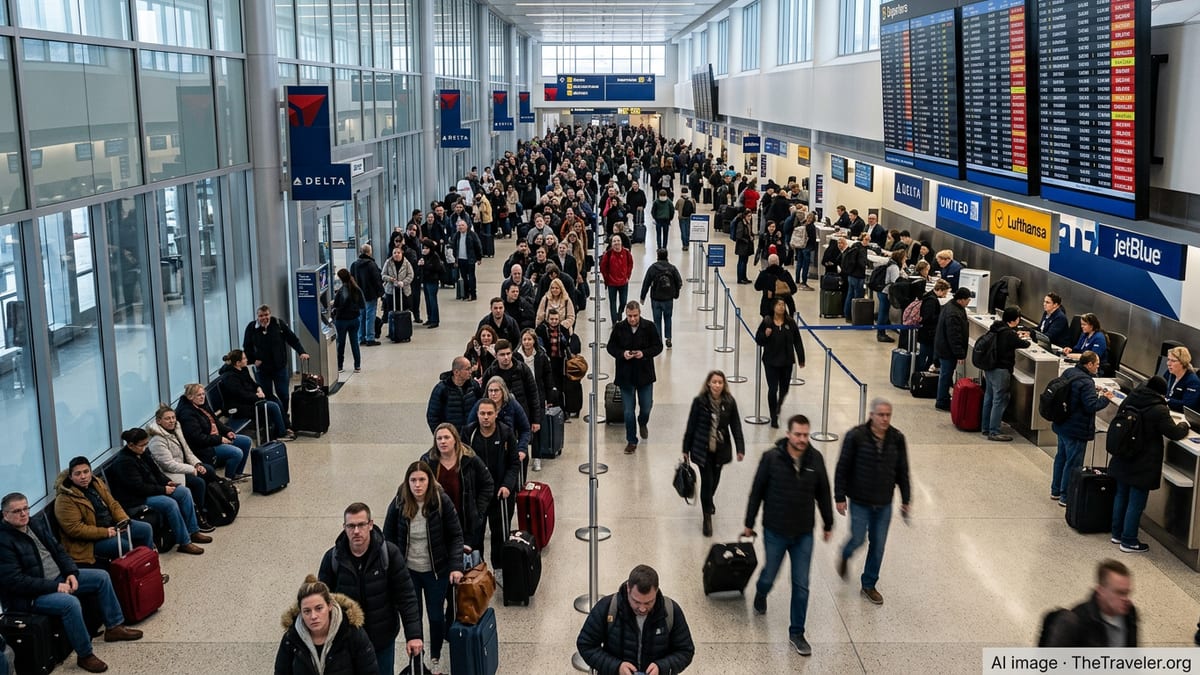
Technical failure ripples from New Jersey to Boston
According to publicly available information from the Federal Aviation Administration and multiple news outlets, Monday’s disruption began with an equipment outage at a key air traffic facility serving the New York region. When systems attempted to switch to a backup connection, the FAA reported that a critical fiber optic link had been damaged, interrupting radar and radio data used to guide aircraft approaches and departures.
Transportation updates and regional coverage indicate that the fiber damage occurred in New Jersey during construction activity involving an Amtrak crew, cutting communications lines that feed air traffic control systems. As controllers lost access to some radar and communications feeds, the FAA instituted ground stops at several large Northeast airports to slow the flow of traffic into the affected airspace.
The outage led to a near standstill in commercial arrivals at Newark Liberty International Airport for much of Monday, with no commercial flights landing there for several hours during the middle of the day, according to flight-tracking data cited in national reporting. Ground stops and restrictions also affected John F. Kennedy International, LaGuardia, and Philadelphia, which in turn disrupted schedules at secondary hubs including Boston Logan International Airport.
By Monday evening, federal transportation updates and statements posted on social media indicated that the damaged lines had been repaired and that normal communications were being restored. However, the sharp slowdown in operations earlier in the day left airlines with aircraft and crews out of position and passengers stranded throughout the region.
Logan faces compounded pressure from outage and construction
At Boston Logan, the technical problems layered on top of existing operational constraints. Massachusetts Port Authority communications cited in local coverage described Logan as being under a ground delay program on Monday due to FAA equipment issues combined with ongoing runway construction at the airport.
Runway work at Logan, including long-planned construction affecting Runway 9/27, has already been limiting capacity and prompting frequent ground delay programs. Travelers and aviation observers have noted in public forums that the construction, scheduled to run into mid-November, reduces the airport’s ability to absorb surges in traffic or diversion flights when nearby hubs experience disruptions.
During Monday’s outage, New York area ground stops and diversions increased the load on Boston’s airspace and parking stands, further straining an airport already operating with constrained runway capacity. Local news reports indicate that hundreds of flights at Logan experienced delays or cancellations through Monday evening, with average delays around 105 minutes at the peak, based on FAA data compiled by broadcasters.
As of early Tuesday, the FAA’s real-time status page for Logan showed that the airport was still subject to some delays tied to runway and taxiway construction, though the worst of the outage-related disruption had eased. Massport and airline communications continued to urge travelers to check directly with their carriers before heading to the airport.
Ongoing impacts across major Northeast airports
The outage’s effects extended well beyond Boston. National and regional reporting on Monday and Tuesday described hundreds of cancellations and many more delays across major Northeast airports, particularly in the New York metropolitan area. Newark Liberty saw more than 600 cancellations on Monday alone, while LaGuardia, JFK, and Philadelphia all reported significant disruption.
Publicly available FAA daily air traffic summaries for Monday show multiple ground stops and flow control programs issued for the New York and New England regions due to equipment outages and volume management. These measures are intended to keep traffic at safe, manageable levels when air traffic control tools are degraded or capacity is reduced.
By early Tuesday morning, those national summaries, along with flight-tracking data cited by outlets such as the Associated Press and local television stations, indicated that overall disruption was easing. One Boston-area report, using FlightAware’s “misery map,” noted fewer than 100 delays and under 50 cancellations nationwide shortly after 7 a.m. Eastern time, a sharp improvement from the day before.
Despite that progress, recovery remained uneven. Some flights departing and arriving in Boston, New York, and Philadelphia on Tuesday continued to face residual delays as airlines repositioned aircraft and crews and worked through backlogs of displaced passengers.
What travelers through Logan and the Northeast should expect
For passengers, the most immediate impact is continued schedule uncertainty. Local coverage from Boston on Tuesday morning reported that Logan was still seeing a smaller number of delays and a handful of cancellations as of around 7 a.m., even though the core FAA systems had been restored. Airlines were in the process of rebalancing schedules, and some early-morning departures were held or retimed.
Public guidance from the FAA and airport operators emphasizes that travelers should rely on their airline’s flight status tools rather than general airport dashboards when planning arrival times at the terminal. Because ground delay programs and flow restrictions can change over the course of the day, a flight that appears on time in the morning can still be adjusted later depending on evolving traffic management decisions.
Given the continuing runway construction at Logan and the potential for additional flow control measures on busy days, aviation analysts quoted in regional coverage suggest that travelers build extra time into connections through Boston and other Northeast hubs over the coming weeks. Even routine weather or volume surges could trigger fresh ground delays while infrastructure work and system resiliency improvements are underway.
For those already affected by cancellations, airline policies vary on rebooking and compensation. Publicly available customer service information from major carriers indicates that, when disruptions stem from air traffic control or telecommunications failures, rebooking on the next available flight is typically offered without additional fare, but hotel or meal vouchers may be more limited. Travelers are encouraged to review their carrier’s contract of carriage and to act quickly via apps or customer service channels, as same-day inventory on popular routes can disappear fast after large-scale disruptions.
Renewed scrutiny of FAA systems and redundancy
The outage has renewed attention on the FAA’s ongoing modernization efforts for air traffic control systems. Recent government accountability reports and agency updates have highlighted aging infrastructure and the need to improve redundancy for critical systems such as radar integration, communications networks, and notice dissemination platforms.
Public documentation on the FAA’s modernization programs shows that the agency has been rolling out new tools and backup architectures intended to prevent a single point of failure from halting operations across a wide region. However, the events of Monday, in which both primary and backup fiber connections were affected, illustrate the continuing vulnerability of physical network infrastructure to construction mishaps and other localized incidents.
Lawmakers and oversight bodies have previously flagged similar outages, including nationwide disruptions tied to notice-to-air-missions systems in earlier years, as warning signs of the risks posed by legacy technology and fragmented redundancy. Analysts cited in recent coverage suggest that the latest incident will likely feature in future hearings and evaluations of whether current investments in backup communications and routing are sufficient.
For travelers, the technical debates may feel abstract, but the practical effect is clear: when key systems fail, even for a few hours, the impact on passenger itineraries can last well into the following day. Until infrastructure and redundancy improvements can fully contain such failures, large hubs like Boston, Newark, and the New York airports are likely to remain vulnerable to sudden bouts of disruption triggered far beyond their own runways.