


More news on this day
Flights at several of the busiest airports in the northeastern United States were halted or severely delayed on Monday, September 21, after an equipment outage at a Federal Aviation Administration air traffic facility triggered ground stops and cascading disruptions across the region.
Get the latest news straight to your inbox!
Fiber cut in New Jersey ripples across the Northeast
Publicly available FAA traffic-management advisories and national airspace status data indicate that the disruption began late Monday morning, September 21, when a telecommunications line supporting air traffic services in the Philadelphia area was damaged during construction in New Jersey. The incident affected both primary and backup systems, interrupting radar and radio communications used to manage a dense swath of East Coast airspace.
According to published coverage from national outlets, the outage forced the FAA to issue ground stops for aircraft bound for Newark Liberty International Airport, John F. Kennedy International Airport, LaGuardia Airport, Philadelphia International Airport and Teterboro Airport. Departures already at those hubs were held at gates or on taxiways while controllers worked under reduced capacity and contingency procedures.
National airspace status summaries released on Monday showed that more than 600 flights into and out of Newark were canceled by early evening, with hundreds more delayed, as operations slowed across the New York City area. Philadelphia also recorded extensive delays, with FAA metrics cited in local coverage showing average departure waits of more than three hours during the peak of the disruption.
The telecom issue was described in multiple transportation reports as an accidental cut to a fiber-optic cable, rather than a cyber incident or targeted attack. By late Monday, statements posted by federal transportation leaders on social media indicated that repairs had been completed and that the affected systems were being returned to service.
Ground stops and long delays at key hubs
Ground stops, which require flights bound for an affected airport to remain on the ground at their origin, were ordered for Newark, LaGuardia, JFK, Philadelphia and Teterboro at various points on Monday, according to flight operations trackers that compile FAA data. In some cases, those restrictions were followed by ground delay programs that limited arrival rates well into the evening.
New York area broadcasters reported that Newark was the first major hub to be hit, with a ground stop that stretched for several hours and eventually expanded to cover a broader set of Northeast airports as the scale of the disruption became clear. Additional reports from regional outlets and aviation-focused sites showed that LaGuardia and JFK later faced halts and heavy metering of arrivals, creating bottlenecks on taxiways and at gates.
At Philadelphia International Airport, an FAA advisory cited by travel industry publications listed the cause of the ground stop as an “equipment / outage” event linked to air traffic control systems. While the formal ground stop there was lifted earlier than at some New York airports, the field continued to see knock-on delays as airlines worked through a backlog of flights and repositioned aircraft and crews.
Data from airline tracking services on Monday evening showed average departure delays of well over an hour at several of the affected airports, with some individual flights slipping by four hours or more. Cancellations mounted through the day as carriers scrubbed later departures that could no longer be accommodated within crew duty limits and nighttime operating constraints.
Travelers face missed connections and overnight stays
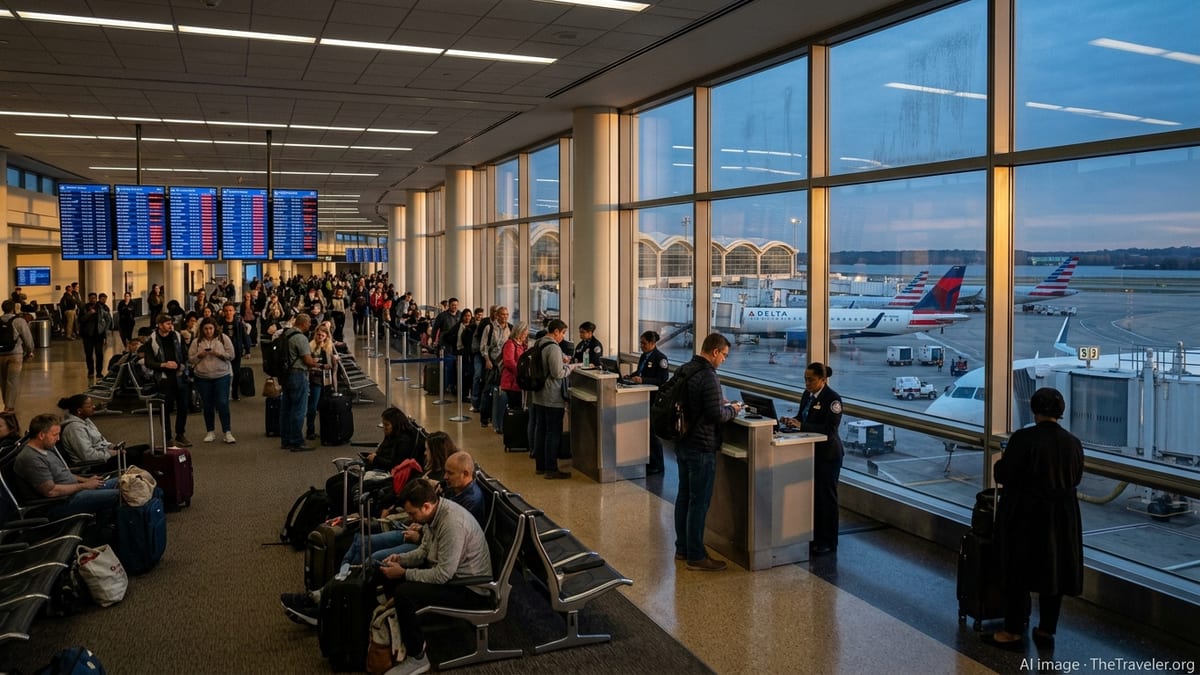
The sudden nature of the outage left thousands of passengers stranded throughout the Northeast corridor. Social media posts and accounts compiled by local media described long lines at check-in counters, crowded concourses and gate areas, and dozens of aircraft idling on tarmacs while waiting for departure clearance once limited operations resumed.
For travelers with tight connections through New York or Philadelphia, the ground stops meant missed onward flights across the United States, Canada and Europe. Airline communications to customers, as relayed in published reports, frequently cited an “air traffic control equipment issue” and encouraged travelers to rebook via mobile apps or websites in order to avoid lengthy queues at customer service desks.
Hotel bookings and on-the-ground arrangements in gateway cities were also affected. With evening departures scrubbed and arrival banks pushed late into the night, many passengers opted to stay overnight and travel the following day, particularly at Newark and JFK, where international itineraries are concentrated. Travel advisories from airlines urged customers departing on Tuesday, September 22, to arrive early and to monitor flight status closely as schedules adjusted.
Rail and road networks absorbed some of the overflow, as travelers between cities such as New York, Philadelphia, Boston and Washington sought alternatives. Coverage from regional outlets noted heavier than normal demand on intercity trains and buses Monday afternoon and evening, although those systems continued to operate on regular timetables.
Operations resume, but residual delays continue
By late Monday, public messages from federal transportation officials stated that the damaged fiber lines had been repaired and that affected systems at the impacted air traffic control facility were back online. The FAA’s own daily air traffic reports for September 22 showed no active ground stops related to the equipment outage, though separate weather-related programs appeared at other airports, including Dallas Fort Worth.
Despite the resolution of the underlying technical issue, schedules at major Northeast hubs remained fragile into Tuesday. Industry data reviewed early on September 22 showed lingering delays and scattered cancellations as aircraft and crews returned to normal rotations. Travelers connecting through New York and Philadelphia were still being advised by airlines and travel agents to allow extra time between flights.
Analysts quoted in national transportation coverage pointed out that the disruption occurred at a time when the region is already managing chronic capacity pressure. Federal documents on slot waivers and staffing at the New York Terminal Radar Approach Control facility have previously warned that even routine summer traffic can overwhelm the system when controllers or infrastructure are under strain.
For airlines, the incident added another layer of complexity to an already challenging operational environment. Carriers must decide which flights to prioritize, how to position crews subject to strict duty limits, and when to cancel services that no longer fit within airport operating windows. Those choices will continue to influence traveler experience across the network for at least several days after the original outage.
What travelers should know for upcoming trips
While the specific ground stops that paralyzed Northeast airports on September 21 have been lifted, aviation and travel experts quoted in recent coverage emphasize that passengers should treat the disruption as a reminder of how quickly conditions can change. Even after a technical issue is resolved, recovery can take multiple days as airlines reposition aircraft, clear backlogs and work around displaced crews.
For travelers heading to or through the Northeast in the coming days, publicly available FAA information and airline status tools remain the most reliable indicators of day-of-travel conditions. Air traffic system status pages detail active ground stops and ground delay programs by airport, while carrier apps generally provide gate and departure updates in close to real time.
Consumer advocates contacted by news outlets also stress the importance of understanding airline policies on delays and cancellations. Because Monday’s problems were attributed to an air traffic control equipment outage rather than carrier-specific issues, many airlines categorized the disruption as outside their control, which can limit obligations for compensation while still requiring refunds if a flight is ultimately canceled.
With peak holiday and business travel seasons approaching, the episode is likely to prompt renewed scrutiny of the resilience of critical air traffic infrastructure in the Northeast corridor. Published analyses of the event have already raised questions about redundancy in telecommunications links and about how quickly backup facilities can assume control when a primary site suffers a sudden loss of capability.