


More news on this day
Alaska Airlines is accelerating its transformation into a global carrier with a slate of seven long-haul nonstop routes from its busiest hub in Seattle, strengthening the Pacific Northwest gateway to Europe and Asia as widebody Dreamliners and partner-operated aircraft take on some of the world’s most in-demand city pairs.
Get the latest news straight to your inbox!
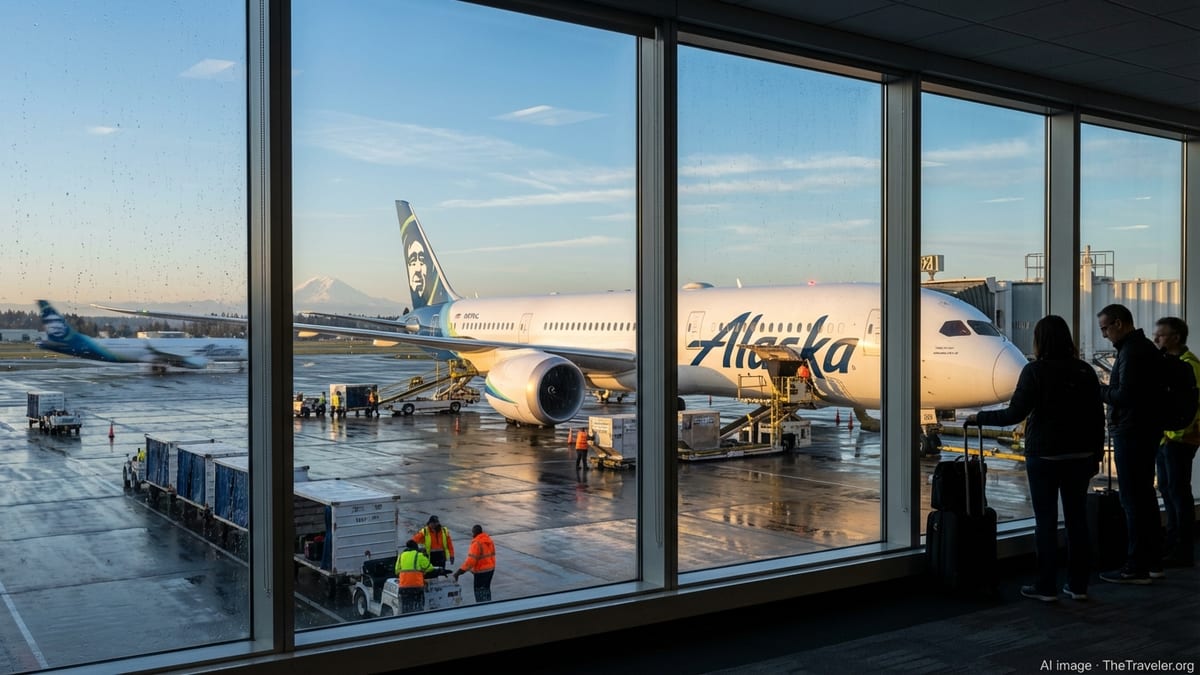
Seven Intercontinental Routes Anchor a New Global Network
Publicly available schedules and company announcements show that by summer 2027 Alaska Airlines will serve seven intercontinental destinations from Seattle on long-haul aircraft, marking a sharp pivot from its traditional West Coast focus. The fast-growing portfolio includes London, Rome, Reykjavík, Athens, Paris, Tokyo and Seoul, using a mix of Boeing 787-9 Dreamliners and Airbus A330s operated by its integrated Hawaiian division.
According to recent route announcements, the European side of the map now features nonstops from Seattle to London Heathrow, Rome Fiumicino, Reykjavík Keflavík, Athens and Paris. These services are built around Alaska’s new 787-9 fleet on most routes, with Reykjavík operated by a 737 MAX 8 tailored for the shorter transatlantic stage length. Japan and South Korea round out the long-haul list, with Tokyo Narita already flying and Seoul Incheon due to follow as additional Dreamliners enter service.
Network planning information indicates that Alaska intends to position Seattle-Tacoma International Airport as a primary long-haul hub on the West Coast. Earlier disclosures highlighted at least a dozen planned international destinations from Seattle by 2030, with the current seven intercontinental routes viewed as a foundation for that growth strategy and a signal of the carrier’s ambitions in the oneworld alliance.
The ramp-up also reflects the completed integration of Hawaiian’s long-haul expertise into Alaska’s broader operation. Seattle has taken on a role as a joint global connecting point, with Honolulu positioned as a secondary hub feeding additional Asia-Pacific and U.S. mainland flying using widebody aircraft inherited from Hawaiian.
Seattle Emerges as Alaska’s Primary Global Gateway
Seattle-Tacoma International Airport is already Alaska’s largest hub by departures, and recent airport and airline disclosures describe it as one of the busiest airline hubs on the U.S. West Coast. With more than 100 nonstop destinations across North America, Seattle provides the domestic feed needed to sustain long-haul flying to multiple continents.
Port of Seattle communications highlight that Alaska’s expansion has pushed total international offerings at the airport past 60 nonstop destinations, with new European routes playing a prominent role. The addition of London and Reykjavík in 2026 was described as a major step in positioning Seattle as a premier global gateway, and subsequent announcements of Athens and Paris have reinforced that trajectory.
Alaska’s corporate updates frame Seattle as the centerpiece of a dual-hub long-haul strategy, pairing the Pacific Northwest with Honolulu. While Honolulu focuses on transpacific and U.S. mainland demand, Seattle is being developed as the main connecting point between Asia and Europe, particularly as more Dreamliners arrive and as partner-operated widebodies feed the network.
To support the increase in international traffic, Alaska is investing in ground infrastructure at its hometown hub. The airline has disclosed plans for a large new global lounge at Seattle, spanning tens of thousands of square feet and designed to handle several hundred guests at a time, with an opening target in the latter part of the decade. Additional lounge investments are planned in other West Coast cities, but Seattle will host the flagship facility.
Inside the New Long-Haul Experience
Alongside the route announcements, Alaska has introduced an all-new international product designed specifically for long-haul missions from Seattle. The airline recently unveiled its first International Business Class Suites, a premium cabin featuring fully flat beds, privacy doors and enhanced dining intended to match offerings from established global competitors.
Company materials present the Dreamliner as the showcase for this experience on flights linking Seattle with London, Rome, Athens, Paris and Seoul. The 787-9s also feature an upgraded premium economy-style cabin and refreshed main cabin, with emphasis on mood lighting, quieter cabins and in-flight entertainment aimed at long-haul travelers.
For shorter transatlantic sectors such as Seattle to Reykjavík, Alaska is configuring 737 MAX 8 aircraft with an adapted premium layout. While these jets do not offer the full suite product, the airline has indicated that they receive their own set of cabin enhancements to bring some of the long-haul comfort features to a narrowbody platform suited to the North Atlantic crossing.
On routes still operated by the Hawaiian division’s Airbus A330s, such as the long-standing Seattle to Tokyo Narita service, travelers see a different but complementary widebody product. Company statements emphasize that the integrated network will gradually converge around a consistent premium standard even as multiple aircraft types remain in use.
Competitive Landscape and Strategic Rationale
Industry analyses suggest that Alaska’s long-haul build-out from Seattle is both an offensive and defensive move in a highly competitive West Coast market. Seattle already hosts international services from several global airlines, and Alaska’s growth allows it to maintain a central role for local travelers while deepening its position within the oneworld alliance.
By operating its own nonstops to major capitals such as London and Paris, Alaska reduces reliance on partners for transatlantic connectivity and can capture higher-yield traffic flows that previously required connections through other hubs. At the same time, the airline continues to rely on alliance and joint venture partners for beyond-Europe connectivity, allowing it to focus its own metal on trunk routes where its brand is strongest.
On the transpacific side, Alaska’s use of Hawaiian-operated aircraft on routes like Seattle to Tokyo builds on Hawaiian’s established long-haul operations while giving Alaska’s Seattle hub more global reach. Published commentary indicates that the merged carrier intends to coordinate schedules and fleet deployment closely so that Seattle’s long-haul routes feed efficiently into both airlines’ historical strongholds.
Analysts also point to loyalty considerations, with the expansion designed in part to add aspirational redemption options for the airlines’ combined rewards program. New services to leisure and cultural centers such as Athens, Rome and Reykjavík broaden the appeal of the network to frequent flyers in the Pacific Northwest and beyond.
What Travelers Can Expect Next
Looking ahead, Alaska has signaled that the seven long-haul nonstops from Seattle are only an early phase of a larger global push. Public financial and strategic disclosures reference plans for at least five additional intercontinental routes by 2030, though specific city pairs have not yet been confirmed.
The delivery of additional Dreamliners and the gradual alignment of Hawaiian’s long-haul fleet are expected to open the door to new destinations in Europe and Asia. Industry observers have speculated about potential future links from Seattle to other major capitals and alliance hubs, but the airline has so far limited official comments to broad growth targets and its intention to connect the Pacific Northwest to more of the world.
For travelers in the Seattle region, the build-out means a growing list of nonstop options that shorten journey times and simplify connections. For Alaska and its integrated Hawaiian operation, the seven routes already on the map from Seattle represent a visible marker of the carrier’s evolution from a predominantly domestic West Coast airline into a player on the global long-haul stage.