

More news on this day
Travelers across the United States and Europe faced widespread disruption today as Delta Air Lines reported 473 delayed flights and 29 cancellations, affecting major domestic and transatlantic routes and leaving passengers stranded at airports from Atlanta to Amsterdam.
Get the latest news straight to your inbox!
Significant Disruptions Across Delta’s U.S. Network
Publicly available tracking data shows that Delta’s operations came under heavy strain, with hundreds of delayed departures and dozens of cancellations concentrated around its largest hubs. Atlanta, the airline’s primary base and the world’s busiest passenger airport, experienced some of the most severe knock-on effects as delays compounded across tightly timed schedules.
Major metropolitan gateways including New York, Orlando and Los Angeles also saw disrupted operations, with passengers reporting rolling departure estimates, extended ground holds and missed connections. The pattern mirrors other recent high-impact travel days in the United States, where a mix of operational constraints, congested airspace and local weather has translated into nationwide ripple effects.
Industry data and past disruption patterns indicate that even a relatively small number of cancellations can cause outsized inconvenience when they affect hub airports at peak travel periods. With Delta’s network structured around banks of connecting flights, delays into cities such as Atlanta and New York can quickly cascade into missed onward services to Florida, the West Coast and Europe.
Available coverage also points to pressure on regional and feeder flights that connect smaller cities into Delta hubs. When those services are delayed or cut from the schedule, travelers often face lengthy rebookings, overnight stays or last-minute rerouting through alternative airports.
Transatlantic Routes To Europe Hit With Cascading Delays
The disruption extended well beyond North America, affecting several of Delta’s most prominent transatlantic routes. Flights linking U.S. hubs to London, Paris, Amsterdam and Rome were among those impacted, according to live schedule information and airport departure boards.
Transatlantic operations are particularly sensitive to timing issues, because aircraft and crew schedules are built around overnight crossings and tight turnarounds in Europe. When a departure from Atlanta, New York or Los Angeles leaves late or is canceled, the aircraft may fail to operate its return leg on time the following day, spreading delays across multiple rotations.
Published route maps for Delta and its joint-venture partners show that these European cities form the backbone of the airline’s long-haul network, funnelling U.S. travelers into broader connections across the continent and beyond. Disruptions on these trunk routes therefore strand not only point-to-point passengers between, for example, Los Angeles and Paris, but also those bound for secondary destinations via London, Amsterdam or Rome.
Travel industry analysis suggests that airlines often prioritize operating long-haul flights over some shorter domestic services when disruptions escalate, because widebody routes typically carry more passengers and generate higher revenue per flight. Even so, when operational conditions deteriorate, delays and cancellations across the Atlantic can become unavoidable.
Weather, Network Complexity And Operational Strain
Several factors commonly cited in recent airline disruption events appear relevant to the latest Delta irregularities. Weather advisories for parts of the southeastern United States, including the Atlanta region, can trigger air traffic control initiatives that slow departures and arrivals, causing ground congestion and schedule compression during peak hours.
Complex crew scheduling requirements may add further strain. Airlines must comply with strict duty-time limitations, and when flights depart late, pilots or flight attendants can reach their maximum allowable hours before an aircraft completes its planned sequence of legs. Industry observers note that this dynamic can force last-minute cancellations even after passengers have endured multiple rolling delays.
Operational commentary in trade publications has also highlighted the fragility of tightly optimized schedules during busy summer and holiday periods. While high aircraft utilization is efficient in normal operations, it leaves little slack when storms, technical inspections or airport constraints arise. Once a delay bank builds at a major hub, recovering to normal operations can take many hours, if not days.
Recent historical coverage of Delta’s network performance points to a pattern in which short bursts of severe disruption can be followed by extended recovery, as aircraft and crew are repositioned and stranded passengers are accommodated. On days like today, that recovery window is likely to stretch across multiple subsequent flight cycles.
Passenger Impact At Atlanta, New York, Orlando And Los Angeles
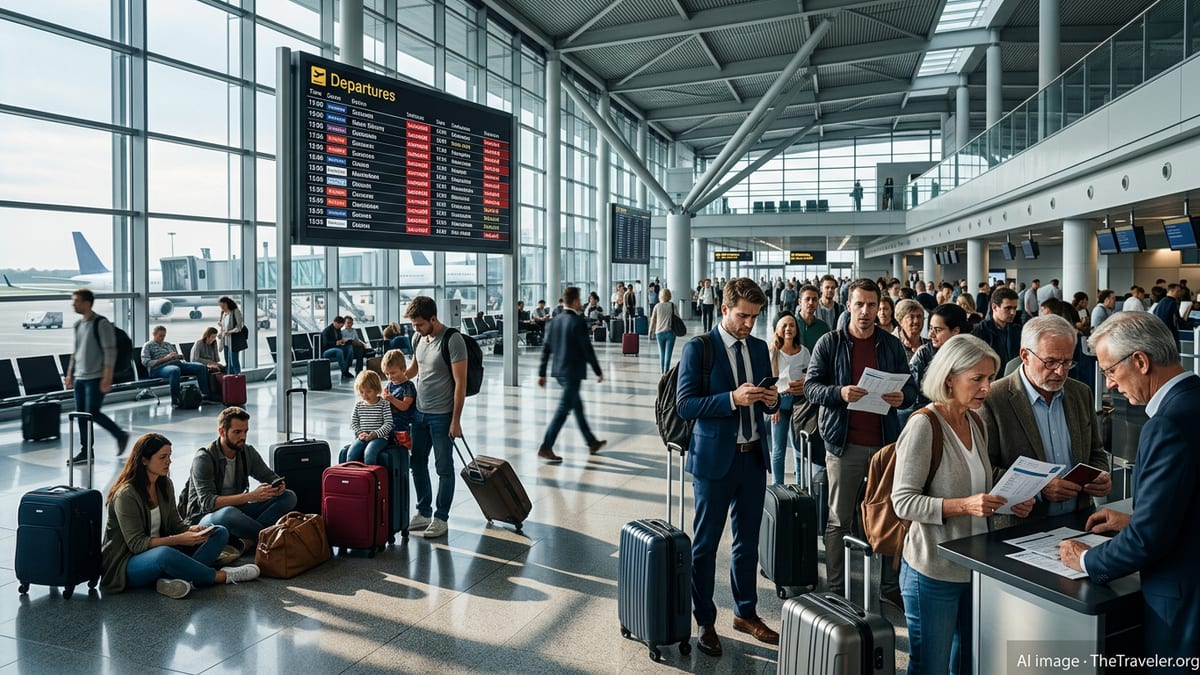
On the ground, the statistics translated into crowded terminals, long customer service lines and overtaxed digital channels for rebooking. Reports from passengers at Atlanta and New York described extended waits for updated departure times, along with difficulty securing alternative itineraries on the same day.
Orlando and Los Angeles, both key leisure and connecting markets for Delta, also experienced significant disruption. Families traveling to and from Florida theme parks and travelers on West Coast business and vacation trips faced itinerary changes, missed hotel reservations and, in some cases, the need to purchase last-minute lodging or ground transport while awaiting new flights.
Travel forums and social media posts indicated that some travelers opted to abandon air itineraries altogether and turn to rental cars, trains or competing airlines when realistic same-day options were not available. Others reported being automatically rebooked for travel one or more days later, particularly on busier routes into and out of hub airports.
Consumer advocates have repeatedly pointed out that while U.S. regulations require airlines to provide refunds when a flight is canceled and the passenger chooses not to travel, compensation policies for delays vary by carrier and circumstance. As a result, many of today’s affected passengers may receive schedule changes or refunds but remain responsible for incidental costs such as meals or overnight stays, depending on the cause of the disruption and the specific fare purchased.
Navigating Rebooking Options And Future Travel
Publicly available guidance from Delta’s customer information channels outlines several options for travelers caught in large-scale disruptions, including the ability to change flights within specified date ranges and destinations when a waiver is in effect. On heavy delay days, same-day confirmed changes and standby options can quickly fill, particularly on routes into busy hubs.
Travel experts generally recommend that affected passengers monitor both airline apps and airport departure boards, as automated notifications do not always update as quickly as operational decisions are made. In situations where long lines form at airport counters, using call centers or direct messaging through official channels may provide faster access to alternative options.
Passengers holding tickets to or through Atlanta, New York, Orlando and Los Angeles in the coming days may see lingering effects as aircraft and crew positioning normalizes. Published analysis of previous disruption events suggests that residual delays can persist even after the initial trigger, especially on complex international routes to European hubs such as London, Paris, Amsterdam and Rome.
Industry observers note that while large airlines have expanded schedules and added capacity to meet robust travel demand in 2026, the combination of tight staffing, crowded skies and volatile weather continues to create conditions in which a single day of severe disruption can echo across networks worldwide.